
Email marketing is the use of email to promote a business, build relationships and sell to people who have agreed to hear from you. It covers one-off campaigns, such as a newsletter or a sale announcement, and automated emails that go out when someone takes an action. It matters because you own your email list, so you can reach your audience directly without relying on a social feed or an ad auction.
Key Takeaways
- Email marketing only works with permission. In the UK, the ICO says you need specific consent or a “soft opt-in” from an existing customer.
- There are two main kinds of send: campaigns, which you schedule, and automated flows, which a person’s action triggers.
- Gmail asks all senders to authenticate their email and keep spam complaints below 0.3%.
- Bulk senders to Gmail must also support one-click unsubscribe and show a clear unsubscribe link.
- A small, engaged list usually beats a large, cold one.
What Is Email Marketing?
At its core, it is a conversation between a business and its subscribers. People join your list, often through a sign-up form or a free guide. Then you send them useful, relevant emails over time. Some of those emails sell. Others teach, inform or simply keep your brand in mind.
For example, a bakery might collect emails at the till and on its website. Each week, it sends a short newsletter with new bakes and a recipe. In addition, new subscribers get a welcome email with a voucher for their first order.
That mix of planned sends and automatic messages is what most teams mean by email marketing. In other words, it is both a channel and a system.
How Email Marketing Works
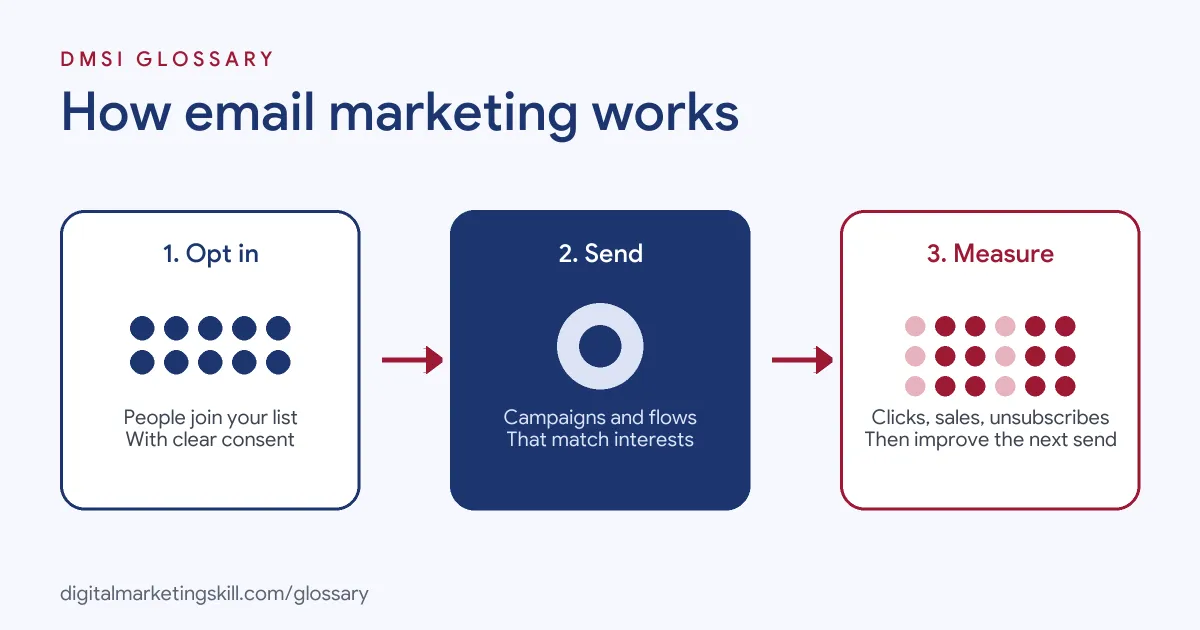
Every programme follows the same basic cycle. First, you grow a list of people who want to hear from you. Next, you send them emails that match their interests. Finally, you measure what they do and improve the next send.
Permission and Consent
Permission comes first. The UK’s Information Commissioner’s Office (ICO) explains the rule in the Privacy and Electronic Communications Regulations. You must not send marketing email to individuals unless “they have specifically consented to electronic mail from you” or they are an existing customer who bought a similar product and was given a simple way to opt out.
The ICO calls the second route the “soft opt-in”. However, it says this rule “does not apply to prospective customers or new contacts (eg from bought-in lists).” You must also show who you are and give a valid address so people can unsubscribe. Other countries have their own laws, so always check the rules where your subscribers live.
Campaigns and Flows
Most email platforms split sending into two types. A campaign is an email you write and schedule for a list or segment, such as a monthly newsletter. A flow, by contrast, runs on its own. Klaviyo describes a flow as “a sequence of automated actions (e.g., sending messages) triggered by a behavior or event.” A welcome series is a common example.
Deliverability
An email only works if it reaches the inbox. That’s why Google publishes sender guidelines for Gmail. All senders must set up SPF or DKIM authentication, use a secure TLS connection and keep spam rates in Postmaster Tools below 0.3%. If you send more than 5,000 messages a day to Gmail accounts, you also need DMARC. In addition, marketing messages must support one-click unsubscribe and include a visible unsubscribe link. Our guide to email deliverability goes deeper.
Email Marketing Examples
Here are three made-up examples of email marketing in action:
- Online shop: A homeware brand sends a weekly campaign with new products. It also runs an abandoned-cart flow that reminds people about items they left behind.
- Training provider: A course provider offers a free checklist. People who download it get five helpful emails over two weeks, then an invitation to apply.
- Local service: A dental clinic emails patients a reminder when a check-up is due, plus a short newsletter with health tips each quarter.
In each case, the email answers a clear need for the reader. That is what keeps people subscribed.
Types of Email Compared
Not every email is marketing, and the rules differ by type. Here is a quick comparison:
| Type | What it is | Example |
|---|---|---|
| Campaign (broadcast) | A planned email sent to a list or segment at a chosen time | Newsletter, product launch, sale |
| Automated flow | A series that a behaviour or event triggers | Welcome series, abandoned cart, birthday |
| Transactional email | A service message about something the person did | Order confirmation, password reset |
Klaviyo suggests setting up three flows first: a welcome series, an abandoned cart flow and a post-purchase flow. Meanwhile, campaigns keep your regular subscribers engaged between those moments.
How to Start Email Marketing
You can start small and grow over time. Follow these steps:
- Choose a platform. Pick an email service that handles sign-up forms, automation and unsubscribes.
- Authenticate your domain. Set up SPF, DKIM and DMARC, so inbox providers trust your mail.
- Build a sign-up form. Explain clearly what people will get and how often. A double opt-in step can confirm each address.
- Write a welcome email. Send it straight after sign-up, while interest is highest.
- Plan your campaigns. Set a steady rhythm, such as one newsletter a week.
- Segment your list. Group people by interest or behaviour, so each email feels relevant.
- Measure and improve. Track clicks, sales, unsubscribes and spam complaints after every send.
The Parts of a Marketing Email
Every good marketing email has the same building blocks. Get each one right, and the whole message works harder:
- From name: a name people recognise, such as your brand or a real person on your team.
- Subject line: a short, honest reason to open, not a trick.
- Preview text: the line that shows next to the subject in most inboxes. Use it to add detail.
- Body: one main message, written for the reader, with short paragraphs.
- Call to action: one clear button or link, such as “Book a call”.
- Footer: who you are, how to contact you and a simple way to unsubscribe, as the ICO requires.
How to Measure Email Marketing
Focus on the numbers that show real interest. Click rate tells you whether the content was useful. Conversions show whether the email drove sales or sign-ups. Meanwhile, unsubscribes and spam complaints warn you when you are sending too often or to the wrong people. Open rates can add context, but clicks and sales tell you more about real value.
Best Practices
- Send only to people who opted in. Never buy lists.
- Make unsubscribing easy. A clear link protects your sender reputation.
- Write one clear goal per email. For instance, one main button, not five.
- Clean your list. Remove addresses that bounce or haven’t engaged for a long time.
- Test before you send. Check links, images and mobile layout every time.
For a wider plan, see our guide to an effective email marketing strategy.
Common Mistakes to Avoid
Beginners tend to make the same few errors. First, they email people who never agreed to it. Second, they skip domain authentication and land in spam. Third, they send the same message to everyone. Finally, they judge success on opens alone and ignore clicks and sales. Each mistake costs trust, and trust is hard to win back.
Where You’ll Use Email Marketing at Work
Email skills appear in a wide range of remote jobs. For example, recent listings ask candidates to:
- “Create and execute email marketing campaigns, newsletters and nurture journeys through HubSpot” (Digital Events and Social Media Executive).
- Bring “experience with email marketing and automation platforms” (Marketing Account Manager).
- “Support newsletter drafting, social media scheduling, or email marketing” (Virtual Assistant).
So if you want to work as an Email Marketing Specialist or Marketing Automation Specialist, employers will expect you to plan campaigns, build flows, follow consent rules and report on results.
Learn It in the Lead Generation and Email Track
You can learn email marketing in the AI-Powered Lead Generation and Email Automation track. There, you build a lead magnet and an automated email sequence that converts, so you have a working example to show employers. You also get unlimited 1-on-1 mentoring and a U.S. Project Internship from day one.
Frequently Asked Questions
What is email marketing in simple terms?
It is sending emails to people who agreed to hear from you, in order to build a relationship and drive sales. It includes newsletters, offers and automated messages.
Do I need consent for email marketing?
For individuals in the UK, yes, unless the soft opt-in applies to an existing customer. The ICO says you must also give a simple way to opt out in every message.
Is email marketing still effective?
It can be, because you reach people directly in their inbox. Results depend on list quality, relevance and deliverability.
What is the difference between a campaign and a flow?
A campaign is an email you schedule for a group. A flow sends automatically when someone does something, such as joining your list.
How do I keep my emails out of spam?
Authenticate your domain, send only to people who opted in, make unsubscribing easy and keep complaints low. Gmail asks senders to stay below a 0.3% spam rate.
Sources: ICO: Electronic mail marketing; Google: Email sender guidelines; Klaviyo Help Center: Getting started with flows; remote job listings on Himalayas.