
Smart Bidding is a set of Google Ads bid strategies that use Google AI to set a bid for every single auction, aiming to win more conversions or more conversion value. Instead of setting a price per click yourself, you tell Google your goal, and it adjusts each bid to that goal. It matters because your bid strategy shapes what you pay and what you get, so knowing how it works helps you control cost and results.
Key Takeaways
- There are four Smart Bidding strategies: Target CPA, Target ROAS, Maximise conversions and Maximise conversion value.
- Google sets a bid at the moment of each auction, which it calls auction-time bidding.
- It uses signals such as device, location, time of day, remarketing lists and the actual search query.
- You need conversion tracking first. Some strategies also work best with a history of conversion data.
- Bids can only be as good as your data. Wrong or missing conversions lead to wrong bids.
What Is Smart Bidding?
Google Ads Help describes it as “bidding strategies that use Google AI to optimise for conversions or conversion value in every auction, a feature known as ‘auction-time bidding’.” In other words, Google decides how much each click is worth to you, based on how likely it is to lead to a sale or lead.
It is one type of automated bidding. Other automated options, such as Maximise clicks or Target impression share, aim for traffic or visibility instead. Smart Bidding, by contrast, focuses on conversions and their value.
The alternative is Manual CPC, where you set each maximum bid yourself. Google notes that with automated bidding, “there’s no need to manually update bids for specific ad groups or keywords.”
How Smart Bidding Works
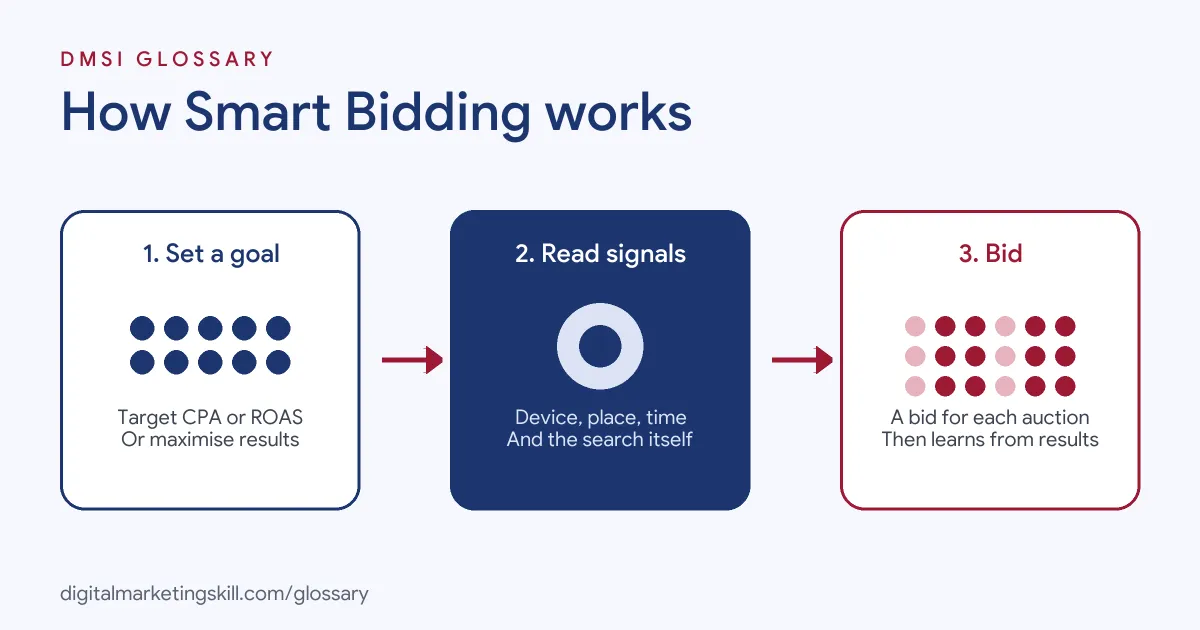
The process has three steps. First, you set a goal, such as a target cost per conversion. Next, Google reads the signals in each auction. Finally, it sets a bid for that auction and learns from the results.
The Four Strategies
Each strategy suits a different goal. Target CPA “sets bids to help get as many conversions as possible at the target cost per action (CPA) you set.” Target ROAS does the same for conversion value at a target return on ad spend. Meanwhile, Maximise conversions and Maximise conversion value aim to get the most results from your budget.
Google notes that “some conversions may cost more or less than your target.” So treat your target as an average, not a cap on each conversion.
Auction-Time Signals
Google explains that signals “are identifiable attributes about a person or their context at the time of a particular auction.” These include device, physical location, location intent, weekday and time of day, remarketing lists, ad characteristics, language, browser and operating system. On Search and Shopping, Google can also bid based on “the text of the query that triggered the ad, not just the matching keyword.”
For example, Google says a shoe retailer’s bid may rise for “leather boots” compared with “boot repairs,” even though both match the keyword “boots.” That’s why this approach pairs well with broad match.
The Data It Needs
Before you can use Target CPA, Google says “you’ll need to set up conversion tracking.” Google also notes that some strategies “rely on a minimum volume of historical conversion data, depending on the campaign type.” Without good data, the system has little to learn from.
Smart Bidding Examples
Here are three made-up examples of how advertisers choose a strategy:
- Lead generation (example): A training school knows a lead is worth about £40 to it. So it uses Target CPA with a £40 target.
- Online store (example): A homeware shop sells items from £10 to £400. It uses Target ROAS, because it values each sale differently.
- New campaign (example): A local service has little history. It starts with Maximise conversions, then adds a target once it has steady data.
In each case, the strategy follows the business goal. The tool comes second.
A Worked Target CPA Example
Here is a made-up example with simple numbers. Over a month, a campaign spends £2,000 and records 50 leads, so its cost per lead is £40. The advertiser sets a Target CPA of £40, close to that real figure. Later, results stay steady, so it lowers the target to £36 in one small step. If lead volume then drops sharply, it moves the target back up. In each step, it changes one thing and waits for clear results before the next change.
Smart Bidding Strategies Compared
| Strategy | What it aims for | Best when |
|---|---|---|
| Maximise conversions | The most conversions within your budget | You want volume and every conversion is worth about the same |
| Target CPA | Conversions at an average cost you set | You know what a lead or sale is worth |
| Maximise conversion value | The most total value within your budget | Sales have different values |
| Target ROAS | Conversion value at a return on ad spend you set | You want profit at a set return |
Google’s own goal table links “increase sales or leads” to Maximise conversions or Target CPA, and “increase profit” to Target ROAS or Maximise conversion value.
How to Set Up Smart Bidding
- Set up conversion tracking. Make sure every key action, such as a purchase or lead form, records correctly.
- Add conversion values if they differ. Value-based strategies need real values, not the same number for everything.
- Pick a strategy that fits your goal. Use the table above as a guide.
- Set a realistic target. Base it on your recent cost per conversion or return, not a wish.
- Check your budget. For Target CPA, Google suggests you be comfortable “spending up to two times your average daily budget,” while staying within the monthly charging limit.
- Give it time. Avoid big changes for a while, so the system can learn.
- Review the bid strategy report. Google provides reports and detailed statuses that show how the strategy is performing.
Best Practices for Smart Bidding
- Track what really matters. Count sales or qualified leads, not page views.
- Use good attribution. Google says you can optimise Search bids to your chosen attribution model, “including data-driven attribution.”
- Change targets gradually. Small steps give the system time to adjust.
- Group similar campaigns. Portfolio strategies let several campaigns share one target and more data.
- Judge results over weeks, not days. Daily cost per conversion can swing up and down.
Common Mistakes to Avoid
The biggest mistake is weak conversion tracking. For instance, counting every page view as a conversion trains Google to buy cheap, useless clicks. Another is setting a target far below your real cost, which can choke delivery. Some advertisers change targets every day, so the system never settles. Others switch on value-based bidding without real values. Finally, many forget to check search terms, even though query quality still matters.
Where You’ll Use Smart Bidding at Work
Bid strategy is a core part of paid search work. For example, real remote job listings ask for:
- “Strong experience with Performance Max, Shopping campaigns, Merchant Center feeds and Smart Bidding strategies” (Google Ads Specialist, Advanced Tracking and AI Automation).
- A “Strong understanding of keyword research, campaign building, bidding strategies, and budget pacing” (Media Buyer Specialist).
So if you want to work as a Google Ads Specialist or PPC Specialist, employers will expect you to choose, set up and report on bid strategies. They will also want proof, such as a campaign with clean conversion tracking and clear results.
Learn It in the Google Specialist Track
You can learn to plan and bid campaigns in the AI-Powered Google Specialist track. It covers Google Ads across Search, Display, Discovery, Gmail and YouTube, plus Google Analytics. Your portfolio project is a Google Ads campaign you launch and measure with conversion tracking. You also get unlimited 1-on-1 mentoring and a U.S. Project Internship from day one.
Next, read how Google Ads budgets and bids work and our guide to PPC campaign optimisation. You may also like our glossary entry on Performance Max.
Frequently Asked Questions
What is Smart Bidding in simple terms?
It is Google Ads automatically setting your bid for each auction, based on how likely that search is to lead to a conversion. You choose the goal, and Google chooses the bid.
Which Smart Bidding strategy should I use?
Use Maximise conversions or Target CPA to grow leads or sales. Use Target ROAS or Maximise conversion value when sales have different values.
Do I need conversion tracking?
Yes. Google requires conversion tracking before you can use Target CPA. In practice, every strategy depends on accurate conversion data.
Is Maximise clicks part of Smart Bidding?
No. Maximise clicks is an automated strategy, but it aims for clicks, not conversions. Smart Bidding covers the four conversion-focused strategies.
Can I still control my bids?
Yes, through your targets, budgets and conversion settings. For example, you can set device-specific targets with Target CPA.
Sources: Google Ads Help: About Smart Bidding; Google Ads Help: About automated bidding; Google Ads Help: About Target CPA bidding; remote job listings on Himalayas.