
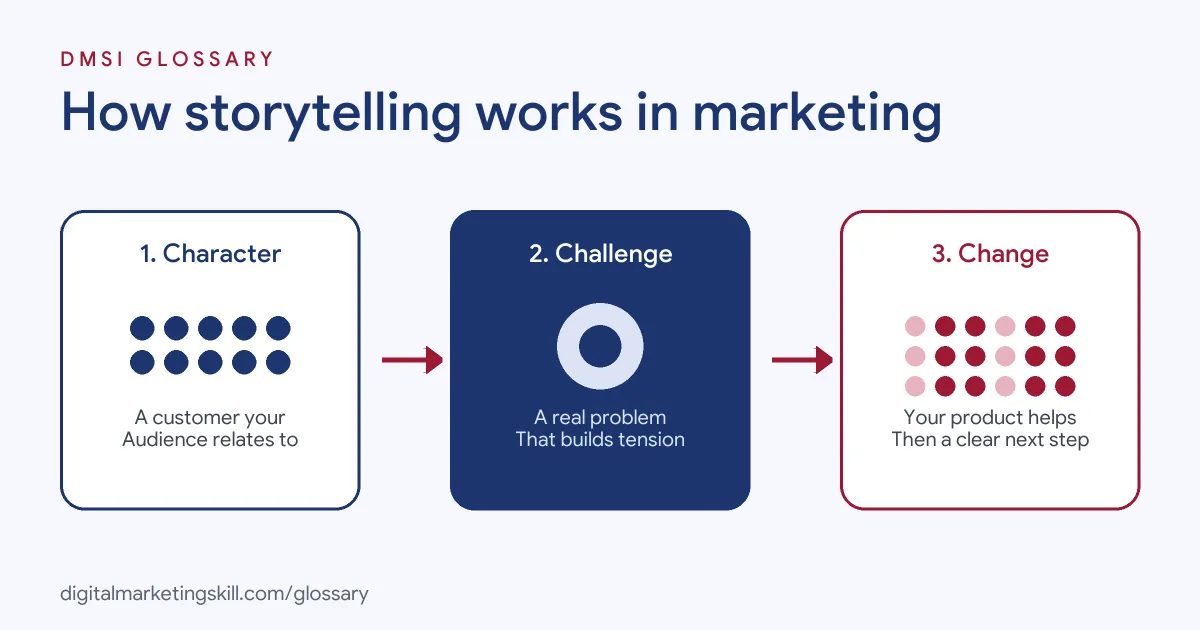
In marketing, storytelling is the use of a narrative, with a character, a problem and a change, to make a message more memorable and persuasive than a list of facts. Instead of saying what a product does, you show someone whose life is better because of it. It matters because people pay attention to stories, feel something and are more likely to act.
Key Takeaways
- A marketing story usually has a character, a challenge and a resolution, often with your product helping along the way.
- Research by neuroscientist Paul Zak links engaging stories to oxytocin, a brain chemical tied to empathy.
- Google’s guidance for YouTube ads tells advertisers to hook attention with an immersive story and to feature people.
- The customer should be the hero. Your brand plays the helper or guide.
- Good stories still end with a clear next step, so people know what to do.
What Is Storytelling in Marketing?
A story is a sequence of events that happens to someone. In marketing, that someone is usually a customer, an employee or a founder. The story shows a problem they faced and how things changed.
Compare two ways to sell a running app. The first says: “Track your pace, distance and heart rate.” The second shows a nervous beginner who couldn’t run for two minutes, then crosses a 5K finish line twelve weeks later with the app’s plan. Both describe the same product. The second gives you a reason to care.
This approach works across almost every format. You’ll see it in video ads, case studies, social posts, email sequences, About pages and even product descriptions.
How Storytelling Works
Most stories follow a shape. Writers have studied this shape for a long time. Gustav Freytag, a German writer, outlined the parts of a drama as introduction, rise, climax, return or fall, and catastrophe. Modern three-act structures grew from the same idea.
The Dramatic Arc in Storytelling
Paul Zak calls this shape “the dramatic arc”. According to his summary, it starts with something new and surprising. Then it builds tension as the characters struggle. Finally, it resolves after a key moment of change. You can fit a 30-second ad or a 1,000-word case study into this same arc.
What Happens in the Brain
Zak’s lab studies why stories move us. He writes: “We have identified oxytocin as the neurochemical responsible for empathy and narrative transportation.” In other words, a good story helps us feel what the character feels. He also found that stories that hold attention trigger the release of stress hormones, which keep us focused.
His research suggests this can change behaviour. In one ad study, people given synthetic oxytocin “donated to 57 percent more of the featured charities and donated 56 percent more money” than people given a placebo.
Storytelling in Video Ads
Google’s ABCD guidance for YouTube ads builds on the same ideas. For attention, it advises you to “Hook and sustain attention with an immersive story.” For connection, it suggests you “Humanize the story” by featuring people, and lean into “storytelling techniques such as humor, surprise, and intrigue.” Google cites research with Kantar showing ads that follow these principles can deliver up to a 30% lift in short-term sales likelihood.
The guidance doesn’t stop at emotion. Its final principle, Direction, tells advertisers to “Ask them to take action.” It also suggests you reinforce the on-screen call to action with a voice-over, so the next step is clear. In short, a strong story earns attention, and a clear ask turns that attention into a result. Without the ask, viewers enjoy the ad and then move on.
Storytelling Examples
Here are three made-up examples of marketing stories:
- Customer story: A bakery owner was losing orders because her website was slow. A web agency rebuilt it, and online orders doubled. The agency tells her story, in her words, on a case study page.
- Founder story: A skincare brand explains how its founder struggled to find products for sensitive skin, so she created her own. The story runs on its About page and in its welcome email.
- Short video: A 15-second ad shows a dad rushing out the door with no breakfast. Then he grabs a ready-made smoothie and smiles. The product appears at the turning point.
In each case, a person faces a problem, and the product helps resolve it. Notice that none of them starts with the brand.
Storytelling Frameworks Compared
You don’t need to invent a structure. Here are three common ones:
| Framework | Structure | Good for |
|---|---|---|
| Problem, solution, result | The challenge, what you did, what changed | Case studies and testimonials |
| Before, after, bridge | Life before, life after, and how to get there | Ads, emails and landing pages |
| Three-act structure | Setup, conflict, resolution | Video ads and longer content |
All three share the same core: someone changes, and the audience sees how.
How to Use Storytelling in Your Marketing
- Choose one goal, such as more trial sign-ups or more trust in a new market.
- Pick a hero your audience can relate to. Usually, that’s a real customer.
- Define the problem clearly. Use the words your customers use.
- Show the turning point, where your product or service helps.
- Show the result with specific, true details.
- Hook attention early. In a video, get to the heart of the story fast.
- End with one clear call to action.
- Test the story against a plain, fact-led version to see which works better.
Where to Find Real Stories
The best stories are often hiding in plain sight. Read reviews and support emails. Ask sales staff which customers they’re proudest of. Interview a few happy clients and record the call, with their permission. As a result, you get real quotes and details that no copywriter could invent.
Best Practices for Storytelling
- Make the customer the hero. Your brand is the guide that helps them win.
- Keep it focused. Google’s ABCD guidance warns against doing too much in one ad.
- Use real people and details. Specifics feel true. Vague claims don’t.
- Show emotion honestly. Humour, surprise and relief all work when they fit the brand.
- Include a call to action. Google advises saying what you’d like viewers to do.
- Get consent. Always ask before you share a customer’s story or name.
Common Storytelling Mistakes
Many brands make themselves the hero, which turns the story into a boast. Others take too long to get going, so people scroll past before the story starts. Some invent stories that sound too perfect, which hurts trust. Another mistake is telling a lovely story with no link to the product. Finally, many forget the ending: a story that moves people but gives them nothing to do wastes the moment.
Where You’ll Use Storytelling at Work
Employers ask for this skill in creative, content and even analytics roles. For example, recent remote job listings ask for:
- “Experience in storytelling & viral content creation (knowing how to hook viewers in the first 3 seconds)” (Paid Ads Content Strategist and Creator).
- Someone with “a strong blend of creative storytelling and performance marketing expertise” (Paid Ads Content Strategist and Creator).
- “Excellent communication and storytelling skills, with the ability to explain complex findings clearly and influence commercial decisions” (Business Analytics Manager).
So whether you aim to be a Digital Marketing Manager, a Growth Marketer or a Freelance Digital Marketer, you will need to turn facts into stories that move people.
Learn It in the Full Stack Track
Stories run through every channel, so the best fit is the Full Stack option, which covers all four tracks. You take all ten courses and complete one portfolio project from each track, from a paid social campaign to an email sequence, a Google Ads campaign and an SEO content plan. You also work on a U.S. Project Internship from day one, with unlimited 1-on-1 mentoring.
Next, read our guide to brand storytelling and our tips for becoming a content creator. You may also like our glossary entries on copywriting and brand identity.
Frequently Asked Questions
What is storytelling in marketing?
It is using a story, with a character, a problem and a change, to share a message in a way people remember and feel.
Why does storytelling work?
Stories hold attention and help people feel what the character feels. Paul Zak’s research links this to oxytocin, a chemical tied to empathy.
Who should be the hero of a brand story?
Usually the customer. The brand works best as the guide or helper that makes the change possible.
How long should a marketing story be?
As short as the channel needs. A video ad might tell a story in 15 seconds, while a case study can run to several pages.
Can data be part of a story?
Yes. A clear before-and-after number, such as orders doubling, often makes the result feel real.
Sources: Greater Good Magazine: How stories change the brain (Paul Zak); Google Ads Help: About the ABCDs of effective video ads; Wikipedia: Dramatic structure; remote job listings on Himalayas.