
A loyalty programme is a scheme that rewards customers for buying from you again, usually with points, discounts, perks or special access. Shopify describes a loyalty program as “a marketing strategy that encourages repeat business by rewarding customers for their continued patronage.” It matters because repeat customers are cheaper to keep than new ones are to win, and a good scheme gives them a reason to come back.
Key Takeaways
- Most schemes work by identifying customers, tracking what they do and rewarding them for it.
- Common types include points-based, tiered, paid, value-based and coalition schemes. Shopify calls points-based schemes the most common type.
- Harvard Business Review reports that winning a new customer can cost five to 25 times more than keeping one.
- Shopify, citing a Deloitte survey, reports that 72% of US loyalty members say schemes make them more likely to spend with their preferred brand.
- The best schemes are simple to join, easy to understand and offer rewards people actually want.
What Is a Loyalty Programme?
Think of a coffee shop stamp card. Buy nine coffees, get the tenth free. That’s a loyalty scheme in its simplest form. Online, the same idea runs through accounts, apps and email, and the rewards can be much more varied.
According to Shopify, with a typical scheme “customers earn points for purchases, which they can then redeem for discounts, free products, or exclusive offers.” Some schemes also reward actions beyond buying, such as referring a friend or writing a review.
A loyalty programme is a key tool for customer retention. It gives people a clear reason to choose you again, rather than shopping around. Over time, that can raise each customer’s lifetime value.
Why Loyalty Pays
The case for keeping customers is strong. Writing in Harvard Business Review, Amy Gallo notes that “acquiring a new customer is anywhere from five to 25 times more expensive than retaining an existing one.” The same article cites research by Frederick Reichheld of Bain & Company, which found that a 5% rise in retention can increase profits by 25% to 95%. A well-designed scheme is one way to earn some of that gain.
How a Loyalty Programme Works
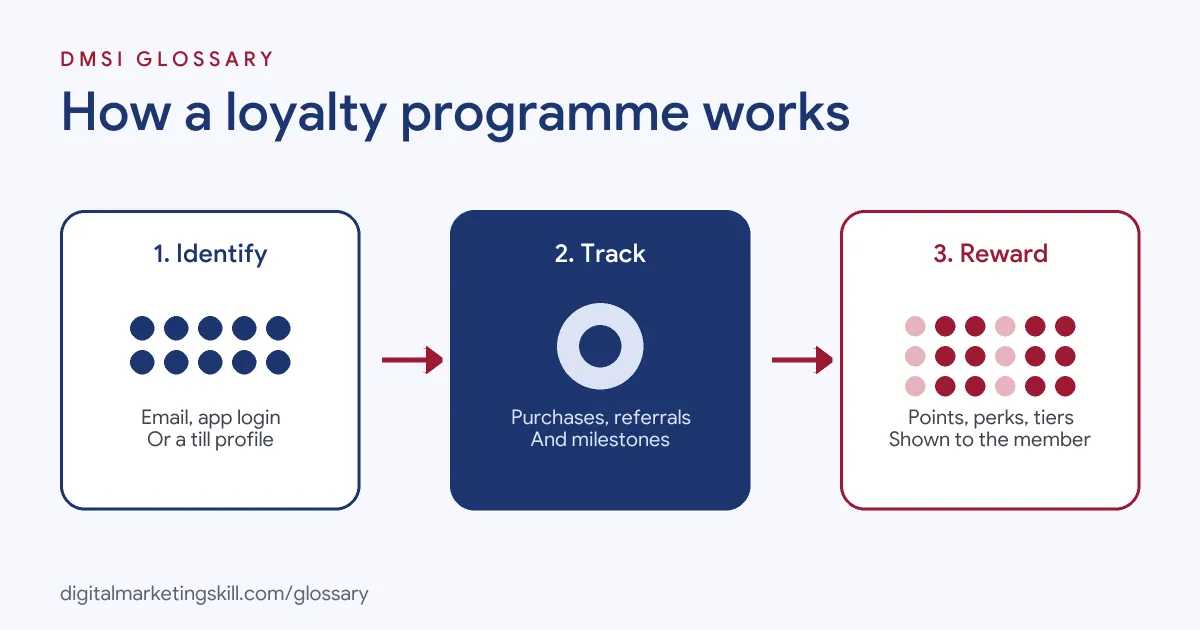
Shopify breaks a typical scheme into three parts. First, you identify customers, usually through an email address, phone number, app login or point-of-sale profile. Next, you track their behaviour, such as purchases, referrals and milestones. Finally, you reward them and keep them informed of their points and offers.
Identifying Customers
You can’t reward people you can’t recognise. So every scheme needs a way to link purchases to a person. Online, that’s usually an account or email. In a shop, it might be a phone number at the till or a card in an app.
Tracking and Rewarding
Next, the scheme records what each member does. Shopify notes that customers can earn “points, rewards, offers, or tier upgrades for making purchases, referring others, and meeting milestones.” The rules should be simple enough that members know how to earn and what they’ll get.
Communicating Status
Finally, members need to see their progress. Shopify says members receive a record of their points, rewards and offers across touchpoints such as apps, emails, text messages and receipts. In fact, regular updates are a natural reason to stay in touch, which supports your wider email marketing.
Loyalty Programme Examples
Here are three made-up examples:
- Coffee shop: Customers collect a digital stamp in an app for each drink. Every tenth drink is free, and members get a free pastry on their birthday.
- Online fashion store: Shoppers earn points on every order, plus bonus points for reviews. Points turn into money off future orders.
- Software company: Customers on a higher plan get early access to new features and a dedicated support line, which works like a tier.
Types of Loyalty Programme Compared
Shopify lists several common types. Here’s how they differ:
| Type | How it works | Best for |
|---|---|---|
| Points-based | Customers earn points and redeem them for rewards | Most shops; Shopify calls it the most common type |
| Tiered | Members unlock better benefits as they spend or engage more | Brands with frequent, high-value customers |
| Paid | Members pay a fee for ongoing perks | Brands that can offer strong, regular value |
| Value-based | Rewards support a cause, such as charitable giving | Audiences that care about social good |
| Coalition | Members earn and redeem across partner businesses | Businesses that can partner with others |
Many brands mix types. For example, a points scheme can also include tiers for the best customers.
How to Create a Loyalty Programme
- Set a clear goal. Decide what you want, such as more repeat orders, higher order values or more referrals.
- Ask your customers. Shopify suggests asking loyal customers whether they prefer discounts, exclusive access or charitable giving.
- Choose a type. Pick the model that fits your goal and margins, such as points or tiers.
- Design simple rules. Keep earning and spending easy to explain in one sentence.
- Pick your tools. Use loyalty software that connects to your store, email platform or till.
- Promote it. Shopify recommends promoting the scheme at natural moments, such as on the homepage and at checkout.
- Measure and adjust. Finally, track sign-ups, repeat purchase rate and the cost of rewards, then refine the offer.
How to Measure Success
Start by comparing members with non-members. Do members buy more often, spend more per order or stay longer? Then check how many members actually redeem rewards, because unused points can signal that the offer isn’t appealing. Also, watch the cost of rewards against the extra profit they bring. If the scheme costs more than it earns, simplify it or change the rewards.
Choosing the Right Rewards
The reward is the heart of the scheme, so choose it with care. First, it must matter to your customers. A free delivery perk may work well for an online shop, while early access suits a fashion brand with new drops. Second, it must be reachable. If members need months to earn anything, many will give up. Third, it must fit your margins. A small discount that brings people back often beats a big one that eats your profit.
Best Practices for a Loyalty Programme
- Make joining effortless. One click or one form field is ideal.
- Give an early win. A small welcome reward shows members the scheme is worth it.
- Reward more than purchases. Referrals, reviews and social follows can all earn points.
- Personalise rewards. Use purchase history to offer things each member will value.
- Keep it visible. Remind members of their points in emails and at checkout.
Common Mistakes to Avoid
A common mistake is making the rules so complex that members give up. Another is offering rewards that take too long to reach. Some brands also launch a scheme and never promote it, so few people join. Others give away so much that the scheme loses money. Lastly, many never compare members with non-members, so they can’t tell if it works.
Where You’ll Use a Loyalty Programme at Work
Loyalty work appears in ecommerce, CRM and lifecycle roles. For example, remote job listings mention:
- “Experience with loyalty programs and lifecycle strategy tied to loyalty segmentation” (Email Marketing Specialist, Klaviyo).
- The need to “Lead the strategy and commercialization of loyalty programs, protection plans, subscription and value-added services, and customer engagement initiatives” (Senior Marketing Manager, Customer Value).
- “A track record of lifecycle, CRM, or loyalty programs that increased repeat purchase” (Senior Director, eCommerce and Customer Fulfillment Technologies).
So whether you aim to be a Digital Marketing Manager, Growth Marketer or Freelance Digital Marketer, you may design, promote or measure a loyalty scheme.
Learn It in the Full Stack Programme
You can learn the channels that support loyalty in the Full Stack (all four tracks) programme. It covers all ten courses, with one portfolio project from each track. You also get unlimited 1-on-1 mentoring and a U.S. Project Internship from day one.
For more ideas, read our guide to building a customer loyalty program and our repeat customer strategies.
Frequently Asked Questions
What is a loyalty programme in simple terms?
It is a scheme that rewards customers for buying from you again, often with points, discounts or special perks.
What is the most common type?
Shopify calls points-based schemes the most common type. Customers earn points and redeem them for rewards.
Do loyalty schemes actually work?
They can. Shopify, citing Deloitte, reports that 72% of US loyalty members say schemes make them more likely to spend with their preferred brand. Still, results depend on the design.
Is a loyalty programme only for big brands?
No. Small shops can run a simple points or stamp scheme using loyalty apps that connect to their store.
How do I measure a loyalty programme?
Compare members with non-members on repeat purchases, order value and how long they stay. Then weigh that against the cost of rewards.
Sources: Shopify: Loyalty programs; Shopify: Customer retention strategies; Harvard Business Review: The value of keeping the right customers; remote job listings on Himalayas.