
Repeat customer strategies turn one sale into a habit. They combine fair pricing, reliable delivery, a loyalty program people actually use, and personal touches that make buyers feel known. Together, these repeat customer strategies turn a first purchase into a second, a third, and steady revenue.
Key Takeaways
- Few buyers drive most revenue. Repeat customers are 21% of a store’s buyers. Yet they drive 44% of its revenue and 46% of its orders (Gorgias).
- Retention compounds profit. A 5% rise in retention grew one company’s profit by 60% within five years. Bain & Company found this at MBNA, a credit card company (Bain & Company).
- Each purchase raises the odds of the next. After a first purchase, the odds a customer returns are about 27%. After a second purchase, the odds of a third jump to 54% (Envive).
- Relevance converts. One personalized recommendation can lift conversion by up to 288%. Recommendations can drive as much as 31% of ecommerce revenue (Barilliance).
- Shipping terms decide loyalty. In a Rakuten Insight survey across six Southeast Asian markets, 54% of shoppers said free shipping makes them more likely to return to the same retailer (Rakuten Insight).
In this guide
- What Most Repeat Customer Advice Gets Wrong
- How Repeat Buying Actually Works
- What Differs Across the Four Retention Levers
- How to Lead With Each Lever
- How to Measure Whether Repeat Customer Strategies Are Working
- The One Decision Rule: Fix the Second Purchase Before You Chase the First
- A Real Case: Chewy’s Handwritten Notes
- Frequently Asked Questions About Repeat Customer Strategies
- Start With Your Best Customers, Then Build the System
What Most Repeat Customer Advice Gets Wrong
Most advice on repeat customer strategies says the same thing. Send a discount email. Start a loyalty program. Neither idea is wrong, but both treat every buyer the same way. A coupon cannot fix a slow delivery. A points program cannot fix a website that frustrates people.
This guide treats repeat buying as a chain of decisions, not one event. It covers four levers that change whether someone buys again: price and value, delivery, loyalty rewards, and personalized service. Each lever needs its own fix, so this guide treats them separately instead of folding them into one checklist.
Here are the ground rules. Every figure below comes from a named study or survey, each with its own scope. The Rakuten Insight figure is regional. It comes from six Southeast Asian markets, so treat it as a strong signal, not a worldwide rule. Treat every number here as a snapshot, not a permanent law of retail.
How Repeat Buying Actually Works
A customer does not decide to become “loyal” in one moment. They decide, order by order, whether the next purchase is worth the effort again. A good experience raises the odds of a repeat visit. A bad one lowers those odds, often for good.
This is why return-odds data matters so much for repeat customer strategies. Envive’s research on ecommerce behavior found a clear pattern. A first-time buyer has roughly a 27% chance of returning for a second order. After that second purchase, though, the odds of a third jump to 54%. The hardest sale a store makes is the second one, not the first.
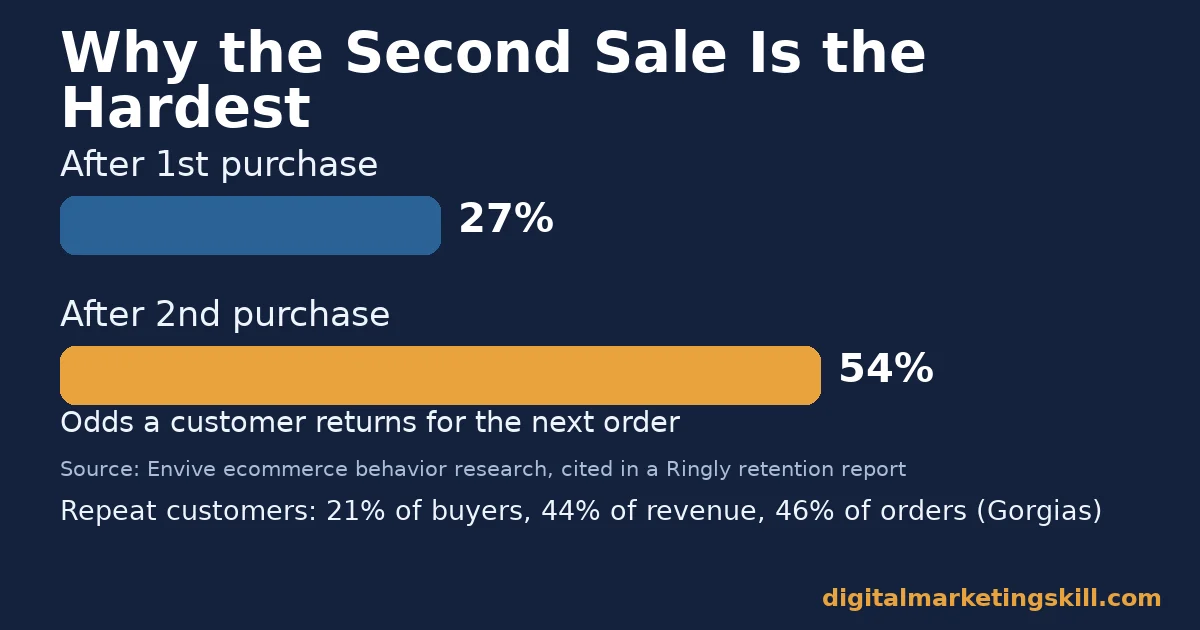
That jump explains why repeat customer strategies pay off so well. Gorgias’s analysis of ecommerce stores found that repeat customers are only 21% of the customer base. Yet they generate 44% of revenue and 46% of orders. A small group of returning buyers carries a store’s growth further than a constant stream of one-time visitors.
The First Purchase Rarely Is the Real Decision
Most marketing budgets chase the first purchase, because it is easy to measure with an ad click. The real financial payoff sits in the second and third purchases. That stage already has higher odds of success, and it costs far less than another paid ad.
Bain & Company’s long-running research on loyalty-based management makes this point well. Writing about the credit card company MBNA, Bain found that a 5% increase in retention grew the company’s profit by 60% within five years. That is one company’s result, not a universal formula. Still, it shows how much leverage sits in the repeat-purchase stage compared with new acquisition.
What a Healthy Repeat Purchase Rate Looks Like
Before changing anything, check where your store already stands. Mobiloud’s analysis of ecommerce benchmarks puts the average 12-month repeat purchase rate at about 28.2%. A healthy range runs from 20% to 40%, depending on the category.
Categories people use up quickly, such as food, drinks, and personal care, sit higher in that range. Customers must buy again on a schedule. Categories like furniture or electronics sit lower. People simply do not need to repurchase as often, no matter how good the first experience was.
What Differs Across the Four Retention Levers
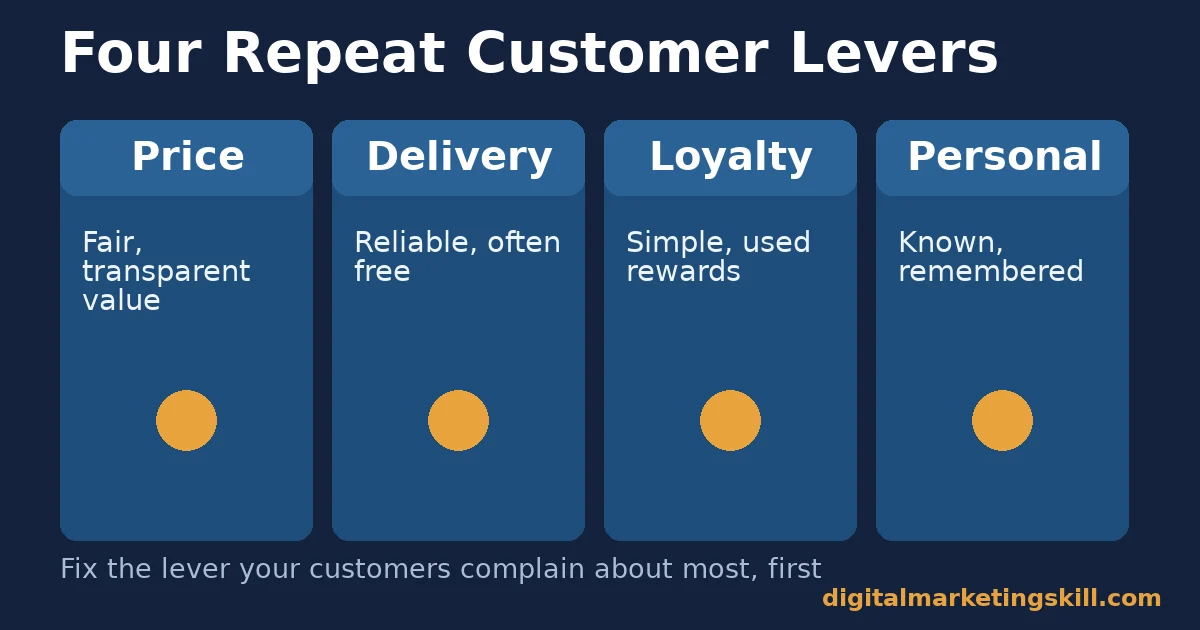
Repeat customer strategies usually fail when a store picks one lever and expects it to fix every weak point. Price, delivery, rewards, and personal service each solve a different objection. Each one needs a different kind of proof before a buyer trusts it.
Price and Value: Built on a Fair Trade
Buyers do not need the lowest price. They need a price that feels fair for what they got. That includes the product, the service around it, and how it compares with competitors they already checked. A price that feels like a trick, even a small one, ends the relationship before it starts.
Delivery and Fulfillment: Built on Reliability
Delivery is a promise a store makes at checkout. It either keeps that promise or breaks it. A Rakuten Insight survey of shoppers across six Southeast Asian markets found that 54% are more likely to return to a retailer that offers free shipping. The same survey found most shoppers expect delivery within seven days, even when shipping is free. Reliability matters as much as speed.
Loyalty Rewards: Built on Repetition
A loyalty program only works once using it becomes a habit. Points that are hard to track or redeem fade into the background of a buyer’s life. Simple, visible rewards keep a store in mind between purchases instead. The reward should feel like recognition of a pattern, not a one-time bribe.
Personalized Service: Built on Being Known
Personalization works because being recognized changes how a buyer reads every other signal from a store. Barilliance’s study of 300 retailers found that one personalized recommendation lifted conversion by 288%, compared with sessions with no recommendation at all. Recommendations accounted for up to 31% of total site revenue for some retailers.
How to Lead With Each Lever
The sections below mirror the four levers above. Start with whichever one your own customers complain about most. Fixing the loudest complaint moves repeat customer strategies from theory into results the fastest.
Price and Value: Lead With Transparent, Competitive Pricing
Show the full price, including shipping and fees, as early as possible. Surprise costs at checkout make a fair price feel unfair, and that feeling sticks longer than the actual number does. Where you can, match or beat the prices of the two or three competitors your buyers are most likely checking. Our guide to ecommerce checkout mistakes that cost sales covers several pricing traps worth avoiding first.
Pair the price with a visible reason to trust it, such as a clear returns policy or a quality guarantee. Buyers who feel protected forgive a slightly higher price more easily than buyers who feel exposed by a cheap one.
Delivery and Fulfillment: Lead With Reliable, Free Shipping
Offer free shipping wherever your margins allow. Set a delivery estimate you can consistently beat, rather than one you can barely meet. The Rakuten Insight data above shows that free shipping drives return visits more reliably than shaving a day off delivery time.
When delays happen, say so before the buyer has to ask. A proactive message about a late order protects the relationship far better than a tracking page that quietly stops updating.
Loyalty Rewards: Lead With a Program Members Actually Use
Keep the earning and redeeming rules simple enough to explain in one sentence. A member should see their points balance and its value without hunting for it. Ideally, redeeming happens right at checkout, where it feels effortless. Our breakdown of why a loyalty program can fail to pay off explains the most common design mistakes.
Tie one reward to a repeat action, like a second or third order. Do not tie every reward to total spend alone. That rewards the exact behavior these repeat customer strategies are trying to build, instead of only rewarding big single purchases.
Personalized Service: Lead With Recommendations and Real Responses
Use a buyer’s past purchases to show a short, relevant set of recommendations, not a generic bestseller list. A Salesforce study, cited in Barilliance’s research, found something useful here. Shoppers who click a product recommendation are 4.5 times more likely to add it to their cart. They are also 4.5 times more likely to complete the purchase.
Personalization also shapes how a store responds to questions and complaints. Answer with a real name. Reference the buyer’s actual order. Avoid scripted replies that feel like they could have gone to anyone. Our guide to post-purchase engagement covers more ways to keep that trust after the sale.
How to Measure Whether Repeat Customer Strategies Are Working
Track behavior, not intentions. Each metric below is defined in one sentence, with a note on how to read it. Together, they show whether your repeat customer strategies are changing buyer behavior, not just feeling better on paper.
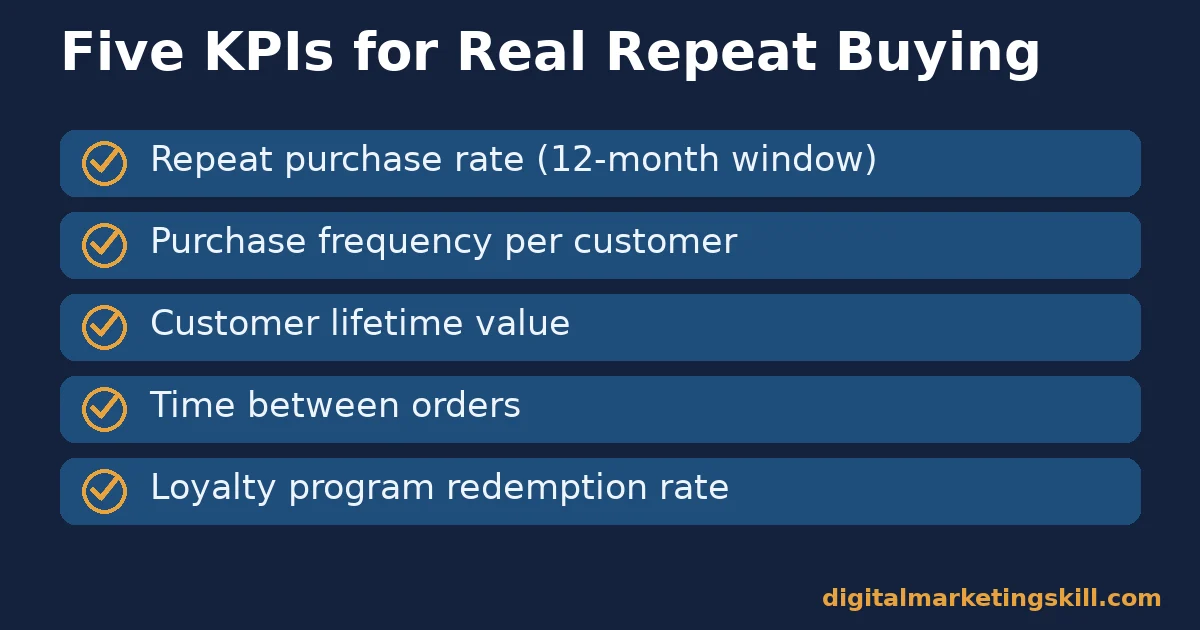
Five KPIs That Show Real Repeat Buying
- Repeat purchase rate. The share of customers who buy a second time within a set window, such as 12 months. Compare it with the 20-40% range Mobiloud found typical for ecommerce, adjusted for your category.
- Purchase frequency. The average number of orders a repeat customer places in a year. A rising number shows your levers are working without needing new customers.
- Customer lifetime value. The total revenue a typical customer generates before they stop buying. Rising lifetime value, alongside a stable acquisition cost, means retention is doing real financial work.
- Time between orders. The average gap between a customer’s purchases. A shrinking gap usually means loyalty touches, such as reminder emails, are prompting earlier return visits.
- Loyalty program redemption rate. The share of enrolled members who actually redeem a reward. A low rate means the program is decoration, not a working lever.
How to Read These Numbers Together
Read repeat purchase rate first. It shows whether people return at all. If that number is healthy but lifetime value is flat, buyers are returning but spending the same each time. That points toward personalization and recommendations, not acquisition.
If purchase frequency is rising but redemption rate is falling, the loyalty program may be riding on habits the store already built elsewhere. It may not be creating new ones. Track all five numbers together for at least one full quarter before judging any single change.
The One Decision Rule: Fix the Second Purchase Before You Chase the First
If this guide leaves you with one decision rule, make it this one. Fix whatever stops existing customers from buying a second time before spending more on new buyers. That stage already carries the highest odds of success per dollar spent.
Here is an illustrative example, with invented numbers. A small home-goods store gets 2,000 new customers a month, but only 22% return for a second order within a year. The store adds a simple post-purchase email series and a visible loyalty balance at checkout. Over the next two quarters, that number rises to 31%, with no change to the advertising budget.
The lesson is about where the leverage sits. Those 2,000 monthly buyers already exist and already trust the store once. Improving what happens after checkout changed the outcome for thousands of real people, without paying for a single new click.
A Real Case: Chewy’s Handwritten Notes
Chewy, the online pet retailer, became known for a specific personalization habit. The company sends handwritten cards to new customers, holiday cards each year, and, in some cases, pet portraits or flowers after the loss of a pet. Reporting on the practice describes it as an established company program, run by the customer service team, not an occasional surprise left to individual staff.
The strategy centers on recognition, not discounting. Customers who received a note described feeling noticed by a large company. The gesture felt personal and unprompted, tied to something real in their account history rather than a generic marketing trigger.
Keep the limits of this case in mind. Chewy has not published a specific percentage lift in repeat purchases tied to the notes program alone. Treat it as a directional example of personalized service, not a controlled study with a measured return.
Frequently Asked Questions About Repeat Customer Strategies
What are the most effective repeat customer strategies?
Four things work best: reliable delivery, clear pricing, a simple loyalty program, and personalized service. Each one fixes a different reason buyers do not return. Combining at least two usually works better than relying on one alone.
How long does it take to see results from repeat customer strategies?
Track one full quarter before judging a change, since purchase cycles vary by category. Fast-moving categories, such as food or beauty, show results sooner than categories people buy only occasionally, like furniture.
Do discounts work as a repeat customer strategy?
Discounts can prompt one extra order. But they also train buyers to wait for the next discount instead of building a habit. Pair any discount with a reason to stay, such as better service or a reward tied to repeat behavior.
Is a loyalty program worth it for a small business?
It can be, if the rules are simple enough that buyers remember them without checking a help page. A complicated program with low redemption is worse than no program. It adds cost without changing behavior.
How much does free shipping really affect repeat purchases?
In the Rakuten Insight survey cited above, 54% of shoppers across six Southeast Asian markets said free shipping made them more likely to return to the same retailer. Treat that as a strong regional signal, not a universal percentage.
What is a good repeat purchase rate?
Mobiloud’s analysis puts a healthy range at 20% to 40% over 12 months, with the average ecommerce store near 28.2%. Compare your own number against your product category, not against the overall average alone.
Should personalization focus on product recommendations or customer service?
Both matter, but they solve different problems. Recommendations influence what a buyer purchases next. Personal service influences whether they trust the store enough to come back at all after a problem.
Start With Your Best Customers, Then Build the System
Repeat customer strategies work best when a store starts with the buyers it already has. Check your own repeat purchase rate first. Pick the lever your customers complain about most, and fix that one thing before adding anything new.
Want guided practice building systems like these? Digital Marketing Skill Institute teaches these skills hands-on inside its Master Diploma in Digital & AI Marketing. The program runs on four AI-powered tracks. Together they total ten courses, including AI-Powered Lead Generation and Email Automation.
A Full Stack option lets you complete all four tracks together. It comes with unlimited 1-on-1 coaching and mentoring, plus a U.S. Project Internship that ends with a verified U.S. Work Reference Letter.
The Master Diploma is dual US and UK accredited, and recognised in more than 100 countries. It is delivered 100% online, so you can study from anywhere in your country. You can also compare this guide with related reading on customer retention strategies. Browse more guides on the Digital Marketing Skill Institute blog, visit the Digital Marketing Skill Institute homepage, or apply for the Master Diploma directly.
Every figure in this guide was checked against its original source before publication. Figures marked as illustrative are invented examples, not real results.
![9 Amazing Digital Marketing Skills to Make Money Online [With Proof]](https://digitalmarketingskill.com/wp-content/uploads/2019/07/9-Amazing-Digital-Marketing-Skills-to-Make-Money-Online-With-Proof-17.png)






