
Search Engine Marketing (SEM) is the practice of winning visits from search engines, mostly by paying for ads that show on search results pages. When someone types a question into Google or Bing, the ads at the top are SEM at work. So it puts your offer in front of people at the exact moment they are looking for it. As a result, SEM is one of the fastest ways to bring new visitors and leads to a website.
Key Takeaways
- SEM is about getting traffic from search engines, mainly through paid search ads.
- Most SEM runs on Google Ads and Microsoft Advertising, with pay-per-click billing.
- An auction decides which ads show and in what order, every time someone searches.
- Your bid matters, but so do ad quality, landing page quality and the search context.
- SEM works best next to SEO, because paid and organic results share the same page.
What Is Search Engine Marketing?
Search engines show two kinds of results. First, there are organic results, which you earn with good content and search engine optimisation. Then there are paid results, which carry a small “Sponsored” label. SEM is the work of planning, buying and improving those paid placements.
Some people use SEM as an umbrella term for both paid and organic search. However, most job ads and agencies now use it to mean paid search. In this guide, we use the paid meaning, because that is how you will hear it at work.
Microsoft Advertising describes SEM as “a type of marketing that involves positioning a URL or ad on the SERP to maximize traffic.” In other words, you want your link on the SERP when the right person searches.
Think of an everyday example. Say your boiler breaks on a cold morning. You search “emergency boiler repair near me” and tap the first ad you see. A local plumber paid for that spot. In return, they got a customer who needed help right now.
Why It Matters
Search is different from most other channels. On social media, you interrupt people who are scrolling. By contrast, on search, people tell you what they want in their own words. So the intent is high, and the visitor is often close to buying. Also, SEM is fast. You can launch a campaign today and see clicks within hours. Finally, it is easy to measure, because you can track each click, lead and sale back to a keyword.
How Search Engine Marketing Works
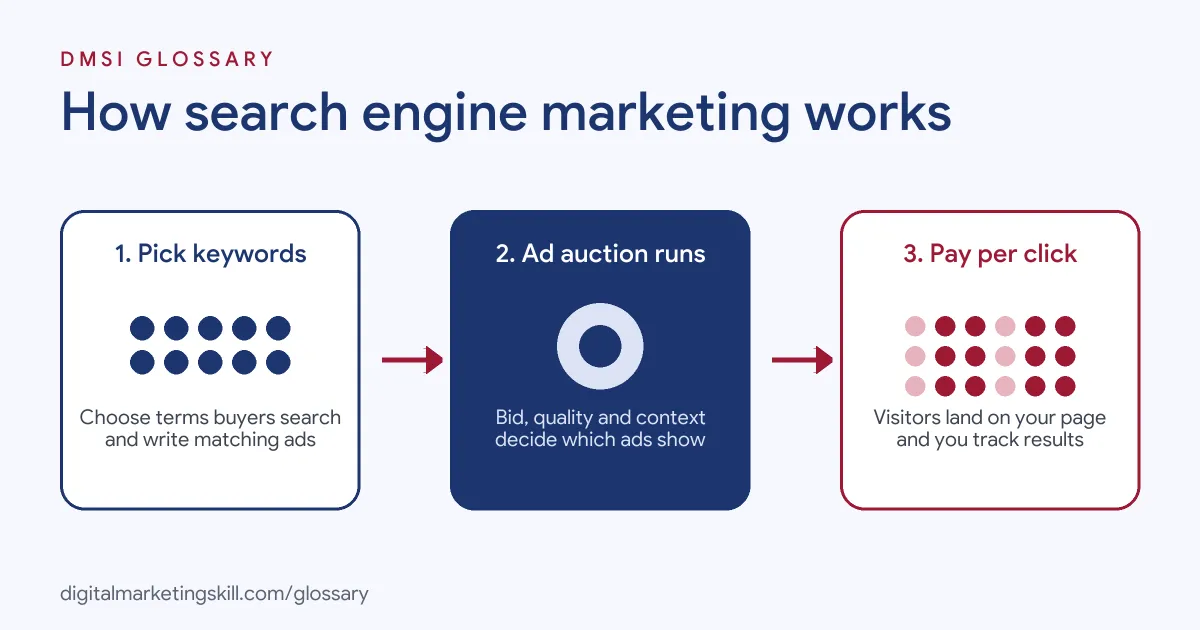
SEM follows a simple loop. You pick keywords, write ads and set a bid. Then, each time someone searches, the search engine runs a quick auction. Finally, the winning ads appear, and you pay when someone clicks.
Keywords and Intent
Everything starts with keywords. These are the words and phrases people type into the search box. For example, a florist might target “same day flower delivery” or “wedding bouquets”. Good keyword research helps you find terms that show buying intent. Then you can also add negative keywords to block searches you don’t want to pay for.
The Ad Auction
Next comes the auction. Google says it “determines which ads should show with a lightning-fast ad auction.” It uses a score called Ad Rank to decide this. According to Google, Ad Rank is based on six factors. These include “your bid”, “the quality of your ads and landing page” and “the context of the person’s search”. So a higher bid alone does not guarantee the top spot.
Paying for Clicks
Most SEM uses pay-per-click billing. That means you pay when someone clicks, not when the ad is only seen. Your bid is the most you are willing to pay. However, Google notes that the amount you actually pay “is often less.” As a result, better ads can lower your costs over time.
Measuring Results
Finally, you track what happens after the click. With conversion tracking, you can see which keywords bring leads or sales. Then you move budget towards what works and cut what doesn’t. This testing loop is the heart of good SEM.
Targeting Options
You also control who sees your ads. For example, Microsoft Advertising says you can “control where your SEM ads appear by city, state, country, and worldwide.” You can also choose the times of day and the devices you want to reach. So a shop that only delivers locally can avoid paying for clicks from far away. In the same way, a business that answers calls only in office hours can run ads only during those hours. Good targeting keeps your budget focused on people who can actually become customers.
Examples of Search Engine Marketing
- A local dental clinic. The clinic bids on “emergency dentist” plus its town name. It also sets the ads to run only within a short distance. So it pays only for clicks from people who can actually visit.
- An online shoe shop. The shop runs search ads for product terms like “waterproof walking boots”. Then it adds shopping ads with photos and prices. As a result, buyers can compare options before they click.
- A B2B software company. The team bids on problem-based terms, such as “automate invoice approvals”. Each ad sends people to a landing page with a free trial offer. Then sales follows up with every trial sign-up.
SEM vs SEO vs PPC
| Point | SEM | SEO | PPC |
|---|---|---|---|
| What it is | Marketing on search engines, mostly paid | Earning organic search rankings | A billing model where you pay per click |
| Where it shows | Sponsored results on search pages | Unpaid results below or beside ads | Search, social, display and more |
| Speed | Fast, often within hours | Slow, often months | Fast |
| Cost | You pay for each click | No click cost, but content and time | You pay for each click |
| When it stops | Traffic stops when budget stops | Rankings can last | Traffic stops when budget stops |
How to Run a Search Engine Marketing Campaign
- Set one clear goal. Decide if you want calls, leads, sales or sign-ups. Then set up conversion tracking before you spend anything.
- Choose your platform. Start with Google Ads, since most searches happen there. Later, you can add Microsoft Advertising to reach Bing users.
- Research keywords. List the terms your buyers search for. Also, group them into tight themes, one theme per ad group.
- Write focused ads. Match the headline to the search. Then add a clear benefit and a simple next step.
- Build a matching landing page. Send each ad group to a page that answers the search directly.
- Set a budget and bids. Start small, so you can learn what works without big losses.
- Add negative keywords. Block searches that waste money, such as “free” or “jobs” if they don’t fit.
- Review and improve weekly. Check the search terms report, pause poor keywords and test new ad copy.
Best Practices for Search Engine Marketing
- Match ads to intent. A person searching “buy” wants a product page, not a blog post.
- Keep ad groups tight. Fewer, closely related keywords make ads more relevant.
- Improve quality, not just bids. Better ads and pages can raise your Quality Score and lower costs.
- Use ad assets. Add sitelinks, calls and callouts, so your ad takes more space and gives more reasons to click.
- Track every conversion. Without tracking, you can’t tell good keywords from bad ones.
- Test one thing at a time. Change one headline or one bid, so you know what caused the result.
Common Mistakes to Avoid
- Sending all ads to the home page. Visitors have to hunt for what they searched for, so many leave.
- Ignoring negative keywords. Without them, you pay for clicks that will never convert.
- Bidding on very broad terms too early. Wide keywords can drain a small budget fast.
- Launching without tracking. You end up guessing which spend works.
- Setting and forgetting. Search behaviour and competitors change, so campaigns need regular care.
- Treating SEM and SEO as rivals. However, the two work best when they share keyword data and goals.
Where You’ll Use Search Engine Marketing at Work
SEM is a core skill in paid search, PPC and performance marketing roles. For example, real remote job listings say:
- “You’ll directly manage search engine marketing (SEM) campaigns across both Google Ads and Microsoft Ads, making optimizations and updates daily.” (Senior Paid Search Manager).
- “The Paid Search Team Lead is responsible for leading a team of Paid Search Specialists while overseeing the successful execution and optimization of Search Engine Marketing (SEM) campaigns for B2B clients.” (Paid Search Team Lead).
- “The Senior Manager, Search Engine Marketing (SEM) leads paid search strategy, execution, and performance across multiple complex client programs.” (Senior Manager, SEM).
Learn It in the WordPress and SEO Track
You can learn how search works, from rankings to paid listings, in the AI-Powered WordPress and SEO Specialist track. Every track includes a U.S. Project Internship from day one, with unlimited 1-on-1 mentoring.
Frequently Asked Questions
Is SEM the same as SEO?
No. SEO earns unpaid rankings, while SEM mostly means paying for ads on search results. However, both aim to win visits from search engines.
Is SEM the same as PPC?
They overlap a lot. PPC is a way of paying, per click. So SEM usually uses PPC, but PPC can also run on social media and display networks.
Which platforms are used for SEM?
The main ones are Google Ads and Microsoft Advertising. Microsoft Advertising shows ads on Bing and its partner sites.
Does the highest bid always win?
No. Google uses Ad Rank, which also looks at ad quality, landing page quality and the search context. So a better ad can beat a bigger bid.
How fast does SEM bring results?
Ads can start showing soon after they are approved. Still, it often takes a few weeks of testing to find the keywords and ads that convert well.
Sources: Microsoft Advertising: The complete guide to search engine marketing; Google Ads Help: How the Google Ads auction works; Google Ads Help: About Ad Rank; remote job listings on Himalayas, Himalayas and Himalayas.