
Customer Segmentation is the process of splitting your customers into groups that share traits, needs or behaviour, so you can market to each group in a more relevant way. Instead of sending one message to everyone, you speak to each group about what it cares about. As a result, your emails, ads and offers feel more personal. It also helps you spend your budget where it brings the best return.
Key Takeaways
- Customer segmentation groups the people who already buy from you by shared traits.
- Common types are demographic, geographic, behavioural, psychographic and firmographic.
- Good segments are easy to measure, large enough to matter and simple to reach.
- Segments shape your messages, offers, channels and budget.
- You should review your segments often, because customers change over time.
What Is Customer Segmentation?
Every business has different kinds of customers. For example, some buy often and spend little. Others buy once a year but spend a lot. Some love your brand, while others only come back for discounts. Customer segmentation puts these people into clear groups.
Qualtrics puts it simply: “Customer segmentation is the process by which you divide your customers up based on common characteristics.” It also draws a useful line. In its words, “Whereas market segmentation relates to the whole market, customer segmentation is your part of the market.”
So the focus is on people you already know. Usually, you have data on them, such as purchases, sign-up dates and email clicks. That data is often your own first-party data, which makes it reliable and yours to use within privacy rules.
Think of a local gym. It might have early-morning regulars, weekend visitors and members who have not come in for months. Each group needs a different message. For instance, the regulars might get a class update. Meanwhile, the quiet members might get a friendly “we miss you” offer.
Why It Matters
Why does this matter? Because one message rarely fits everyone. When you send the same email to all customers, many will ignore it. However, when the message matches the reader, they are more likely to open, click and buy. In addition, segments help you see which groups bring the most value. That way, you can focus on keeping them. Finally, segmentation is the base for wider personalisation work across your site, ads and emails.
How Customer Segmentation Works
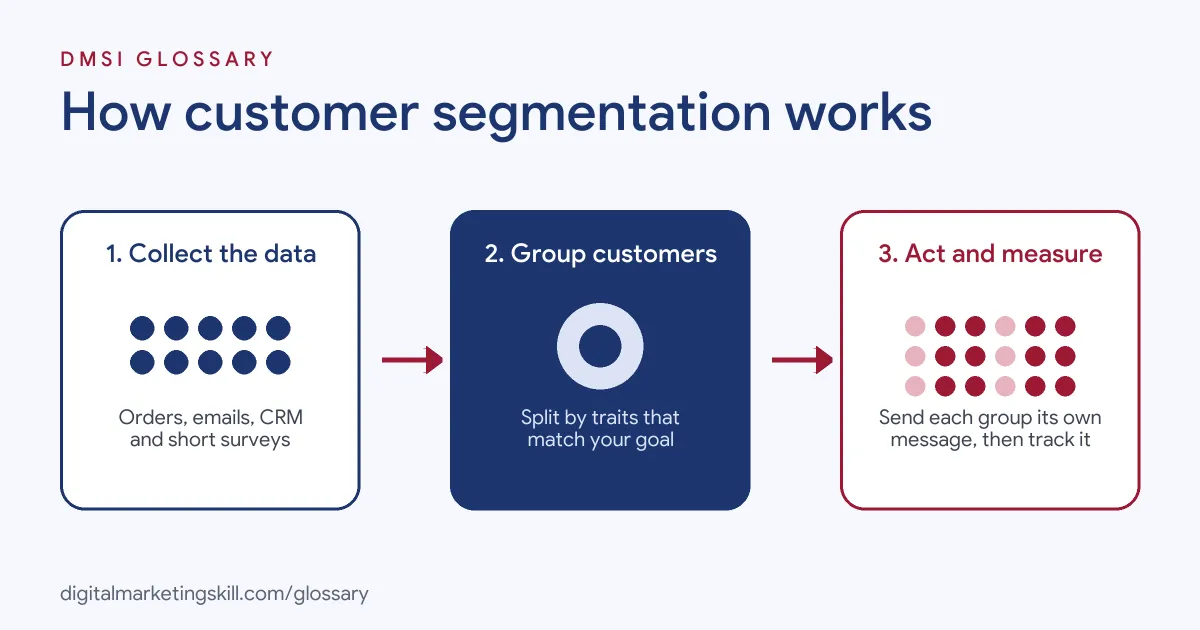
Customer segmentation follows a simple loop. First, you collect data about your customers. Then you group them by the traits that matter most. Finally, you act on each group and measure the results.
Step 1: Collect the Data
You start with what you already have. For example, your shop platform holds order history. Your email tool holds opens and clicks. Your CRM holds job titles and company sizes. Also, short surveys can add needs and goals. Mailchimp notes you can segment by when contacts joined, where they live and how they engage with your marketing.
Step 2: Choose Your Segment Types
Next, you pick the lens that fits your goal. There are several common types:
- Demographic: age, gender, income or family status.
- Geographic: country, region, city or language.
- Behavioural: how often people buy, what they buy and how much they spend.
- Psychographic: interests, values and lifestyle.
- Firmographic: for B2B, the industry, size and location of the company.
Also, many teams use needs-based or value-based groups. For example, value-based segments compare the revenue a customer brings with the cost of serving them.
A Simple Model: RFM
Many shops start with RFM. It stands for recency, frequency and monetary value. In other words, you ask three questions. When did this person last buy? How often do they buy? And how much do they spend?
Then you give each customer a score for each question. So a customer who bought last week, buys often and spends a lot sits at the top. By contrast, someone who bought once, long ago, sits near the bottom. As a result, you can spot loyal fans, rising stars and people about to drift away. This also links neatly to customer lifetime value, because your best RFM group usually holds your most valuable customers.
What Makes a Good Segment
Not every group is useful. First, a good segment is measurable, so you can count who is in it. Second, it is large enough to be worth a separate plan. Third, you can reach it through a channel you already use. Finally, it should respond in a different way from other groups. If two segments get the same message and act the same way, merge them.
Step 3: Act and Measure
Then you build a plan for each segment. That could mean a different email, offer or ad audience. After that, you track results by segment, such as open rate, repeat purchase or churn rate. If a segment does not respond, you change the message or merge it with another group.
Examples of Customer Segmentation
- An online clothing shop. The team splits buyers into first-time buyers, repeat buyers and lapsed buyers. First-time buyers get a welcome series. Meanwhile, lapsed buyers get a win-back email with a small discount.
- A B2B software company. The company groups accounts by size and product usage. So small teams get self-serve tips, while large accounts get a call from their account manager.
- A language school. The school groups students by goal, such as travel, work or exams. As a result, each group sees course pages and ads that match its reason for learning.
Customer Segmentation vs Market Segmentation vs Buyer Personas
| Point | Customer Segmentation | Market Segmentation | Buyer Persona |
|---|---|---|---|
| Who it covers | People who already buy from you | The whole market, including non-customers | One imagined, typical customer |
| Main data | Your own customer data | Research and market data | Interviews and research |
| Output | Real groups you can target | Market groups to choose from | A profile with goals and pains |
| Main use | Retention, upsell, personal messages | Deciding where to compete | Writing copy and planning content |
In short, these work well together. For example, a buyer persona can describe the typical person inside one of your customer segments.
How to Segment Your Customers
- Set a clear goal. Decide what you want to improve, such as repeat sales, sign-ups or retention.
- Gather your data. Pull customer data from your shop, CRM, email tool and analytics into one place.
- Pick a few key traits. Choose two or three traits that link to your goal. For example, use purchase frequency for a loyalty push.
- Build the groups. Create segments in your CRM or email tool. Keep the number small at first, such as three to five.
- Check the size. Make sure each segment is big enough to test and worth the effort.
- Write for each group. Create messages and offers that match each segment’s needs.
- Measure and adjust. Compare results by segment. Then refine, merge or split groups as you learn.
Best Practices for Customer Segmentation
- Start simple. A few clear segments beat dozens of tiny groups that nobody uses.
- Link segments to actions. Each segment should lead to a different message, offer or channel.
- Use behaviour, not only demographics. What people do often predicts what they will do next.
- Keep data clean. Remove duplicates and fix missing fields, so contacts land in the right group.
- Respect privacy. Collect and use data in line with rules such as GDPR and your own privacy notice.
- Review often. Customers move between groups, so refresh your segments on a regular schedule.
Common Mistakes to Avoid
- Making too many segments. Too many groups means too little content and weak test results.
- Segmenting without a goal. Groups that don’t change your marketing waste time.
- Relying on guesses. Base segments on real data, not on how you think customers behave.
- Setting and forgetting. Old segments can send the wrong message to people who have changed.
- Ignoring small but valuable groups. A small group of loyal buyers may bring a large share of revenue.
Where You’ll Use Customer Segmentation at Work
Customer segmentation appears in customer marketing, CRM and customer success roles. For example, real remote job listings ask you to:
- “Define and maintain customer segmentation and lifecycle stage frameworks (e.g., by tier, usage, health score) to enable targeted, relevant marketing programs.” (Manager, Customer Marketing).
- “You understand process design, CS models, customer segmentation, retention levers, expansion motions, and how to drive measurable customer value in a high-growth SaaS environment.” (Senior Customer Success Manager).
- “Marketing technology: Familiarity with HubSpot, Salesforce, customer segmentation, or marketing automation systems” (Senior Customer Marketing Manager).
Learn It in the Lead Generation and Email Track
You can learn customer segmentation, along with email automation and CRM skills, in the AI-Powered Lead Generation and Email Automation track. Every track includes a U.S. Project Internship from day one, with unlimited 1-on-1 mentoring.
Frequently Asked Questions
What are the main types of customer segmentation?
The most common types are demographic, geographic, behavioural and psychographic. In B2B, firmographic segmentation groups companies by industry and size.
How many segments should I have?
Start with three to five. Then add more only when each new group gets its own message and has enough people to measure.
Is customer segmentation the same as market segmentation?
No. Market segmentation looks at the whole market, while customer segmentation looks at the people who already buy from you.
What tools can I use for customer segmentation?
Most email tools, CRMs and analytics platforms can build segments. For example, you can filter contacts by purchases, location or email activity.
Can small businesses use customer segmentation?
Yes. Even a simple split between new and repeat customers can make your email marketing more relevant.
Sources: Qualtrics: Understanding Customer Segmentation; Mailchimp: Getting Started with Segments; Contentsquare: Customer Segmentation Models; remote job listings on Himalayas, Himalayas and Himalayas.