
Jobs-to-be-Done (JTBD) is a way of understanding customers that focuses on the progress a person wants to make in a given situation, rather than on who they are. The idea is simple: people “hire” a product to get a job done, and they “fire” it when something else does the job better. As a result, JTBD helps you see your real competitors and write messages that match real needs. It also gives product, marketing and sales teams one shared view of why people buy.
Key Takeaways
- JTBD looks at the job a customer wants done, not at their age, job title or income.
- People “hire” products to make progress and “fire” them when they stop helping.
- Every job has functional, social and emotional sides.
- The situation, or circumstance, matters as much as the person.
- Marketers use JTBD to shape positioning, content and campaign messages.
What Is Jobs-to-be-Done?
Jobs-to-be-Done is a theory about why people buy things. It is linked most closely to the late Harvard Business School professor Clayton Christensen and his co-authors. The Christensen Institute describes it as “a lens that reveals the circumstances—or forces—that drive people and organizations toward and away from decisions.”
In plain words, you don’t buy a product for its own sake. Instead, you buy it because you want something in your life to get better. For example, you might buy a project tool because your team keeps missing deadlines. So the job is “help my team deliver on time”, not “buy software”.
An old sales line sums it up. As one commenter on a Harvard Business School article put it, “You’re not selling the drill, you’re selling the hole.” In other words, the hole is the job, and the drill is just one way to get it.
JTBD also explains why customer types alone can mislead you. Christensen argued that “The fact that you’re 18 to 35 years old with a college degree does not cause you to buy a product.” Demographics may match a purchase. However, they rarely cause it.
Why It Matters
Why should a marketer care? Because the job shows you who you really compete with. For instance, a meal kit doesn’t only compete with other meal kits. It also competes with takeaways, ready meals and simply eating toast. Once you see that, your value proposition can speak to the real choice in the customer’s mind. In addition, your ads can talk about the progress people want, not just your features.
How Jobs-to-be-Done Works
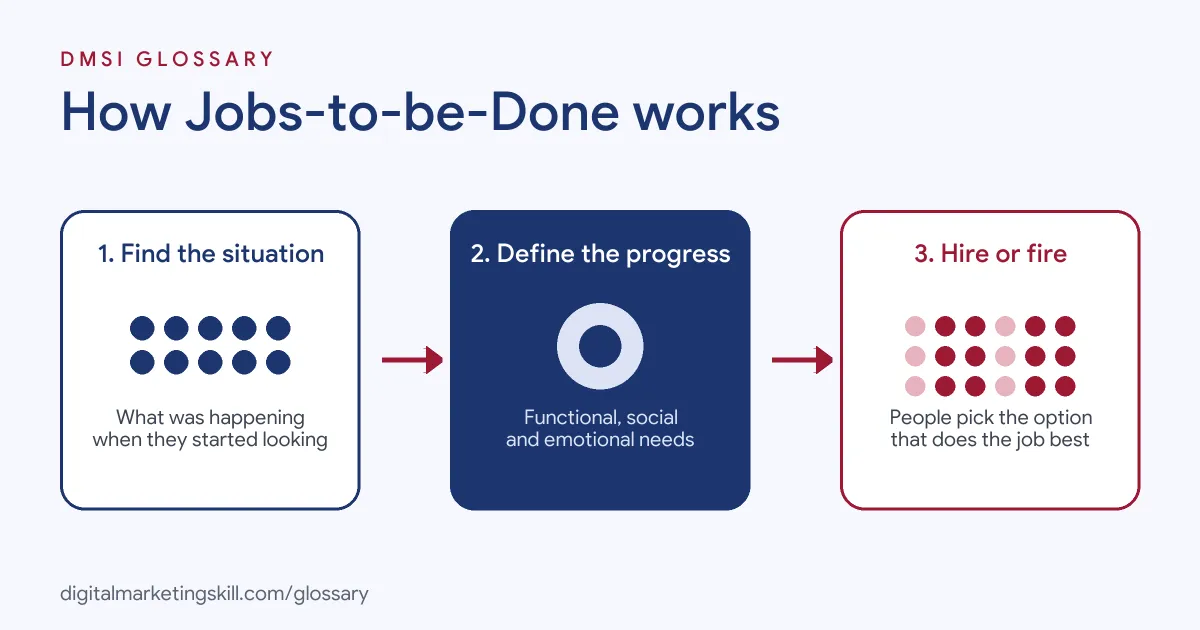
JTBD works by asking why someone chose a product at a certain moment. First, you find the situation they were in. Then you learn what progress they wanted. Finally, you look at what pushed them to switch and what held them back.
The Circumstance
Every job starts with a situation. The Christensen Institute notes that people hire for different jobs because of “our changing circumstances.” For example, the same person may want a quick lunch on a workday and a long meal on a Sunday. So the circumstance, not the person, defines the job.
Functional, Social and Emotional Sides
Next, each job has three layers. The functional side is the practical task, such as “get my books done”. The social side is how the choice looks to others. Meanwhile, the emotional side is how it makes the person feel. The Christensen Institute says, “All Jobs incorporate functional, social, and emotional forces at play in decision-making.” As a result, a message that covers only features often misses the point.
Hiring and Firing
Then comes the choice. People “hire” the option that does the job best in their situation. Later, they may “fire” it and switch. For instance, a famous fast-food study found that many morning milkshake buyers were commuters. As the study notes, “They weren’t yet hungry, but knew that they’d be hungry by 10 a.m.” So the shake was hired to make a dull drive easier and keep hunger away.
Forces That Drive Change
Finally, JTBD looks at the forces around a switch. Some forces push people towards a new choice, such as frustration with the old one. Others hold them back, such as habit or fear of the unknown. So your marketing can boost the push and reduce the fear, for example with a free trial or clear guarantees.
How Marketers Apply It
So how does this reach your daily work? First, JTBD shapes your positioning. You describe your offer as the best way to get a job done. Next, it guides your content. For example, a blog post can answer the exact question someone has at the start of a job. In addition, it sharpens your ad copy, because you speak to a real situation instead of a broad audience. It also helps your market research, since interviews focus on real decisions. Finally, it gives you better test ideas. You can compare two headlines, each built around a different job, and see which one wins.
Examples of Jobs-to-be-Done
- An accounting app for small firms. Owners don’t want to learn accounting. They just want their books done. So the team cuts jargon from its landing page and leads with “finish your books in less time”.
- A gym with early classes. Interviews show that many members join to feel calm before work, not to build muscle. As a result, the gym’s ads talk about starting the day clear-headed.
- An online course provider. The team learns that many learners want to switch careers, not collect certificates. Then it rewrites its emails around first jobs, portfolios and confidence.
Jobs-to-be-Done vs Buyer Personas
| Point | Jobs-to-be-Done | Buyer persona |
|---|---|---|
| Main question | What progress does the person want? | Who is the typical customer? |
| Focus | The situation and the goal | Traits, role and habits |
| Groups people by | The job they need done | Shared characteristics |
| Best for | Positioning, product ideas and messaging | Targeting, tone and channel choice |
| Main risk | Jobs written too vaguely | Stereotypes that don’t explain buying |
You don’t need to pick one. In fact, many teams add a job statement to each buyer persona.
How to Use Jobs-to-be-Done
- Talk to recent buyers. Interview people who bought or switched recently. Their memory of the decision is still fresh.
- Ask about the moment. Find out what was happening when they started looking. For example, “What made you look for a new option that week?”
- Map the timeline. Trace the steps from first thought to purchase. Note what they tried before you.
- Write job statements. Use a simple pattern: “When I am in this situation, I want to make this progress, so I can get this outcome.”
- Sort the forces. List what pushed them to change and what nearly stopped them.
- Group by job. Use the jobs for segmentation, not only age or location.
- Apply it to your marketing. Rewrite headlines, ads and emails so they speak to the job and the situation.
- Test and learn. Then run small tests to see which job-based message performs best.
Best Practices for Jobs-to-be-Done
- Focus on the switch. The most useful stories come from the moment someone changed products.
- Keep jobs solution-free. A job like “keep my team on schedule” stays true even if tools change.
- Cover all three sides. Include the functional, social and emotional parts of each job.
- Look beyond your category. List every option customers hire for the same job, including doing nothing.
- Use the customer’s words. Real phrases from interviews make stronger copywriting.
- Share the findings. Give product, sales and support teams the same job statements.
Common Mistakes to Avoid
- Writing jobs that are too broad. “Be happy” is not a job you can design for.
- Naming your product in the job. The job should describe progress, not your feature.
- Asking people what they want. Instead, ask what they did and why. Past actions tell you more than wishes.
- Ignoring emotions. Many choices turn on worry, pride or relief, not only on price.
- Treating JTBD as a one-off. Circumstances change. So revisit your jobs as markets move.
Where You’ll Use Jobs-to-be-Done at Work
JTBD shows up in product marketing, content, CRM and product roles. It often sits next to user research and go-to-market strategy. For example, real remote job listings ask for:
- “Use the Jobs-to-Be-Done (JTBD) framework to shape user-focused content.” (Content Lead).
- “You are well versed in Jobs To Be Done.” (Lead Product Marketer / Head of Product Marketing).
- “Experience conducting user research, JTBD interviews, and hypothesis-driven experimentation.” (Product Manager).
Learn It in the Full Stack Track
You can learn JTBD alongside personas, funnels, ads and email in the Full Stack programme, which covers all four tracks. Every track includes a U.S. Project Internship from day one, with unlimited 1-on-1 mentoring.
Frequently Asked Questions
Who created Jobs-to-be-Done?
The theory is most closely linked to Clayton Christensen and his co-authors. Others, such as Bob Moesta, helped develop the methods used to apply it.
What is a job statement?
It is a short sentence that describes the situation, the progress wanted and the outcome. For example, “When I start a new role, I want to learn fast, so I can make a good first impression.”
Is JTBD only for product teams?
No. Marketers use it for positioning, content, ads and email. Also, sales teams use it to frame calls around the buyer’s goal.
Does JTBD replace buyer personas?
Not usually. Instead, many teams combine them, so each persona has clear jobs attached.
How many interviews do I need?
There is no fixed number. However, many teams start with a small set and stop when new interviews stop revealing new patterns.
Sources: Christensen Institute: Jobs to Be Done Theory; Harvard Business School Working Knowledge: Clay Christensen’s Milkshake Marketing; strategy+business: The “Jobs to Be Done” Theory of Innovation; remote job listings on Himalayas, Himalayas and Himalayas.