
Freemium is a pricing model where a business gives away a basic version of its product for free and charges for extra features, more usage or better support. The name joins the words “free” and “premium”. It lets people try your product with no risk. Then, once they see its value, some of them upgrade. As a result, freemium can bring in many users without a large sales team.
Key Takeaways
- Freemium offers a free plan forever, with paid plans for more.
- The free plan is usually limited by features, usage or support.
- It differs from a free trial, which gives the full product for a short time.
- Freemium works best when the product is cheap to serve to extra users.
- The key number to watch is how many free users become paying customers.
What Is Freemium?
With freemium, anyone can sign up and use a basic plan without paying. There is no end date. However, the free plan has limits. When users need more, they move to a paid plan.
Wikipedia describes freemium as “a pricing strategy by which a basic product or service is provided free of charge”. Money is then charged for extra features, services or goods. The model is older than the name. For example, software makers used it long before the word appeared. The name itself came out of a discussion started by investor Fred Wilson.
Here is an everyday example. Think of a music app. You can listen for free, but you hear adverts and have fewer controls. Then, if you pay each month, the adverts go and you get more features. Most people stay on the free plan. Still, enough people upgrade to fund the business.
Freemium is closely linked to product-led growth. ProductLed describes this as an approach where the product itself drives user acquisition, conversion and retention. In other words, the free plan does much of the selling.
Why It Matters
Why do so many software companies use freemium? Because it removes the biggest barrier, which is the price. So more people try the product. In addition, happy free users often tell others. This can lower your customer acquisition cost. However, free users also cost money to support. That is why the free plan must be designed with care.
How Freemium Works
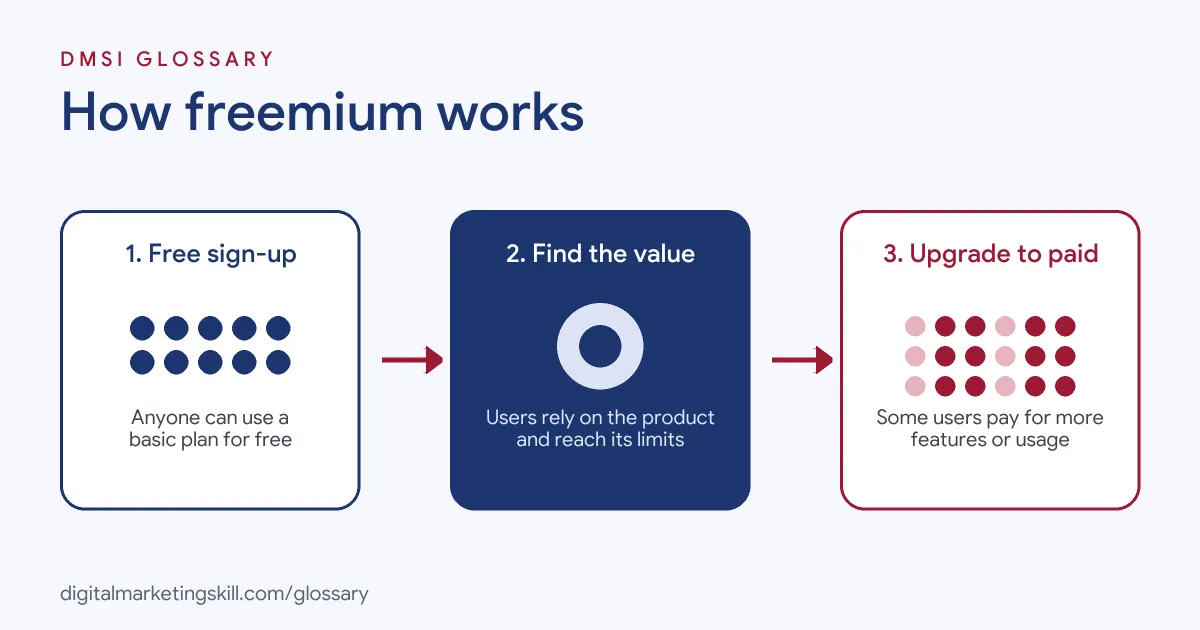
Freemium follows a simple path. First, people sign up for the free plan. Then they use it and find real value. Finally, some of them reach a limit and pay to upgrade.
The Free Plan and Its Limits
Every freemium product draws a line between free and paid. ProductLed names three common types of limit. First, reduced features, where extra tools need a paid plan. Second, reduced capacity or usage, such as less storage. Third, reduced support. Also, many companies mix these limits together.
Slack is a clear example. Its help centre says the free plan is “limited to the most recent 90 days of message and file history.” It also says free workspaces are “limited to 10 third-party or custom app installations.” So a small team can work for free, but a growing team soon wants more.
The Upgrade Moment
Next comes the upgrade. Users usually pay when they hit a limit that matters to them. For example, they run out of storage or need a feature for their team. So the best freemium products make that moment clear. They show what the paid plan adds, right when the user needs it.
Nurturing Free Users
Not every user upgrades on their own. That is why many companies add an email sequence for new sign-ups. These emails teach key features and share tips. Then, at the right time, they explain the benefits of paying. Also, in-app messages can point to paid features as people use the product.
The Numbers Behind It
Freemium only works if the maths adds up. On one side, you have the cost of serving free users. On the other, you have the revenue from paying users. So you track your free-to-paid conversion rate, the value of each paying customer and the cost of each free one. If the free plan costs more than upgrades bring in, you need to change the limits.
Is Freemium a Good Fit?
Before you choose freemium, ask a few simple questions. First, is your product cheap to run for each extra user? Software often is, while a service with human time usually is not. Second, can people get value on their own, without a sales call? Third, will a share of users naturally grow into a paid need? If the answer to all three is yes, freemium may suit you. Otherwise, a free trial, a demo or a lead magnet may be a better first step. Also, remember that a free plan is a long-term promise. So pick limits you can keep for years, rather than ones you will need to cut later.
Examples of Freemium
- A team chat tool. The free plan keeps a limited message history and caps app connections. As teams grow and need older messages, they move to a paid plan.
- A cloud storage service. Users get a small amount of free storage. Then, when their files fill it up, they pay for more space.
- A design app for small businesses. Anyone can make simple graphics for free. However, brand kits and premium templates sit behind a paid plan.
Freemium vs Free Trial vs Paid Only
| Point | Freemium | Free Trial | Paid Only |
|---|---|---|---|
| How long it is free | Forever, with limits | A set time, often 14 or 30 days | Not free |
| What users get | A basic version | Usually the full product | The full product after paying |
| Main goal | Wide adoption, then upgrades | Fast decision to buy | Revenue from day one |
| Main risk | Many users never pay | Users leave when the trial ends | Fewer people try it |
Some companies combine these. For example, a free plan can include a short trial of the top plan, so users taste the premium features early.
How to Set Up a Freemium Model
- Check your costs. Work out what it costs to serve one extra free user. Freemium suits products where that cost is low.
- Find your core value. Decide what makes users love the product. Keep enough of it in the free plan so people see the value.
- Choose your limits. Pick feature, usage or support limits that growing users will naturally reach.
- Design the paid plans. Make each paid plan clearly better, with a strong value proposition.
- Plan the upgrade path. Show upgrade prompts at the moment a limit is reached.
- Nurture new users. Set up onboarding emails and in-app tips for the first weeks.
- Track and adjust. Measure sign-ups, activation, upgrades and churn rate. Then change limits if the numbers fall short.
Best Practices for Freemium
- Make the free plan useful. A free plan that does too little will not win fans.
- Don’t give everything away. If the free plan covers every need, few people will pay.
- Explain limits clearly. Tell users what is free and what is paid before they sign up.
- Time your prompts. Ask for the upgrade when users hit a real limit, not at random.
- Look after free users. They can become paying customers or send you referrals later.
- Use upgrades wisely. Offer bigger plans as accounts grow, a form of upselling.
Common Mistakes to Avoid
- Choosing freemium for the wrong product. If each user is costly to serve, a free trial may fit better.
- Setting limits that never bite. Users have no reason to upgrade if they never reach a limit.
- Setting limits that bite too early. Users may leave before they see any value.
- Ignoring free users after sign-up. Without onboarding, many people sign up and never return.
- Changing the free plan without warning. Sudden cuts can upset loyal users, so explain changes early.
Where You’ll Use Freemium at Work
We did not find a current remote job listing that names freemium directly. However, the model sits at the heart of product-led growth roles. For example, growth marketers plan how free users move to paid plans. Lifecycle and email marketers write onboarding and upgrade emails. Also, product marketers design pricing pages and plan comparisons. Finally, growth marketing teams test limits and prompts to raise upgrade rates.
Learn It in the Lead Generation and Email Track
You can learn how to turn free sign-ups into paying customers with onboarding and email automation in the AI-Powered Lead Generation and Email Automation track. Every track includes a U.S. Project Internship from day one, with unlimited 1-on-1 mentoring.
Frequently Asked Questions
What does freemium mean?
Freemium means a product has a free basic plan and paid plans with more features, usage or support. The word joins “free” and “premium”.
What is the difference between freemium and a free trial?
A freemium plan is free forever but limited. By contrast, a free trial usually gives the full product for a set time, then asks you to pay.
What kinds of limits do freemium plans use?
The most common limits are on features, usage or capacity, and support. Many products combine more than one.
Is freemium right for every business?
No. It suits products that are cheap to serve to extra users. If each user costs a lot, a free trial or demo may work better.
How do you get free users to upgrade?
Show clear value in the free plan, then prompt users when they reach a limit. In addition, onboarding emails can explain what paid plans add.
Sources: Wikipedia: Freemium; ProductLed: What is product-led growth?; Slack Help Center: Feature limitations on the free version of Slack.