
A Content Writer is a person who researches and writes text for websites, blogs, emails, social media and other marketing channels, so a business can inform, attract and keep its audience. Good content writers turn complex ideas into clear words that readers trust. Also, their work often supports search traffic, sales and brand awareness at the same time. As a result, content writing is one of the most common remote jobs in digital marketing.
Key Takeaways
- A content writer creates blog posts, web pages, emails, case studies and more.
- Content writers often cover many topics, unlike writers who stick to one field.
- Research, clear writing and basic SEO are the core skills of the job.
- Most content follows a brief, a brand voice and a review step before it goes live.
- Many content writing jobs are remote, freelance or agency-based.
What Is a Content Writer?
Every business needs words. For example, it needs a home page, product pages, help articles, emails and social posts. A content writer produces that text. Usually, they work from a plan set by a marketing team or a client.
The U.S. Bureau of Labor Statistics describes writers as people who “develop written content for various types of media.” It also notes, “Content writers write about any topic of interest, unlike writers who usually specialize in a given field.” So a content writer might write about accounting software on Monday and holiday travel on Friday.
Think of a content writer as a translator. On one side, there is an expert, a product or a set of facts. On the other side, there is a reader with a question. So the writer’s job is to connect the two in plain, useful words.
Content writer vs copywriter
In practice, the two roles overlap, and many people do both. However, the focus is different. A content writer mainly informs and educates, for example with guides and articles. By contrast, copywriting mainly persuades, for example with ads, sales pages and calls to action.
Why it matters
Often, content is how people first meet a brand. For instance, they search a question, find a helpful article, and later come back to buy. So clear, accurate writing builds trust long before a sales call. In addition, good content supports content marketing, email and social media all at once. That is why skilled writers stay in demand, even as AI tools spread.
Skills you need
So what makes a strong content writer? First, you need clear writing. The BLS says writers “must be able to write clearly and effectively.” Next, you need research skills, so your facts hold up. In addition, you need to meet deadlines, because content often runs on a set calendar. Also, basic SEO knowledge helps your work get found. Finally, curiosity matters. The best writers enjoy learning new topics quickly.
Where content writers work
Content writers work in many settings. For example, some join an in-house marketing team at one company. Others work at agencies, where they write for many clients. Meanwhile, many are freelancers who find work through job boards and referrals. As a result, the job suits people who want flexible, remote work.
How Content Writing Works
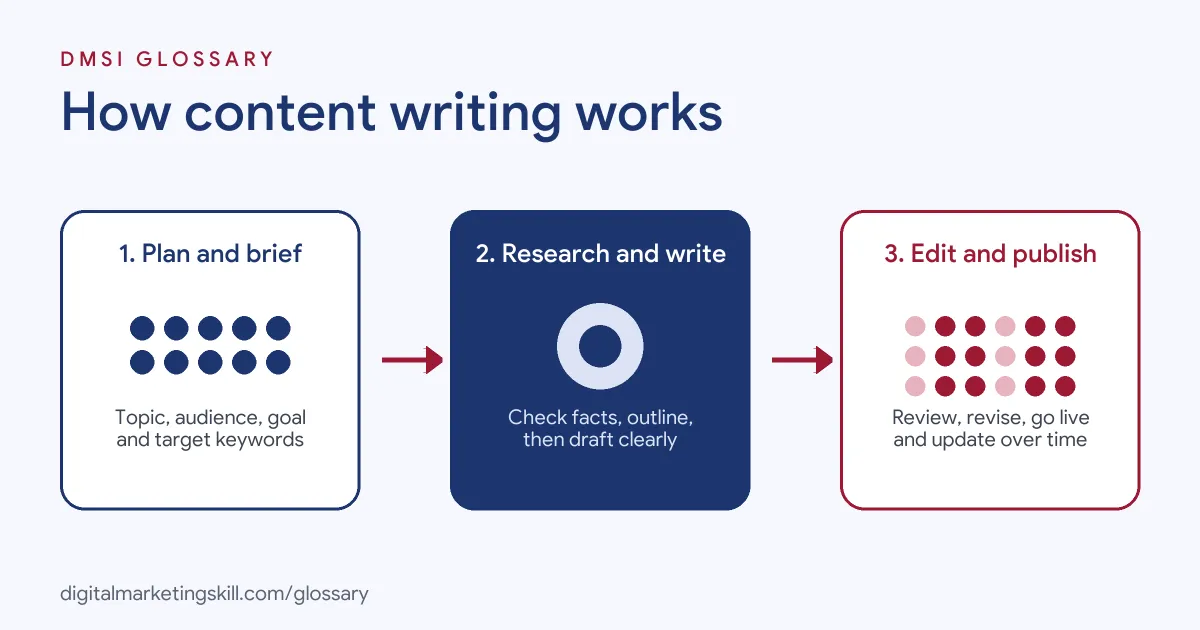
Most content follows the same basic process. First, someone decides what to write. Then the writer researches and drafts. Finally, an editor reviews the piece before it is published. Here is what each step looks like.
Planning and the brief
Writing usually starts with a content brief. It sets out the topic, the audience, the goal and the key points. Also, for SEO pieces, it often lists target keywords and questions to answer. As a result, the writer knows exactly what success looks like.
Research
Next, the writer gathers facts. The BLS lists “conduct research to get factual information and authentic detail” as a core duty. For example, a writer might read official docs, interview a subject expert, or study what already ranks in search. Then they plan an outline that answers the reader’s questions in a logical order.
Writing and SEO
Then comes the draft. Google’s SEO Starter Guide advises you to make sure “the content is well written, easy to follow, and free of spelling and grammatical mistakes.” It also suggests you “break up long content into paragraphs and sections, and provide headings.” In addition, writers think about the words readers search for, which links to keyword research.
Editing and updating
Finally, an editor or client reviews the draft. Typically, they check facts, tone and structure, and then ask for changes. After the piece goes live, the work isn’t always done. Google suggests you “check in on previously published content and update it as needed.” So many writers also refresh older articles.
Examples of Content Writer Work
- A dental clinic’s blog. A writer creates a guide to caring for teeth after a filling. She checks the facts with the dentist and adds a short FAQ, so the page answers common patient questions.
- A software company’s help centre. A writer turns a technical feature into a simple step-by-step article. Then he adds screenshots and links to related guides.
- An online shop’s email series. A writer drafts a welcome email series for new subscribers. After that, each email shares one useful tip, plus a gentle link to the shop.
Content Writer vs Copywriter vs Content Strategist
| Point | Content writer | Copywriter | Content strategist |
|---|---|---|---|
| Main goal | Inform and educate | Persuade and convert | Plan what content to make |
| Typical work | Blogs, guides, help articles, newsletters | Ads, sales pages, product copy | Content plans, calendars, briefs |
| Length | Often long-form | Often short and punchy | Documents and frameworks |
| Key skills | Research, clarity, SEO basics | Persuasion, testing, headlines | Audience research, analytics, planning |
| Measured by | Traffic, engagement, time on page | Clicks, conversions, sales | Overall content results |
So where do you start? In many teams, one person does all three jobs. For example, a small business might ask its content writer to plan topics and write ads too. However, larger teams often split the roles. Therefore, it helps to learn a little of each.
How to Become a Content Writer
- Practise writing every week. Start a blog or write sample articles on topics you know. In addition, ask others for honest feedback.
- Learn SEO basics. Understand keywords, headings, internal links and on-page SEO.
- Build research habits. Use official and primary sources. Then keep notes on where every fact came from.
- Pick a few niches. For example, choose two or three topics you enjoy, such as finance, health or software.
- Create a portfolio. Then collect your best five to ten samples on a simple website or shared folder.
- Learn the tools. Next, get comfortable with WordPress, Google Docs, grammar checkers and AI writing assistants.
- Apply and pitch. Look for remote jobs and freelance projects. Also pitch agencies that need extra writers.
- Keep improving. Track how your articles perform. After that, use the results to write better next time.
Best Practices for Content Writers
- Write for the reader first. Google advises writing content “that your readers will find helpful and reliable.”
- Answer the question early. First, put the main answer near the top, then add detail below.
- Keep it simple. Use short sentences, plain words and clear headings.
- Follow the brand voice. Match the tone set in the client’s brand voice guide.
- Check every fact. Also, link to sources and never invent numbers or quotes.
- Use AI with care. AI can speed up outlines and drafts. However, always add your own research, checks and insight.
Common Mistakes to Avoid
- Writing without a brief. Without a clear goal, content often drifts and misses what readers need.
- Stuffing keywords. For instance, forcing the same phrase into every line makes text hard to read.
- Copying others’ work. Google says, “don’t copy others’ content in part or in its entirety.”
- Padding for length. Extra words with no value can turn a page into thin content.
- Skipping the edit. Even strong writers miss typos. So always reread, or ask someone else to check.
- Ignoring deadlines. Besides, in client work, being reliable matters as much as writing well.
Where You’ll Use Content Writing at Work
Content writing is a full job title, and it also shows up inside SEO, marketing and agency roles. For example, real remote job listings ask you to:
- “Write clear, well-researched content across multiple formats” (Content Writer).
- “Apply on-page SEO best practices to written content.” (Content Writer).
- “1-3 years in content writing or editing, and you genuinely care about content that works.” (Content Writer).
Learn It in the WordPress and SEO Track
You can learn to plan, write and optimise web content in the AI-Powered WordPress and SEO Specialist track. Every track includes a U.S. Project Internship from day one, with unlimited 1-on-1 mentoring.
Frequently Asked Questions
What does a content writer do?
A content writer researches topics and writes text such as blog posts, web pages, emails and guides. They usually work from a brief and revise after feedback.
Do I need a degree to become a content writer?
Not always. The BLS says writers typically have a degree in English or a related field. Still, many employers care most about your portfolio and writing samples.
Is content writing the same as copywriting?
No, but they overlap. Content writing mainly informs, while copywriting mainly persuades people to take an action.
Can content writers work remotely?
Yes. Many content writing jobs are fully remote, and much freelance work is done online with clients in other countries.
Will AI replace content writers?
AI tools can help with drafts and ideas. However, businesses still need people who research, check facts, add real insight and match the brand voice.
Sources: U.S. Bureau of Labor Statistics: Writers and Authors; Google Search Central: SEO Starter Guide; Google Search Central: Creating helpful, reliable, people-first content; remote job listings on Himalayas, Himalayas and Himalayas.