Instagram ads are paid posts that appear in people’s Feed, Stories, Reels, Explore and search results, marked “Sponsored”. You create them in Meta Ads Manager, the same tool used for Facebook ads, by choosing an objective, an audience, a budget and your creative. Instagram has around three billion monthly users, and DataReportal reports that its ads can reach close to two billion accounts. Instagram ads work best when the creative looks native to the app, the objective matches what you want people to do and you judge results by cost per sale or lead, not likes.
This guide explains the formats and placements, what Instagram ads cost, how to set up your first campaign and how to measure it. If you sell to small businesses, our guide to Instagram for small business covers the organic side.
Key Takeaways
- Meta has said Instagram has about three billion monthly active users.
- DataReportal’s mid-year figures show Instagram ads could reach about 1.99 billion accounts.
- WordStream’s Meta benchmarks show an average cost per click of $0.70 for traffic campaigns and $1.92 for lead campaigns.
- The same study puts the average cost per lead across Meta at $27.66.
- Instagram ads run in up to six Instagram placements: Feed, profile feed, Explore home, Stories, Reels and search results.
In this guide
- What Most Instagram Ads Guides Miss
- How Instagram Ads Work
- Instagram Ad Formats
- Where Instagram Ads Appear
- How Much Instagram Ads Cost
- How to Run Your First Instagram Ad Campaign
- Creative Tips for Instagram Ads
- Boosting a Post vs Using Ads Manager
- Common Instagram Ad Mistakes
- How to Measure Instagram Ads
- The One Rule for Instagram Ads
- An Illustrative Case
- Frequently Asked Questions About Instagram Ads
- Your Next Step
What Most Instagram Ads Guides Miss
Many guides treat Instagram ads as a design job: make a nice image, pay some money, wait for sales. In practice, three things decide results far more than design.
- The objective. Meta’s system finds people likely to do what you ask for. Ask for clicks and you get clickers. Ask for purchases, with tracking set up, and it looks for buyers.
- The offer. A weak offer with beautiful creative still loses. A clear, useful offer with simple creative often wins.
- The page after the click. If the landing page is slow or confusing, you pay for clicks that never turn into customers.
Get those three right, and the creative becomes the thing you test, not the thing you hope will save you.
How Instagram Ads Work
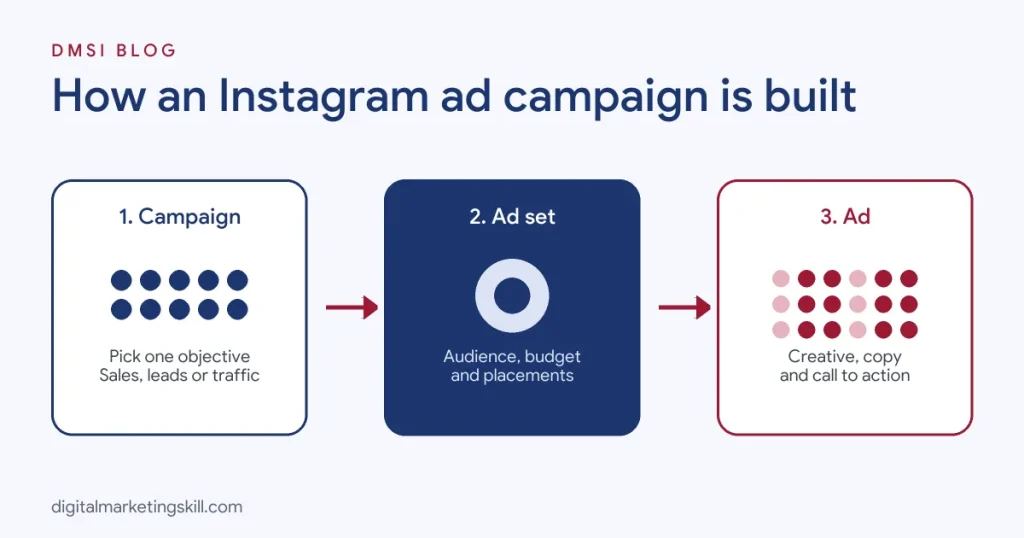
Instagram ads run through Meta’s ad system, which also serves Facebook, Messenger and WhatsApp ads. Every campaign has three levels.
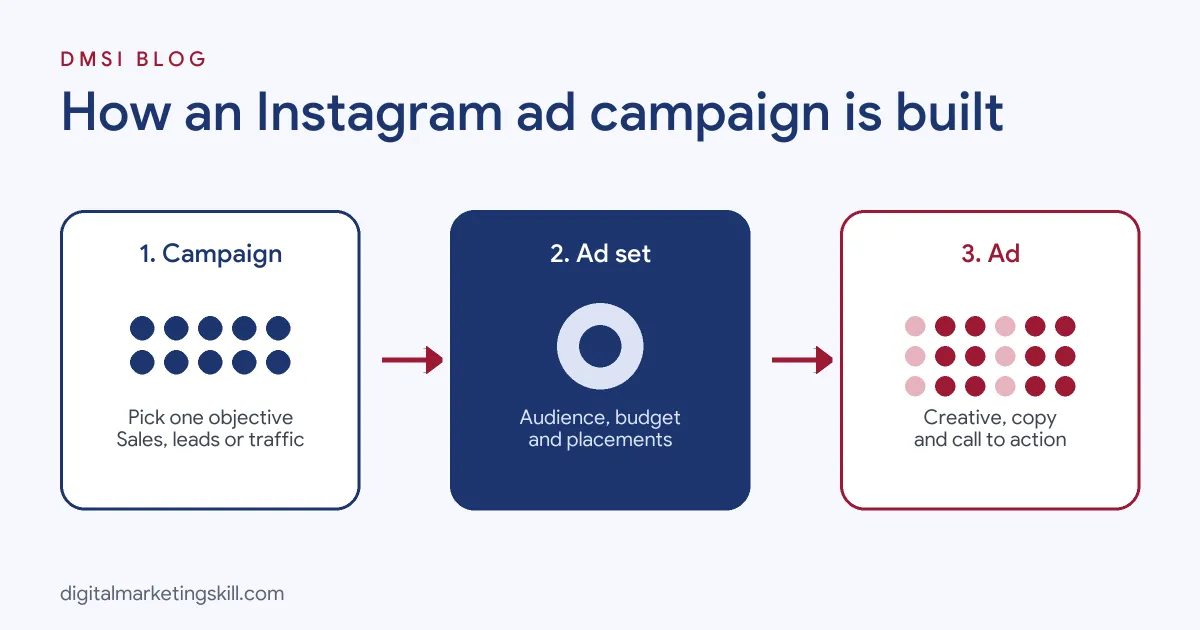
- Campaign: where you choose one objective, such as Awareness, Traffic, Engagement, Leads, App promotion or Sales.
- Ad set: where you choose the audience, budget, schedule and placements.
- Ad: the creative, text, headline and call-to-action button people see.
When someone opens Instagram, Meta runs an auction for each ad slot. It weighs your bid, how likely the person is to take your chosen action and how relevant your ad is. Better ads can win the auction at a lower cost, which is why creative quality affects price.
To track sales and leads from your website, install the Meta Pixel and, ideally, the Conversions API. Our glossary entry on the Meta Pixel explains how it works.
Instagram Ad Formats
Single Image: Built for Simple Messages
One photo or graphic with a caption and button. Quick to make and good for a clear offer. Use 4:5 for Feed and 9:16 for Stories and Reels.
Video: Built for Attention
Short vertical videos usually perform best, because they fit Reels and Stories. Hook viewers in the first second and add captions for people watching without sound.
Carousel: Built for Choice and Steps
Up to ten swipeable cards in the Feed, each with its own image or video. Good for showing several products, a step-by-step process or a before and after. In Stories, carousels are limited to two or three cards.
Collection: Built for Shopping
A cover image or video with product tiles beneath. Tapping opens a full-screen shopping experience linked to your product catalogue.
Lead and Message Ads: Built for Conversations
Lead ads open a short form inside Instagram. Click-to-message ads open a chat in Instagram Direct, Messenger or WhatsApp. Both suit service businesses, courses and B2B offers.
Partnership Ads: Built for Trust
You run ads through a creator’s handle, with their permission, so the ad shows both names. This mixes influencer marketing with paid reach.
Where Instagram Ads Appear
| Placement | What it looks like | Best creative |
|---|---|---|
| Feed | Between posts in the main feed | 4:5 image, video or carousel |
| Profile feed | Between posts when someone browses a profile | Same as Feed |
| Explore home | A tile in the Explore grid | Eye-catching image or video |
| Stories | Full screen, between Stories | 9:16 vertical video or image |
| Reels | Full screen, between Reels | 9:16 vertical video with sound and captions |
| Search results | In results when people search | Same as Feed |
Most beginners should leave Advantage+ placements on, so Meta can show ads wherever they perform best. Then, if you have the budget, make both a 4:5 and a 9:16 version so every placement looks right.
How Much Instagram Ads Cost
Instagram ads have no fixed price list. You set a budget, and the auction decides what each result costs. Benchmarks give a starting point:
| Metric | Benchmark | Source |
|---|---|---|
| Cost per click, traffic campaigns | $0.70 | WordStream (Meta) |
| Cost per click, lead campaigns | $1.92 | WordStream (Meta) |
| Cost per lead | $27.66 | WordStream (Meta) |
| Instagram Feed CPM (worldwide median) | About $5 | Emplifi |
Your costs will differ. Country matters a great deal: reaching people in the US or UK usually costs more than reaching people in Nigeria or India. Season matters too, with prices rising around Black Friday and Christmas. Above all, your offer and creative matter, because ads people like can cost less to show.
A practical approach is to set a small test budget, run it for a week and look at your cost per result. If one sale earns more profit than it costs to get, scale slowly.
How to Run Your First Instagram Ad Campaign
- Switch to a professional account. Make your Instagram a business or creator account and connect it to a Meta Business portfolio.
- Set up tracking. Add the Meta Pixel to your website so you can measure sign-ups and sales.
- Choose one objective. Pick Sales or Leads if you can track them. Pick Traffic only if you cannot yet track results.
- Set the budget. Start with a daily budget you are happy to spend for a week as a test.
- Define the audience. Set location and age, then either add a few interests or go broad. Create a custom audience of website visitors and Instagram engagers for retargeting.
- Choose placements. Leave Advantage+ placements on unless you have a reason to limit them.
- Build two or three ads. Use the same offer with different hooks or visuals, so you can see what works.
- Write clear copy. Lead with the benefit, keep the first line short and choose a matching button, such as Shop now or Sign up.
- Publish and leave it alone. Give the campaign several days before you change anything.
- Review and adjust. Pause the weakest ad, keep the best one and test a new idea against it.
For a deeper walkthrough of the interface, read our guides to Facebook Ads Manager and Facebook ad targeting. Both apply to Instagram, because they share the same system.
Creative Tips for Instagram Ads
Once the objective and offer are right, creative is the biggest lever you control. These habits help most small advertisers:
- Open with the hook. Put the most interesting moment, face or claim in the first second, not a logo.
- Show the product in use. Real hands, real rooms and real customers feel more trustworthy than studio shots.
- Write for silent viewing. Add captions and on-screen text, because many people scroll with sound off.
- Use customer proof. A short review or user-generated content often beats brand-made claims.
- Keep one message per ad. If you have three benefits, make three ads and test them.
- Refresh regularly. When the same people see an ad many times, results usually fall. Plan new versions every few weeks.
Boosting a Post vs Using Ads Manager
The Instagram app lets you boost a post in a few taps. Boosting is quick and fine for extra reach on a popular post. However, it offers fewer objectives, simpler targeting and limited reporting.
Ads Manager takes longer to learn but gives you full control: every objective, custom and lookalike audiences, A/B tests, detailed reports and conversion tracking. If you want leads or sales, use Ads Manager. If you just want more people to see a post, boosting can be enough.
Common Instagram Ad Mistakes
Choosing the Wrong Objective
Running a Traffic campaign when you want sales often brings cheap clicks from people who never buy.
Skipping Tracking
Without the Pixel, you cannot see which ads bring sales, so you end up guessing.
Ads That Look Like Ads
Stock photos and heavy text stand out in the wrong way. Native-looking content usually performs better.
Changing Things Every Day
Frequent edits reset Meta’s learning and make results harder to read. Make changes in planned steps.
Ignoring the Landing Page
A great ad sending people to a slow, confusing page wastes money. Test the page on a phone first.
How to Measure Instagram Ads
- Cost per result: the cost of each lead, sale or sign-up. This is the number that matters most.
- Return on ad spend: revenue divided by ad spend, for sales campaigns.
- Click-through rate: shows whether the ad and offer interest people.
- Conversion rate after the click: shows whether the landing page does its job.
- Frequency: how often the same person sees your ad. If it climbs and results drop, refresh the creative.
Use UTM tags on your links so Google Analytics shows Instagram ad traffic clearly. Our guide to campaign tracking shows how.
The One Rule for Instagram Ads
Choose the objective that matches the result you want, then judge every ad by the cost of that result. Likes, views and comments are useful signals, but they do not pay the bills. A plain ad that brings leads at a good price is a better ad than a beautiful one that does not.
An Illustrative Case
Imagine a UK-based online course creator who teaches Canva design to small business owners. Her first campaign used the Engagement objective and a polished promo video. It earned many likes but almost no course sales.
She installs the Meta Pixel, switches to a Leads campaign and offers a free 20-minute mini class in exchange for an email address. She creates three short vertical videos with different hooks and leaves Advantage+ placements on. After a week, one hook brings sign-ups at a much lower cost than the others. She pauses the weaker two and follows up new subscribers with an email series that offers the full course.
Now she judges the campaign by cost per lead and by how many leads buy within 30 days, not by likes. This case is an illustrative example, not a real result.
Frequently Asked Questions About Instagram Ads
How much do Instagram ads cost?
There is no fixed price. WordStream’s Meta benchmarks show an average cost per click of $0.70 for traffic campaigns and $1.92 for lead campaigns. You choose your own budget.
What is the minimum budget for Instagram ads?
You can start with a small daily budget. A short test of a week gives you enough data to judge your first ads.
Do I need a Facebook account to run Instagram ads?
You need an Instagram professional account connected to Meta’s business tools. Ads Manager is shared by Facebook and Instagram.
What is the best format for Instagram ads?
Short vertical video often works best because it fits Reels and Stories, but test images and carousels too. The right format depends on your offer.
Are Instagram ads better than Facebook ads?
Neither is always better. They share one system, so many advertisers run both and let Meta decide where each ad performs best.
How do I target the right people on Instagram?
Start with location and age, add a few interests or go broad, and use custom audiences of website visitors and engagers for retargeting.
How long should I run an Instagram ad before judging it?
Usually at least several days to a week, so the system has time to learn and results settle.
Why are my Instagram ads getting likes but no sales?
Check your objective, your offer and your landing page. An Engagement campaign finds people who like posts, not necessarily buyers.
Can I run Instagram ads from Nigeria to reach UK or US customers?
Yes. Ads Manager lets you target any country Meta serves. Costs depend on the audience’s location, not yours, and you need a payment method Meta accepts.
Your Next Step
Running Instagram ads well means combining creative, targeting, tracking and analysis. The Master Diploma in Digital & AI Marketing at Digital Marketing Skill Institute includes an AI-powered Social Media Management and Advertising track where you plan, create and run a real paid social campaign, alongside tracks in Lead Generation and Email Automation, Google, and WordPress and SEO.
From day one, you work on a real U.S. company’s project through the U.S. Project Internship, so you finish with real results and a verified U.S. work reference letter. You also get unlimited one-on-one coaching. The program carries dual US and UK accreditation, is recognised in more than 100 countries, and runs 100% online over three months.
You can build those skills wherever you live, anywhere in your country. Read student reviews, then apply for the 65% partial scholarship to see if you qualify.
Every figure in this guide was checked against its source before publication: Meta, DataReportal, WordStream and Emplifi. Ad costs change with season, country and competition, so treat benchmarks as a starting point. The case above is an illustrative example, not a real result.