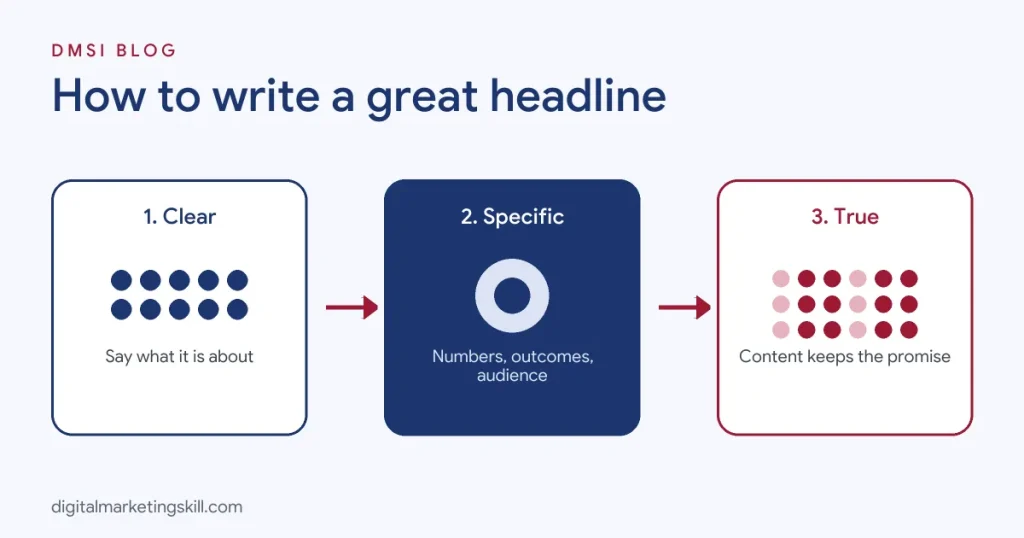
To write a strong headline, state the main benefit or idea clearly, make it specific, write for the person you want to reach and give them a reason to read now. The best headlines are concise, often around 6 to 12 words or about 50 to 60 characters for web pages and search results, use active verbs and concrete details such as numbers or outcomes, and honestly match what the content delivers. Proven formats include how-to headlines, numbered lists, questions, direct benefit statements and “without” headlines that remove an objection. Write several options, pick the clearest, and test headlines where you can, because small changes in wording can change how many people click, open or read.
This guide covers the principles of great headlines, the eight classic headline types, ready-to-use formulas with examples, how to adapt headlines for blogs, SEO, emails, ads, landing pages and social media, and how to test them. It is a companion to our guide on how to write a blog post.
Key Takeaways
- Advertising pioneer David Ogilvy wrote that, on average, five times as many people read the headline as read the body copy.
- Google’s guidance on title links recommends titles that are descriptive, concise and avoid keyword stuffing.
- Search results usually show around 50 to 60 characters of a title before cutting it off, so put key words first.
- Specific headlines with numbers, outcomes or timeframes usually outperform vague ones.
- Testing two or more headlines is the most reliable way to learn what your audience responds to.
In this guide
- What Most Headline Guides Miss
- Why Headlines Matter So Much
- The 7 Principles of a Great Headline
- The 8 Types of Headlines
- 15 Headline Formulas With Examples
- How to Write Headlines Step by Step
- Headlines for Different Channels
- How to Write News Headlines
- Headline Rewrites: Before and After
- How to Test Headlines
- Using AI to Brainstorm Headlines
- Headline Mistakes to Avoid
- Headline Checklist
- The One Rule for Headlines
- An Illustrative Case
- Frequently Asked Questions About Writing Headlines
- Your Next Step
What Most Headline Guides Miss
Many headline guides hand you a list of “power words” and templates. Templates help, but they can turn into clickbait or sound like everyone else. Three ideas matter more.
- Clarity beats cleverness. A clever pun that confuses readers loses to a plain headline that tells them exactly what they get. People scan quickly; they reward instant understanding.
- The best headline depends on where it appears. A blog title, a Google title tag, an email subject line and a Facebook ad headline each have different readers, lengths and goals. One headline rarely fits all.
- A headline is a promise. If the content does not deliver what the headline promises, readers leave quickly and trust drops. Great headlines are honest and specific, and the content lives up to them.
Why Headlines Matter So Much
The headline is often the only thing people read. In search results, social feeds and inboxes, readers decide in a second or two whether to click. David Ogilvy famously wrote that five times as many people read the headline as read the body copy, which means the headline does most of the selling.
Headlines affect:
- Click-through rate from search results, social posts and ads. See our glossary entry on click-through rate.
- Open rate for emails, where the subject line works as the headline.
- Engagement, because readers who click with clear expectations are more likely to keep reading.
- Sharing, since a clear, compelling headline makes content easier to pass on.
Headlines also matter more as search changes. When Google shows AI Overviews or other rich results, fewer people scroll through every link, so the titles that remain visible need to earn the click instantly. A clear, specific headline that matches the searcher’s question gives your page the best chance of standing out, whether it appears in a list of blue links, a news carousel, a social feed or an AI-generated summary that cites your content.
The 7 Principles of a Great Headline
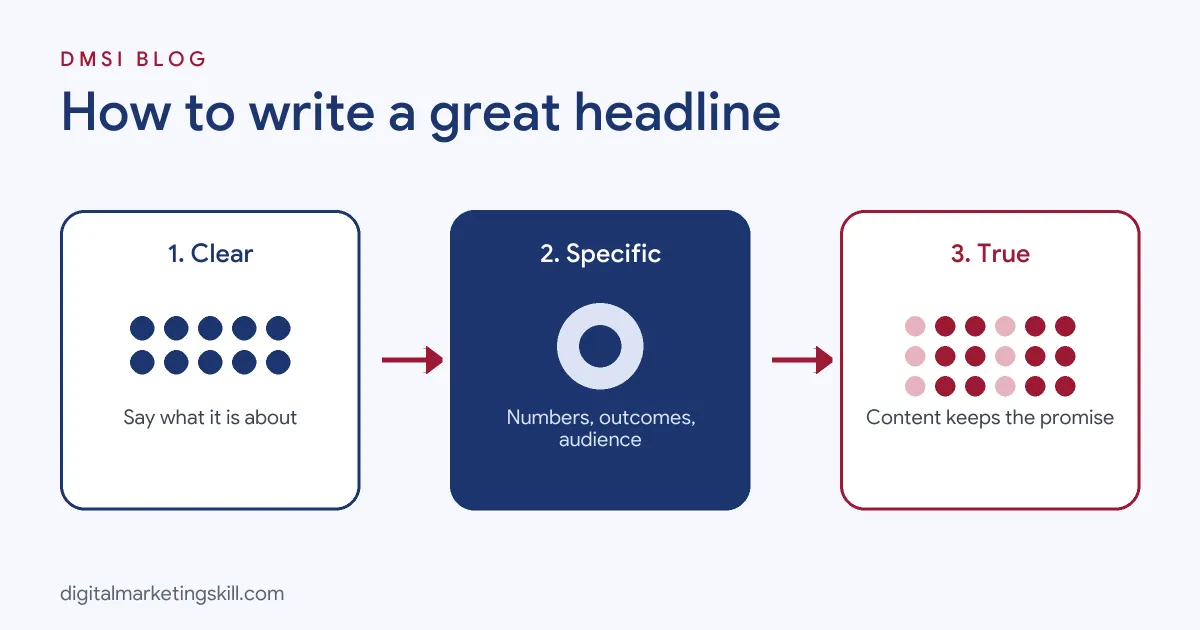
- Be clear. Readers should know what the content is about at a glance.
- Be specific. “How to Get Your First 100 Email Subscribers in 30 Days” beats “How to Grow Your Email List.”
- Lead with the benefit. Focus on what the reader gains, not what you did.
- Know your reader. Speak to their situation: “for beginners,” “for small businesses,” “without a degree.”
- Use active, vivid words. Verbs like “grow,” “save,” “fix,” “avoid” and “master” create momentum.
- Create a reason to read now. Curiosity, urgency, novelty or a surprising angle help, used honestly.
- Keep the promise. The content must deliver exactly what the headline suggests.
The 8 Types of Headlines
Copywriting teachers often group headlines into eight classic types. Knowing them gives you a range of options for every piece of content.
| Type | What it does | Example |
|---|---|---|
| Direct | States the offer or point plainly | “Free Social Media Templates for Small Businesses” |
| Indirect | Uses curiosity or a double meaning | “The Marketing Mistake Hiding in Your Inbox” |
| News | Announces something new | “Introducing Our New AI Course for Beginners” |
| How-to | Promises to teach a skill or solve a problem | “How to Write a LinkedIn Summary That Gets Interviews” |
| Question | Asks something the reader wants answered | “Is Your Website Losing Customers on Mobile?” |
| Command | Tells the reader what to do | “Stop Wasting Money on Ads That Don’t Convert” |
| Reason-why | Lists reasons or benefits | “7 Reasons Your Blog Isn’t Getting Traffic” |
| Testimonial | Uses a customer’s words or result | “”I Landed My First Remote Client in Six Weeks”” |
15 Headline Formulas With Examples
Use these formulas as starting points, then make them specific to your content and audience.
- How to [Achieve Result]: “How to Start a Blog That Makes Money”
- How to [Result] Without [Pain]: “How to Grow on Instagram Without Posting Every Day”
- [Number] Ways to [Result]: “11 Ways to Get More Website Traffic for Free”
- [Number] [Things] Every [Audience] Should Know: “9 SEO Basics Every Small Business Owner Should Know”
- The Complete Guide to [Topic]: “The Complete Guide to Email Marketing for Beginners”
- [Topic]: What It Is and How It Works: “Social Selling: What It Is and How It Works”
- [X] vs [Y]: Which Is Better for [Goal]?: “Canva vs Photoshop: Which Is Better for Social Media?”
- Why [Common Belief] Is Wrong: “Why Posting More Won’t Fix Your Engagement”
- [Number] Mistakes That [Bad Outcome]: “7 Blogging Mistakes That Kill Your Traffic”
- Get [Result] in [Timeframe]: “Build a Simple Website in One Weekend”
- The [Adjective] Way to [Result]: “The Easiest Way to Track Your Marketing Results”
- What [Expert/Group] Knows About [Topic]: “What Top Recruiters Look for in a Marketing CV”
- [Result] for [Specific Audience]: “Remote Marketing Jobs for Beginners in Nigeria”
- Question headline: “Are You Making These Email Subject Line Mistakes?”
- Case study headline: “How One Bakery Doubled Online Orders With Instagram Reels”
How to Write Headlines Step by Step
- Write the content first, or at least outline it. You can only write an honest headline once you know exactly what the content delivers.
- Define the reader and the main benefit. Finish the sentence: “This helps [reader] to [result].”
- Identify your keyword if the headline needs to rank in search. Put it near the start.
- Write at least ten options. Use different types and formulas. Your first idea is rarely your best.
- Add specifics. Swap vague words for numbers, timeframes, audiences and outcomes.
- Cut extra words. Remove filler such as “really,” “very” and “in order to.”
- Read it aloud and check the promise. Does the content fully deliver it? Would you click?
- Pick a winner and a backup to test where possible.
Headlines for Different Channels
The same piece of content often needs several headlines, each adapted to where it appears.
Blog Post Headlines
Blog headlines appear at the top of the article and often in social shares. They can be slightly longer and more descriptive, but should still be clear at a glance. Lists, how-tos and complete guides work well for blogs.
SEO Title Tags
Your title tag is the headline that appears in Google results. Google’s guidance on title links recommends titles that are descriptive and concise, unique for each page, and free of keyword stuffing. Because results typically show around 50 to 60 characters, put your main keyword and benefit first, and keep your brand name short or at the end. Your on-page headline and title tag can differ: the title tag is optimised for search, while the on-page headline can be more conversational.
Email Subject Lines
Subject lines are headlines for the inbox. Keep them short enough to read on a phone, make the benefit or curiosity clear and pair them with preview text that adds detail. Personalisation and specific benefits often help. See our glossary entry on subject lines and preheader text.
Ad Headlines
Ad headlines must work in tight character limits. Google’s responsive search ads let you write several short headlines that Google combines and tests automatically. Focus on the searcher’s intent, the main benefit and a reason to act, such as a free trial or fast delivery. For social ads, the first line of text and any text on the image act as headlines.
Landing Page Headlines
A landing page headline should instantly confirm that visitors are in the right place and state the core offer. Match the headline to the ad or link that brought them there, and support it with a subheading that adds detail.
Social Media Hooks
On social platforms, the first line of a caption or the first second of a video works as the headline. Strong hooks name the viewer, promise a result or challenge a belief, and they must work within the first glance.
| Channel | Typical length | Main goal |
|---|---|---|
| Blog headline | 6 to 14 words | Clarity and click from shares and search |
| SEO title tag | About 50 to 60 characters | Rank and earn the click in Google |
| Email subject line | Short enough for mobile | Earn the open |
| Search ad headline | Short, set by ad limits | Match intent and earn the click |
| Landing page headline | One clear sentence | Confirm the offer and keep visitors |
| Social hook | The first line or second | Stop the scroll |
How to Write News Headlines
News headlines follow slightly different rules from marketing headlines. Journalism guides recommend:
- Summarise the most important fact of the story.
- Use the present tense for recent events, such as “City Council Approves New Bus Routes.”
- Use active voice and strong verbs.
- Keep them accurate and avoid sensational wording.
- Leave out unnecessary words such as articles where your publication’s style allows.
Marketers can borrow these habits for company news and press releases, where accuracy and clarity matter more than curiosity.
Headline Rewrites: Before and After
Seeing weak headlines transformed is one of the fastest ways to learn. Here are ten rewrites, with the reason each improves.
| Before | After | Why it is better |
|---|---|---|
| Email Marketing Tips | 9 Email Marketing Tips That Boost Open Rates | Adds a number and a clear benefit |
| Our New Course | New: Learn Google Ads in 4 Weeks, Even as a Beginner | States what, how fast and for whom |
| Thoughts on SEO | Why Your Website Isn’t Ranking (and 5 Fixes) | Names a problem and promises solutions |
| Social Media Update | How We Grew Instagram Engagement by 40% in 60 Days | Specific result and timeframe |
| Freelancing Advice | How to Find Your First Freelance Client Without a Portfolio | Removes a common objection |
| Canva Guide | Canva for Beginners: Design Social Posts in 10 Minutes | Audience plus fast, concrete outcome |
| The Importance of Branding | 7 Branding Mistakes That Make Small Businesses Look Unprofessional | Turns an abstract topic into a practical list |
| Webinar Next Week | Free Webinar: Get More Leads From LinkedIn (Thursday, 6pm) | Benefit, cost and timing at a glance |
| Blogging Is Hard | Struggling to Blog Consistently? Try This Simple Weekly System | Speaks to the reader’s pain and offers a fix |
| About Remote Work | Remote Marketing Jobs: Where to Find Them and How to Get Hired | Matches what people search for and promises a full answer |
Notice the pattern. Each improved headline replaces a vague topic with a specific promise: a number, an outcome, a timeframe, an audience or a solution to a problem. None relies on tricks or exaggeration. They simply tell the right reader exactly why the content is worth their time.
Try this exercise with your own content: take your last five headlines, write three better versions of each using the formulas above, and ask a colleague or friend which one they would click. You will quickly develop an instinct for what works.
How to Test Headlines
Even experienced copywriters are surprised by which headlines win. Testing replaces guesswork with data.
- Email: most email platforms let you A/B test subject lines on a small share of your list, then send the winner to everyone else.
- Ads: run several headline variations and compare click-through and conversion rates.
- Landing pages: test headline variations with an A/B testing tool and compare conversions.
- SEO titles: if a page ranks well but gets few clicks, rewrite the title tag and compare click-through rate in Google Search Console over the following weeks.
- Social posts: share the same content with different hooks on different days and compare engagement.
Change one thing at a time and give each test enough impressions to be meaningful. Our guide to split testing explains the method.
Using AI to Brainstorm Headlines
AI tools are useful for generating many headline ideas quickly. Give the tool your topic, audience, main benefit and preferred tone, and ask for 20 options across different headline types. Then choose, combine and edit them. Watch for generic phrases and overpromises, which AI often produces. Our glossary entry on AI copywriting covers best practice.
Headline Mistakes to Avoid
- Clickbait. Misleading headlines may earn clicks but damage trust and increase bounce rates.
- Vagueness. “Some Thoughts on Marketing” gives no reason to click.
- Cleverness over clarity. Puns and wordplay that confuse readers lose them.
- Too long. Long headlines get cut off in search results and on mobile.
- Keyword stuffing. Repeating keywords makes headlines unreadable and can hurt search performance.
- Writing the headline last-minute. Give it as much attention as the content.
- One headline for everything. Adapt headlines for each channel.
Headline Checklist
- Is it immediately clear what the content is about?
- Does it state a specific benefit or outcome?
- Does it speak to a defined reader?
- Does it include the keyword near the start if it needs to rank?
- Is it concise enough for the channel?
- Does it use an active verb or concrete detail?
- Does the content fully deliver the promise?
- Have you written and compared at least ten options?
The One Rule for Headlines
Make a clear, specific promise, then keep it. A headline earns attention by telling the right reader exactly what they will gain. Content earns trust by delivering it. Get both right, and your headlines will work harder than any trick or template.
An Illustrative Case
Imagine an online course creator in London who publishes a free guide titled “Thoughts on Freelance Pricing.” It gets few clicks from her newsletter or social posts.
She writes 12 alternative headlines, then tests two in her email: “How to Price Your Freelance Services (With a Free Calculator)” and “Are You Undercharging? 5 Signs Your Freelance Rates Are Too Low.” The question headline earns a 22% higher open rate. For the blog page, she uses the clearer how-to version as the title tag because it matches what people search for.
Within two months, the page starts ranking for freelance pricing searches, and newsletter clicks to the guide more than double. The content did not change. The promise in front of it did.
This example is illustrative, not a real person, but it shows how headline testing changes results.
Frequently Asked Questions About Writing Headlines
What makes a good headline?
A good headline is clear, specific, focused on the reader’s benefit, concise for its channel and honest about what the content delivers.
What are the 8 types of headlines?
Direct, indirect, news, how-to, question, command, reason-why and testimonial headlines. Each suits different goals and audiences.
How long should a headline be?
For web pages and search results, around 50 to 60 characters is a common guide. Blog headlines can be a little longer, while email and ad headlines are usually shorter.
What is an article headline?
It is the title at the top of an article that tells readers what it is about and persuades them to read it.
How do you write a catchy headline?
Lead with a clear benefit, add a specific detail such as a number or timeframe, use active verbs and create honest curiosity. Write many options and choose the clearest.
Should headlines include numbers?
Numbers often help because they signal specific, scannable content, especially for list posts. Use them when they reflect real structure in your content.
What is the difference between a headline and a title tag?
The headline appears on the page. The title tag appears in search results and browser tabs. They can be the same or adapted, with the title tag optimised for search.
How do I write a headline for SEO?
Put your main keyword near the start, keep it descriptive and concise, make each page’s title unique and avoid repeating keywords.
How do you write a news headline?
Summarise the key fact accurately in active voice and present tense, using strong verbs and as few words as possible.
Can AI write good headlines?
AI is great for brainstorming many options quickly. Edit its suggestions for clarity, accuracy and your brand voice, and avoid exaggerated claims.
Your Next Step
Writing headlines that earn clicks is a core skill in copywriting, SEO, email marketing and advertising. The Master Diploma in Digital & AI Marketing at Digital Marketing Skill Institute covers four tracks: AI-powered Social Media Management and Advertising, Lead Generation and Email Automation, Google, and WordPress and SEO.
From day one, you work on a real U.S. company’s project through the U.S. Project Internship, so you finish with real results and a verified U.S. work reference letter. You also get unlimited one-on-one coaching. The program carries dual US and UK accreditation, is recognised in more than 100 countries, and runs 100% online over three months.
You can build those skills wherever you live, anywhere in your country. Read student reviews, then apply for the 65% partial scholarship to see if you qualify.
Every claim in this guide was checked against its source before publication: Google Search Central guidance on title links and David Ogilvy’s Confessions of an Advertising Man. The case above is an illustrative example, not a real result.