Continuing professional development (CPD) is the ongoing learning you do after your first qualification to keep your skills current and improve how you work. For marketers, CPD covers courses and certificates, but also conferences, webinars, reading, mentoring and learning on real projects. The Chartered Institute of Marketing (CIM) expects Chartered Marketers to complete 35 hours of CPD a year. Even if no body requires it, CPD matters because marketing tools change so fast: the World Economic Forum expects 39% of workers’ core skills to change by 2030.
This guide explains what counts as CPD, how much you need, how to plan and record it and how to earn it for free or cheaply. If you are deciding where to start, our guide to in-demand digital marketing skills shows which skills employers ask for most.
Key Takeaways
- The CIPD defines CPD as learning experiences that help you develop and improve your professional practice, not only formal courses.
- The CIM asks Chartered Marketers, and those working towards chartered status, to complete 35 hours of CPD a year, with short reflections on each activity.
- The CIPD recommends about 30 hours a year of planned learning, plus learning in the flow of work.
- The World Economic Forum’s Future of Jobs Report expects 39% of workers’ existing skills to be transformed or outdated by 2030.
- The same report estimates that 59 in every 100 workers will need training by 2030.
In this guide
- What Most Advice on CPD Misses
- How CPD Works: The Cycle
- What Counts as CPD for Marketers
- How Many CPD Hours Do Marketers Need?
- How to Build a CPD Plan in Seven Steps
- How to Record Your CPD
- Free and Low-Cost Ways to Earn CPD
- CPD Ideas by Marketing Role
- Common CPD Mistakes
- How to Measure the Impact of Your CPD
- The One Rule for CPD
- An Illustrative Case
- Frequently Asked Questions About Continuing Professional Development
- Your Next Step
What Most Advice on CPD Misses
Most people think of CPD as collecting certificates. That is part of it, but it misses the point. Professional bodies care less about how many hours you sat through and more about what changed in your work as a result. That is why the CIM asks for a short reflection on each activity, and why the CIPD stresses the impact of learning.
The second thing advice often misses is that the most valuable CPD is often unplanned. Fixing a broken tracking setup, running your first A/B test or getting feedback on a campaign can teach more than a week of videos. The trick is to notice that learning and record it.
Finally, CPD is not only for people in formal membership schemes. Freelancers and job seekers benefit just as much, because a clear record of recent learning makes a strong story for clients and employers.
How CPD Works: The Cycle
Most professional bodies describe CPD as a cycle with four stages.
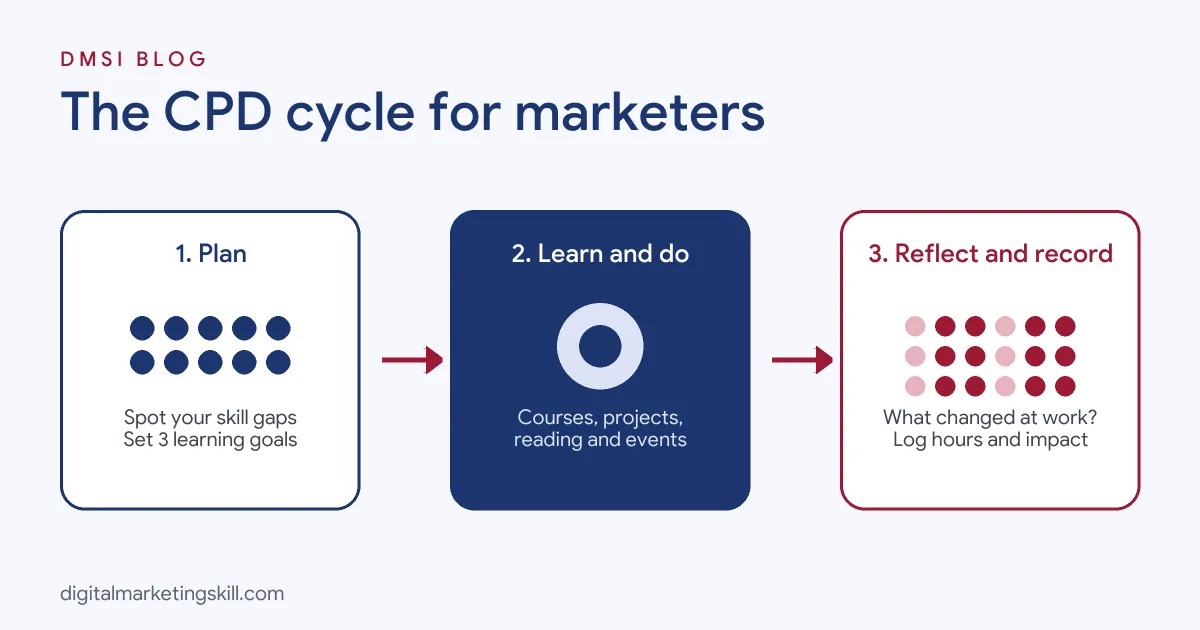
- Identify: look at your role and goals, and spot gaps in your skills.
- Plan: choose what to learn and how, with a rough timetable.
- Act: do the learning, and apply it to real work as soon as you can.
- Reflect: write down what you learned, how you used it and what you will do next.
Then the cycle starts again. The CIPD recommends that CPD combines planned learning, where you choose a development need, with unplanned learning that happens in the flow of work.
What Counts as CPD for Marketers
Almost any learning that improves your professional practice can count. Here are the main types, grouped the way professional bodies usually describe them.
Formal Learning: Built for Structured Skills
Qualifications, diplomas, short courses, e-learning, conferences and seminars. These often count in full towards annual targets.
Learning on the Job: Built for Real Results
Taking on a new channel, leading a campaign, running experiments or learning a new tool at work. Record what you learned, not just what you did.
Self-Directed Learning: Built for Staying Current
Reading industry reports, listening to podcasts, following platform updates and studying competitors’ campaigns. Many bodies cap how much of this counts, so balance it with other types.
Learning From Others: Built for Perspective
Mentoring, being mentored, peer reviews and professional networking groups. Teaching others is also a strong way to deepen your own understanding.
Giving Back: Built for Breadth
Volunteering your marketing skills for a charity or community group, writing articles or speaking at events.
How Many CPD Hours Do Marketers Need?
| Body | Expectation | Notes |
|---|---|---|
| Chartered Institute of Marketing (CIM) | 35 hours a year | Required for Chartered Marketers and those working towards chartered status, with reflections |
| Institute of Data and Marketing (IDM) | 35 hours a year | For members who want formal CPD recognition |
| Institute of Sales Management (ISM) | At least 20 hours recommended | Voluntary for members |
| CIPD (HR and L&D) | About 30 hours of planned learning | Useful benchmark even outside HR |
There is no single legal requirement for CPD in marketing. However, 35 hours a year, roughly 40 minutes a week, is a sensible target for any marketer who wants to stay current.
How to Build a CPD Plan in Seven Steps
- Write down your goal. For example, “get my first remote paid social role” or “move from executive to manager”.
- List the skills the goal needs. Read five job adverts for the role you want and note the skills that come up most.
- Rate yourself honestly. Score each skill from one to five, with evidence.
- Pick three priorities. Choose the gaps that matter most for your goal, not everything at once.
- Choose a learning method for each. A course for the basics, a project to practise and a mentor or community for feedback.
- Book the time. Put learning sessions in your calendar, for example two 30-minute slots a week.
- Review every quarter. Check progress, record what changed and adjust the plan.
Writing SMART objectives for your learning helps. “Run and report on one Google Ads campaign by March” is easier to act on than “learn Google Ads”.
How to Record Your CPD
If you belong to a body such as the CIM, use its online portal. If not, a simple spreadsheet works. For each activity, record:
- Date and activity: for example, “Google Analytics 4 course, module 3”.
- Type: formal, on the job, self-directed, from others or giving back.
- Hours: the time spent.
- What you learned: one or two sentences.
- How you applied it: the change in your work.
- Evidence: a certificate, a link to work or a short report.
A good reflection is short and specific. For example: “Learned how to set up conversion tracking in GA4. Used it to fix our sign-up tracking, which showed that LinkedIn drives twice as many sign-ups as we thought. Next, I will learn to build a simple dashboard.”
Keep this log up to date as you go. Trying to remember a year of learning in one evening is hard, and the reflections are much weaker.
Free and Low-Cost Ways to Earn CPD
- Platform academies: Google Skillshop and Meta Blueprint offer free training on their own ad tools.
- Webinars: many software companies and professional bodies run free sessions.
- Industry reports: annual reports from platforms and research firms are free and keep you up to date.
- Side projects: run a small campaign for a local business or charity and write up what you learned.
- Communities: online groups and local meetups for marketers offer feedback and new ideas.
- Teaching: explain a topic in a blog post or a short video. Teaching shows you where your understanding is thin.
You can also browse our free resources, and our digital marketing glossary for quick definitions as you learn.
CPD Ideas by Marketing Role
The right CPD depends on where you are now and where you want to go. Here are starting ideas for common roles.
| Role | Skills worth building | A practical CPD project |
|---|---|---|
| Beginner or career changer | Marketing basics, one channel, analytics | Run a small campaign for a friend’s business and report results |
| Social media manager | Short-form video, paid social, reporting | Test three Reels formats for a month and compare reach |
| SEO or content marketer | Search for AI answers, technical SEO, data | Audit and update ten old articles, then track rankings |
| PPC specialist | Automated bidding, conversion tracking, scripts | Set up and document server-side conversion tracking |
| Email marketer | Automation, segmentation, deliverability | Build a five-email welcome sequence and A/B test the first email |
| Freelancer | Sales, proposals, client reporting | Create a reporting template and use it with every client |
Whatever your role, include at least one AI skill in your plan. The World Economic Forum lists AI and big data among the fastest-growing skills, and most marketing tools now include AI features. Learning to brief AI tools well, check their output and use them to speed up reporting are all useful, practical CPD goals.
Common CPD Mistakes
Collecting Certificates Without Applying Them
A certificate shows you finished a course. Applying the skill is what improves your work and convinces employers.
Learning Everything at Once
Spreading time across ten topics leaves you shallow in all of them. Focus on three.
Not Recording Learning on the Job
Some of your best learning happens while working. If you do not log it, you lose the evidence.
Skipping Reflection
Without reflection, you repeat the same mistakes. A few lines after each activity makes the learning stick.
Leaving It Until the Deadline
Cramming hours at the end of the year turns CPD into a chore and weakens the record.
How to Measure the Impact of Your CPD
Hours tell you effort. Impact tells you value. Ask these questions every quarter:
- What can I do now that I could not do before?
- Which work results improved? For example, a lower cost per lead or a faster report.
- What new responsibilities have I taken on?
- What do clients or managers say has changed?
- Is my portfolio stronger? Add new projects as you complete them.
Turn the best examples into short case studies for your portfolio and LinkedIn profile. That is where CPD starts paying back in job offers and client work.
The One Rule for CPD
Learn something, use it at work, then write down what changed. If every CPD activity follows those three steps, you will meet any hours target easily, and more importantly you will become visibly better at your job.
An Illustrative Case
Imagine a marketing assistant in Manchester who wants to become a paid social specialist within a year. She reads ten job adverts and notices three skills keep coming up: Meta Ads Manager, reporting in Google Analytics and short-form video.
She builds a simple plan: a free Meta Blueprint course in the first quarter, a GA4 course in the second and a video editing project in the third. She asks her manager to let her run a small paid social test for one product line. She records each activity in a spreadsheet with a short reflection on what changed.
By the end of the year she has logged more than 35 hours, run three campaigns and written two short case studies. In her next review she uses them to make the case for a specialist role. This case is an illustrative example, not a real result.
Frequently Asked Questions About Continuing Professional Development
What does CPD stand for?
Continuing professional development. It means the ongoing learning you do to keep your skills current and improve your work.
What counts as CPD?
Courses, qualifications, conferences, webinars, reading, mentoring, learning on the job and volunteering can all count, as long as they improve your practice.
How many CPD hours do marketers need?
The CIM asks Chartered Marketers for 35 hours a year. If no body requires it, 35 hours is still a sensible target.
Is CPD mandatory for marketers?
Not by law. It is required for some memberships and chartered status, and many employers expect it as part of performance reviews.
Can free courses count as CPD?
Yes, if they improve your professional practice and you record what you learned and how you used it.
How do I record CPD?
Use your professional body’s portal or a spreadsheet with the date, activity, hours, what you learned, how you applied it and evidence.
What is the difference between CPD and training?
Training is one type of CPD. CPD is broader and includes self-directed reading, learning on the job and reflection.
Does CPD help me get a job?
It can. A clear record of recent learning and the projects it led to shows employers you keep your skills up to date.
How often should I review my CPD plan?
Every three months is a good rhythm. It is often enough to stay on track and adjust as your goals change.
Can I count my job as CPD?
Your normal daily tasks usually do not count on their own. What counts is new learning at work, such as taking on an unfamiliar channel, running a first experiment or learning a new tool, especially when you reflect on what you learned and how it changed your results.
Your Next Step
If your CPD plan includes building practical digital marketing skills with real project results, the Master Diploma in Digital & AI Marketing at Digital Marketing Skill Institute covers four tracks: Social Media Management and Advertising, Lead Generation and Email Automation, Google, and WordPress and SEO.
From day one, you work on a real U.S. company’s project through the U.S. Project Internship, so you finish with real results and a verified U.S. work reference letter. You also get unlimited one-on-one coaching. The program carries dual US and UK accreditation, is recognised in more than 100 countries, and runs 100% online over three months.
You can build those skills wherever you live, anywhere in your country. Read student reviews, then apply for the 65% partial scholarship to see if you qualify.
Every figure in this guide was checked against its source before publication: the Chartered Institute of Marketing, the CIPD, CPD UK and the CPD Standards Office, and the World Economic Forum’s Future of Jobs Report. CPD rules can change, so check your professional body’s current requirements. The case above is an illustrative example, not a real result.