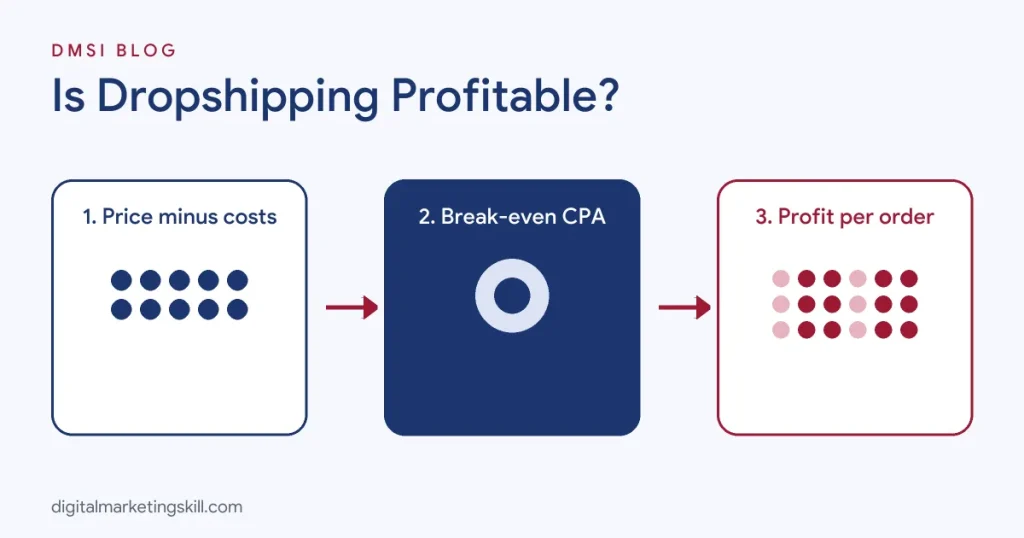
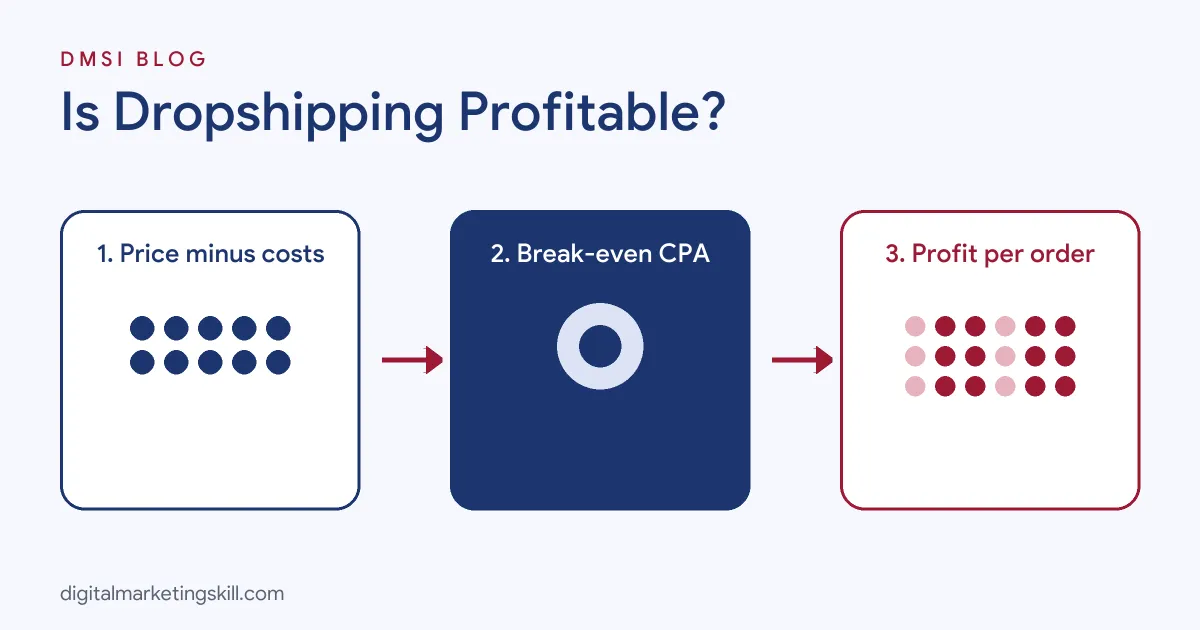
Yes, dropshipping can be profitable, but many stores never make money. The difference comes down to unit economics: what is left from each sale after product cost, shipping, fees, returns and, above all, the cost of getting each customer. A product with a healthy-looking markup can still lose money once advertising is counted. This guide shows realistic margins, a worked profit calculation, a break-even formula you can run before you spend, the costs that eat profit, and the practical changes that make a dropshipping store more likely to earn rather than burn cash.
Key Takeaways
- Printful puts realistic dropshipping net margins at 10% to 30% after product costs, shipping, platform fees and advertising, with beginners typically under 15%.
- Wix gives an average dropshipping profit margin range of 20% to 30%, while Syncost stresses that gross margin and net margin are very different numbers.
- Customer acquisition cost, mostly paid advertising, is the cost that most often turns a profitable-looking product into a loss.
- Your break-even cost per acquisition is the profit per order before ads; if ads cost more than that per sale, you lose money on every order.
- Tax and import rules matter: the UK collects VAT at the point of sale on most imported goods up to £135, and the EU’s IOSS scheme covers low-value imports up to €150.
- The Short Answer
- Gross Margin vs Net Margin
- A Worked Profit Example
- What Eats Dropshipping Profit
- The Break-Even Calculation
- Three Scenarios
- Which Models Are Most Profitable?
- How to Improve Profitability
- FAQ
The Short Answer: Is Dropshipping Profitable?
Dropshipping is a way of selling where you list products in your own online store or on a marketplace, take the customer’s payment and then pass the order to a supplier who ships it directly to the customer. You never hold stock. That makes it cheap to start, which is why it is so popular, and also why it is so competitive. If you want the full picture of how the model works, read our guide to starting a dropshipping business.
Profitability is possible because you set the selling price and only pay the supplier after a customer has paid you. It is difficult because you usually have to pay to attract each customer, you compete with many sellers offering similar products, and you depend on suppliers for quality and delivery speed. A store is profitable only when the money left after every cost, including advertising and refunds, is positive and large enough to be worth your time.
So the honest answer is: dropshipping is not automatically profitable or unprofitable. It is a business model with thin margins that rewards careful product choice, good marketing skills and strict attention to numbers. Anyone promising guaranteed income from dropshipping is selling something other than the truth.
What Most “Is Dropshipping Profitable” Guides Miss
Many articles quote margin ranges and income figures without showing how to work out your own. A margin figure from someone else’s store tells you very little about yours, because your product, price, supplier, ad costs and country all differ. Three points get less attention than they deserve:
- Profit is decided per order, not per month. If each order loses money after ads, more sales only means bigger losses.
- Revenue screenshots are not profit. A store showing large monthly sales can still be losing money once ad spend, refunds and fees are counted.
- Taxes, duties and consumer law affect margins. Rules on VAT, import duties and refunds change what you keep, especially when selling across borders.
Gross Margin vs Net Margin
Two margin figures matter, and confusing them is one of the most common reasons new sellers think they are making money when they are not.
Gross margin
Gross margin is the selling price minus the cost of the product and its delivery, shown as a percentage of the selling price. If you sell a product for $40 and the supplier charges $12 plus $5 shipping, your gross profit is $23 and your gross margin is 57.5%. That looks healthy, and it is the number many beginners focus on.
Net margin
Net margin is what is left after every cost: product, shipping, payment processing, platform subscriptions, apps, refunds, chargebacks, advertising and taxes. Syncost describes net margin as the real number, because it is the money you actually keep. Printful’s realistic net range of 10% to 30% shows how much is lost between gross and net. On a $40 sale, a 10% net margin means you keep $4.
Contribution margin sits between the two: it is the profit per order after all variable costs except advertising. It is the most useful number for deciding how much you can afford to pay for a customer, as the worked example below shows.
A Worked Dropshipping Profit Example
Here is a simple calculation for a single product. The figures are illustrative to show the method, not a forecast for any real store. Replace them with your own supplier quotes, fees and ad results.
| Item | Amount per order |
|---|---|
| Selling price | $40.00 |
| Product cost from supplier | -$12.00 |
| Shipping to customer | -$5.00 |
| Payment processing (about 3% plus a fixed fee) | -$1.50 |
| Platform and app costs spread per order | -$1.00 |
| Allowance for refunds and returns (3% of price) | -$1.20 |
| Contribution before advertising | $19.30 (48%) |
| Advertising cost per order (cost per acquisition) | -$15.00 |
| Profit per order | $4.30 (about 11%) |
A 57.5% gross margin has become an 11% net margin. If the advertising cost per order rises from $15 to $20, the store loses $0.70 on every sale. That is how a store with growing sales can still run out of money. It also shows why small improvements matter: lowering the cost per order by a few dollars, raising the average order value with a bundle or reducing refunds can change the result completely.
What Eats Dropshipping Profit
The selling price minus the supplier price is only the start. These are the costs that reduce what you keep, roughly in order of how much damage they usually do.
1. Customer acquisition cost
Customer acquisition cost is the total marketing spend divided by the number of new customers it brings. For most dropshipping stores this is mainly paid social and search advertising, and Syncost explains why paid ads are almost mandatory for many stores: a new store has no audience, no search rankings and no repeat customers. Ad costs rise as more sellers compete for the same audiences, and a winning ad often stops working once many people have seen it. This single cost decides whether most stores are profitable.
2. Product and supplier costs
Cheap supplier prices look attractive, but the cheapest supplier is not always the most profitable. Slow shipping, poor quality and inaccurate product descriptions lead to refunds, complaints and chargebacks, which cost far more than a slightly higher unit price. Supplier prices also change, so a product that is profitable today can become unprofitable without warning.
3. Shipping
Free shipping is popular with customers, but it is never free for you. Its cost has to be built into the selling price. Faster shipping from suppliers with warehouses closer to your customers usually costs more per order but tends to reduce refunds and complaints and can improve your conversion rate.
4. Payment processing and platform fees
Store platforms charge monthly subscriptions, payment providers charge a percentage and often a fixed fee per transaction, and marketplaces take a commission. Apps for reviews, upsells, product sourcing and email add more monthly costs. Individually these look small; together they can take several percentage points of revenue.
5. Refunds, returns and chargebacks
When a product arrives late, damaged or not as described, customers ask for refunds. You may refund the customer but not recover the money from the supplier, especially if returning the item costs more than it is worth. Chargebacks, where a customer disputes a payment through their bank, can add fees and, if they happen often, put your payment account at risk.
6. Taxes and import duties
Selling across borders brings tax obligations that many beginners overlook. In the UK, VAT on most imported goods worth up to £135 is collected at the point of sale, so overseas sellers selling to UK customers may need to register for and account for UK VAT. In the EU, the Import One-Stop Shop (IOSS) lets sellers collect and pay VAT on low-value imports up to €150. In the United States, duty-free de minimis treatment for most low-value imports was suspended in 2025, which raised costs for many sellers shipping from overseas. These rules change, so check the current position with official sources or an accountant for the countries you sell to.
7. Your time
A store that makes a small profit but takes 40 hours a week of customer service, product research and ad testing may pay less than a regular job. Count your hours when you judge whether dropshipping is worth it.
The Break-Even Calculation to Run Before You Spend
Before spending on ads, work out the most you can afford to pay for each sale. This takes five minutes and prevents many expensive mistakes.
- Find your contribution before ads: selling price minus product cost, shipping, payment fees, app and platform costs per order and a refund allowance. In the example above, that is $19.30.
- That figure is your break-even cost per acquisition. If each sale costs less than $19.30 in advertising, you make a profit; if it costs more, you lose money.
- Work out break-even ROAS: divide the selling price by the contribution before ads. Here, $40 divided by $19.30 is about 2.07. Your ads need to return at least $2.07 in revenue for every $1 spent just to break even.
- Set a target, not just a break-even point. Decide what profit per order you want and subtract it from the contribution to get your target cost per acquisition.
- Test with a fixed budget. Decide in advance how much you will spend testing a product and what result means stop.
Return on ad spend, often shortened to ROAS, is revenue from ads divided by ad spend. Platforms report it, but their attribution can differ from what your store records, so compare platform figures with your actual orders and bank balance.
Three Illustrative Scenarios
These scenarios show how the same model produces very different outcomes. They are illustrative examples and not real stores or income predictions.
Scenario A: a generic low-priced product with paid ads
A seller picks a trending gadget priced at $19.99 with a $6 supplier cost and $4 shipping. After fees and refunds, contribution before ads is about $8. Competing sellers run near-identical ads, and the cost per sale settles around $10. Every order loses money. The seller sees revenue rising and assumes the store is working until the card statement arrives. This is the most common pattern behind the claim that dropshipping does not work.
Scenario B: a focused niche store with organic content
A seller who knows a hobby well builds a small store around accessories for that hobby, writes helpful guides, posts short videos and builds an email list. Sales grow slowly, but many customers come from search, social content and repeat purchases, so the average acquisition cost stays low. Profit per order is modest, but positive, and the store builds an audience it owns. The trade-off is time: results usually take months rather than weeks.
Scenario C: a branded store with repeat customers
A seller moves from generic products to a narrower range with better suppliers, faster shipping, branded packaging and a clear brand story. Prices are higher because customers trust the store, and repeat buyers make the original acquisition cost worth paying. Over time, this seller may move part of the range to private label or hold some stock for faster delivery. At this point the business is less pure dropshipping and more a normal e-commerce brand.
Which Dropshipping Models Are Most Profitable?
Wix groups dropshipping into low-ticket, high-ticket and private-label models. Print on demand is a close relative worth comparing. Each has a different profit profile.
| Model | How it makes money | Profit strengths | Profit risks |
|---|---|---|---|
| Low-ticket dropshipping | Many sales of cheap products | Easy impulse purchases, simple to test | Small profit per order leaves little room for ad costs; heavy competition |
| High-ticket dropshipping | Fewer sales of expensive products | More dollars of profit per sale to cover acquisition costs | Longer buying decisions, higher expectations for service, costly returns |
| Private-label dropshipping | Supplier products sold under your brand | Less direct price comparison, stronger brand loyalty | Minimum orders or setup costs, more responsibility for quality |
| Print on demand | Your designs printed on products when ordered | Unique products, no stock, easier to stand out | Higher unit costs mean thinner margins unless designs command higher prices |
For many beginners, the most important factor is not the model but the gap between contribution per order and acquisition cost. Products with a higher selling price often leave more room for marketing, which is why many experienced sellers prefer mid or high priced products over very cheap ones. If you are thinking of building a branded store rather than a pure dropshipping store, our guide to starting an online boutique compares dropshipping with holding your own stock.
Why Many Dropshipping Stores Are Not Profitable
There is no reliable official data on how many dropshipping stores fail, and figures quoted online are often repeated without a clear source. What is clear from sellers and platforms is the set of reasons stores struggle:
- Selling the same products as everyone else. When many stores sell an identical item, customers compare prices and the cheapest seller wins, squeezing margins.
- Underpricing. Beginners often price too low to compete and leave no room for advertising.
- Not knowing the numbers. Without a break-even calculation, it is impossible to know whether ads are working.
- Weak marketing skills. Product choice matters, but creative ads, landing pages, offers and email follow-up decide whether customers buy.
- Poor supplier experience. Long delivery times and quality problems lead to refunds, bad reviews and account problems.
- Giving up or scaling too early. Some sellers quit before learning enough; others increase ad budgets before the product is reliably profitable.
How to Make Dropshipping More Profitable
Printful lists choosing high-margin products, building a brand, reducing reliance on ads through SEO, streamlining operations, focusing on retention and using technology as ways to improve margins. Here is how to apply those ideas in practice.
Choose products with room for marketing
Look for products where the contribution before ads is large enough to pay a realistic acquisition cost. Products that solve a specific problem, suit a clear audience and are hard to compare directly on price are usually easier to sell at a healthy margin than generic trending items.
Raise the average order value
Bundles, multi-packs, complementary add-ons and free shipping thresholds increase the average order value. Because acquisition cost is paid per customer, not per item, a higher order value spreads that cost over more revenue.
Build a brand customers trust
A clear brand, honest product pages, real photos, clear delivery times and an easy returns policy let you charge more than anonymous stores and reduce refunds. Trust also improves conversion rates, which lowers the cost per sale from the same ad spend.
Reduce dependence on paid ads
Organic channels take longer to build but cost less per customer over time. Helpful content and search optimisation, short-form video, partnerships with creators and marketplace listings can all bring customers without paying for every click. Syncost highlights the organic route as an alternative for sellers who cannot afford high acquisition costs.
Earn repeat purchases
Selling again to an existing customer costs far less than finding a new one. Email marketing, post-purchase offers and products people buy regularly increase customer lifetime value, which lets you spend more to win the first sale. Retargeting ads can bring back visitors who did not buy the first time, though they should be measured against the same break-even numbers.
Choose suppliers for reliability, not only price
Order samples, test delivery times to your main markets and ask about quality control and returns. Suppliers with local warehouses often cost more but reduce delivery problems. Keep a backup supplier for your best-selling products.
Use tools carefully
Automation tools for order routing, inventory syncing, reviews and email can save time, but each subscription reduces margin. Our guide to dropshipping tools explains which jobs are worth paying for. Review your app costs every few months and cancel what you do not use.
Track profit weekly
Record revenue, product and shipping costs, fees, ad spend and refunds each week. A simple spreadsheet is enough. Profit per order, cost per acquisition and refund rate tell you more than total revenue ever will.
How Long Does It Take for Dropshipping to Become Profitable?
There is no standard timeline. Some sellers find a profitable product quickly; many test several products over months without success; some never reach profit. Printful notes that beginners typically earn modest amounts at first. Expect to spend time and money learning, set a budget you can afford to lose and judge progress by improving numbers, such as falling acquisition cost and rising profit per order, rather than by early revenue.
Is Dropshipping Profitable for Beginners?
It can be, but beginners face the steepest learning curve. They usually lack marketing experience, audience and supplier relationships, and they are most likely to choose crowded products. Beginners who treat the first few months as paid learning, start with a small test budget, learn the numbers and build marketing skills give themselves a much better chance. Many of the skills involved, such as paid advertising, copywriting, analytics and email marketing, are also valuable in other careers, so even an unsuccessful store can teach something useful.
Common Mistakes
- Judging success by revenue. Revenue minus all costs is what matters.
- Ignoring the break-even cost per acquisition. Without it, you cannot tell good ad results from bad ones.
- Choosing the cheapest supplier by default. Refunds and complaints can cost more than the savings.
- Forgetting taxes and duties. Cross-border VAT and import rules can turn a profit into a loss or a legal problem.
- Scaling ad spend too fast. Costs per sale often rise as budgets grow, so scale gradually and recheck profit.
- Believing income screenshots. Revenue images rarely show ad spend, refunds or fees.
- Making unrealistic claims to customers. Misleading delivery times or product claims break consumer law and platform rules.
One Rule to Remember
Know your profit per order before ads and never pay more than that to acquire a customer: if the numbers do not work on one order, they will not work on a thousand.
Example: a new seller plans to sell a posture support product for $35. After supplier cost, shipping, fees and a refund allowance, contribution before ads is $14. The first week of ads costs $22 per sale, so the seller pauses, improves the product page, adds a two-pack offer that raises average order value to $52 and tests a new video ad. The second week’s cost per sale is $18 against a new contribution of $22, giving a small profit per order. The seller decides to keep testing carefully before increasing spend. This example is illustrative and not a real business.
Why These Skills Matter for Your Career
Whether or not you run a store, the skills that make dropshipping profitable are core digital marketing skills: understanding unit economics, running paid ads against a target cost per acquisition, writing persuasive product pages, building email flows and analysing results. Employers and e-commerce clients worldwide look for marketers who can connect ad spend to profit. If you are in your country, building these skills can open doors to e-commerce marketing roles, freelance work with online stores or a more informed start to your own business.
Frequently Asked Questions
Is dropshipping still profitable?
It can be. Competition and advertising costs are high, so generic stores built on trending products often struggle, while stores with focused niches, reliable suppliers, strong marketing and repeat customers have a better chance of making a profit.
What is a good profit margin for dropshipping?
Printful describes 10% to 30% net as realistic after all costs including advertising, and Wix gives 20% to 30% as an average range. Your own margin depends on your product, pricing and acquisition cost, so calculate it rather than relying on averages.
How much can an average dropshipper make?
There is no reliable average because results vary widely and many stores make nothing or lose money. Printful notes that most beginners earn modestly at first. Treat any specific income promise with suspicion.
Is $1,000 enough to start dropshipping?
It can cover a store subscription, product samples, basic apps and a small ad test, but it does not leave much room for repeated testing. Decide in advance how you will split the budget and when you will stop a test that is not working.
Can you dropship without paid ads?
Yes, through organic social media, content and search, marketplaces, creator partnerships and email. Organic growth is cheaper per customer but slower, and it requires consistent content and marketing effort.
Why do most dropshipping stores fail?
Common reasons include selling the same products as many competitors, pricing too low, paying more for each customer than the profit per order, poor supplier quality and slow delivery, and stopping before learning enough or scaling too soon.
Is dropshipping legal?
Dropshipping is a legal business model in most countries, but you must follow consumer protection law, platform rules, advertising standards, tax rules and intellectual property law. Selling counterfeit or misleadingly described products is illegal.
Do I need to pay tax on dropshipping income?
In most countries, yes. You may also need to collect VAT or sales tax for the places you sell to. Rules vary, so check official guidance or speak to an accountant.
Is high-ticket dropshipping more profitable?
High-ticket products can leave more profit per sale to cover marketing, but they usually need more trust, better customer service and longer sales cycles. They are not automatically easier.
Is print on demand more profitable than dropshipping?
Not necessarily. Print on demand lets you sell unique designs, which helps you stand out, but unit costs are often higher. Profit depends on whether your designs and audience let you charge enough to cover costs and marketing.
How do I know if my store is profitable?
Track every cost each week, including ad spend, fees, refunds and apps, and compare it with revenue. Calculate profit per order and compare your cost per acquisition with your break-even figure.
Your Next Step
Learn the marketing and analytics skills behind profitable online stores. The Master Diploma in Digital & AI Marketing at Digital Marketing Skill Institute covers AI-powered Social Media Management and Advertising, Lead Generation and Email Automation, Google, and a WordPress and SEO track where you build and rank a real website.
From day one, you work on a real U.S. company’s project through the U.S. Project Internship, so you finish with real results and a verified U.S. work reference letter. You also get unlimited one-on-one coaching. The program carries dual US and UK accreditation, is recognised in more than 100 countries, and runs 100% online over three months.
You can build those skills wherever you live, anywhere in your country. Read student reviews, then apply for the 65% partial scholarship to see if you qualify.
Sources checked November 2026: Printful: How profitable is dropshipping, Wix: Is dropshipping worth it, Syncost: Is dropshipping profitable, GOV.UK: VAT and overseas goods sold to customers in the UK, European Commission: Import One-Stop Shop. We have no connection with these companies.