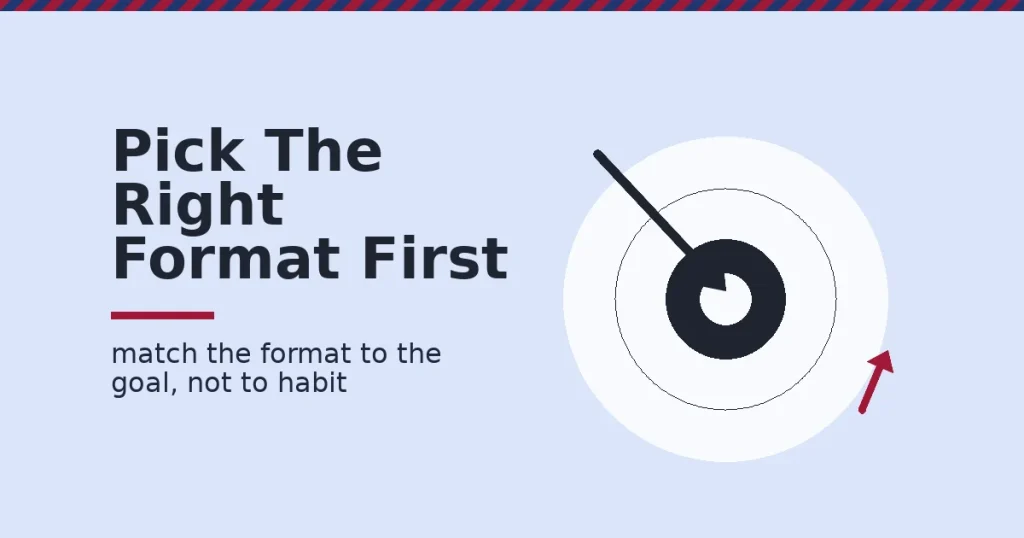
Most Instagram marketing strategy advice is a list of tactics with no order. This guide ranks them. Pick the right format for the goal first. Structure the post around that format second. Measure the right number third. Hashtags and filters come last.
Key Takeaways
- Instagram ads now reach 1.99 billion people a month worldwide. 54.6% of adult internet users say they used the platform in the past month (DataReportal).
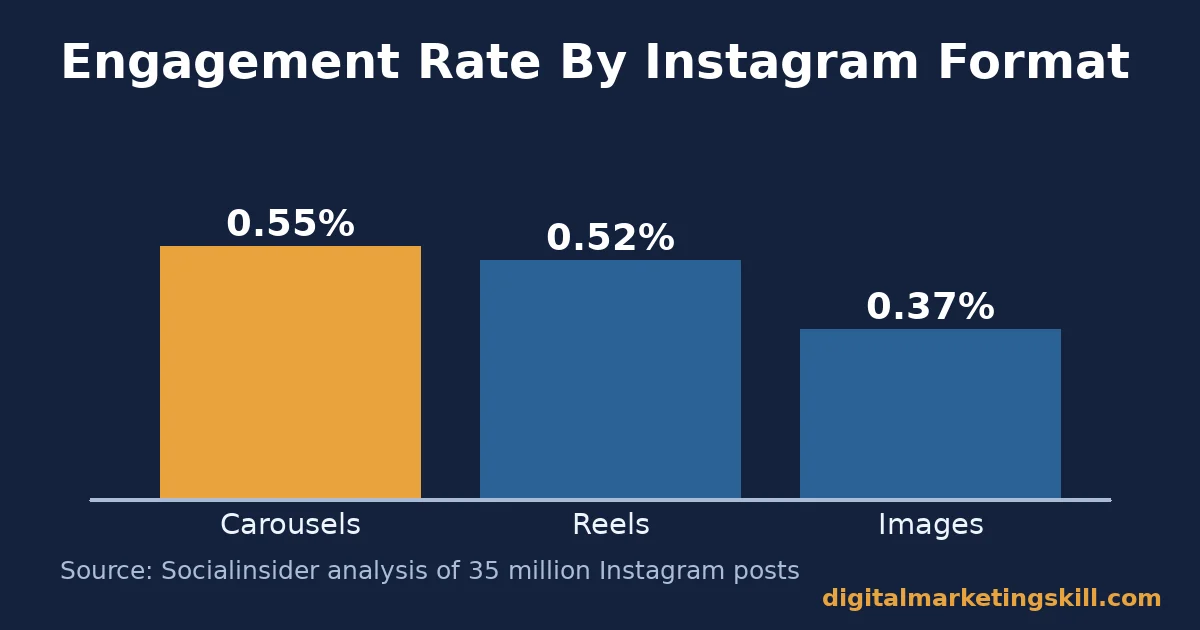
- Socialinsider’s analysis of 35 million posts found carousels average 0.55% engagement, reels 0.52%, and single images just 0.37% (Socialinsider).
- A separate Socialinsider study of more than 75 million posts found hashtag count does not meaningfully change distribution. Big accounts did best with 3-4 tags, smaller accounts with 5-6 (Social Media Today).
- Format choice matters more than almost any other single decision in an Instagram marketing strategy. Reach and engagement are built into the format before a word of copy is written.
- Reels win on total reach because the platform distributes them beyond your follower base. Carousels win on engagement rate because they reward a second and third look.
In this guide
- Why Generic “Instagram Tips” Lists Keep Underperforming
- How Instagram Actually Decides What To Show
- What Differs By Format In An Instagram Marketing Strategy
- How To Lead With The Right Format For Your Goal
- Measuring An Instagram Marketing Strategy: KPIs And How To Read Them
- The One Decision Rule Behind Every Instagram Marketing Strategy
- A Real Case: Strategy Before Platform Tactics
- Frequently Asked Questions About Instagram Marketing Strategy
- Turn This Into A Skill You Can Use For Any Client Or Brand
Why Generic “Instagram Tips” Lists Keep Underperforming
Search for Instagram marketing strategy advice and you get the same list every time. Post consistently. Use hashtags. Run a contest. None of it is wrong. None of it explains why two accounts doing the same five things get different results.
The missing step is format. A single tip, like “use carousels,” behaves differently depending on the goal. Is the goal reach, engagement, or sales? This guide is a snapshot, not a fixed formula. Instagram’s distribution system changes often, so treat every benchmark here as a comparison point, not a permanent ranking.
The order that matters: pick the format for your goal first. Structure the post around that format’s strength second. Measure the number that reflects the goal third. Hashtags and filters come last, because the research below shows they move the needle far less than people assume.
None of this works without a plan for what to post and when. A loose content calendar that maps formats to goals in advance stops a strategy from collapsing into whatever is easiest to film that day.
The competition for attention is real: the average online adult now uses close to seven different social platforms a month, according to DataReportal’s Digital Global Overview. An Instagram marketing strategy is not competing only against other Instagram accounts; it is competing against every other app on the same phone.
How Instagram Actually Decides What To Show
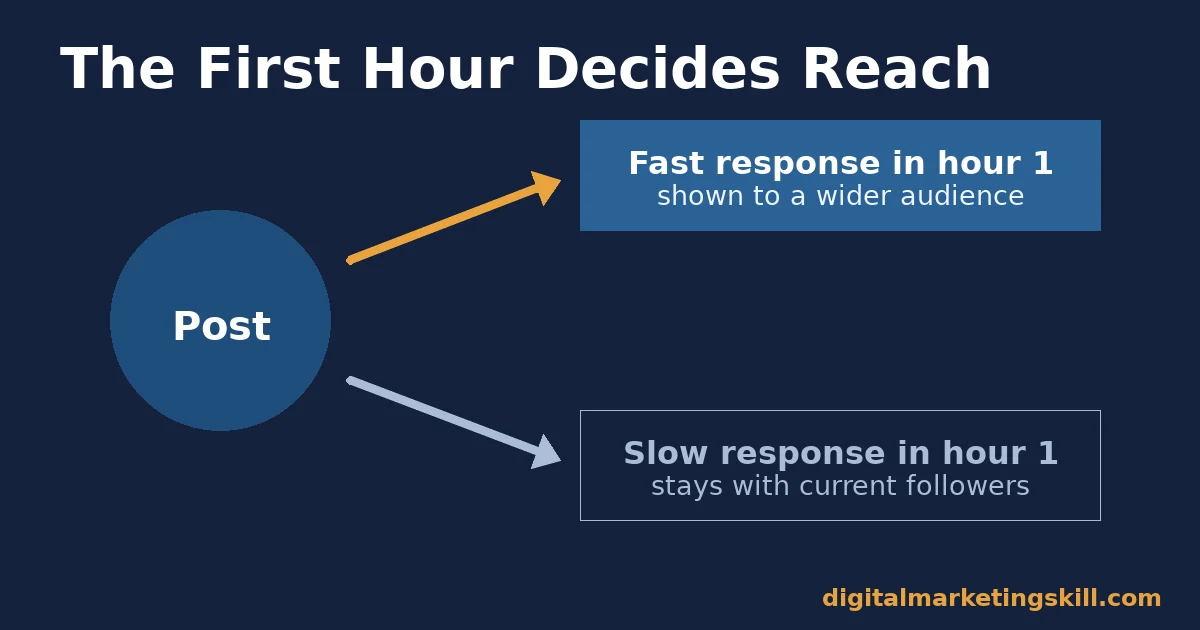
Instagram does not rank every post the same way. It separates distribution into two pools: your existing followers’ feeds, and everyone else’s Explore and Reels surfaces. A post only reaches the second pool if the first pool responds fast.
Instagram’s own engineering team has confirmed this split directly. In its own explanation of how the app works, it states that Explore and Reels mostly show “accounts you don’t follow,” while Feed and Stories stay built around people you already follow.
That first pool is small by definition. Only a fraction of your followers are active in the minutes after you post, so the early response rate from that small group decides whether the platform tests the post with a wider audience. A post that stalls in its first hour rarely recovers later, no matter how good the content turns out to be.
This is also why an Instagram marketing strategy built only on follower count underperforms. An account with 50,000 followers and a disengaged audience can be outperformed in reach by an account with 5,000 followers whose early viewers reliably respond. Audience quality, not audience size, decides whether the platform extends a post beyond its first pool.
Why Format Drives Reach
Format drives much of an Instagram marketing strategy’s success. Reels are built to be shown outside your follower base by default. A single reel can reach far more people than your account normally would.
Carousels are built to be revisited. A second slide, a third slide, each one is a fresh chance to earn a like or a save. That is why carousels post the highest engagement rate of the three formats.
Single images carry neither advantage. Socialinsider’s 35-million-post analysis found images averaging 0.37% engagement. Carousels sit at 0.55% and reels at 0.52%. That gap has widened as the platform leans harder into swipeable and video content.
The First Hour Decides More Than The First Day
Most of a post’s lifetime performance is set within the first hour or two after publishing. If early viewers like, comment or save quickly, the platform tests the post with a wider circle. If they scroll past it, the post rarely gets a second chance later.
This is a practical argument for posting when your specific audience is actually online, rather than copying a generic “best time to post” schedule built for a different audience entirely. Your own account’s insights will show this more accurately than any general benchmark.
Where Hashtags Actually Fit
Hashtags sit outside this mechanism almost entirely. A separate Socialinsider analysis of more than 75 million posts found hashtag count does not meaningfully change how far a post travels.
Larger accounts performed best with just 3-4 tags. Smaller accounts did marginally better with 5-6. Hashtags still help the right searcher find your post, but they are a targeting tool, not a reach lever.
Treat hashtag choice as a search problem, not a reach problem. A few specific, relevant tags that match what your audience actually searches will outperform a long list of broad, generic ones, even though the broad ones look more popular. Our guide on using hashtags on Instagram covers how to pick that short list.
What Differs By Format In An Instagram Marketing Strategy
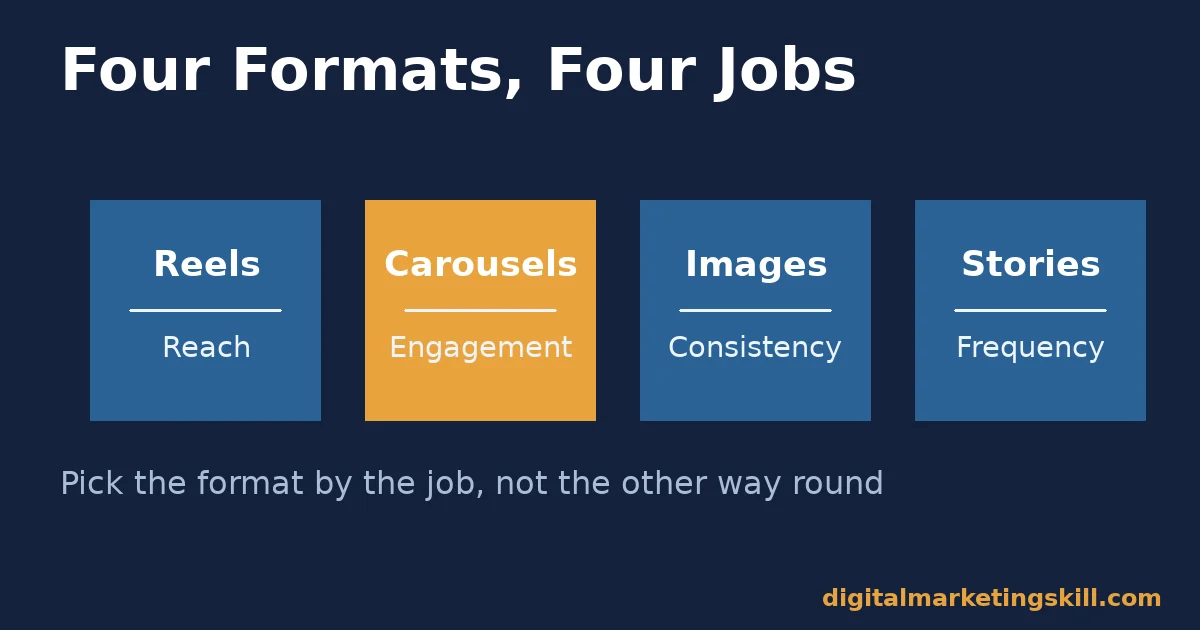
Each format is built to win a different part of the funnel. The same content idea needs a different structure depending on which one you choose.
Reels: Built For Reach Beyond Followers
Reels exist to be shown to people who do not follow you yet. That makes them the right format when the goal is new audience growth, not deeper engagement from people who already know your brand.
A business launching in a new market, or a creator trying to grow past a plateau, should lean on reels first. A brand with a loyal audience it wants to sell to more often should not, since reach to strangers does little for a sales goal on its own.
Carousels: Built For Engagement And Dwell Time
Carousels only work if the first slide earns a swipe. Every additional slide someone views is a stronger engagement signal than a single like. That is part of why carousels lead on engagement rate.
Brands with an existing, engaged audience should reach for carousels more often than reels. The format rewards an audience that already trusts you enough to keep swiping, which is exactly the audience a loyal follower base provides.
Single Images: Built For Consistency, Not Discovery
A single image rarely wins reach or engagement. But it is the fastest format to produce, and it keeps a feed visually consistent between bigger reel and carousel efforts. Treat it as the maintenance format, not the growth format.
Stories: Built For Frequency, Not Permanence
Stories disappear after 24 hours, which removes the pressure to make every one perfect. Use them for the frequent, lower-stakes updates a feed post would feel too permanent for: a quick poll, a behind-the-scenes clip, a reminder about something already posted. Our guide on using Instagram Stories covers the format in more depth.
How To Lead With The Right Format For Your Goal
Once the goal is clear, structure the post around the one thing that format does well. Do not apply the same structure to every post type.
Reels: Lead With A Hook In The First Second
Reels are shown to strangers first. The opening frame has to work with no context and no prior relationship with your account. State the payoff before the explanation. A viewer who does not recognise your brand will not wait for a slow build-up.
Carousels: Lead With A Reason To Swipe
The first slide should promise something the second slide delivers: a number, a step, a before-and-after. A carousel that puts the whole idea on slide one gives the viewer no reason to keep going. That caps the engagement signal the format depends on.
A Quick Note On Mixing Formats In One Week
Most accounts do not need to pick one format and stay there. A workable weekly mix for an Instagram marketing strategy might be one or two reels for reach, one carousel for engagement, and single images or Stories to fill the gaps. The exact ratio matters less than making sure every post has a stated goal before you decide its format.
Single Images: Lead With Brand Consistency
A single image is not competing for reach. Use it to reinforce a consistent visual identity instead: the same colour palette, the same crop ratio, the same tone. The feed then reads as one brand even on days you post the simplest format.
Stories: Lead With Frequency, Not Production Value
Do not script or over-produce a Story the way you would a reel. Post more often, with less polish, and use interactive stickers like polls or questions to get a direct response. The goal is a steady presence between bigger posts, not another perfect asset.
Measuring An Instagram Marketing Strategy: KPIs And How To Read Them
Match the metric to the goal the format was chosen for. Do not use a single number for every post.
The Four KPIs To Track
- Reach — accounts that saw the post, including non-followers. This is the number reels are built to move. A reel with low reach relative to your other reels usually has a weak opening frame.
- Engagement rate — likes plus comments divided by followers, as a percentage. Compare it to the 0.48% overall average from Socialinsider’s benchmark, named above. Expect carousels to beat that average more often than images do.
- Saves — a stronger intent signal than a like, because saving something means a viewer expects to need it again. A high save rate with flat reach usually means the content is valuable but not shown to enough new people yet.
- Profile visits and follows from a post — the number that actually reflects growth, not just engagement on one post. A reel can get huge reach with almost no profile visits if the content does not signal who the account is for.
Read Them Together, Not One At A Time
Read reach and engagement rate together before judging a format as a failure. A carousel with low reach but a strong engagement rate is working as designed. It was never built to be shown outside your followers in the first place.
Track these numbers weekly rather than per post. A single post can spike or flop for reasons unrelated to format or strategy, but a weekly trend across several posts of the same format shows whether the underlying choice is working. Give any change in your Instagram marketing strategy at least three to four weeks of consistent posting before judging whether it worked.
Instagram’s own business resource hub documents the current tools available for each format, including shopping tags and ad placements, which is worth checking before you finalise a content calendar, since the available tools change more often than the underlying format logic does.
The One Decision Rule Behind Every Instagram Marketing Strategy
Choose the format by the goal, not by habit or what is easiest to produce that day. If the goal is new audience growth, default to reels. If the goal is deeper engagement with an audience you already have, default to carousels. Everything else, hashtags, filters, caption length, is a smaller lever than this one choice.
Illustrative, invented numbers to show the scale of the effect: an account with 10,000 followers posts a single image. At a 0.37% typical engagement rate, that gets roughly 37 engagements.
The same idea reworked as a carousel, matching the 0.55% benchmark, would get roughly 55 engagements from the same follower base, before any other change. The format choice alone accounts for that gap.
That does not mean every post should become a carousel. A business whose goal is new customer discovery, not deeper engagement from existing followers, would be trading away the one format built to reach strangers. Apply the decision rule to the goal of each individual post, not to the account as a whole.
A Real Case: Strategy Before Platform Tactics
Digital Marketing Skill Institute student Chinonso Ahuwa’s story, published on the Institute’s reviews page, makes the same point from the advertiser’s side. Ahuwa described learning “a whole lot ranging from designing a customer avatar, to running Facebook and Instagram ads and designing a website.”
The customer avatar came first, before the ad or the platform-specific tactic. That mirrors the core idea in this guide: decide who the content or ad is for and what outcome you want. Then pick the format and platform mechanics that fit that goal, not the other way round.
This is one published account of one student’s experience, not a guaranteed outcome for every account or budget. Results vary by niche, effort and starting audience.
The same logic applies at the content level, not just the ad level. A reel without a clear sense of who it is for will struggle to hook anyone in the first second, because there is no specific viewer in mind to write the hook for. Define the audience before the format, and the format choice becomes much easier to make.
Frequently Asked Questions About Instagram Marketing Strategy
What is the most important part of an Instagram marketing strategy?
Choosing the right format for the goal. Reels are built for reach beyond your current followers. Carousels are built for engagement from people who already follow you. Picking the wrong one for the goal undercuts everything else you do.
Do hashtags still matter on Instagram?
They matter for being found by the right searcher, but not for overall reach. Socialinsider’s analysis of more than 75 million posts found hashtag count does not meaningfully change how far a post travels. Treat hashtags as a targeting tool, not a growth lever.
How many hashtags should I use?
The same research found larger accounts performed best with just 3-4 relevant hashtags. Smaller accounts did marginally better with 5-6. Relevance matters more than quantity either way.
Are reels better than carousels?
Neither is “better” in general; they are built for different outcomes. Reels win on total reach because Instagram distributes them beyond your follower base. Carousels win on engagement rate, averaging 0.55% against 0.52% for reels, because every extra slide viewed is a stronger signal.
What is a good Instagram engagement rate?
Socialinsider’s benchmark puts the overall average around 0.48%. That figure has fallen sharply in recent years as competition for attention has increased. Compare your own rate against that average by format, not against one flat target.
Should I still run Instagram contests and giveaways?
They can still work for a short-term follower or engagement spike. Check Instagram’s current promotion rules before running one, since platform policies on this change. Treat a contest as a supplement to a format-led strategy, not a replacement for one.
Can a small business compete with bigger accounts on Instagram?
Yes, more easily than on most platforms, because the algorithm rewards early engagement rate, not raw follower count. A small, engaged following that reliably responds in the first hour can outperform a much larger, passive one. That is one reason an Instagram marketing strategy built on genuine audience relevance travels further than one built purely on growth tactics.
How often should I post on Instagram?
Less important than consistency and format fit. A steady cadence you can sustain, matched to the right format for each post’s goal, outperforms a high-frequency schedule of posts with no clear purpose.
Do I need a different Instagram marketing strategy for a service business than for a product business?
The format logic stays the same either way, but the content differs. A service business usually has fewer visual products to show, so process, results and client stories carry more weight in carousels and reels than product shots do. A product business can lean harder on demonstration content in reels, since the product itself gives the format something concrete to show.
Does an Instagram marketing strategy need to be different for a small account versus a large one?
Yes, at least for hashtags. Socialinsider’s research found larger accounts performed best with fewer tags, 3-4, while smaller accounts did marginally better with more, 5-6. Format choice, by contrast, follows the same logic at any account size: pick reels for reach, carousels for engagement.
Turn This Into A Skill You Can Use For Any Client Or Brand
Choosing the right format for the right goal is one decision inside a much bigger skill set. Planning, running and measuring social campaigns that actually move a business forward takes more than one guide. Digital Marketing Skill Institute’s Master Diploma in Digital & AI Marketing is built around that kind of practical, execution-first training.
It offers four AI-powered tracks: AI-Powered Social Media Management and Advertising, AI-Powered Lead Generation and Email Automation, AI-Powered Google Specialist, and AI-Powered WordPress and SEO Specialist. Together they total ten courses, with a Full Stack option for completing all four. See the curriculum at digitalmarketingskill.com. Every track includes unlimited 1-on-1 coaching and mentoring, plus a U.S. Project Internship with a verified U.S. Work Reference Letter.
The program is dual US and UK accredited, recognised in more than 100 countries, and 100% online, so you can study wherever in your country you happen to be. See the full program details on the Master Diploma page. Browse more guides on the blog, and when you are ready, apply here. Learn more at digitalmarketingskill.com.
Every figure in this guide was checked against its original source before publication. Figures marked as illustrative are invented examples, not real results.