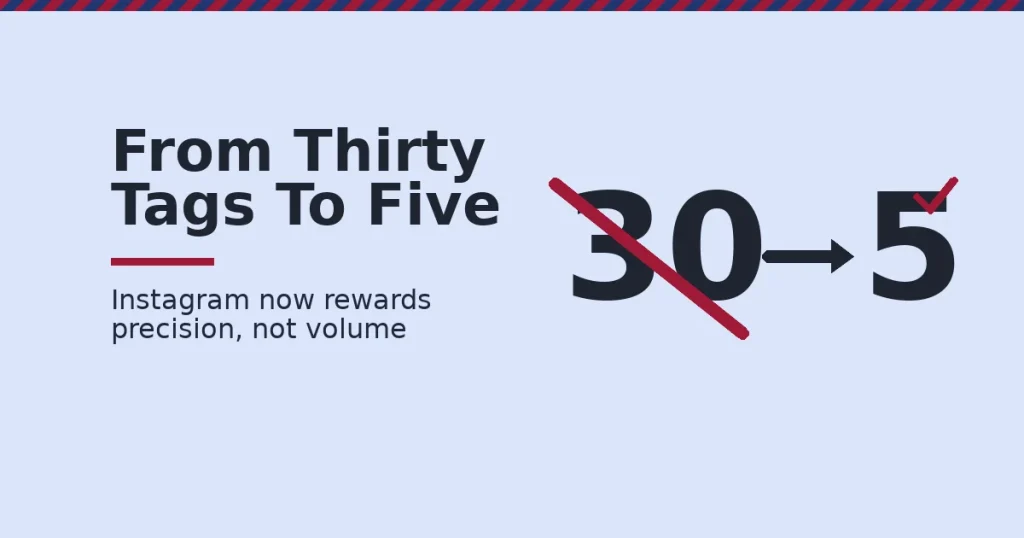
Instagram hashtags changed fundamentally when the platform cut the limit from 30 per post to just 5. The old advice to stack broad and niche tags together no longer applies. This guide covers what actually works now, and how to pick your 5 well.
Key Takeaways
- The limit dropped from 30 to 5. Instagram’s @creators account announced the change, reported directly by Social Media Today, and it applies to captions on both posts and Reels.
- Instagram wants quality over quantity. The platform’s own stated reason: “using fewer (up to 5) more targeted hashtags, rather than many generic ones, can improve both your content’s performance and people’s experience.”
- Hashtags were never a reach lever. Instagram’s head, Adam Mosseri, has said repeatedly, as reported directly, that hashtags “don’t meaningfully increase reach,” and are better understood as a way to categorise a post.
- A post with more than 5 tags is now penalised. Instagram stops pushing posts with over 5 hashtags in Explore, hashtag browse pages and Reels recommendations.
- Branded hashtags still build community. Lush Cosmetics’ long-running #LushLife tag carries millions of pieces of user content, a live example of a hashtag used for identity rather than reach.
In this guide
- What Most Instagram Hashtags Advice Still Gets Wrong
- How Instagram Hashtags Actually Work Now
- What Differs Between a Weak and a Strong Hashtag Choice
- How to Choose Your 5 Hashtags
- How to Measure Hashtag Performance
- The One Decision Rule: Pick Your 5 Before You Write the Caption
- A Real Case: Lush Cosmetics and #LushLife
- Frequently Asked Questions About Instagram Hashtags
- Start With Five, Not Thirty
What Most Instagram Hashtags Advice Still Gets Wrong
Most articles on Instagram hashtags still describe a world that no longer exists. Stack 20 to 30 tags, mix big ones with small ones, and rotate them to avoid looking spammy. That advice was built for a 30-tag limit. Instagram has since removed that limit and replaced it with a hard cap of 5.
This guide treats Instagram hashtags as a precision tool, not a volume game. It explains the new rule and what a hashtag actually does inside Instagram’s current system. Then it shows how to choose your 5 well and measure whether they are working.
The shift fits a broader pattern. Analysis of the change frames it simply: thirty hashtags gave creators room to game the system, while five force honesty about what a post is actually about. Instagram hashtags are moving from a discovery hack into a search and classification signal, alongside captions and on-screen text.
A quick ground rule. Instagram’s own guidance and Adam Mosseri’s public comments are the primary sources here. Treat them as the platform’s current position, not a permanent law of social media. Engagement benchmarks will keep shifting as users and the algorithm adapt to the new limit. Check your own account’s numbers against the method in this guide, not a fixed target.
How Instagram Hashtags Actually Work Now
The New 5-Tag Rule
This change affects every account type differently. A large, established account with a loyal following can afford to use its 5 tags mostly for topic labelling. Its reach comes mainly from followers and Explore anyway. A small or new account relies more heavily on hashtags to be found at all. Each of its 5 choices matters more, not less.
Instagram’s current rule is simple. You can include up to 5 hashtags in the caption of a post or Reel. Add a sixth, and the platform will not publish it as written. Instagram explained the change directly: fewer, more targeted hashtags perform better and create a better experience than long generic lists.
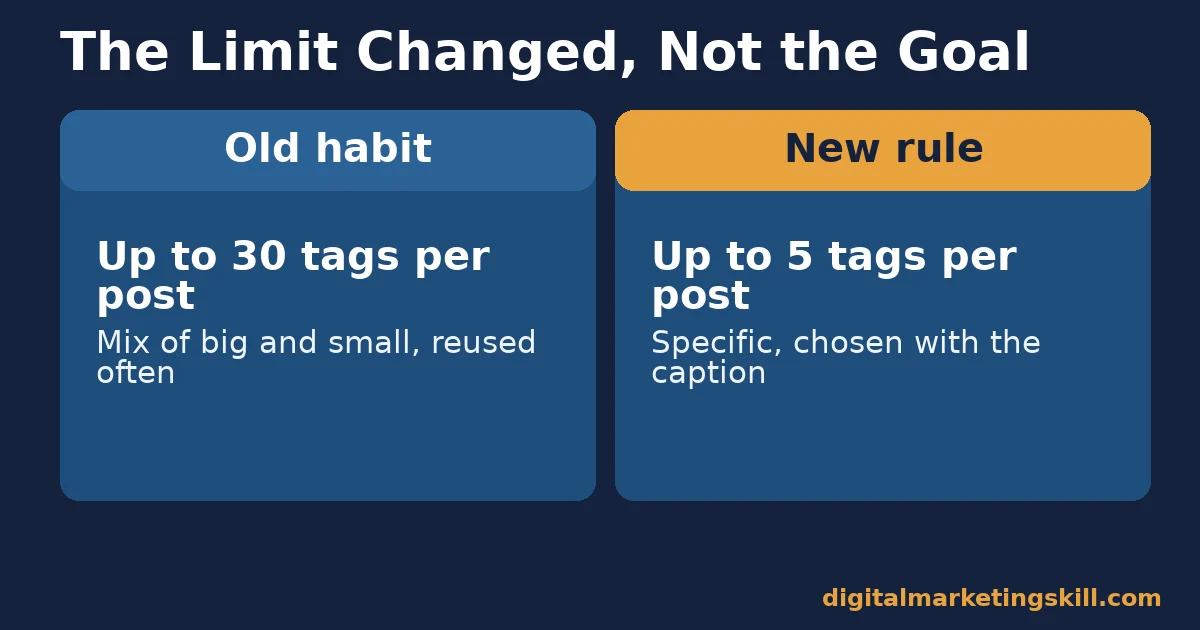
For Instagram hashtags, the cap is enforced, not just suggested. Posts carrying more than 5 hashtags are excluded from Explore, hashtag browse pages and Reels recommendations. A post that still has 20 old-style tags in its caption is not just wasting space. It is actively hurting its own distribution.
What a Hashtag Actually Does
In short, a hashtag is a label, not a megaphone. When you tag a post, it becomes searchable and groups into a page other users can browse by that term. That is its real job. It helps someone who is already searching find your content, and it helps Instagram understand your post’s topic.
Adam Mosseri has said this plainly in multiple public question sessions: hashtags do not improve reach. They are useful for search and for connecting posts around a topic, not for pushing content to people who were not looking for it. That distinction matters more than ever under the new 5-tag limit. Every tag you choose has to earn its place.
What Differs Between a Weak and a Strong Hashtag Choice
The two approaches to choosing Instagram hashtags below are paired with their fix later in this guide. Most accounts are still running the old, weak approach out of habit.
Generic Tags: Built for a System That No Longer Rewards Them
Typically, a weak hashtag choice reaches for the biggest, broadest tags available: generic one-word labels used on millions of unrelated posts. These tags used to work as a volume play, when 30 slots meant you could afford a few long shots. With only 5 slots, a broad tag competing against millions of other posts rarely helps a specific post get found.
Broad tags also say almost nothing about your post. A tag used on ten million posts cannot meaningfully group your content with the handful of people actually looking for what you offer. Our guide to Instagram SEO covers the other signals, beyond hashtags, that help Instagram understand and surface your content.
Specific Tags: Built to Signal What the Post Is About
By contrast, a strong hashtag choice is specific enough that someone searching it is very likely to want your exact content. These tags carry fewer total posts, but a much higher share of people browsing them are your actual audience.
Specific tags also work better alongside Instagram’s current Search and Explore system, which relies on caption text and on-screen context, not just hashtags, to understand and surface a post. A tag should confirm the topic your caption already makes clear, not try to do all the work alone.
How to Choose Your 5 Hashtags
These three moves replace the old habit of stacking as many Instagram hashtags as the limit allowed.
Lead With Specific, Searchable Tags
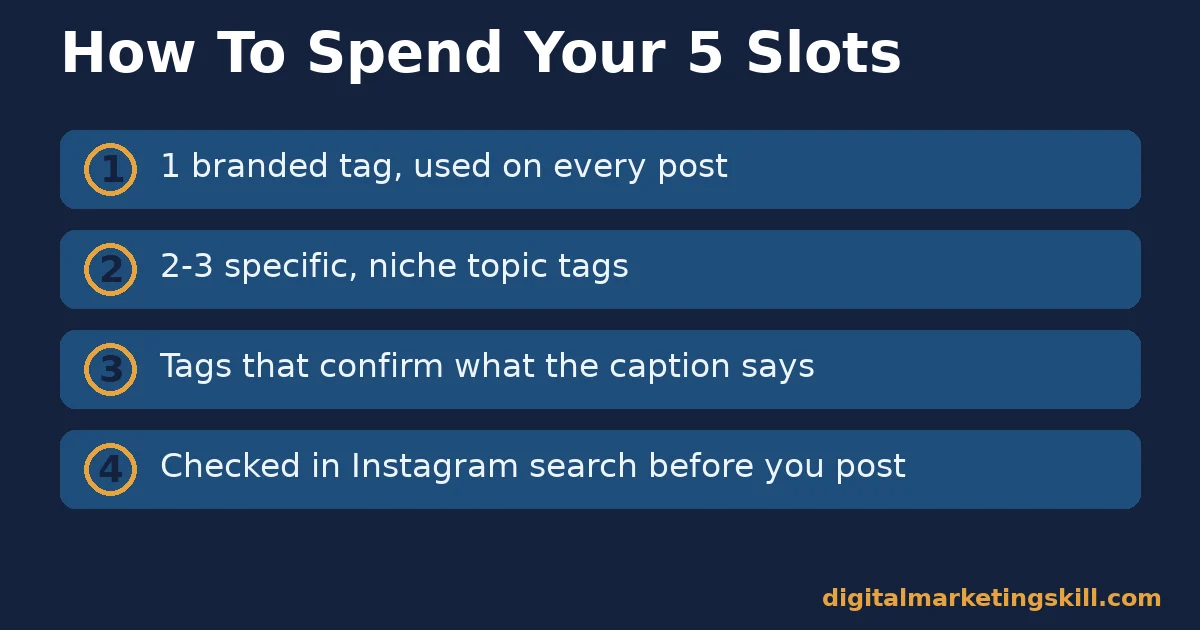
First, choose tags a real, interested person would actually type into Instagram’s search bar. A niche product term, a specific technique or a named style usually beats a generic category word. Spend your 5 slots on terms with a real, if smaller, audience searching them.
Check each candidate tag on Instagram’s own search before you use it. If the top posts under that tag look nothing like what you make, skip it. A popular tag with the wrong audience will not connect you to the right people.
Lead With Keyword-Rich Captions
Next, write your caption as if it has to do the discovery work alone, because increasingly it does. Describe what is in the post, who it is for, and what problem it solves, using the words your audience would actually search for.
Treat your 5 hashtags as a short confirmation of the caption’s topic, not a replacement for writing one clearly. A vague caption with 5 perfect hashtags still underperforms a clear, specific caption with 5 decent ones. Our guide to Instagram post ideas covers how to plan content that gives both your caption and your hashtags something specific to say.
Lead With One Branded Tag
Finally, reserve one of your 5 slots for a hashtag unique to your business, used consistently across every post. This will not drive new reach on its own. But it gives customers a simple way to find and share content connected to you.
Invite customers to use that same tag when they post about your product. Over time, it becomes a searchable archive of real customers talking about your business, which is worth more than a generic tag chasing strangers.
Do not treat your branded tag as fixed forever. If it is not being adopted by customers after a reasonable stretch of consistent use, simplify it. A tag that is hard to spell or remember will not spread, no matter how good the product behind it is. Our wider guide to the benefits of Instagram for business covers other ways to turn followers into an active community beyond hashtags alone.
How to Measure Hashtag Performance
Judge your Instagram hashtags on a short set of metrics, each defined in one sentence, so you can tell whether your 5 choices are earning their place.
Five Metrics Defined
- Reach from hashtags. Instagram’s own in-app Insights break down how many accounts saw a post specifically through a hashtag, separate from your followers or Explore. This is the most direct measure of whether your tags are pulling in new viewers.
- Impressions from hashtags. How many times your post was viewed via a hashtag, including repeat views from the same account. Compare it against reach to see how often a hashtag viewer returns.
- Engagement rate. Likes, comments, saves and shares divided by reach. A post with strong hashtag reach but weak engagement usually means the tags attracted the wrong audience.
- Branded tag volume. How many posts carry your unique branded hashtag, checked directly on its Instagram page. Rising volume over time shows growing customer-generated content.
- Save rate. The share of viewers who save a post. Saves are a strong signal that the content genuinely matched what a hashtag-driven searcher was looking for.
Reading Them Together
Read these numbers together, not alone. Strong hashtag reach with weak engagement usually means your tags are too broad and pulling in the wrong viewers. Weak reach with strong engagement among the few hashtag viewers you do get usually means something different. Your tags are accurate, just too small to matter much yet.
Check this monthly rather than per post, since any single post’s hashtag performance can swing a lot from small sample sizes. If Reels are a big part of your content, our guide to Instagram Stories format covers the same reach-versus-engagement trade-off for that format.
The One Decision Rule: Pick Your 5 Before You Write the Caption
If you remember one rule, make it this one. Decide your 5 hashtags before you finish writing the caption, not after as an afterthought. Choosing tags first forces you to be specific about the topic, which then makes the caption sharper too.
Here is an illustrative example, with invented numbers. A small ceramics studio used to post with 25 to 30 hashtags, mixing broad tags like #art and #handmade with a few niche ones. After the cap, they narrow to 5: one branded tag, two specific technique tags, and two tags naming their exact product category. Hashtag-driven reach per post drops at first, from roughly 400 to 250 accounts, but the engagement rate among those viewers nearly doubles, and saves rise noticeably.
The lesson is about audience match, not raw volume. Fewer, sharper tags brought in a smaller but far more interested group of viewers.
A Real Case: Lush Cosmetics and #LushLife
Lush Cosmetics, the cosmetics retailer, has used the branded hashtag #LushLife for years to gather customer content around its products. Checking the tag’s own Instagram page directly shows it carries millions of pieces of content. All of it is built up from customers and the brand posting under one consistent label, across far more years than the tag has been subject to any single hashtag-count rule.
The tag was never designed to chase Instagram’s algorithm for reach. Its value is as a searchable, ongoing archive. Anyone curious about the brand can browse real customer photos and reviews gathered under one name, built gradually over years rather than any single viral moment.
Read the limits alongside the result. This is a live snapshot of one large, long-established brand’s tag, not a controlled study. A small business will not replicate millions of tagged posts quickly, and should not expect to. The lesson to take is the method: a consistent branded tag, used patiently, becomes a searchable asset regardless of the platform’s current hashtag limit.
Frequently Asked Questions About Instagram Hashtags
How many hashtags can I use on Instagram now?
Up to 5 per post or Reel, under Instagram’s current rule. Captions with more than 5 hashtags will not publish as written. Posts that try to work around the limit by hiding extra tags elsewhere also lose distribution in Explore and hashtag pages. This is a sharp change from the old habit of filling every one of 30 available slots, so audit your saved caption templates and remove the extra tags before you post again.
Do Instagram hashtags still matter at all?
Yes, but for search and topic labelling, not for broad reach. Adam Mosseri has said hashtags do not meaningfully increase reach; their real value is helping an interested searcher, or Instagram itself, understand what your post is about.
Should I use big, popular hashtags or small, niche ones?
Favour specific, niche tags over broad, generic ones under the new 5-tag limit. A broad tag’s audience is mostly uninterested strangers, while a specific tag’s smaller audience is far more likely to actually want your content. If you are unsure, test one slot with a slightly broader tag and keep the rest specific, then compare reach and engagement from hashtags on that post against your other recent posts.
What happened to the old 30-hashtag limit?
Instagram has removed it and replaced it with a hard cap of 5 hashtags per post or Reel, stating that fewer, more targeted tags perform better than long generic lists.
Can I still put extra hashtags in the first comment?
No. Instagram’s new limit applies to the caption, which includes anything added through the first comment. There is no longer a workaround for exceeding 5 tags on a single post.
What should my branded hashtag be?
Something short, easy to remember, and clearly tied to your business name, so customers can find and reuse it without confusion. Use it on every post so it builds into a consistent, searchable record over time. Avoid changing it once customers start adopting it, since a mid-stream switch splits your archive across two tags instead of building one strong one.
How do I find good hashtags under the new limit?
Search candidate tags directly inside Instagram and look at the posts already ranking under them. If those posts closely match what you make, the tag is worth one of your 5 slots; if they do not, skip it.
Does the new hashtag limit apply to Stories too?
The cap announced by Instagram covers captions on posts and Reels. Stories have historically used hashtag stickers differently from caption tags, so check your own account’s current behaviour there rather than assuming the same cap applies.
Do Instagram hashtags work the same way for every type of account?
Not quite. A large account with steady follower traffic can treat Instagram hashtags mainly as topic labels. Most of its views already come from followers and Explore. A new or small account depends more on hashtags for initial discovery. Its 5 choices carry more weight relative to its overall reach.
Will using fewer hashtags hurt my existing posts?
Older posts that already carry more than 5 hashtags are not retroactively deleted, but Instagram’s own guidance suggests they lose eligibility for hashtag-based distribution going forward. There is little benefit to editing old captions purely to fix this.
Should every post use all 5 hashtag slots?
Not necessarily. Use as many as are genuinely specific and relevant, up to 5. A post with 2 accurate, specific tags will usually outperform one padded out to 5 with weak, loosely related ones.
Do hashtag generator tools still help under the new limit?
They can, but use them differently than before. A tool that suggests dozens of related tags is less useful now that you only have 5 slots to fill. Use it to find a shortlist of genuinely specific, lower-competition terms, then pick your 5 by hand rather than pasting in a long generated list.
Start With Five, Not Thirty
Instagram hashtags now reward precision, not volume. However, that does not mean hashtags are pointless. It means every one of your 5 choices has to genuinely describe the post, so treat each slot as a small, deliberate decision rather than a reflex. Pick one branded tag and a few specific, searchable tags that genuinely describe each post, write your caption to do the real discovery work, and track reach and engagement from hashtags monthly to see what is actually working.
If you want structured, hands-on practice with social content strategy, including how to adapt quickly when a platform changes its rules, Digital Marketing Skill Institute‘s Master Diploma in Digital & AI Marketing is built around four AI-powered tracks, including an AI-Powered Social Media Management and Advertising track, drawn from ten execution-first courses in total. There is also a Full Stack option for completing all four tracks, unlimited 1-on-1 coaching and mentoring, and a U.S. Project Internship with a verified U.S. Work Reference Letter. The diploma is dual US and UK accredited and recognised in more than 100 countries.
The programme is 100% online, so you can study from anywhere in your country. Explore more on the blog, browse reviews, and when ready, apply or visit the homepage.
Every figure in this guide was checked against its original source before publication. Figures marked as illustrative are invented examples, not real results.