
A useful Twitter marketing guide today has to explain the X algorithm, not just posting tips. X’s own open-source ranking code rewards replies. It punishes blocks far more than old Twitter ever did. This Twitter marketing guide covers that mechanism, four goals with different playbooks, how to measure results and one decision rule to use before every post.
Key Takeaways
- X reaches a small, specific audience, not a mass one. Pew Research surveyed US adults and found only 8% use X. That is far below YouTube’s 84%, Facebook’s 71% and even TikTok’s 32%, so treat X as a precision channel, not a reach channel.
- X’s own advertising reach is shrinking. DataReportal’s tracking put X’s addressable ad audience at 586 million. That is down 5.3%, or 33 million accounts, year over year, so plan for a smaller audience next year, not a bigger one.
- Replies and negative signals outweigh likes in ranking. X’s open-source For You code scores predicted actions by weight. Its own documentation says negative signals such as blocks and reports carry far heavier weight than positive ones, so one angry reply thread can outrank a dozen quiet likes.
- Threads beat single link tweets for reach. In Buffer’s own 10-post experiment, threads averaged 63% more impressions and 54% more engagement than matching link tweets. Link clicks were only about 8% higher, and that gap was inconsistent.
- Response speed drives sales, not just goodwill. Sprout Social’s research found 36% of users get a brand reply within an hour. It also found 34% of users say they bought something after a positive service exchange.
In this guide
- What Most Twitter Marketing Guides Still Get Wrong
- How the X Algorithm Actually Ranks Your Posts
- Four Goals, Four Different Playbooks in This Twitter Marketing Guide
- How to Lead With Each Goal
- Measuring Whether Your Twitter Marketing Guide Playbook Is Working
- The One Decision Rule: Pick Your Primary Metric Before You Post
- A Real Case: What Buffer’s Own Thread Experiment Shows
- Frequently Asked Questions About This Twitter Marketing Guide
- Start With One Goal, Then Expand
What Most Twitter Marketing Guides Still Get Wrong
Most Twitter marketing guides read like they were written before the platform became X. Post consistently. Use hashtags. Follow people back. None of that is false, but it skips the part that now decides whether anyone sees your posts at all: how the ranking system actually scores a tweet.
This Twitter marketing guide starts there instead. It explains the mechanism X itself published. It shows how four common goals need four different approaches. Then it gives you a measurement plan and one decision rule, instead of a generic checklist. Treat the figures here as a snapshot of a platform that changes its own rules often, not a permanent ranking of what works.
Here are the ground rules for this Twitter marketing guide. The usage and reach numbers come from Pew Research and DataReportal, two independent trackers, not from X itself. X stopped publishing audited user numbers some years ago, so every outside number is now an estimate.
The algorithm details come from code X open-sourced, which is real but incomplete, since X keeps the exact weight values private to limit gaming. Read that as documented mechanism and an informed inference about behavior, not a settled formula you can reverse-engineer.
How the X Algorithm Actually Ranks Your Posts
This Twitter marketing guide starts with the mechanism because X’s “For You” feed does not show posts in the order people wrote them. It scores every candidate post for every viewer, then ranks by that score. The code for this system is public, in a repository called x-algorithm on GitHub, so the mechanism is not a guess.
The scoring formula is a sum. For each action a viewer might take on a post, the system predicts the probability of that action. It multiplies that probability by a fixed weight. Then it adds every weighted probability into one final score. Tracked actions include favoriting, replying, reposting, quoting, clicking a link and watching video. On the negative side they include muting, blocking and reporting.
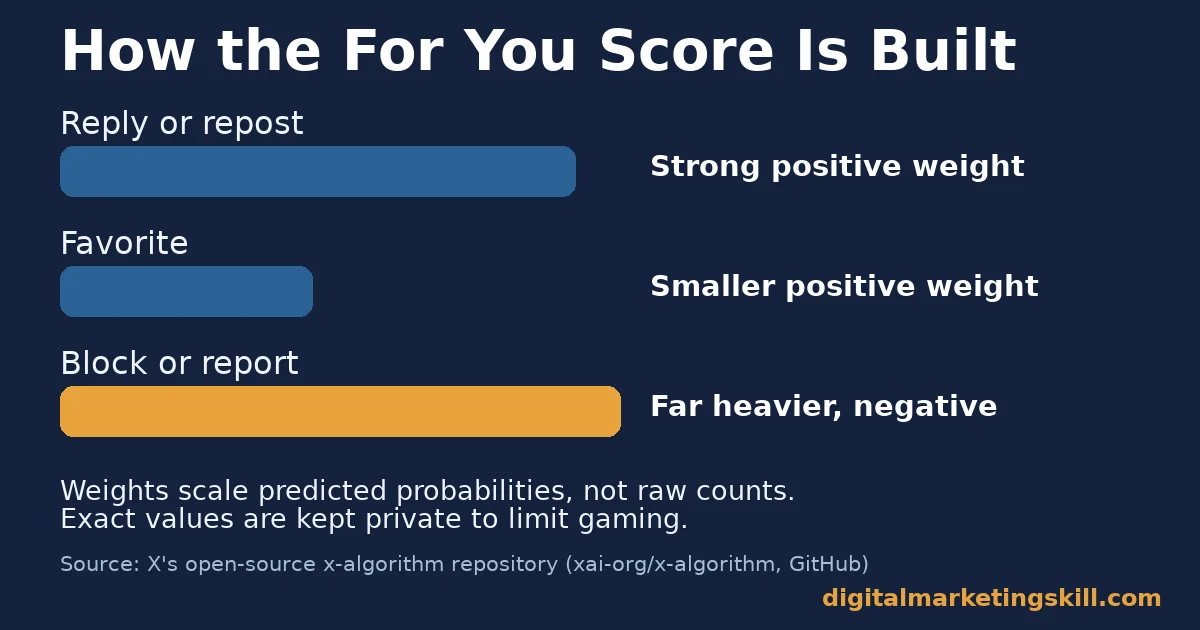
X keeps the exact weight numbers private, specifically to stop people from gaming them. Still, three details matter more than those hidden weights. First, replies and reposts count as stronger signals than a favorite, because they predict more effort from the viewer. Second, negative actions carry far heavier weight than positive ones. A post that collects a handful of blocks or reports can rank below a quieter post with modest likes and no complaints.
Third, the system applies three corrections after scoring. It lowers the score of repeated posts the same author shows close together. It discounts posts from accounts a viewer does not follow, relative to ones they do. And it gives a promotional lift to posts from smaller or newer accounts, so the feed does not only ever show the same large accounts.
What Being Verified Actually Changes
A paid X Premium subscription does not simply buy reach. The same open-source code shows something narrower. A signal marking an account as subscriber-verified feeds into the starting score for candidate retrieval. It also feeds into how that account’s replies rank inside a conversation. In practice, a brand account with X Premium is more likely to be considered for the feed.
Its replies are more likely to be seen first under other posts. But the account is not automatically shown to more people overall.
Why Community Context Now Travels With Some Posts
X also attaches crowd-sourced context notes to some posts. A broad, ideologically mixed set of contributors has to agree a post is missing information first, rather than one moderator deciding alone.
For marketers, this matters in a specific way. A claim-heavy or statistic-heavy post can pick up a public correction if a number is wrong or missing context. That correction then rides alongside the post for every future viewer. Source every figure you post before you publish it. Do not wait for someone else to check it for you.
Four Goals, Four Different Playbooks in This Twitter Marketing Guide
A single “Twitter strategy” does not really exist. The ranking system and the reader’s intent reward different behavior depending on what you are trying to achieve. This Twitter marketing guide covers four goals most businesses actually use X for: brand awareness, lead generation, customer service and thought leadership. Each one needs its own reading of the mechanism above before it needs tactics.
Brand Awareness: Built for Reach, Not Conversion
Awareness content is judged on how far it travels outside your existing followers. The out-of-network discount described above works against you by default. You offset it by publishing content designed to be reposted, not just liked. Reposts carry more ranking weight, and they put your post in front of a new, unconnected audience.
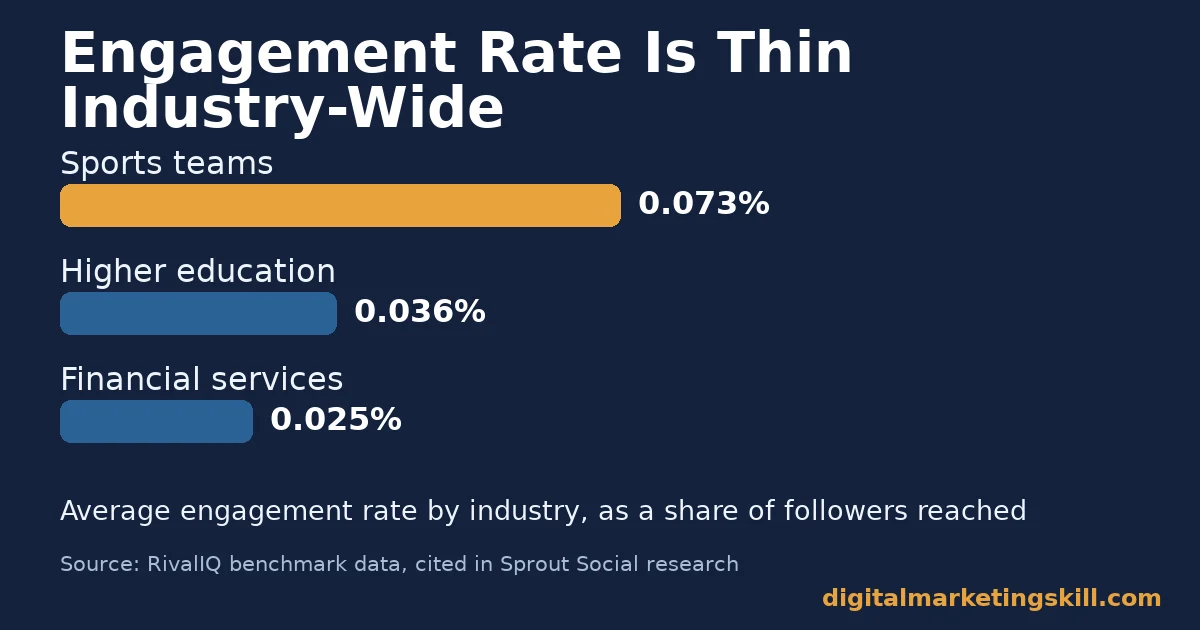
RivalIQ’s benchmark data, cited in Sprout Social’s research, shows how thin that travel can be, even for active industries. Sports team accounts average a 0.073% engagement rate. Higher education accounts average 0.036%. Financial services accounts average 0.025%.
Read those numbers as a ceiling check, not a target. If your engagement rate sits near or above your industry’s benchmark, more awareness content is a reasonable bet. If it sits well below, the content is the problem, not the posting frequency.
Lead Generation: Built for Clicks, Not Impressions
Lead generation lives or dies on the click, not the impression. That creates a direct conflict with the mechanism. A post with an outbound link gives a viewer a reason to leave X. The ranking system’s own engagement weighting rewards replies and reposts that keep people on the platform instead.
Buffer’s own experiment captured this tension cleanly. Across 10 matched posts, threads that kept the full idea on X produced 63% more impressions and 54% more engagement than a single tweet with a link. Yet the link tweets were not reliably worse at producing clicks. Buffer measured only about an 8% difference there and called the result inconsistent.
The honest reading is simple: a thread earns attention, and a well-placed link inside or after that thread still captures some of it.
Customer Service: Built for Speed, Not Scale
Service use of X rewards the one thing most brands under-resource: response time. Sprout Social’s research found that 36% of users who contact a brand on social get a reply within an hour. That sets the bar your own account is implicitly compared against every time a customer tags you with a complaint.
The payoff for clearing that bar is concrete. The same research found 34% of people who had a positive customer-service experience on social went on to buy from that brand. A fast, genuinely helpful reply is closer to a sales channel than a cost center. Treat an unanswered complaint on X as a lead you are actively declining, not a problem you can quietly ignore.
Thought Leadership: Built for Trust, Not Virality
Thought-leadership content is judged over months. It depends on whether the same account keeps showing up with something specific to say, not on any single post’s reach. The algorithm discounts repeated posts the same author shows close together. So posting ten similar points in one day works against you more than spacing ten genuinely different points across a longer stretch.
This is also where the new-author boost works in your favor if you are starting from zero. The ranking system gives smaller, newer accounts a promotional lift, specifically so the feed is not permanently dominated by the same large accounts. A new account that posts specific, checkable claims has a real, documented path into the feed. It is not just a theoretical one.
How to Lead With Each Goal
Understanding the mechanism only matters if it changes what you post next, which is the whole point of a practical Twitter marketing guide. The four sections below mirror the four goals above, each with the single highest-leverage change to make.
Brand Awareness: Lead With Repostable Formats
Write the post to be repostable on its own, before you add a link. A short, strong claim, a single chart or a compact how-to thread gives a stranger a reason to repost it without leaving X. That satisfies the algorithm’s weighting of reposts and spreads the post past your own followers. Save the link to your site for a reply underneath, not the first post.
Timing adds a smaller but real boost: Sprout Social’s analysis of nearly 2 billion engagements puts the strongest window on Tuesday through Thursday, midday to early evening in the viewer’s own time zone. If X is only one channel in a wider plan, our social media marketing guide covers how to split awareness work across platforms.
Lead Generation: Lead With a Thread, Then One Clear Link
Open with a thread that delivers real value on its own. Use your strongest two or three points from a guide or report. Place one clear link, either inside the thread where it supports a specific claim, or in a single reply at the end.
Do not put it in the opening post. This follows Buffer’s own finding directly: threads earn the impressions, and a well-placed link inside or after one still captures a meaningful share of clicks. For more format-specific tactics once someone clicks, see our dedicated X lead generation guide.
Customer Service: Lead With a Public Response-Time Promise
Decide on a specific, realistic response-time target. Publish it in your bio or pinned post. Route every tagged complaint to one person or team responsible for hitting it.
Sprout Social’s finding that 36% of users already expect an answer within an hour is your starting bar. Beating it, even by replying in 20 or 30 minutes during business hours, is a visible difference most competitors still are not matching. Fast public replies also feed directly into the broader customer retention strategies that keep those same buyers coming back.
Thought Leadership: Lead With Original Data and Real Replies
Post your own numbers, a small experiment you ran, or a specific disagreement with a common claim in your field. Then spend more time replying to the responses than writing the next post. Genuine replies compound two ways here. The algorithm’s reply weighting lifts the thread for other viewers. And the conversation itself is what turns an anonymous account into a recognized one over months.
Measuring Whether Your Twitter Marketing Guide Playbook Is Working
Pick metrics that match your goal from the sections above, instead of tracking everything equally. Each one below is defined in a single sentence, with a note on how to read it alongside the metrics you already track elsewhere.
- Engagement rate. The share of people who saw a post and took any tracked action on it, divided by impressions. Compare it against your own account’s trend first, then against an industry benchmark like RivalIQ’s, since benchmarks vary enormously by industry.
- Reply ratio. The number of replies divided by total engagements on a post. A rising reply ratio over time is the clearest sign your thought-leadership content is starting a real conversation, not just being seen.
- Median response time. The typical time between a customer’s tagged complaint or question and your account’s first reply. Track the median, not the average. One slow weekend reply can distort an average without reflecting your normal service.
- Link click-through rate. Clicks on a post’s link divided by impressions. Use this specifically to judge lead-generation posts, since it is the metric awareness and thought-leadership content are not optimized for; our guide to ways to increase website traffic covers the landing-page side once a click arrives.
- Follower growth from non-followers. New followers gained in a period who had never engaged with your account before. This isolates whether awareness content is actually reaching new people, rather than just re-engaging followers you already had.
Any solid Twitter marketing guide will tell you to read these five together, not in isolation. A high engagement rate with a flat reply ratio usually means people are liking without truly reading. A slow median response time, paired with a rising complaint volume on X, means the service gap is actively costing you a share of the 34% of buyers Sprout Social’s research found a good experience can create.
The One Decision Rule: Pick Your Primary Metric Before You Post
If you take one rule from this Twitter marketing guide, make it this one. Decide which single metric a post is meant to move before you write it. Then judge the post only against that metric afterward. A post written for awareness that gets measured on link clicks will always look like it failed, even when it worked exactly as intended.
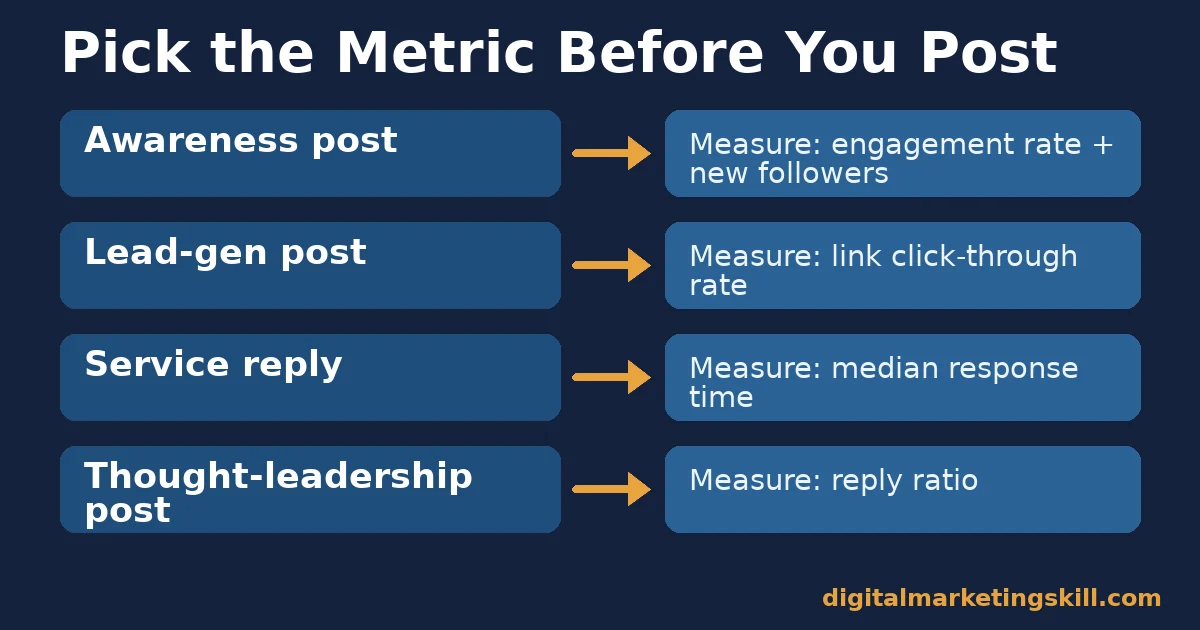
Here is an illustrative example, with invented numbers. A small software company posts three times a week: one awareness thread, one lead-generation post with a link, and one customer-service reply round-up. If the team judged all three by click-through rate, the awareness thread would look like the weakest post every single week. Yet it consistently drove the most reposts and new followers.
Once the team started grading each post only against its own assigned metric, the awareness thread was correctly rated a success. The team stopped quietly dropping the one format that was actually growing their audience.
A Real Case: What Buffer’s Own Thread Experiment Shows
Few sources for a Twitter marketing guide are better than a company testing its own account. Buffer, the social media scheduling company, ran a small experiment on its own X account, rather than citing someone else’s claim. It took 10 blog posts and published each one twice: once as a multi-post thread, and once as a single tweet with a link to the same article.
According to Buffer’s own write-up of the test, the threads averaged 63% more impressions and 54% more engagement than the matching link tweets. Link clicks were only about 8% higher on the threads, on average. Buffer’s own team called that difference inconsistent across the 10 posts, not a reliable effect.
Buffer was honest about the limits, and you should carry the same caution into your own account. The content of each thread and its matching tweet was not identical. The sample was only 10 posts from one company’s account.
Publishing order may have affected how people responded to the second version of each post. Read this as a working model other accounts can repeat, not as a settled law of how X ranks threads.
Frequently Asked Questions About This Twitter Marketing Guide
Is X still worth using for business marketing?
For most businesses, yes, but as a precision channel rather than a mass-reach one. Pew Research found only 8% of US adults use X, well below Facebook or Instagram. That suits businesses whose specific audience is active there, such as B2B, media, finance and technology brands, more than mass-market consumer brands.
How does the X algorithm decide what to show people?
It predicts the probability of several possible actions on each post, such as replying, reposting or blocking. It multiplies each probability by a fixed weight, then sums the results into a single score. Negative signals like blocks and reports carry much heavier weight than positive ones like favorites.
Do hashtags still help on X?
A hashtag can help a post surface in a topic search, but it is not a ranking signal in the open-source scoring formula itself. Spending your limited character count on a specific claim or a clear hook usually matters more than adding extra hashtags.
Are threads better than single tweets?
In Buffer’s own small experiment, threads produced noticeably more impressions and engagement than matching single tweets with a link. The gain in actual link clicks was smaller and inconsistent. Treat threads as the better format for ideas worth explaining, and single tweets as the better format for a quick, specific point.
How fast should a business reply to a complaint on X?
This is one of the most common questions this Twitter marketing guide gets, and the honest answer is: fast enough to beat the expectation your audience already has. Sprout Social’s research found 36% of users already get a reply within an hour from brands generally. Replying within that window, and faster during business hours, is a realistic and valuable target.
Does paying for X Premium increase reach?
Not directly. The open-source ranking code shows that subscriber-verified status feeds into an account’s starting score for being considered in the feed, and into how its replies rank in conversations. It does not guarantee a larger audience for every post.
What is the single most useful thing to measure on X?
Whichever metric matches the goal of the specific post, chosen before you publish it. Judging an awareness post by link clicks, or a service reply by follower growth, will make a working strategy look broken.
Start With One Goal, Then Expand
Close this Twitter marketing guide by picking the one goal that matches what your business actually needs from X right now: awareness, leads, service or trust. Commit to its matching metric for a full month before you judge the results. Running all four goals at once, with no clear metric for any of them, is the most common reason Twitter marketing efforts quietly stall out.
If you want structured, hands-on practice building and measuring campaigns like this, the Digital Marketing Skill Institute teaches it inside the Master Diploma in Digital & AI Marketing. The program is built around four AI-powered tracks totalling ten courses, including AI-Powered Social Media Management and Advertising and AI-Powered Lead Generation and Email Automation, with a Full Stack option for completing all four tracks.
It includes unlimited 1-on-1 coaching and mentoring and a U.S. Project Internship with a verified U.S. Work Reference Letter. It is dual US and UK accredited and recognised in more than 100 countries.
The program is fully online, so you can study from anywhere in your country. Browse more guides on the Digital Marketing Skill Institute blog, read real outcomes on the reviews page, or go straight to the Master Diploma program page and apply when you are ready. You can also start from the Digital Marketing Skill Institute homepage.
Every figure in this guide was checked against its original source before publication. Figures marked as illustrative are invented examples, not real results.
![9 Amazing Digital Marketing Skills to Make Money Online [With Proof]](https://digitalmarketingskill.com/wp-content/uploads/2019/07/9-Amazing-Digital-Marketing-Skills-to-Make-Money-Online-With-Proof-17.png)






