
X lead generation means turning posts, replies and ads on X into contact details you can follow up with. It is not just likes. Most accounts never set this up. No landing page, no offer, no measurement. Clicks disappear and nobody can say what worked.
Key Takeaways
- X reaches 251 million daily active users and a potential ad audience of 557 million, with users aged 25-34 and 18-24 making up almost seven in ten of that ad audience (Sprout Social).
- 58% of X users interact with brand content at least weekly, which is engagement you can redirect toward an offer instead of losing to the feed (Sprout Social).
- In a HubSpot study of more than 5,000 businesses, Twitter-sourced visitors converted to leads at 0.69%, well behind LinkedIn’s 2.74% (HubSpot).
- Posts using one or two hashtags earn roughly 21% more engagement than posts using three or more, and going past two hashtags cuts engagement by about 17% (hashtag performance analysis).
- Promoted X posts average a 1-3% click-through rate, well above the 0.5-1.5% typical for organic posts, so paid budget still needs a working landing page behind it to pay off (WebFX).
In this guide
- The X Lead Generation Gap Most Accounts Never Close
- How X Lead Generation Actually Works
- What Differs By Account Type
- Fix Your Lead Funnel, By Account Type
- Measure What Matters For X Lead Generation
- The One Decision Rule
- A Real Case, And Its Limits
- Frequently Asked Questions About X Lead Generation
- Your Next Step With X Lead Generation
The X Lead Generation Gap Most Accounts Never Close
Reach and leads are not the same thing. An account can post daily and gain followers. It can still produce zero contact details. Nothing on the profile or in the thread ever asks for one.
This guide is an informed inference about X lead generation. It is built from platform data and a widely cited conversion study, not a settled fact for every account. Results vary by industry and offer. For context, social media now reaches an estimated 5.66 billion active identities worldwide, so the audience problem most accounts worry about rarely exists at this scale (DataReportal).
The rest of this guide treats X lead generation as a system. A hook earns a click, a landing page earns the contact, and a measurement habit shows which part is broken.
Done well, X lead generation does not need a bigger following first. It needs these three steps to exist at all, in a deliberate order. That order is what most accounts skip.
How X Lead Generation Actually Works
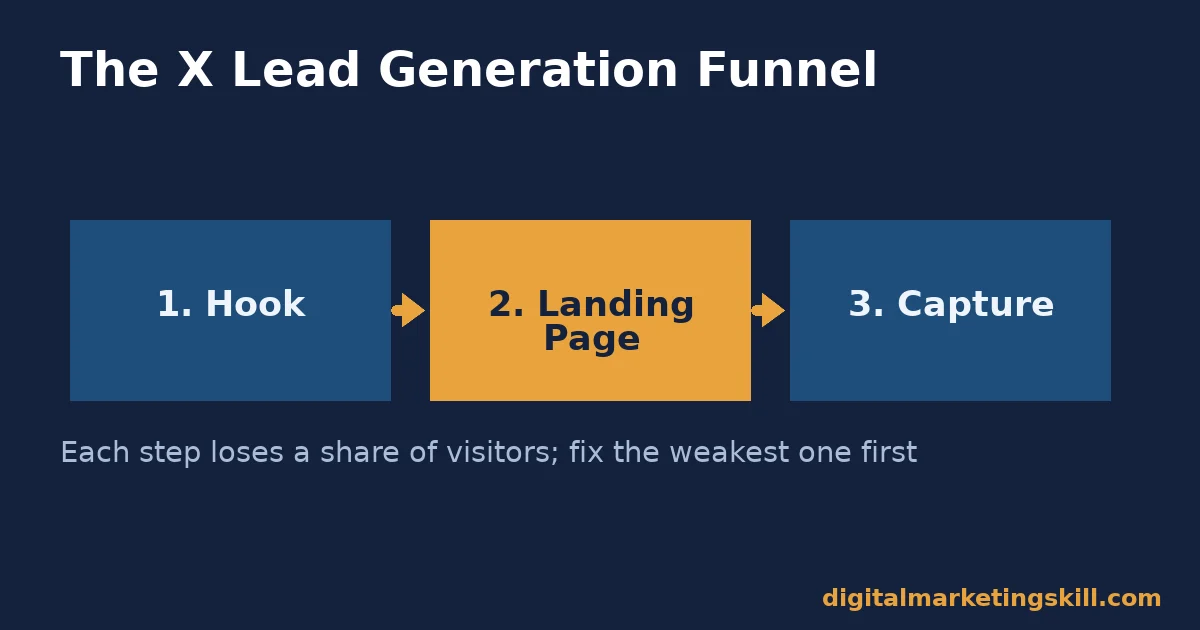
X lead generation is created in three steps. Each step loses a share of people, so every step has to be deliberate.
Step one is the hook: a post, reply or ad that earns a click instead of a scroll-past. Step two is the landing page: the first thing the click sees after leaving X. The capture step comes third: a form, a DM automation, or a lead-gen ad card that stores the contact.
Most accounts optimize step one only. They skip steps two and three, sending clicks to a generic homepage with no form above the fold. Fixing the hook alone raises traffic. It does not raise leads. This is the single most common mistake in X lead generation: spending weeks improving the post while the page that follows it stays untouched.
58% of X users already engage with brand content weekly (Sprout Social). The audience is not the constraint for most accounts. The missing landing page and the missing capture step are.
Pick A Hook Format
Three hook formats repeat across accounts that do turn clicks into leads. The first is a specific number: a stat or a before-and-after figure, stated plainly in the first sentence.
A named example works almost as well: a real account or situation a reader can picture. Open questions earn clicks too, used sparingly so the post does not read as clickbait. The next click should answer the question the hook raised.
None of the three works if the landing page breaks the promise of the post. A hook that names a number has to land on a page that shows that number again near the top. Otherwise the visitor assumes they clicked the wrong link and leaves within seconds. This match between post and page is the single most common fix for a dead bio link.
Timing matters less than consistency. An account that posts at the same few times most days builds a predictable habit for its audience. The resulting steady profile-visit rate is more useful for diagnosing problems than one viral post that cannot be repeated on demand.
Choose The Right Post Format
Three post formats carry most of the weight in a working X lead generation setup. A short, standalone post with one hook and one link covers quick offers well. Threads work better for a case that needs building up before the final post links out. Replying inside someone else’s thread, with the offer mentioned only if relevant, earns the most trust of the three.
Paid promotion sits on top of whichever organic format already works. It should not replace the need for one.
For example, boosting a post that already earns genuine replies tends to outperform boosting a post written only for an ad campaign. The engagement signals from real replies carry into the paid audience. In practice, this means testing a post organically for a day or two before deciding whether it deserves a budget at all.
A bio link is also part of the mechanism, not an afterthought. Point it at the single best-performing offer, not a generic homepage. Update it whenever that offer changes, so every profile visit lands on the most current version of the page instead of an outdated one left over from a previous campaign.
What Differs By Account Type
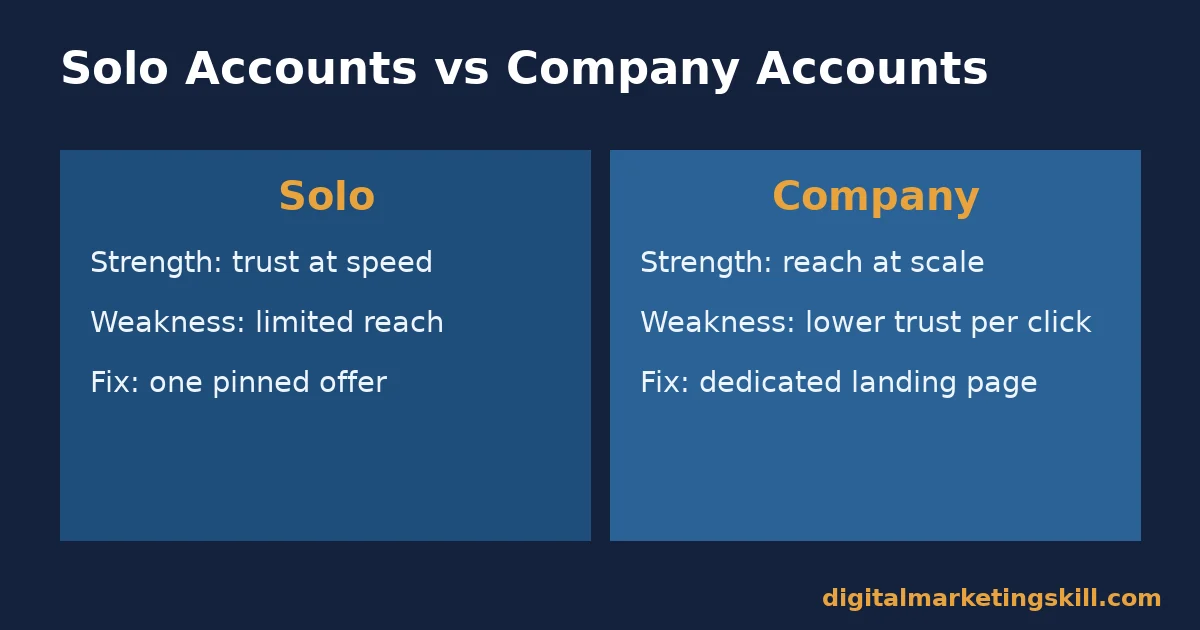
A solo consultant and a company account chase the same outcome: lead contact details. The mechanism that gets them there is different. Copying one account’s playbook onto the other usually fails.
Solo Accounts: Built For Trust At Speed
A solo account’s advantage is a visible person behind every reply. Followers can see who they would be working with before they click anything. That shortens the trust-building step company accounts have to engineer with case studies instead. As a result, a solo account can often turn a cold reply into a warm conversation in a single exchange.
The weakness is reach. A solo account rarely has an ad budget, so every lead has to come from organic replies, quote-posts and DMs. As a result, that caps volume even when each click converts well, and growth tends to be slow but steady rather than sudden.
A solo account also benefits more from the 25-34 and 18-24 age brackets. Together they make up nearly seven in ten viewers of X’s ad audience (Sprout Social). Those groups follow an individual’s running commentary more readily than a corporate feed, and reply more often too.
Company Accounts: Built For Reach At Scale
A company account can buy reach directly. Promoted posts, follower campaigns and X’s native lead-gen ad formats put the offer in front of a chosen audience instead of waiting for the algorithm.
The weakness is trust. A logo and a brand voice convert at a lower rate per visitor than a named person. That is consistent with the below-average 0.69% visitor-to-lead rate the HubSpot study found for Twitter, pulled down partly by brand-voice accounts with no personal reply pattern.
In addition, a company account has more moving parts to coordinate: a content calendar, an ads account, a landing-page builder, usually more than one person posting. Overall, that coordination cost is the real reason company-account lead generation takes longer to set up, not a lack of platform reach.
Fix Your Lead Funnel, By Account Type
The fix for each account type mirrors its weakness. Solo accounts need a way to scale what already converts. Company accounts need a way to borrow the trust a logo cannot provide alone.
Solo Accounts: Lead With A Single Offer
Pin one post with one offer: a checklist, a short audit, or a template. Link it from the bio instead of a generic “DM me.” A specific offer is easier to decide on than an open-ended invitation, so more replies turn into an actual contact.
Reply to relevant threads in your field with a genuine answer first. Only mention the offer when someone asks a follow-up question. This keeps the account’s trust advantage intact instead of trading it for an unwanted sales pitch.
Keep a short list of five to ten accounts whose audience overlaps with yours. Reply to their posts before your own gets attention. A useful reply in front of an engaged audience earns more profile visits than a post published into a quiet timeline.
Company Accounts: Lead With A Landing Page
Send every promoted post to a page built for that specific audience, with the form above the fold and one clear next step. Never the general homepage. A dedicated page removes the extra click a visitor has to make to find the offer, which is where most company-account traffic is lost today.
Add one named person to the account’s replies: a real employee answering real questions in their own voice. This recovers some of the personal-trust effect that keeps solo accounts converting at a higher rate per click. Over time, readers start to recognize that person specifically, which adds a layer of trust a logo alone cannot build.
Run a small test budget across two or three ad creatives before scaling spend on any single one. A company account’s reach advantage only turns into leads if the ad itself earns a click.
Share the same five KPIs below with whoever owns the ad budget, not just the social team. X lead generation stalls when the marketing lead and the sales lead work from different numbers.
Measure What Matters For X Lead Generation
Five numbers show which step of the system is broken. Track them weekly, not just at the end of a campaign.
- Profile-visit rate: the share of people who see a post and tap through to the profile. It shows whether the hook is interesting enough to investigate further.
- Link click-through rate: the share of profile visitors who click the bio link. A low number here usually means the offer is unclear, not that the audience is wrong.
- Visitor-to-lead rate: the share of landing-page visitors who submit a form or start a DM flow. This is the number the HubSpot study measured at 0.69% for Twitter traffic, well under the 6.6% median landing page conversion rate seen across industries generally (Unbounce). Treat your own rate as the thing to beat, not either benchmark.
- Cost per qualified lead: total spend divided by leads that actually match your offer, not just any form submission. This catches a cheap-but-irrelevant lead flow before it wastes a sales team’s time.
- Reply-to-DM rate: the share of public replies that turn into a private conversation. A healthy rate shows the offer is interesting enough to discuss privately, a useful early signal before a campaign has enough volume for the other four numbers.
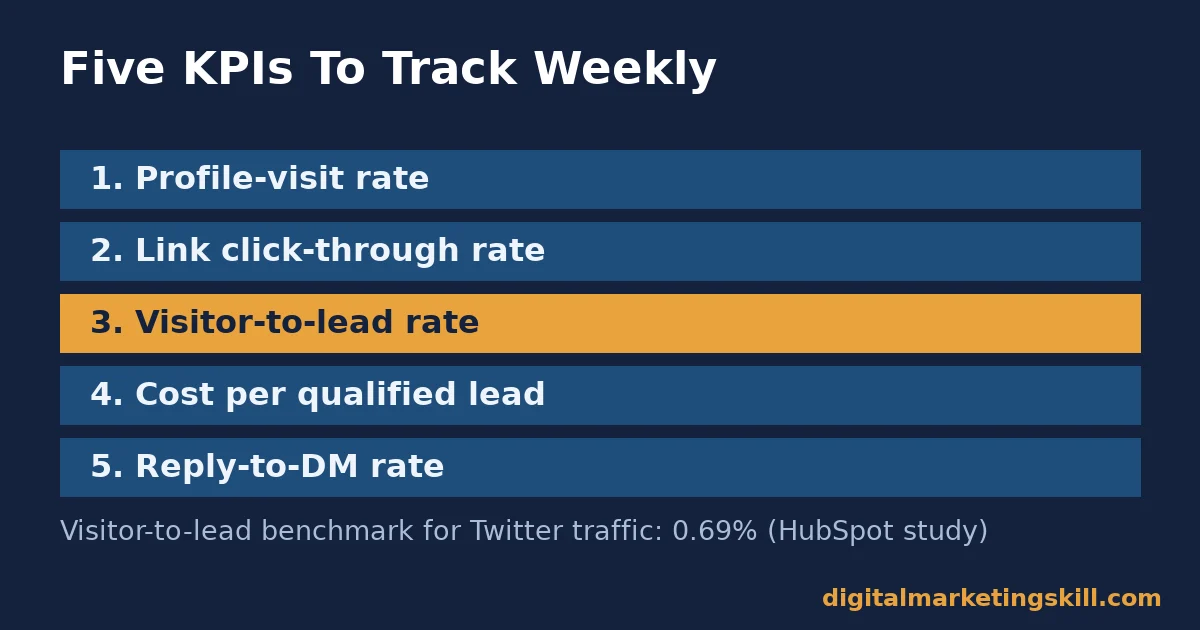
Review these five numbers weekly, not only when a campaign ends. A funnel that looks fine in a monthly report can already be leaking for weeks. A weekly check catches that while it is still cheap to fix.
The One Decision Rule
If your link click-through rate is healthy but your visitor-to-lead rate is below benchmark, the landing page is the problem, not the X account. Fixing the hook further will not rescue a broken page.
Illustrative, invented numbers: an account sending 1,000 profile visitors a month, with a 4% click-through rate and a 1% visitor-to-lead rate, produces 10 clicks and roughly zero reliable leads. Doubling the click-through rate to 8% still only doubles a near-zero number. Raising the visitor-to-lead rate toward a more typical 3-5% changes the outcome far more. That is why the rule points at the page first.
This is also why spending more on ads before fixing the page rarely helps. More budget raises the number of clicks arriving at the same broken page. Consequently, it raises wasted clicks, not leads. Fix the page first, then scale the spend afterward, in that order and not the other way around.
The reverse rule applies too. If your visitor-to-lead rate is already strong but your click-through rate is low, the page is fine and the hook is the problem. Rewrite the post or ad copy first. Changing a page that already converts well risks breaking something that was working.
A Real Case, And Its Limits
Olajire Jacob, a Digital Marketing Skill Institute graduate, built paid email funnels for international clients after training. They described scaling that work to $5,000 a month in service revenue, starting from a $500 client project, as published on the Institute’s reviews page.
This case is about email automation and client service, not X specifically. One case is not a guarantee of similar results for every reader. It is included because the underlying skill, turning a cold contact into a paying client, is the same skill this guide applies to X traffic. See the earnings disclaimer for how to read student income results generally.
What this case does not show: a platform-specific X result, a controlled comparison against other channels, or a timeline for how long the funnel took. Treat it as evidence that the funnel skill transfers across channels, not as a number to expect from any single X account.
In short, the platform changes the tactics. The underlying habit, matching an offer to an audience and measuring what happens, stays the same wherever it gets applied.
Frequently Asked Questions About X Lead Generation
Do I need a large following to generate leads on X?
No. A small, relevant following that includes real buyers converts better than a large, untargeted one. The bio link and the replies are reaching people who already care about the topic.
Should every post ask for a lead?
No. Most posts should earn attention and trust. Only a small share need to carry a direct offer. An account that asks for a contact in every post usually sees engagement drop faster than leads rise.
Are X’s native lead-generation ad cards worth using?
They are worth testing once you already have a working landing page, because the card format removes a click from the funnel. They are not a fix for an offer that has not yet proven it converts on a normal page. In other words, test the offer cheaply on a regular landing page before paying extra for the convenience of a native card.
How many hashtags should a lead-generation post use?
One or two, placed naturally in the sentence rather than stacked at the end. Posts with one or two hashtags earn roughly 21% more engagement than posts using three or more, and reach drops further as more are added (hashtag performance analysis).
What is a realistic visitor-to-lead rate to aim for?
Treat the 0.69% average from the HubSpot study as a floor to beat, not a target. A focused, single-offer landing page commonly converts in the low single digits once the offer and audience are matched. This varies by industry and cannot be promised.
How long does it take to see results from X lead generation?
Most accounts need four to eight weeks of consistent posting, plus at least one landing-page revision, before the five KPIs above form a stable pattern. Therefore, judging X lead generation from one week of data usually leads to the wrong conclusion about which step to fix next.
Does a verified or paid account badge improve lead generation results?
A badge can add a little credibility to a cold profile visit. It does not replace the hook, landing page and capture step covered above. Accounts that rely on the badge instead still see the same low visitor-to-lead rate the HubSpot study found.
Is DM automation a substitute for a landing page?
It can capture a lead without leaving X, which removes a step. It still needs the same single, specific offer a landing page would use. A vague automated DM converts no better than a vague landing page.
How often should a lead-generation account post?
Consistency matters more than frequency. A handful of posts a week, published at the same few times, builds a more measurable pattern than daily posting that stops the moment the account gets busy.
Should I link to a product page or a lead-capture page first?
For most offers, capture the contact first and sell afterward by email or DM. A direct link to a product page skips the step where you build enough trust to convert someone who was not already ready to buy. Overall, the contact-first approach gives you a second and third chance to make the case, instead of only one.
Your Next Step With X Lead Generation
Building a working lead funnel for X lead generation, or any channel, is one of the skills covered in the Institute’s Master Diploma in Digital & AI Marketing. The AI-Powered Social Media Management and Advertising track and the AI-Powered Lead Generation and Email Automation track both cover it, with an option to complete all four tracks as the Full Stack diploma.
Both tracks walk through the same hook-page-capture structure covered in this guide. It applies across whichever channels a business actually uses, so the skill does not expire when a new platform appears.
The program includes unlimited 1-on-1 coaching and mentoring, a U.S. Project Internship with a verified U.S. Work Reference Letter, and dual US and UK accreditation recognised in more than 100 countries. It runs 100% online from anywhere in your country.
Read more student outcomes on the reviews page, browse the blog for more guides like this one, or go straight to apply to start. Wherever you live, the program runs fully online. Explore Digital Marketing Skill Institute to see the full curriculum before you decide, and visit digitalmarketingskill.com for the rest of the blog.
For a platform-by-platform comparison, see our guides to generating leads on LinkedIn and the broader lead generation guide. For the content side of this work, see content marketing and our full X (Twitter) marketing guide.
Every figure in this guide was checked against its original source before publication. Figures marked as illustrative are invented examples, not real results.
![9 Amazing Digital Marketing Skills to Make Money Online [With Proof]](https://digitalmarketingskill.com/wp-content/uploads/2019/07/9-Amazing-Digital-Marketing-Skills-to-Make-Money-Online-With-Proof-17.png)






