
LinkedIn referrals move faster than cold outreach because they borrow someone else’s trust instead of building your own from scratch. A referral is not a mass connection request. It is a specific ask, made to a specific person, through a specific shared contact. This guide shows how to ask for one well.
Key Takeaways
- LinkedIn is a large, specific network. LinkedIn’s own newsroom reports more than 1.3 billion members worldwide.
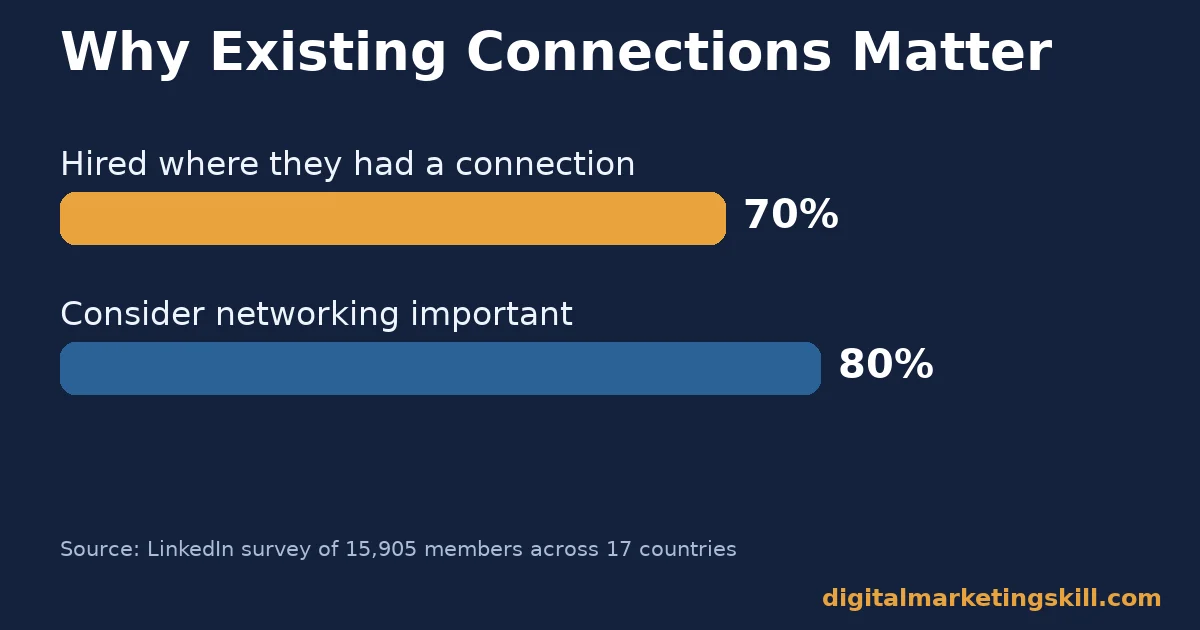
- Existing connections already decide hiring outcomes. In LinkedIn’s own survey of 15,905 members across 17 countries, 70% of people hired said they joined a company where they already had a connection.
- Networking is not optional for most professionals. The same LinkedIn survey found about 80% of respondents consider networking important to career success.
- Warm beats cold by a wide margin. Expandi’s own platform data, drawn from more than 13 million connection requests, found LinkedIn messages reply at 10.3%, roughly double a 5.1% cold email baseline.
- Properly warmed outreach goes further still. The same platform data put warm Messenger-style campaigns at a 16.86% reply rate.
In this guide
- What Most Advice Gets Wrong About LinkedIn Referrals
- How LinkedIn Referrals Actually Happen
- How LinkedIn Referrals Differ by Connection Type
- How to Ask for a LinkedIn Referral From Each Connection Type
- How to Measure Whether Your LinkedIn Referrals Are Working
- The One Rule for Better LinkedIn Referrals: Ask Narrow
- A Real Case: What Platform-Scale Outreach Data Shows
- Frequently Asked Questions About LinkedIn Referrals
- Start With One Specific Ask
What Most Advice Gets Wrong About LinkedIn Referrals
Most LinkedIn advice treats referrals and cold connection requests as the same activity. They are not. A LinkedIn referral asks an existing contact to vouch for you or introduce you. A cold request asks a stranger to accept you, with nothing backing the ask but your profile.
This guide treats LinkedIn referrals as a specific skill, separate from general lead generation. Treat the figures here as current signals from named sources, not guarantees. A platform’s own reply-rate data describes its own customers’ campaigns, not every LinkedIn user.
Databox’s comparison of B2B marketers found that more than half primarily use LinkedIn for B2B marketing. Nearly three-quarters said it was the network that enabled most of their success reaching decision-makers. That reach only turns into a conversation once a referral, not a cold pitch, opens the door.
For the broader lead-generation picture, see our guide to LinkedIn lead generation. This guide goes narrower: the specific mechanics of asking for, and giving, a LinkedIn referral.
How LinkedIn Referrals Actually Happen
A LinkedIn referral has three parts. First, a mutual connection exists between you and the person you want to reach. Second, that mutual connection trusts you enough to vouch for you. Third, you give them an easy, specific way to do it. Miss any one of these and the whole request tends to fall flat, no matter how polished the wording is.
Skip any of the three parts and the referral usually fails. A missing mutual connection leaves nothing to borrow trust from. Missing trust makes the introduction feel forced. And a vague ask leaves your contact to do the work of figuring out what you actually want.
How Many People This Actually Reaches
Pew Research’s social media fact sheet found that about a quarter of US adults surveyed use LinkedIn. That is a smaller slice than the biggest consumer networks, but it concentrates working professionals in a way general social platforms do not.
This concentration is exactly why LinkedIn referrals work differently from a referral on a general social network. The people you need to reach for a job search or a sale are disproportionately likely to already be on LinkedIn, actively maintaining a professional profile.
Why Warm Beats Cold on LinkedIn
Expandi’s own platform data shows LinkedIn direct messages replying at roughly double the rate of cold email. That gap exists because a LinkedIn message arrives inside a professional context the recipient already trusts, even before any personal connection is added on top.
A referral adds a second layer of trust on top of that platform effect. The message no longer comes from a stranger at all. It comes introduced by someone the recipient already knows, which is a different kind of message entirely.
Why Referred Relationships Outperform Generally
The pattern behind LinkedIn referrals shows up well beyond the platform. A Journal of Marketing study tracked roughly 10,000 new customers at a German bank over 33 months. Referred customers carried about 25% higher lifetime value, 18% lower churn, and roughly 25% more profit per year than customers acquired another way.
That study measured bank customers, not LinkedIn introductions, so treat it as supporting evidence for the general pattern rather than a LinkedIn-specific figure. The underlying mechanic is the same one driving LinkedIn referrals: a relationship that starts with someone else’s trust behaves differently from one that starts cold.
The Three-Step Referral Path
Most successful LinkedIn referrals follow the same visible path. Start by identifying a specific person you want to reach. Then find the shortest real connection path to them, usually a second-degree mutual contact. Finally, ask that mutual contact for a specific, easy favour, not a vague one.
How LinkedIn Referrals Differ by Connection Type
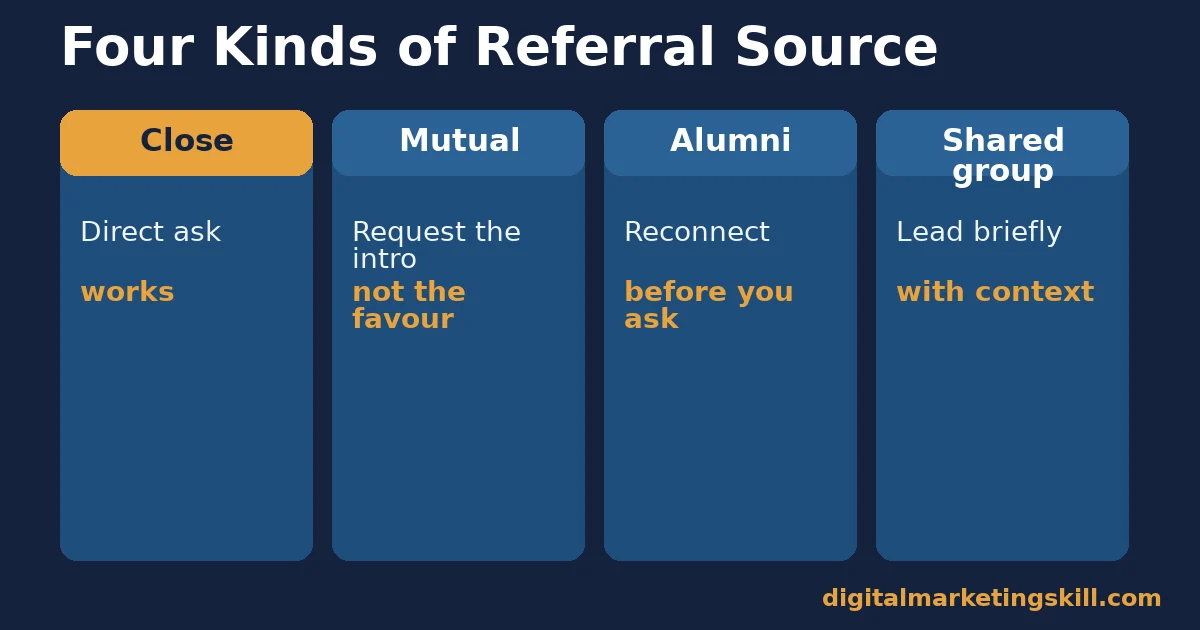
Not every contact is a referral source in the same way. The four connection types below need a different approach, because each one carries a different kind of trust.
Close Connections: Built for a Direct Ask
A close connection, someone you have worked with directly or spoken to recently, already trusts your judgement. They do not need convincing that you are worth introducing. The risk here is being too vague, since a close contact will act quickly on a clear request but may not chase down a fuzzy one.
Mutual Connections: Built for an Introduction
A second-degree contact, reached through someone you both know, needs a different kind of trust transfer. Your mutual connection has to feel comfortable enough to put their own reputation behind the introduction. That means the ask has to be easy for them to say yes to.
Former Colleagues: Built on Trust Already Banked
A former colleague or classmate carries trust from shared history, even after years apart. This trust fades slowly, but it fades. A short reconnection message before the ask usually performs better than an ask with no warm-up at all.
Shared Groups: Built on a Narrow, Borrowed Context
A shared LinkedIn group or alumni network creates a thin layer of context between two people who have never actually met. It is weaker than a real relationship, but it still beats a cold message with no context at all.
Use this context sparingly. Naming the shared group in your opening line signals that you did some homework. Claiming a closer bond than actually exists tends to backfire once the other person checks.
How to Ask for a LinkedIn Referral From Each Connection Type
These steps mirror the four connection types above. Match your message to the kind of trust you are actually drawing on.
A Related Risk: Asking the Same Contact Too Often
A contact who says yes once is not an unlimited resource. Repeated LinkedIn referral requests to the same person, especially within a short stretch, draw down the goodwill that made the first request work in the first place. There is no fixed number of requests that is always safe, since it depends on how close the relationship actually is.
Space requests out. When you do return to the same contact, lead with something that benefits them first, such as a useful introduction of your own. A LinkedIn referral relationship that only flows one direction rarely lasts.
Close Connections: Ask Directly, Make It Easy
Name the exact person or company you want reaching, and explain in one sentence why. Offer a short line they can forward as-is, so saying yes to your LinkedIn referral request costs them thirty seconds, not ten minutes of writing.
Mutual Connections: Request the Introduction, Not the Favour
Ask your mutual connection whether they are comfortable making an introduction, rather than asking them to make one outright. This gives them an easy way to say no without feeling awkward, which paradoxically makes more people say yes.
Former Colleagues: Reconnect Before You Ask
Send a short, genuine message first, with no ask attached. Mention a specific memory or shared project. Only raise the actual referral request in a second message, once they have replied to the first.
Shared Groups: Lead With the Shared Context, Briefly
Open with the specific group or network you share, in one short clause, then move straight to your ask. Do not build the entire message around the shared context, since it is doing a small amount of the work, not most of it.
A Short Checklist Before You Hit Send
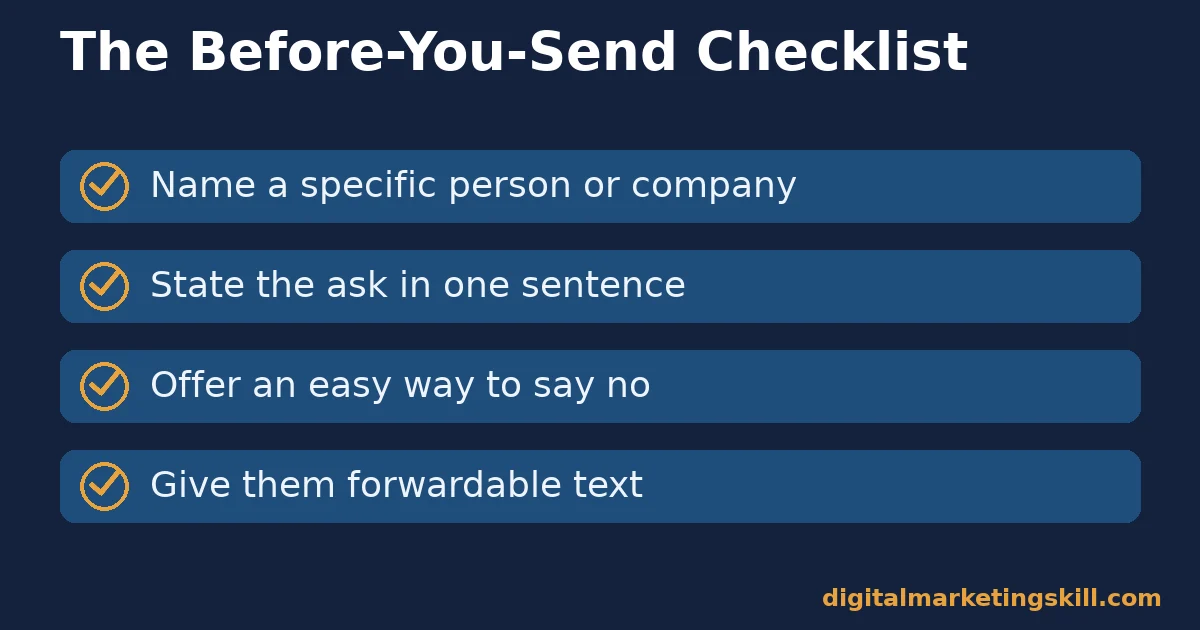
- Name a specific person or company. A vague “any connections at tech companies” ask is far harder to act on than a named target.
- State the ask in one sentence. If your message needs a second paragraph to explain what you want, the ask is not narrow enough yet.
- Offer an easy way to say no. A line like “no worries if this isn’t a good fit” lowers the cost of a yes by removing the awkwardness of a refusal.
- Give them forwardable text. A short paragraph they can copy and paste removes the biggest reason people delay helping: not knowing what to write.
How to Measure Whether Your LinkedIn Referrals Are Working
A referral approach is working if it produces real conversations, not just accepted connections. Track these from your own outreach log, not from LinkedIn’s own counters alone.
What Counts as a Reasonable Response Time
Most people do not check LinkedIn every day. A reasonable window for a first reply is about a week, not a day or two. Judge your referral requests against that window, rather than against the speed of an email or a text message.
If a full week passes with no response, a single polite follow-up is reasonable. A second follow-up rarely helps and often costs more goodwill than it gains, so treat a second silence as a soft no and move on to the next contact.
Four Metrics That Show Real Progress
- Response rate. The share of referral requests that get any reply at all, positive or negative, within a set window such as one week.
- Introduction rate. The share of requests that convert into an actual introduction or forwarded message, not just an acknowledgement.
- Meeting rate. The share of introductions that turn into an actual call or meeting with the target contact.
- Time to response. How long a typical referral request takes to get a reply; a rising average often signals your ask has become too vague or too frequent.
Our guide to LinkedIn optimization covers the profile work that makes a referral easier to accept in the first place, since a thin profile undercuts even a well-written ask.
Keeping a Simple Referral Tracking Sheet
A basic spreadsheet beats memory for tracking LinkedIn referrals. List the contact’s name, the date you reached out, whether they replied, and what happened next. Four columns are enough; a complicated system you abandon after a week helps no one.
Review the sheet every few weeks rather than daily. Patterns in response rate and introduction rate only become visible once you have enough rows to compare, and checking too often just adds anxiety without adding information.
Reading the Numbers Together
Start with response rate, since it is the first and easiest number to move. A low response rate usually points to the ask itself as the problem. When responses are fine but introductions are not happening, the issue has shifted to how easy you are making the favour.
The One Rule for Better LinkedIn Referrals: Ask Narrow
If you only remember one rule, make it this one. The narrower your ask, the more likely someone is to act on it. A vague request for “any helpful connections” asks your contact to do your thinking for you, and most people quietly do nothing instead.
Here is an illustrative example, with invented numbers. A job seeker sends twenty broad messages asking contacts for “any leads,” and gets two replies. They switch to naming one specific company and one specific role per message, sent to twenty different contacts. Replies roughly triple, because each contact can say yes or no in seconds rather than having to think of someone first.
A Real Case: What Platform-Scale Outreach Data Shows
Expandi, a LinkedIn outreach platform, published an analysis of its own customer campaigns covering more than 13 million connection requests and 6 million outbound messages. Across that dataset, plain LinkedIn messages replied at 10.3%, while warmer, more personalised Messenger-style campaigns reached 16.86%.
The data carries real limits. It reflects one platform’s paying customers, who are already running structured outreach campaigns, not a random sample of all LinkedIn activity. It also measures messages in general, not referral requests specifically. Treat it as directional evidence that warmth and personalisation raise reply rates, not as a guaranteed figure for your own referral requests.
The direction still matches what this guide argues throughout. A message that borrows existing trust, whether through a platform’s warming sequence or a genuine mutual connection, consistently outperforms a cold one. The exact percentage will vary by audience, industry and how well the message itself is written.
Frequently Asked Questions About LinkedIn Referrals
What is a LinkedIn referral, exactly?
It is a specific request made to an existing connection, asking them to introduce you to someone they know or vouch for you directly. It differs from a cold connection request, which carries no existing relationship behind it.
How do I ask for a LinkedIn referral without sounding pushy?
Make the ask specific and easy to decline. Name exactly who or what you want, explain briefly why, and make clear that a simple “not comfortable with this one” is a fine answer.
Should I ask for an introduction or make the request myself?
Ask for an introduction when you do not already know the target contact. Reach out directly once you have one, using the introduction as the opening line, since repeating a redundant ask to your mutual connection wastes their goodwill.
How many mutual connections do I need before asking for a referral?
One genuine one is enough, provided the trust is real. A long list of weak, rarely-interacted-with connections is less useful than a single contact who would actually recognise your name.
Does a complete LinkedIn profile actually affect referral success?
Yes, indirectly. A thin or outdated profile makes your mutual connection’s introduction look worse, since the person they are vouching for does not match the story they are telling about you.
How long should I wait before following up on a referral request?
Give it at least a week before a gentle follow-up. A referral is a favour, not a transaction, so chasing too quickly can undo the goodwill the request was built on.
Is it rude to ask a former colleague for a referral after years of silence?
It is better to reconnect first. A short, genuine message with no ask attached, followed by the actual request once they reply, performs better than an ask with no warm-up at all.
Can I ask for a LinkedIn referral from someone I have never met in person?
Yes, provided there is a genuine shared context, such as a long history of commenting on each other’s posts or membership in the same professional group. A connection with no real interaction behind it carries little trust to borrow.
Does paying for LinkedIn Premium make referrals easier?
Not directly. Premium features such as InMail can help you reach people outside your network, but they do not create the trust a genuine referral relies on. Treat Premium as a reach tool, not a substitute for a real connection.
What should I do if my referral request gets no response at all?
Send one polite follow-up after about a week, then let it go. Treat continued silence as a soft no rather than a problem to solve, and move your attention to the next contact on your list.
Start With One Specific Ask
LinkedIn referrals work best as a narrow, specific skill, not a volume game. Pick one real target contact, find the shortest genuine path to them, and write one request specific enough that your mutual connection can say yes in under a minute. Repeat that process consistently, and LinkedIn referrals compound in a way a single cold message never does.
If you want to build this kind of networking and lead-generation skill properly, Digital Marketing Skill Institute teaches it hands-on inside the Master Diploma in Digital & AI Marketing. The diploma runs across four AI-powered tracks totalling ten courses, including the AI-Powered Lead Generation and Email Automation track, with a Full Stack option for completing all four.
Every student gets unlimited 1-on-1 coaching and mentoring, plus a U.S. Project Internship with a verified U.S. Work Reference Letter. The diploma is dual US and UK accredited, and it is recognised in more than 100 countries. For a broader look at building your presence first, see our guide to building your personal brand on social media.
The programme is 100% online, so you can apply what you learn anywhere in your country. Browse more guides on the Digital Marketing Skill Institute blog, or when you are ready, apply for the Master Diploma from Digital Marketing Skill Institute.
Every figure in this guide was checked against its original source before publication. Figures marked as illustrative are invented examples, not real results.
![9 Amazing Digital Marketing Skills to Make Money Online [With Proof]](https://digitalmarketingskill.com/wp-content/uploads/2019/07/9-Amazing-Digital-Marketing-Skills-to-Make-Money-Online-With-Proof-17.png)






