
Website ranking is the position your pages hold in search results for a given term. It depends on three things working together: content that matches search intent, trusted sites linking to you, and a technically healthy site Google can crawl. There is no shortcut. There is only a repeatable process.
Key Takeaways
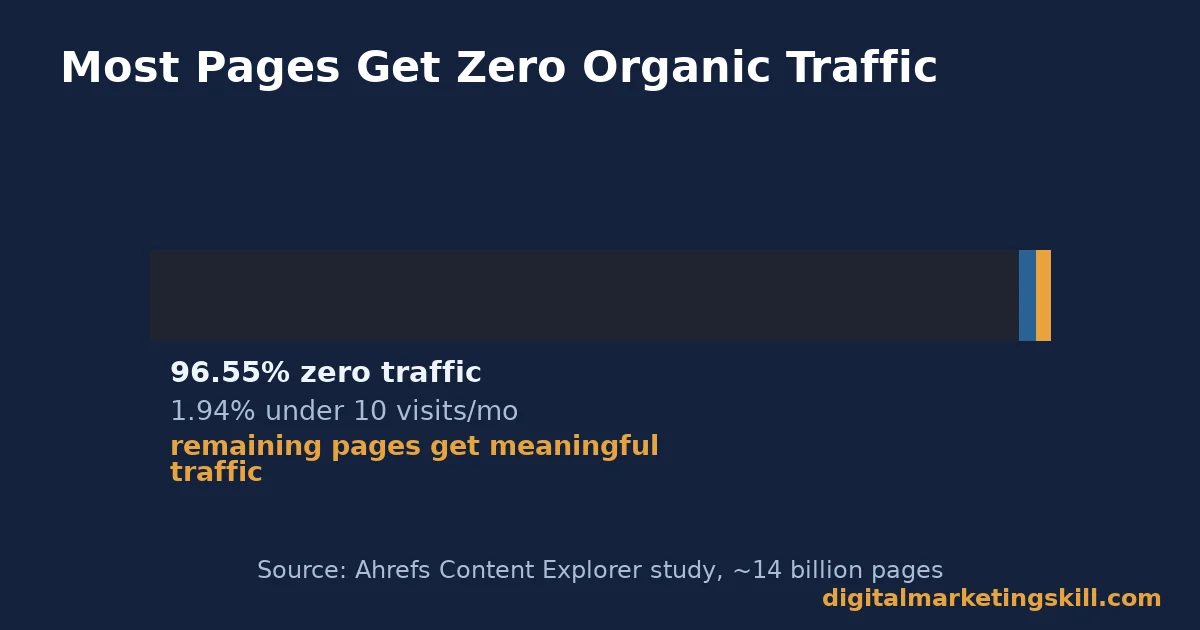
- 96.55% of pages get zero traffic from Google, and another 1.94% get fewer than 10 monthly visits (Ahrefs, Content Explorer study).
- The average page in Google’s top 10 results runs about 1,447 words (Backlinko, 11.8 million search results analyzed).
- Referring domains correlate with top-20 rankings at roughly 0.24-0.26, a moderate but real relationship (Ahrefs, 1 million keywords studied).
- Google rewrote 61.6% of title tags in one large study; titles 51-60 characters had the lowest rewrite rate (Zyppy, 80,959 title tags).
- Crawling alone can take “a few days to a few weeks,” and Google’s own documentation states indexing is never guaranteed (Google Search Central).
In this guide
- The Gap: Why Most Pages Never Achieve Website Ranking
- How Website Ranking Actually Works
- What Differs By Website Ranking Lever
- How to Fix Each Website Ranking Lever
- Measuring Whether Your Website Ranking Work Is Paying Off
- The One Decision Rule: Fix Crawlability Before Anything Else
- A Quick Website Ranking Checklist
- Real Case: Scaling Organic Traffic With Clusters, Not One-Off Posts
- Frequently Asked Questions About Website Ranking
- Put This Into Practice
The Gap: Why Most Pages Never Achieve Website Ranking
Here is an informed inference, not a settled fact. Most site owners treat website ranking as a single lever. Usually that lever is keywords, or backlinks, alone. It is not one lever. It is three systems working at once.
The scale of the gap is stark. Ahrefs found that 96.55% of pages get zero organic traffic from Google, drawn from a study of roughly 14 billion pages. An additional 1.94% get fewer than 10 visits a month, which means well over 98% of all indexed pages are effectively invisible in search. Most of those pages were not thin or spammy. They were simply missing one of the three systems this guide covers.
It is worth sitting with that number for a moment. Nearly every page that has ever been published sits somewhere in that silent 98%, including pages written by people who did genuinely useful work. The gap, in other words, is not usually a quality problem. It is a systems problem, and systems problems have systematic fixes.
No Guarantees, Only a Process
One ground rule before we go further: nobody can guarantee a specific website ranking. Google’s own SEO guidance states plainly that “no one can guarantee a #1 ranking.” Treat every figure below as a snapshot from the study that measured it. None of them is a formula you can plug numbers into.
That same Google guidance recommends a useful screening question for anyone offering to improve your website ranking: ask for “examples of past work” and “how will you measure the success of your work.” A real practitioner can answer both without hedging. Anyone who cannot is selling a shortcut that does not exist.
How Website Ranking Actually Works
Website ranking runs through three stages. A page has to clear all three before it ranks for anything.
Crawling comes first. Googlebot has to find your page, usually through a link or a sitemap. Indexing comes next. Google has to decide the page is worth storing and understanding. Ranking comes last. Google compares your indexed page against every other indexed page for a search term, and picks an order.
Each stage has its own timeline. None of them is instant. Google’s own documentation states that crawling “can take anywhere from a few days to a few weeks.” Requesting a crawl, it adds, “does not guarantee that inclusion in search results will happen instantly or even at all.” A new page with no existing authority can sit in this pipeline for weeks before it shows up anywhere.
What Ranking Actually Compares
Once a page is indexed, ranking comes down to relevance, authority and experience. Google’s documentation on Core Web Vitals confirms they are “part of Google’s core ranking systems,” alongside other page experience signals. Passing scores alone never guarantee a top spot, though. Content quality and backlinks still carry more weight.
It also helps to know what Google is actually comparing your page against. For every search, Google is not simply looking for “a good page.” It is looking for the best available match among every page it has already indexed for that exact query, which is why a technically perfect page on the wrong topic still loses to a rougher page that answers the question more directly.
This is also why website ranking is relative, not absolute. Your page does not need to be flawless. It needs to be the best available answer among the pages Google has indexed for that specific search, at that specific moment, which is a bar that shifts constantly as competitors publish, update and occasionally remove their own content.
What Differs By Website Ranking Lever
Three levers drive most website ranking outcomes. Each one works differently. Weakness in any single lever caps what the other two can achieve.
Content Depth: Built For Completeness, Not Length Alone
Backlinko’s analysis of 11.8 million search results found the average top-10 page runs about 1,447 words. That is a correlation, not a rule. Longer pages tend to cover a topic more completely, and completeness is, in turn, what actually gets rewarded.
For example, a 500-word page can genuinely outrank a 2,000-word page on the same topic, provided it answers the query more directly and the longer page is padded with repetition. Word count, in other words, is a side effect worth tracking, not a goal worth chasing on its own.
Backlink Authority: Built For Trust, Not Volume Alone
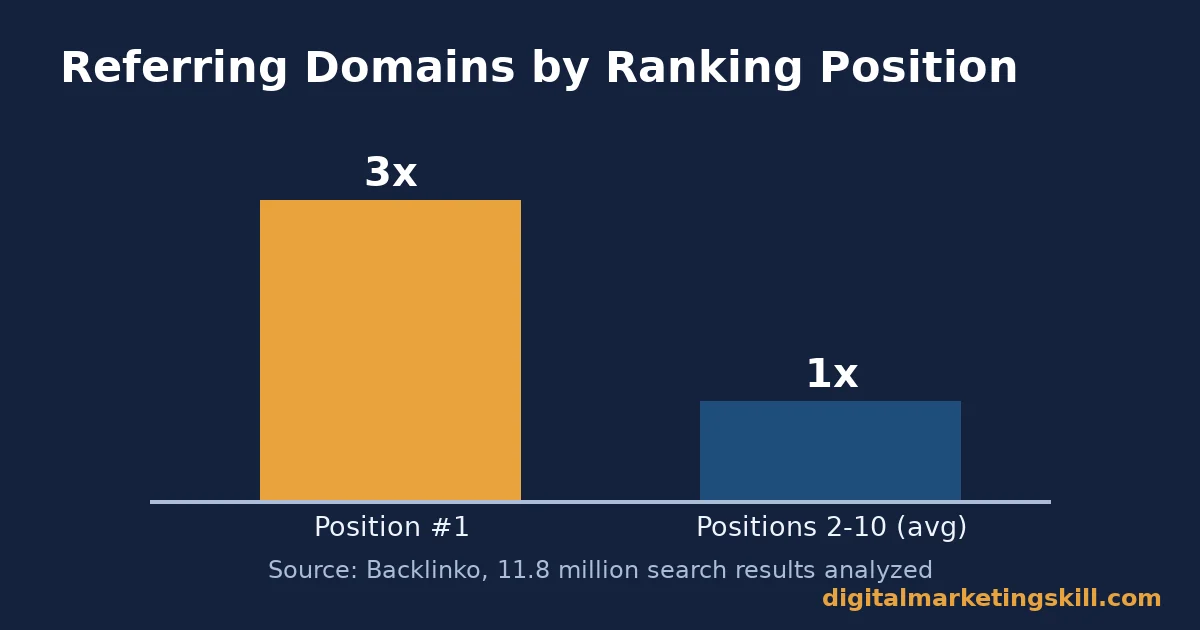
Ahrefs studied around 1 million keywords and found referring domains correlate with top-20 rankings at roughly 0.24 to 0.26. That is a real but moderate relationship, not a guarantee. Backlinko, meanwhile, separately found the average #1 result has about three times more referring domains than results in positions two through ten, which suggests the relationship strengthens specifically near the very top of the results.
Technical Health: Built For Access, Not Just Speed
A page that is slow, blocked from crawling, or missing from a sitemap never gets the chance to compete on content or backlinks. Technical health is, therefore, the gate the other two levers have to pass through first. As a result, a technical problem is usually the cheapest fix on this list and the easiest one to overlook, because nothing about the page’s own content or links points to it.
A fast, well-structured site also supports the other two levers indirectly. Visitors stay longer on a page that loads quickly, and a longer, more engaged visit is itself a signal of a genuinely useful page, the same kind of signal that content depth and backlinks are trying to earn through different means.
How to Fix Each Website Ranking Lever
Each lever above has a specific, practical fix. Work through them in order. Fixing content on a page Google cannot crawl wastes the effort.
Content Depth: Lead With the Full Answer, Not a Padded One
Cover the topic’s full scope. Include every subtopic a searcher would reasonably expect, in one place, rather than splitting it across five thin pages. Length should be a side effect of completeness, never a target you write toward directly.
Backlink Authority: Lead With Something Worth Linking To
Build one genuinely citable asset: original research, a free tool, or a uniquely clear explanation. That beats chasing links to a generic page. Other sites link to pages that make their own content better, not to pages that simply ask nicely.
Technical Health: Lead With Crawlability First
Confirm the page is not blocked in robots.txt. Check that it actually appears in your sitemap. Then make sure it loads fast enough that Googlebot does not give up partway through. Fix these before touching anything else, because they are usually a one-time technical check, not an ongoing project. Consequently, once this check is done for a site, it rarely needs repeating unless a major platform or theme change happens later.
Measuring Whether Your Website Ranking Work Is Paying Off
Four numbers tell you whether website ranking work is actually paying off. Each one isolates a different part of the system.
- Average position, from Google Search Console, tracks where your pages typically rank for their target queries. A slow, steady rise over weeks is the realistic pattern, not a sudden jump.
- Indexed pages, also from Search Console, confirms Google can actually see the pages you want ranked. A page cannot rank if it is not indexed. This number is a prerequisite check, not a vanity metric.
- Referring domains tracks how many separate websites link to you, not just how many total links exist. Ten links from ten different sites matter more than fifty links from one.
- Organic traffic is the outcome metric that ties the first three together. Rising average position with flat traffic usually means you are ranking for the wrong queries.
Check these monthly, not daily. Website ranking moves slowly enough that daily checks mostly show noise, not signal. A single day’s position can move several spots up or down for reasons that have nothing to do with your page, so treat daily fluctuation as background noise, not a signal worth reacting to.
How to Read the Trend, Not the Noise
Instead, compare the same four numbers month over month. If average position is improving but organic traffic is flat, that usually means you are moving up for low-volume queries, which is still progress, just not the kind that shows up in a traffic chart yet. Give any single change at least a full month before judging it, since shorter windows rarely separate a real trend from ordinary variance.
The One Decision Rule: Fix Crawlability Before Anything Else
If you remember one rule from this guide, make it this one. Before writing another word of content, or chasing a single backlink, confirm Google can actually crawl and index the page. Every other website ranking effort is wasted on a page Google cannot see.
Why this order? Content and backlinks are investments that compound over weeks and months. A crawlability problem blocks that compounding entirely. It does so silently, often without any obvious symptom beyond flat traffic.
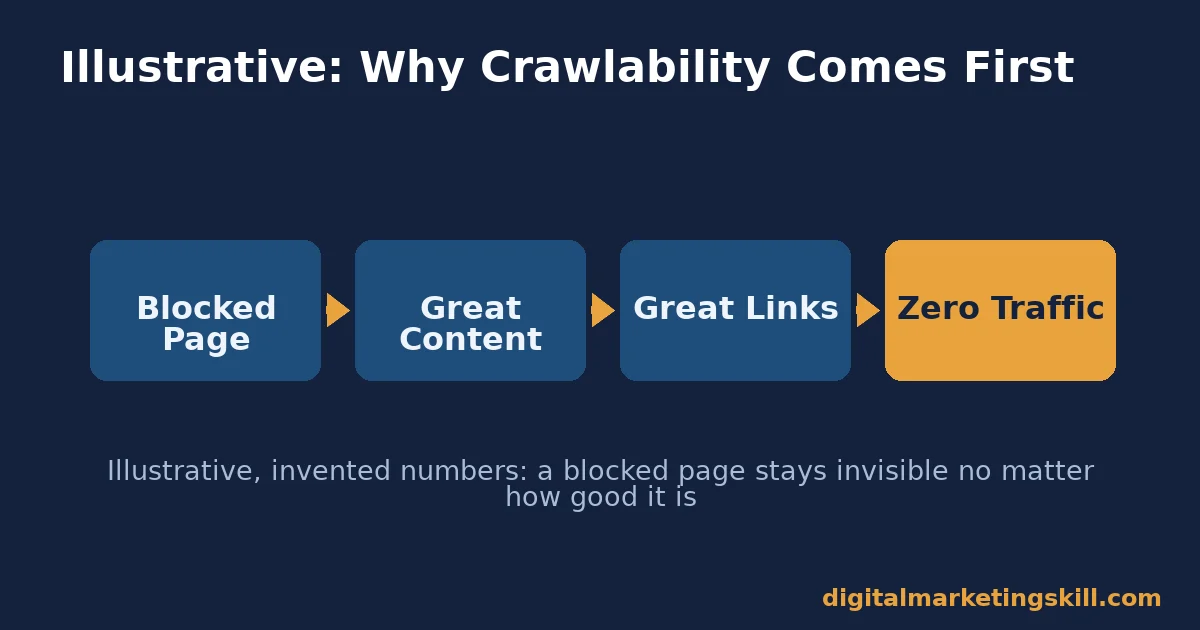
Here is an illustrative example, with invented numbers, not a real study. Imagine two identical articles. One is blocked in robots.txt by accident. One is not. Over six months, the unblocked article might climb steadily toward page one. The blocked article, no matter how well written or well linked, would plausibly show zero organic traffic the entire time.
In this illustrative scenario, the technical fix is worth more than every other optimization combined. It is the one fix that makes the others possible at all. Check your robots.txt, your sitemap, and the URL Inspection tool in Search Console first, every time, before any other website ranking work begins.
A Quick Website Ranking Checklist
Run through this short list before investing further in content or links for any page:
- Confirm the page is indexed, using the URL Inspection tool in Search Console.
- Check robots.txt and the sitemap for accidental blocks or omissions.
- Read the page as if you were the searcher: does it fully answer the query, not just mention it?
- List what would make another site want to link to this page, specifically.
- Track average position and organic traffic monthly, not daily, and watch the trend, not the noise.
None of these steps takes long on its own. Together, they catch most of the reasons a page fails to improve its website ranking despite real effort going into it. Run through the list again after any major content update, rather than only once when a page first goes live.
Real Case: Scaling Organic Traffic With Clusters, Not One-Off Posts
G2’s own Learning Hub published a case study of its content strategy. The team grew blog organic traffic from roughly 3,000-5,000 monthly sessions to 991,748 organic sessions over about two years. They credit keyword research, topic clustering of 20-40 articles per cluster, a dedicated outreach and link-building team, and consistent on-page SEO fundamentals.
G2’s own write-up does not isolate which single factor mattered most. The result reflects a well-resourced team working for two full years, not a quick win. Still, the mechanism is instructive: clustering 20-40 related articles together, rather than publishing isolated posts, builds the kind of topical completeness and internal linking that supports every page in the cluster, not just the biggest one. Treat it as evidence that the three levers in this guide compound when applied together and sustained, not as a timeline you should expect to match.
Frequently Asked Questions About Website Ranking
How long does website ranking actually take?
Crawling alone can take a few days to a few weeks, according to Google’s own documentation. Ranking improvements typically unfold over months, not days. Expect a slow, compounding climb rather than a fast jump. Treat any promise of guaranteed fast rankings as a red flag.
Do I need backlinks to improve website ranking?
Backlinks correlate meaningfully with higher rankings in large studies, but the relationship is moderate, not absolute. A page with strong content and no links can still underperform a weaker page with many trusted links pointing to it. Treat backlinks as one of three levers, not the only one.
Does content length directly cause better website ranking?
No. Longer top-ranking pages are a correlation, not a cause. Length works when it reflects genuine completeness on a topic. Padding a short answer to hit a word count target does not reproduce the same effect.
Can I improve website ranking without any technical SEO work?
Only partially, and only temporarily. A page with real crawlability or indexing problems caps what content and backlinks can achieve, no matter how good either one is. Technical health is a prerequisite, not an optional extra.
What is the single biggest mistake that hurts website ranking?
Treating content, backlinks and technical health as separate projects instead of one system. A page can have excellent content and still rank poorly if it is slow or blocked. It can have strong links and still underperform if the content does not answer the query.
How do I know if my website ranking problem is technical?
Check whether the page is actually indexed, using the URL Inspection tool in Search Console, before assuming the problem is content or backlinks. A page that is not indexed cannot rank for anything, regardless of how good the content is.
Should I target one keyword per page for website ranking?
Target one primary topic per page, built around a main keyword. Still cover closely related terms a searcher would also use, naturally, within that same page. Splitting near-identical topics across multiple thin pages usually dilutes website ranking rather than improving it.
Why did my website ranking drop after I did not change anything?
Competitors publish and update content constantly, so a static page can lose ground even without any change on your end. Google also rolls out ranking algorithm updates on an ongoing basis, and a page that relied on a factor that lost weight in an update can slip, through no fault of its own.
Is paid advertising a substitute for website ranking?
No. Paid ads stop the moment you stop paying, while a well-ranked organic page keeps earning traffic for as long as it holds its position. The two can work together, with ads providing faster, temporary visibility while organic website ranking work compounds in the background.
Does social media activity help website ranking?
Not directly. Google has stated social signals are not a direct ranking factor, though social sharing can indirectly help by exposing content to people who then link to it from their own websites. Treat social media as a distribution channel for earning links, not as a ranking factor in its own right.
How many backlinks do I actually need for website ranking?
There is no fixed number, because quality and relevance matter more than raw count. A handful of links from genuinely authoritative, topically relevant sites typically outperforms dozens of links from low-quality or unrelated ones, so chase the right links rather than a target quantity.
Can an old page be re-optimized for better website ranking, or should I start over?
Updating an existing page almost always beats starting over, provided the page already has some history and inbound links. A fresh page starts the crawling and indexing clock from zero, while an updated page keeps whatever trust it has already earned and simply asks Google to re-evaluate improved content.
Put This Into Practice
Improving website ranking is rarely about one clever trick. It is about running all three levers (content depth, backlink authority, technical health) at the same time, and giving the process the months it realistically needs.
If you want to build this skill properly, alongside the wider toolkit of technical SEO and content strategy, look at the Digital Marketing Skill Institute’s Master Diploma in Digital & AI Marketing. It includes an AI-Powered WordPress and SEO Specialist track among its four AI-powered tracks, built from ten execution-first courses in total, with a Full Stack option for completing all four.
What the Program Includes
The program pairs unlimited 1-on-1 coaching and mentoring with a U.S. Project Internship and a verified U.S. Work Reference Letter. It is dual US and UK accredited, and recognised in more than 100 countries. Because it runs 100% online, you can study and apply what you learn anywhere in your country.
Technical health and content depth work together with the basics covered in our guide to website SEO tips, and a fast, well-structured site starts with website page speed. Read more real outcomes on the reviews page, browse the digital marketing blog for more practical guides, or go straight to the application page to see if the program fits. Wherever you live, these same three levers apply the same way. Learn more at digitalmarketingskill.com, or start your application at digitalmarketingskill.com today.
Every figure in this guide was checked against its original source before publication. Figures marked as illustrative are invented examples, not real results.