
A marketing budget is the plan that turns strategy into approved spending. Most proposals stall for one reason: they speak marketing language, not finance language. This guide covers three budgeting models, how to pitch each one to a CFO, which numbers to track, and one rule for picking the right model.
Key Takeaways
- Marketing budgets averaged 9.6% of total company budget and 9.0% of revenue in the most recent Deloitte-Duke CMO Survey. Both figures sit at their lowest level in several survey cycles.
- Gartner’s CMO Spend Survey puts budgets at 7.8% of revenue. That is far below the roughly 11% average firms held before the post-pandemic pullback.
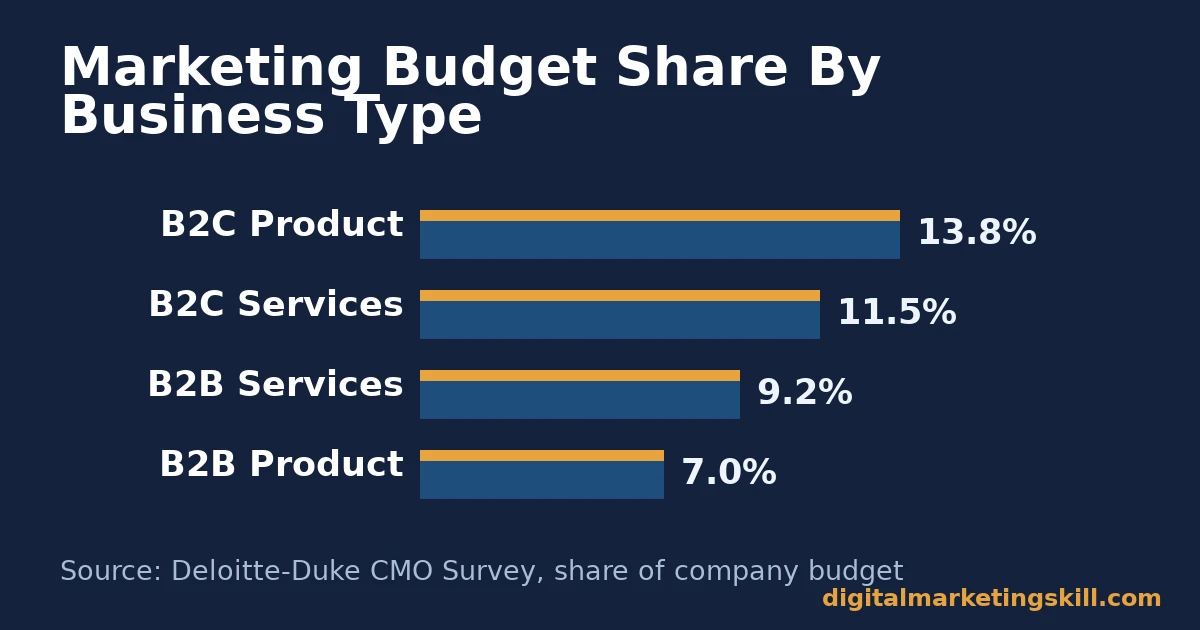
- Budget share varies sharply by business type. B2C product companies allocate 13.8% of company budget to marketing, versus 7.0% for B2B product companies, per the CMO Survey.
- Digital channels now take roughly 67.5% of marketing spend, up from 54.9%. Traditional advertising has fallen to about 3.8%, Gartner and the CMO Survey both report.
- Measuring marketing ROI is the single biggest challenge marketing leaders report. HubSpot found 33.0% of over 1,500 surveyed marketers named it their top obstacle.
In this guide
- The Marketing Budget Approval Gap
- How a Marketing Budget Actually Works
- Marketing Budget Allocation by Channel
- What Differs by Marketing Budget Model
- How to Present Each Marketing Budget Model
- Measuring Whether Your Marketing Budget Is Working
- The One Rule for Choosing a Marketing Budget Model
- A Real Case: What CFOs Actually Approve, By Business Type
- Common Marketing Budget Mistakes to Avoid
- Frequently Asked Questions About Marketing Budgets
- Build the Skills Behind Every Approved Budget
The Marketing Budget Approval Gap
Most marketing budget proposals get stuck for one reason. The marketer explains reach, engagement, and brand lift. The CFO wants payback period and cost per acquisition. These are two different conversations.
This guide offers a framework, not a guarantee. Every company’s approval process differs. Instead, no single tactic replaces trust between marketing and finance, built across several budget cycles. So treat what follows as a starting structure you adapt, not a script you read word for word.
The ground rules are simple. Use finance’s own vocabulary, not marketing jargon, the way Google’s own guidance on CFO-facing terms recommends. Show your math instead of asserting a conclusion. Admit what you cannot yet measure. CFOs approve budgets they can defend to their own boss, instead of ones that merely sound confident.
One more rule matters. A marketing budget proposal is a snapshot of one cycle, not a permanent verdict on marketing’s value. Treat a rejection as feedback on this version, instead of a verdict on the function itself.
A clear target audience definition also changes how a budget reads. A proposal built around a named, researched audience lets you estimate cost per result with real confidence. One built around a vague customer description cannot do that, and CFOs notice the gap fast.
How a Marketing Budget Actually Works
A marketing budget is simply money set aside for a period. It gets split across channels, people, and tools, then matched against expected results. Every approval runs on three moving parts.
First, a baseline: how much money exists, usually set as a percentage of projected revenue or of the overall company budget. Second, an allocation: how that pool splits between paid media, content, martech, and labor. Third, a justification: the logic tying each line item to a business outcome the CFO already tracks, such as pipeline or margin.
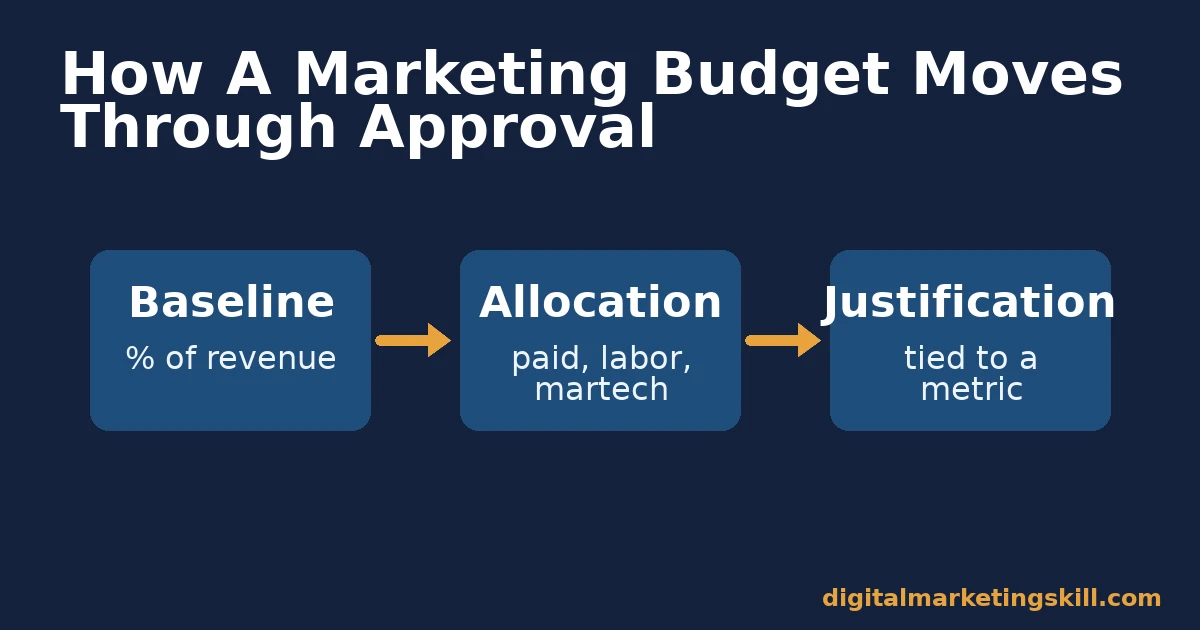
Finance teams test that third part above all else. If the justification holds up under questioning, the number usually survives, even when it is large. If it does not, even a modest number gets trimmed, because an unjustified dollar reads as risk, not investment.
So the three models below matter more than the dollar figure itself. Each model changes which questions you must be ready to answer. Switching models mid-cycle, with no explanation, is one of the fastest ways to lose finance’s confidence.
Mapping spend against the stages of your sales funnel helps too, not just against channels. A budget that funds only top-of-funnel awareness, with nothing for consideration or decision stages, tends to produce reach without pipeline. So a sharp CFO will ask about that gap directly.
Marketing Budget Allocation by Channel
Once the baseline is set, finance will ask how the money splits by channel. Gartner’s CMO Spend Survey reports paid media now takes 31.4% of the typical marketing budget, labor 24.5%, and martech 19.4%.
Meanwhile, the mix inside that paid media share has shifted hard toward digital. Digital channels now account for roughly 67.5% of marketing spend, versus 54.9% a few survey cycles earlier. Traditional advertising has fallen to about 3.8% of budgets, according to the CMO Survey. Within digital spend, search and social advertising are the two largest line items.
None of this means every company should match these averages. But a local service business and a global software company face different channel economics entirely. Use the breakdown as a gut check on an unusual allocation, not as a target to copy exactly.
A seasonal business faces a different question again. Spend can concentrate heavily in the months that drive most of the year’s revenue, with a smaller baseline budget the rest of the year. A flat monthly allocation often fits this pattern poorly, even when the annual total looks reasonable.
Labor and martech deserve the same scrutiny as paid media, though they rarely get it. A software line item that grows every cycle, with no matching growth in output, is an easy place for a CFO to find savings. No campaign even needs to change.
What Differs by Marketing Budget Model
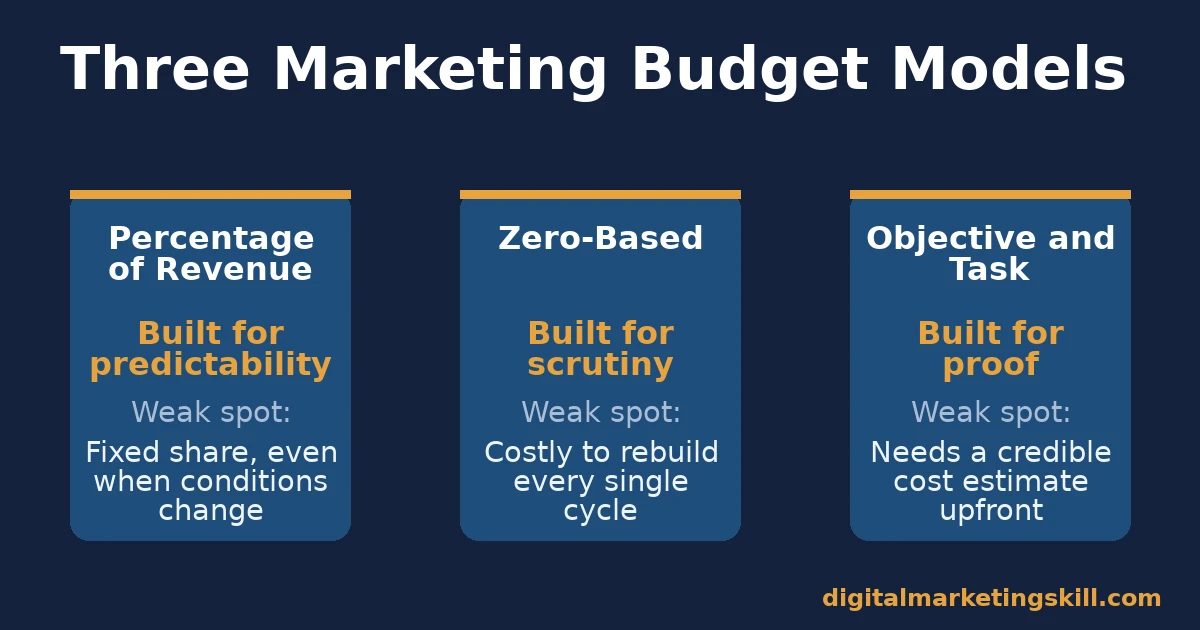
Three models cover most real-world marketing budgets. Each has a strength, and a weak spot a CFO will probe first.
Percentage-of-Revenue Budgeting: Built For Predictability
Here, marketing gets a fixed share of projected revenue, often 6-10%, the range the CMO Survey and Gartner both call typical. It is simple to plan around. It is also simple for finance to fit into the wider company budget, which is exactly why it remains the default starting point.
Its weakness is that it treats marketing as a cost that scales with sales, instead of a lever that creates sales. A sharp CFO will ask why the share should stay fixed when market conditions, competition, or a new launch change the underlying math.
Zero-Based Budgeting: Built For Scrutiny
Zero-based budgeting starts every cycle at zero, not from the prior cycle’s number. As a method, every line item must be justified again from scratch. It is common after a leadership change or during cost-cutting, because it exposes spending nobody has questioned in a while.
Its weakness is time. So rebuilding every justification each cycle costs real hours. Most finance teams only tolerate it occasionally, not as a permanent default. Teams that try to run it every single cycle often burn out before the insight pays off.
Objective-and-Task Budgeting: Built For Proof
Here, you start with a business objective, such as a lead-volume target, and work backward to the spend it requires. Instead, the budget is a sum of tasks, not a percentage of anything. It is the most literal translation of strategy into dollars.
Its weakness: it demands a credible cost-per-result estimate before the campaign has run. So that is hard for a genuinely new channel or audience. These budgets also expose a marketer’s forecasting skill directly, since every miss is visible against the original number.
How to Present Each Marketing Budget Model
Choosing the right model is half the job. Presenting it the way finance actually evaluates proposals is the other half. Each model above has a matching opening move.
Percentage-of-Revenue Budgeting: Lead With the Benchmark
Open with the external benchmark for your business type. Then explain any gap from it. A B2C product company citing the CMO Survey’s 13.8% figure has an easier opening line than one that states a number with no anchor at all.
Next, explain the trend behind the number. So a flat percentage with no trend context reads as arbitrary. If budgets industry-wide have dropped, say so, and explain why your figure still makes sense for your stage and growth target.
Zero-Based Budgeting: Lead With the Justification Trail
Show the full paper trail: which old line items you cut, why, and what you reinvested the savings into. A CFO reading a zero-based proposal checks whether you questioned your own past spending, not just the new requests.
Name at least one thing you eliminated. A budget with zero cuts rarely looks zero-based to the person reviewing it, whatever the document is titled. So a reviewer who spots that gap will usually ask about it directly.
Objective-and-Task Budgeting: Lead With the Business Metric
Translate the objective into the metric finance already tracks before you mention a single channel. Pipeline value, not impressions. Net new customers, not followers. Then show the math connecting spend to that metric, step by step.
Keep the chain short: spend, result, business metric. Long chains with weak links in the middle are the easiest part of any budget to pick apart. A skeptical reviewer will find them fast. Cut any step you cannot defend under direct questioning.
This same chain works for any channel, not just a new one. Even a long-running campaign benefits from re-stating the chain occasionally, since a CFO reviewing a renewal budget asks the same questions a CFO reviewing a brand-new proposal would.
Measuring Whether Your Marketing Budget Is Working
A marketing budget proposal is only as strong as the measurement plan behind it. Five numbers cover most conversations with finance.
Customer Acquisition Cost (CAC) is total marketing and sales spend divided by new customers gained in the period. Read it beside customer lifetime value. So a rising CAC is only a problem if lifetime value is not rising faster.
Marketing-sourced pipeline is the dollar value of sales opportunities marketing directly generated. Read it as a leading indicator. It moves weeks or months before revenue does, which means it is the number to watch first.
Marketing budget as a percentage of revenue is total marketing spend divided by revenue for the same period, the benchmark figure cited throughout this guide. Read it against your business type’s typical range, not a single universal target.
Return on marketing investment (ROMI) is the profit attributable to marketing, divided by marketing spend. Read it with caution. Attribution models vary, and can overstate marketing’s role when they double-count assisted conversions.
Payback period is how long a new customer’s gross margin takes to repay what it cost to acquire them. Many CFOs trust this number most, since it is expressed in time, a unit finance already trusts.
Agree on these five definitions with finance before the budget cycle starts, not during the approval meeting. A dispute over what a number means is worse, and slower to resolve, than one over the number itself, so agreeing on terms matters early.
The One Rule for Choosing a Marketing Budget Model
Match the model to what your CFO already distrusts about marketing spend. If they distrust the scale, use percentage-of-revenue and anchor it to a named benchmark. When they distrust waste in the base, use zero-based and show your cuts. If they distrust marketing’s impact entirely, use objective-and-task and show the math instead.
Here is an illustrative, invented example. Say a CFO has repeatedly questioned whether marketing spend produces measurable pipeline, not whether the total is too high. An objective-and-task proposal built around 400 qualified leads, at an estimated $150 cost per lead, with a transparent cost-per-opportunity figure layered on top, answers that exact doubt. A percentage-of-revenue pitch would not, however well-argued, because it never addresses impact at all.
Picking the model that answers the real objection, rather than the model you prefer building, is usually the biggest factor in first-pass approval. It matters more than the dollar amount requested.
This rule holds even when two models could technically fit the same request. Choose the one that speaks to the specific doubt in the room, not the one that happens to be easiest for your team to assemble.
A Real Case: What CFOs Actually Approve, By Business Type
The clearest evidence of how much budget gets approved, and why it varies, comes from the Deloitte-Duke CMO Survey, which has tracked budgets through self-reported data from senior marketing leaders across many survey cycles.
Its most recent breakdown shows B2C product companies at 13.8% of company budget for marketing, B2C services at 11.5%, B2B services at 9.2%, and B2B product companies at only 7.0%. The pattern repeats across cycles: consumer-facing, lower-consideration purchases get a larger marketing budget share than complex, relationship-driven B2B sales.
The limits matter here. This is a self-reported survey, weighted toward larger firms and U.S.-based respondents. It shows correlation between business type and budget share, not proof that one percentage is correct for your company. Use it to sanity-check a proposed budget, not to justify a number on its own.
It also says nothing about why a given company sits above or below its tier’s average. A B2B product company at 10% of budget, well above its 7.0% typical range, might be investing ahead of a major launch, or might simply be overspending. The survey cannot tell the two apart; only your own context can.
Pair any benchmark with your own growth target and your cash flow strategies before settling on a final figure. A business type with a smaller typical marketing budget is not automatically underinvesting. It may simply rely more on referrals, direct sales, or renewals than on marketing-driven acquisition.
Common Marketing Budget Mistakes to Avoid
Three mistakes show up again and again in rejected proposals, across every model above.
Treating the prior cycle’s number as the default. Carrying a figure forward with no fresh justification signals that nobody has re-examined the budget recently. That is exactly what a zero-based reviewer is trained to catch.
Funding channels, not outcomes. A list of platforms and tools, with no stated business result attached to each one, forces the CFO to do the translation work. Reviewers who have to do that work tend to default to no.
Ignoring the diminishing-return point. Requesting more spend in a channel that has already plateaued, without acknowledging it, damages credibility more than a smaller ask elsewhere would. So naming the ceiling yourself, before anyone else raises it, is almost always safer.
Frequently Asked Questions About Marketing Budgets
What percentage of revenue should a marketing budget be?
Most companies land between 6% and 10% of revenue. The right figure depends heavily on business type: consumer product companies typically budget well above that range, and B2B product companies typically budget below it.
How do you build a marketing budget from scratch?
Start with a business objective. Estimate the cost per result for the channels you plan to use. Total those costs into a proposed spend. Then check that total against a revenue-based benchmark for your business type, as a sanity check, not a starting point.
Why does my CFO keep rejecting the marketing budget?
It is usually a translation problem, not a dollar-amount problem. The proposal explains marketing outcomes, such as reach, instead of business outcomes, such as pipeline or acquisition cost, that a CFO is trained to evaluate first.
Should marketing budget be based on the prior cycle’s spend?
Only partly. Using the prior figure as a reference point is reasonable. Defending the new budget purely by pointing at the old number, with no fresh justification, is the most common reason zero-based reviewers reject a proposal.
What is the difference between a marketing budget and a marketing plan?
A marketing plan describes the strategy, channels, and timeline a team intends to follow. A marketing budget is the financial translation of that plan into approved spending by line item and period.
How often should a marketing budget be reviewed?
Quarterly reviews are common practice. They let a team shift spend toward what is working without waiting a full cycle, while still giving each channel enough time to show a real result.
Does more marketing budget always mean better results?
No. Beyond a certain point, extra spend in the same channel typically produces diminishing returns. That is why the measurement section above matters as much as the size of the number you request.
Who should own the marketing budget, marketing or finance?
Marketing typically owns the proposal and day-to-day allocation decisions, while finance owns approval and the ongoing check against actual results. So the clearest budgets separate these two roles explicitly.
What happens if a marketing budget runs out mid-cycle?
Flag it early, with the specific reason, rather than quietly slowing spend. A CFO who hears about an overrun in advance, with a clear cause and a plan, reacts very differently than one who discovers it after the fact.
Build the Skills Behind Every Approved Budget
Building, defending, and measuring a marketing budget is one skill inside a much wider discipline. It is one of the practical, execution-first skills taught across the Digital Marketing Skill Institute’s Master Diploma in Digital & AI Marketing.
The program is built from four AI-powered tracks: AI-Powered Social Media Management and Advertising, AI-Powered Lead Generation and Email Automation, AI-Powered Google Specialist, and AI-Powered WordPress and SEO Specialist. Together, these total ten courses, with a Full Stack option for students who complete all four.
Every track includes unlimited 1-on-1 coaching and mentoring, a U.S. Project Internship with a verified U.S. Work Reference Letter, and dual US and UK accreditation recognised in more than 100 countries. The program runs 100% online, so you can train for a marketing career anywhere in your country.
Browse more practical guides on the digital marketing blog. See how this thinking applies to a wider digital marketing strategy, read real outcomes on the reviews page, or go straight to the application page to start wherever you live. Learn more about the Institute at digitalmarketingskill.com, or start your own program search from the homepage at any time.
Every figure in this guide was checked against its original source before publication. Figures marked as illustrative are invented examples, not real results.
![9 Amazing Digital Marketing Skills to Make Money Online [With Proof]](https://digitalmarketingskill.com/wp-content/uploads/2019/07/9-Amazing-Digital-Marketing-Skills-to-Make-Money-Online-With-Proof-17.png)






