
Cash flow strategies keep a business solvent between sales. They cover how fast money comes in and how long it lasts without new revenue. Good cash flow strategies do not just chase profit. They protect the business from running out of cash while waiting to get paid.
Key Takeaways
- Most businesses run on a thin buffer. The median small business holds only 27 days of cash buffer; the bottom quarter holds 13 days or fewer (JPMorgan Chase Institute).
- Late payments are common. 59% of US small businesses have invoices overdue by 30 days or more, with unpaid balances averaging $17.7K (QuickBooks).
- Cash flow is a top financial challenge. 51% of US employer firms cite uneven cash flow as a financial challenge, and 56% cite paying operating expenses (Federal Reserve).
- Processing delays bite too. 49% of owners say standard payment processing times create critical or moderate cash-flow problems (QuickBooks).
- Financing tools cost differently. Invoice factoring typically costs 1% to 5% of invoice value; a line of credit can run 10% to 99% APR on what you draw.
In this guide
- What Most Cash Flow Advice Gets Wrong
- How Cash Flow Actually Works
- What Differs Across the Four Cash Flow Levers
- How to Lead With Each Lever
- How to Measure Whether Your Cash Flow Strategies Work
- The Cash Flow Strategies Decision Rule: Fix Collections Before You Borrow
- A Real Case: How a Cash Buffer Varies by Industry
- Frequently Asked Questions About Cash Flow Strategies
- Build Your Buffer, Then Build the System
What Most Cash Flow Advice Gets Wrong
Most cash flow advice says the same thing: cut costs and raise prices. Both can help, but neither fixes the real problem for many businesses. The real problem is timing. A business can be profitable on paper and still run out of cash, simply because money goes out faster than it comes in.
This guide treats cash flow strategies as a timing problem, not only a profit problem. It covers how to measure your real buffer and speed up what comes in. It also covers how to choose financing when a gap appears, and how to plan ahead instead of reacting.
Ground rules first. The figures below come from named, US-focused studies and surveys. Treat them as a strong signal for businesses anywhere. They are not an exact match for every country’s payment norms or lending market. Every number is a snapshot of one study’s sample, not a permanent law of business.
How Cash Flow Actually Works
Profit and cash are not the same thing. Profit is revenue minus expenses on paper. Cash flow is the actual money moving through your bank account, on the actual days it moves. A business can show a profit for the month and still miss payroll. That happens when the customers who generated that profit have not paid yet.
This gap is why a cash buffer matters so much. JPMorgan Chase Institute analyzed hundreds of millions of small business transactions. It found that the median business holds a cash buffer of just 27 days. If every inflow stopped tomorrow, half of all small businesses could only cover about four weeks of expenses.
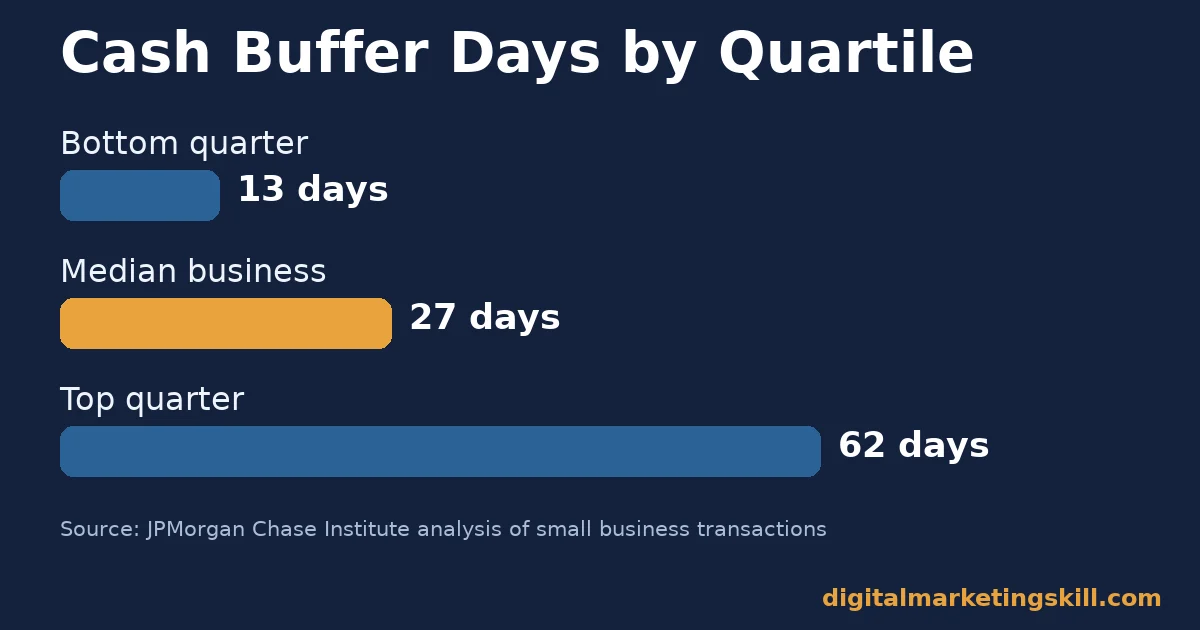
That buffer is not evenly spread. A quarter of small businesses hold 13 cash buffer days or fewer. The top quarter holds 62 days or more. Restaurants and other labor-intensive businesses tend to sit near the low end, since wages go out constantly. Real estate and other capital-intensive businesses tend to sit near the high end.
Why the Buffer Shrinks Faster Than Owners Expect
Buffers shrink fastest when customers pay late. A QuickBooks Small Business Late Payments Report found that 59% of small businesses have invoices overdue by 30 days or more. That is a sharp rise from the previous survey. The average unpaid balance sat at $17.7K per business, money already earned but not yet usable.
Processing delays add another layer. The same report found that 49% of owners say standard payment processing times create critical or moderate cash-flow problems. A further 19% took on debt or used credit cards they would not otherwise have used, just to cover the gap.
Why Cash Flow Ranks Among the Top Financial Challenges
This is not a niche problem. The Federal Reserve’s Small Business Credit Survey found that 51% of US employer firms cite uneven cash flow as a financial challenge. That is close behind the 56% who cite paying operating expenses. Both point to the same underlying issue: expenses are steady, but income is not.
What Differs Across the Four Cash Flow Levers
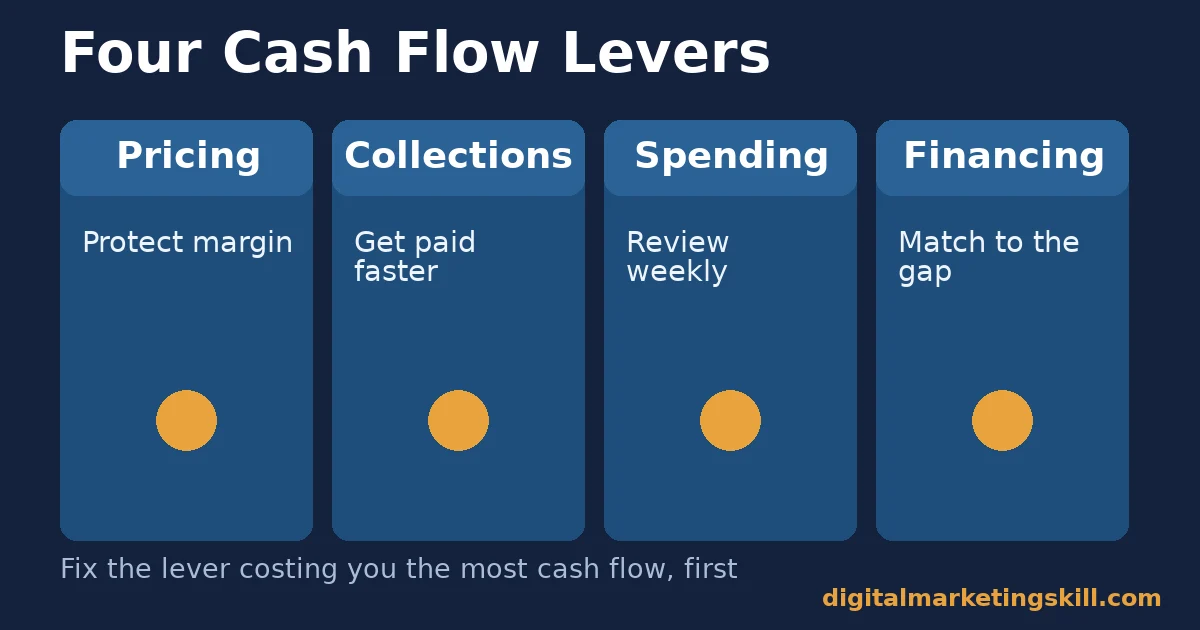
Cash flow strategies usually fail when a business picks one fix and expects it to solve everything. Pricing, collections, spending discipline, and financing each solve a different part of the timing problem. Each one needs its own approach.
Pricing and Packaging: Built on Protecting Margin
A discount feels like a sales win, but it drains the exact cash a thin buffer needs. One of the best cash flow strategies for pricing is to protect margin first. Use bundles or guarantees to add value instead of cutting price. Choosing a profitable online business model in the first place makes this lever far easier to pull later.
Collections and Invoicing: Built on Speed
Every day an invoice sits unpaid is a day it cannot be spent. Collections-focused cash flow strategies shorten that gap: clear terms, fast invoicing, and a quick follow-up the moment a payment is late. Pacing growth spending against a marketing strategy sorted by budget stage also helps. It keeps costs from outrunning what collections can support.
Spending Discipline: Built on Visibility
You cannot control what you cannot see. Spending discipline means tracking where cash actually goes each week, not just at month-end, so a small leak gets caught before it becomes a real shortfall.
Financing: Built on Matching the Tool to the Gap
Not every cash gap needs the same fix. Invoice factoring, a line of credit, and a cash reserve all close a gap, but at different costs and speeds. The right one depends on whether the gap is one-time or ongoing.
How to Lead With Each Lever
The sections below mirror the four levers above. Start with whichever one is costing you the most cash flow today. Fixing that lever first moves these cash flow strategies from theory into real runway the fastest.
Pricing and Packaging: Lead With Bundles, Not Discounts
Before cutting a price, calculate your real break-even cost. Many owners discount without knowing their true margin, which quietly drains cash on every sale. Instead, bundle a related product or service to raise perceived value without cutting the price itself.
Use a back-end offer for customers who are not ready to pay full price upfront. A lower-cost first step, followed by a higher-value offer later, can protect cash flow while still winning the customer relationship.
Collections and Invoicing: Lead With Clear Terms and Fast Follow-Up
A slow checkout can create the same cash gap as a slow-paying customer. See our guide to ecommerce checkout mistakes for how hidden costs and forced logins quietly delay the sale itself.
State payment terms in writing before the work starts, not after. Send the invoice the same day the work is delivered, not at the end of the month. Every day of delay on your side becomes a day of delay on the customer’s side too.
Follow up on a late invoice within a few days, not weeks. A short, polite reminder sent early recovers more cash than a stern message sent after 60 days of silence.
Spending Discipline: Lead With a Weekly Cash Review
Review inflows and outflows every week, not just at month-end. A weekly rhythm catches a problem while there is still time to act on it. Monthly reviews often catch the same problem too late.
Keep a cash reserve for unexpected expenses or a slow month. Even a small reserve, built gradually from excess cash, reduces how often you need expensive short-term financing. The same weekly discipline applies to marketing spend. Our guide on building a marketing budget your CFO will approve covers how to size that spend without starving cash flow.
Financing: Lead With the Cheapest Tool That Fits the Gap
For a one-time gap tied to slow-paying customers, invoice factoring converts unpaid invoices into cash quickly. It typically costs a fee of 1% to 5% of the invoice value. A line of credit charges interest only on what you draw, though the APR can range widely, from 10% up to 99%, depending on your credit profile and lender.
Match the tool to the problem. Factoring treats a specific set of invoices as the asset being sold. A line of credit supports broader needs like inventory, payroll, or seasonal swings. If growth spending is the real driver of your cash gap, see our guide to creating a marketing budget for a small business before you borrow.
How to Measure Whether Your Cash Flow Strategies Work
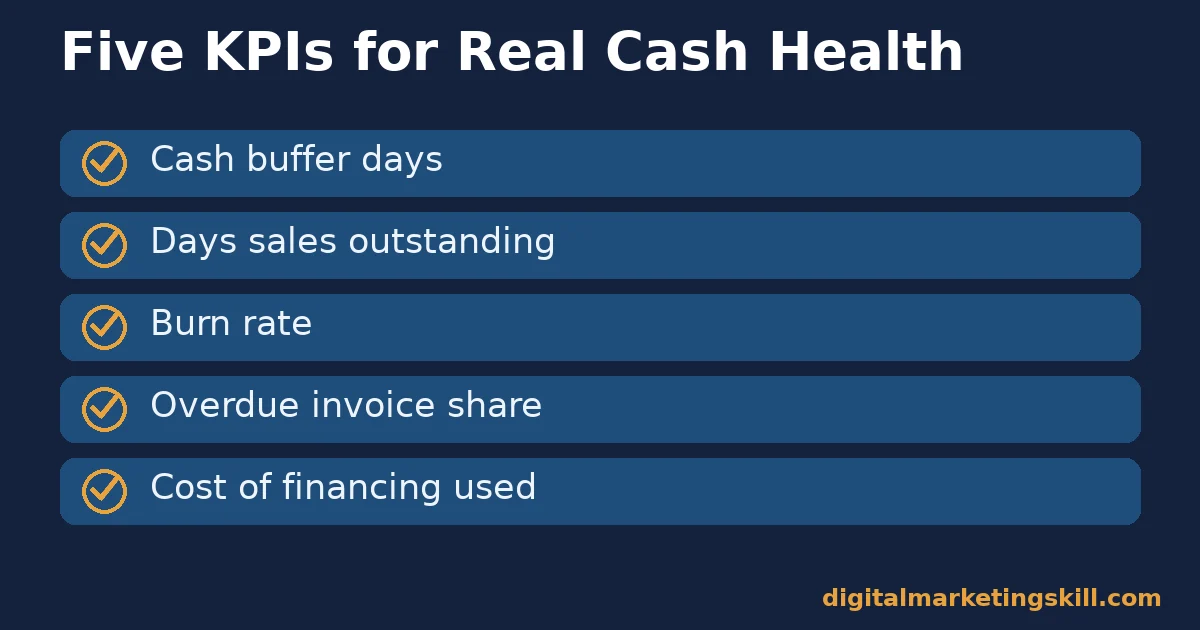
Track your runway, not just your bank balance on a given day. Each metric below is defined in one sentence, with a note on how to read it. Together they show whether your cash flow strategies are actually extending your runway.
Five Numbers That Show Real Cash Health
- Cash buffer days. How many days your current cash would cover typical outflows if income stopped. Compare it with the 27-day median JPMorgan Chase Institute found, adjusted for your industry.
- Days sales outstanding. The average number of days it takes to collect payment after a sale. A falling number means collections are speeding up.
- Burn rate. How much cash the business spends, net of income, in a typical month. Rising burn rate with flat revenue is an early warning sign.
- Overdue invoice share. The share of your invoices more than 30 days overdue. Compare it with the 59% figure QuickBooks found across US small businesses.
- Cost of financing used. The actual rate or fee paid on any factoring, credit line, or short-term loan. Rising cost of financing over time signals a structural cash flow problem, not a one-off gap.
How to Read These Numbers Together
Read cash buffer days first. It shows how much time you have before a problem becomes urgent. If buffer days are low but days sales outstanding is also high, slow collections are the most likely root cause, not spending.
If burn rate is rising while buffer days stay flat, revenue is likely growing alongside spending. That combination is healthier than it looks at first glance. Track all five numbers together for at least one full quarter before changing your financing approach.
The Cash Flow Strategies Decision Rule: Fix Collections Before You Borrow
If this guide leaves you with one decision rule, make it this one. Before taking on financing to cover a cash gap, fix whatever is slowing down collections. Speeding up money you already earned is cheaper than borrowing new money.
Here is an illustrative example, with invented numbers. A small services business has $40,000 in unpaid invoices and only 10 days of cash buffer. Instead of taking a loan, the owner tightens invoice terms and follows up within three days of every due date. Over two months, days sales outstanding drops from 45 to 28, and the buffer grows to 24 days without any new debt.
The lesson is about sequencing. Financing can buy time, but it also adds a cost on top of an existing problem. Fixing collections first often removes the need for financing altogether, or at least shrinks how much you need to borrow.
A Real Case: How a Cash Buffer Varies by Industry
The JPMorgan Chase Institute’s analysis of small business transactions did not just report one buffer number. It broke buffer days down by industry, which shows why a single rule of thumb does not fit every business.
Restaurants held the fewest cash buffer days of the industries studied, at around 16 days. Constant wage and inventory costs explain why. Real estate businesses held the most, at around 47 days, reflecting a slower, less continuous expense cycle. Health care services and construction sat in between.
Keep the limits of this case in mind. The analysis covered a specific set of US industries and metro areas over a defined window, not every business type or country. Treat the industry gap as a reason to benchmark your own buffer against similar businesses, not against one universal target.
Frequently Asked Questions About Cash Flow Strategies
What are the best cash flow strategies for a new business?
Build a cash buffer early, invoice quickly, follow up on late payments within days, and review inflows and outflows weekly. Pair these habits with the cheapest financing tool that fits any remaining gap.
How many days of cash buffer should a small business keep?
There is no single safe number, since it varies by industry. JPMorgan Chase Institute found a median of 27 days across small businesses. Labor-intensive businesses like restaurants sit nearer 16 days; capital-intensive businesses like real estate sit nearer 47.
What is the difference between profit and cash flow?
Profit is revenue minus expenses on paper, often counted the moment a sale happens. Cash flow is the actual money moving through your bank account on the days it moves. It can lag profit by weeks or months.
Should a new business use a line of credit or invoice factoring?
Invoice factoring suits a one-time gap tied to specific unpaid invoices, usually for a fee of 1% to 5% of invoice value. A line of credit suits ongoing or unpredictable needs instead, with interest that can run from 10% to 99% APR on what you draw.
How do late payments affect small business cash flow?
Significantly. QuickBooks found that 59% of US small businesses have invoices overdue by 30 days or more, with unpaid balances averaging $17.7K. A further 39% of owners say a single late payment made it hard to cover payroll or bills.
What is the fastest way to improve cash flow?
Speed up collections before anything else. Send invoices immediately, state terms clearly, and follow up within a few days of a missed due date. This is usually faster and cheaper than arranging new financing.
How often should a small business review its cash flow?
Weekly, not monthly. A weekly review catches a developing shortfall while there is still time to act. A monthly review often surfaces the same problem only after it has grown.
Build Your Buffer, Then Build the System
Cash flow strategies work best when a business starts by measuring its real buffer, not by guessing. Check your own cash buffer days first. Fix the lever costing you the most cash today, and add financing only once collections and spending are under control.
Want guided practice building financial and marketing systems like these? Digital Marketing Skill Institute teaches practical skills hands-on inside its Master Diploma in Digital & AI Marketing. The program runs on four AI-powered tracks totaling ten courses, including AI-Powered Lead Generation and Email Automation, with a Full Stack option for completing all four tracks together.
It comes with unlimited 1-on-1 coaching and mentoring, plus a U.S. Project Internship that ends with a verified U.S. Work Reference Letter. The Master Diploma is dual US and UK accredited, recognised in more than 100 countries, and delivered 100% online. You can study from anywhere in your country.
Browse more guides on the Digital Marketing Skill Institute blog, visit the Digital Marketing Skill Institute homepage, or apply for the Master Diploma directly.
Every figure in this guide was checked against its original source before publication. Figures marked as illustrative are invented examples, not real results.
![9 Amazing Digital Marketing Skills to Make Money Online [With Proof]](https://digitalmarketingskill.com/wp-content/uploads/2019/07/9-Amazing-Digital-Marketing-Skills-to-Make-Money-Online-With-Proof-17.png)






