
Advanced Facebook advertising goes beyond boosted posts. It means structured audiences, tested creative, a clear budget method and a real retargeting funnel. Each piece solves a different problem, so mixing them up wastes spend. This guide groups the techniques by what they fix. It shows how to apply each one, and it ends with one rule for diagnosing a struggling campaign.
Key Takeaways
- Average price per ad across Meta’s apps rose 12% year-over-year. Ad impressions delivered rose 14% too, per Meta’s most recent quarterly earnings report. So, rising costs make technique, not just budget, the lever that matters.
- Advanced Facebook advertising techniques fall into four groups: audience, creative, budget and retargeting. Each fixes a different kind of underperformance.
- A campaign usually fails for one dominant reason at a time. Diagnosing which group is failing matters more than applying every technique at once.
- Frequency and cost per result, read together, are the fastest diagnostic. They show whether an audience problem or a creative problem is driving rising costs.
- Retargeting and prospecting are different jobs. Treating them with the same audience, budget or creative is a common and costly mix-up.
- Up to 47% of a video campaign’s value lands in the first three seconds, and up to 74% within the first ten, per research Meta ran with Nielsen. A weak hook loses most of its audience before the offer even appears.
In this guide
- Why Most Advanced Facebook Advertising Guides Fall Short
- How Meta’s Ad Auction Actually Allocates Spend
- What Differs by Advanced Facebook Advertising Technique
- How to Apply Each Advanced Facebook Advertising Technique
- Measuring Whether a Technique Is Actually Working
- The One Decision Rule for Diagnosing a Struggling Campaign
- A Real Case: A Small, Documented Test
- Frequently Asked Questions About Advanced Facebook Advertising
- Build This Skill Set With Structured Training
Why Most Advanced Facebook Advertising Guides Fall Short
Most “advanced Facebook advertising” lists read like a grab-bag: fifteen tactics, no order, no diagnosis. A reader tries two or three and has no way to tell whether they picked the right ones for their actual problem.
That approach also assumes every account has the same problem. A brand-new account and a mature one rarely share the same weak point. A new account usually struggles to find the right audience at all. A mature account more often struggles with fatigue inside an audience it already found. Advanced Facebook advertising, done well, starts with identifying which of those two situations an account is actually in.
The real gap is diagnostic, not tactical. A rising cost per result could mean a few things. The audience could be fatigued. The creative could be weak. The budget setup could be broken, or retargeting could be missing. Each cause needs its own fix. Guessing wastes budget that a short diagnosis would save.
A ground rule before the detail: these are mechanisms and methods, not guaranteed results. Meta’s ad auction, policies and interface change often. Verify current settings against Meta’s own documentation before applying anything here to a live account.
A second ground rule: results vary enormously by industry, offer and existing brand trust. A technique that works well for an established ecommerce brand may underperform for a brand-new service business with no reviews or track record yet.
How Meta’s Ad Auction Actually Allocates Spend
Every Facebook ad competes in an auction. Meta scores each ad on three things: the bid, estimated action rate, and ad quality, as Meta’s own explanation of its ad auction describes. The three combine into one score Meta calls “total value.” The ad with the highest total value wins the impression, not the ad with the highest bid.
This is why a cheap, relevant ad can beat an expensive, generic one. Specifically, estimated action rate rewards ads the algorithm predicts people will actually engage with. Weak creative lowers that prediction. As a result, a lower prediction raises the effective cost of every impression, even at the same bid.
This also explains why the same ad set can get cheaper over the first few days of delivery, then more expensive later. Early engagement teaches the algorithm who to show the ad to. A fatiguing audience, by contrast, teaches it the opposite lesson, and costs climb again. Understanding this mechanism is what separates advanced Facebook advertising from simply reacting to a number going up or down.
What Differs by Advanced Facebook Advertising Technique
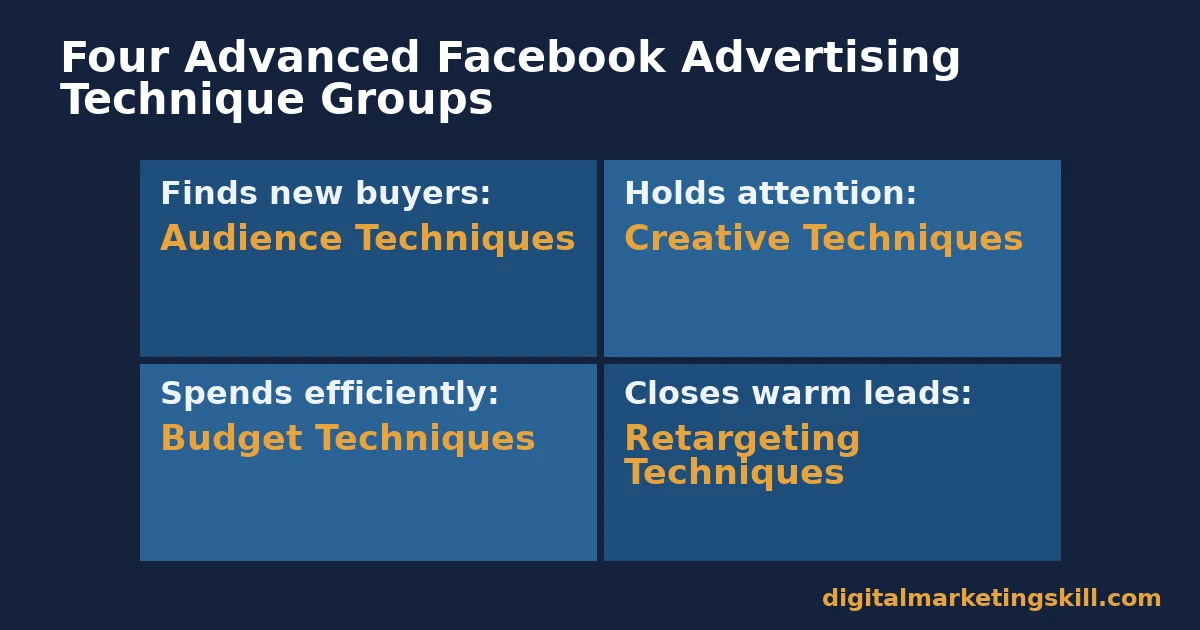
Four technique groups cover most of what separates a basic campaign from an advanced one. Each is built to fix a different weak point. Applying the wrong group, polishing creative when the real problem is audience fatigue, wastes time that a quick diagnosis would have saved.
Audience Techniques: Built for Finding New Buyers
Lookalike audiences, layered interest targeting and exclusion lists all aim at the same problem. They try to reach people who resemble existing buyers, without wasting spend on people who will not convert. This group matters most when a campaign reaches plenty of people but converts few of them.
Exclusion lists often get skipped, but they matter as much as the targeting itself. Excluding existing customers from a new-buyer campaign, for example, stops a brand from paying full price to re-acquire someone who already bought.
Creative Techniques: Built for Holding Attention
Hook-first video, format testing across feed, Reels and Stories, and systematic creative rotation all fight the same enemy. That enemy is a scroll that takes a fraction of a second. This group matters most when reach and targeting look fine but click-through stays low.
Format matters as much as message here. The same offer, reshaped as a native-feeling Reel instead of a repurposed static banner, often earns a very different level of attention, even with identical targeting underneath it.
Budget Techniques: Built for Efficient Spend
Campaign budget optimization, bid caps and structured testing budgets share one goal. They put spend where the auction already wants to reward it. Otherwise, budget splits evenly across ad sets regardless of performance. This group matters most when some ad sets clearly outperform others, but budget stays split evenly anyway.
A bid cap can also protect against the auction chasing volume at any cost. Without one, a system optimizing purely for spend can quietly accept worse and worse results as a tradeoff for hitting the budget.
Retargeting Techniques: Built for Closing Warm Leads
Website custom audiences, cart-abandonment segments and funnel-stage sequencing all aim at the same people. Those people already showed interest but did not convert, the core idea behind retargeting more generally. This group matters most when cold traffic converts reasonably well, but nobody follows up with the people who almost bought.
This is often the cheapest technique group to run well. The audience is small compared to cold prospecting, so the same budget reaches each warm lead far more often, at a lower cost per impression.
How to Apply Each Advanced Facebook Advertising Technique
Knowing the category is step one. Each one has a specific, practical way to apply it that beats the generic version, and that specificity is what makes advanced Facebook advertising different from simply knowing the vocabulary.
Audience Techniques: Apply With a Tight Lookalike Seed
Build a lookalike from your highest-value customers, not your full contact list. Meta’s own guidance suggests a source of 1,000 to 50,000 of your best customers, ranked by lifetime value or order size, rather than your entire list. The algorithm has less noise to learn from in a smaller, cleaner source.
Refresh the seed list periodically as your customer base grows and changes. A stale seed built from older buyers can drift away from who is actually converting now, especially after a pricing or product change.
Creative Techniques: Apply With a Hook in the First Three Seconds
Write the first line of a video or the top of an image to work with sound off and in a tiny thumbnail. In research Meta ran with Nielsen, up to 47% of a video campaign’s value was delivered in the first three seconds, and up to 74% within the first ten. If the hook needs five seconds of setup, most of the audience never reaches the offer. Therefore, test three distinct hooks before testing anything else about the ad.
Keep the rest of the ad stable while the hooks rotate. Changing the hook, the offer and the call to action all at once makes it impossible to tell which change actually moved the result.
Budget Techniques: Apply With Campaign Budget Optimization, Then Watch It
Let the campaign distribute budget across ad sets automatically, using Meta’s own budget controls. Check weekly that one ad set is not quietly starving the others of the learning volume they need. Automation reduces manual work. It does not remove the need to watch results.
Give a new ad set enough budget to exit the learning phase before judging it. Pulling budget from a new ad set after one slow day is a common reason a genuinely strong ad never gets the chance to prove itself.
Retargeting Techniques: Apply With Funnel-Stage Segmentation
This pairs naturally with basic retargeting setup tips if the funnel segments above are new to your account.
Do not retarget every site visitor with the same ad. Split audiences by how far they got: viewed a product, added to cart, started checkout. Show each segment a message that matches how close they already were to buying. This first requires a working Meta Pixel setup to track those stages.
A cart-abandonment segment usually responds better to an urgency or incentive message. A simple product-view segment usually responds better to more information, since that visitor has not yet decided the product is right for them.
Measuring Whether a Technique Is Actually Working
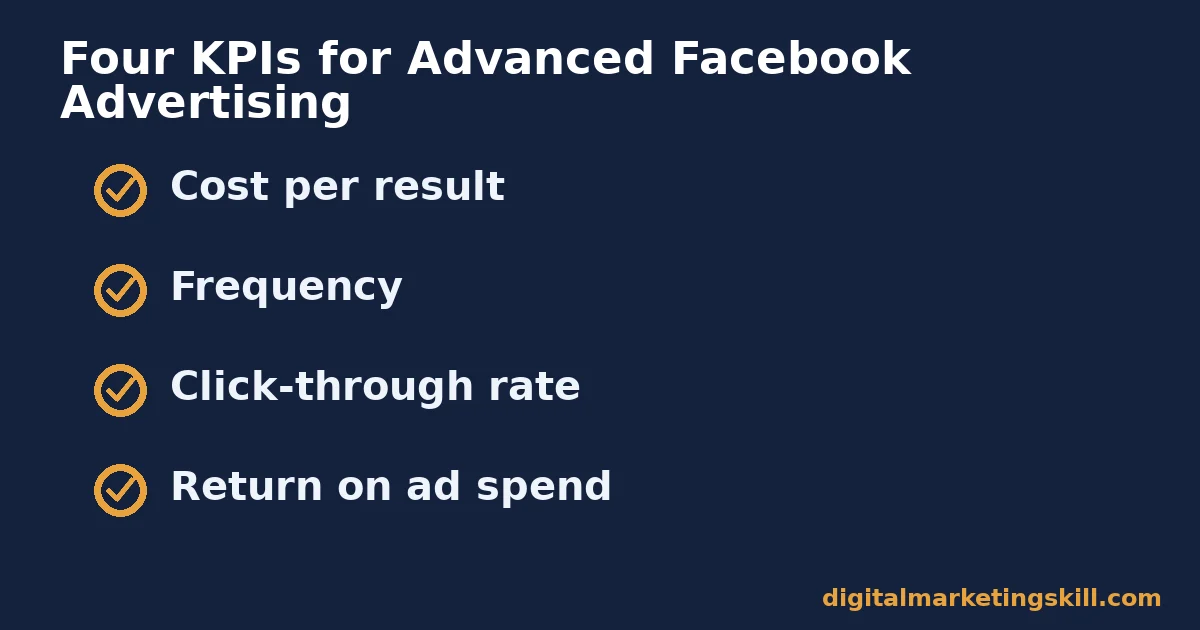
Four numbers diagnose most advanced Facebook advertising problems without needing a specialized dashboard. All four sit inside Meta’s own ad reporting, with no extra tool required.
- Cost per result — total spend divided by the specific action you are paying for, such as a lead, a purchase or an install. This is the headline number, but on its own it hides which layer is actually failing.
- Frequency — average times a single person has seen the ad over the reporting window. Rising frequency alongside rising cost per result usually signals audience fatigue, not a creative problem.
- Click-through rate — clicks divided by impressions, read as a percentage. A low rate with healthy frequency usually signals a creative problem, not an audience problem.
- Return on ad spend — revenue divided by spend, segmented by cold versus retargeting audiences separately. Blending the two hides how much of your result is coming from already-warm leads instead of genuinely new demand.
Pull all four together before changing anything. Otherwise, a single metric in isolation, especially cost per result alone, often points at the wrong fix. Similarly, the same discipline applies to conversion rate work downstream of the ad, not just the ad account itself.
The One Decision Rule for Diagnosing a Struggling Campaign
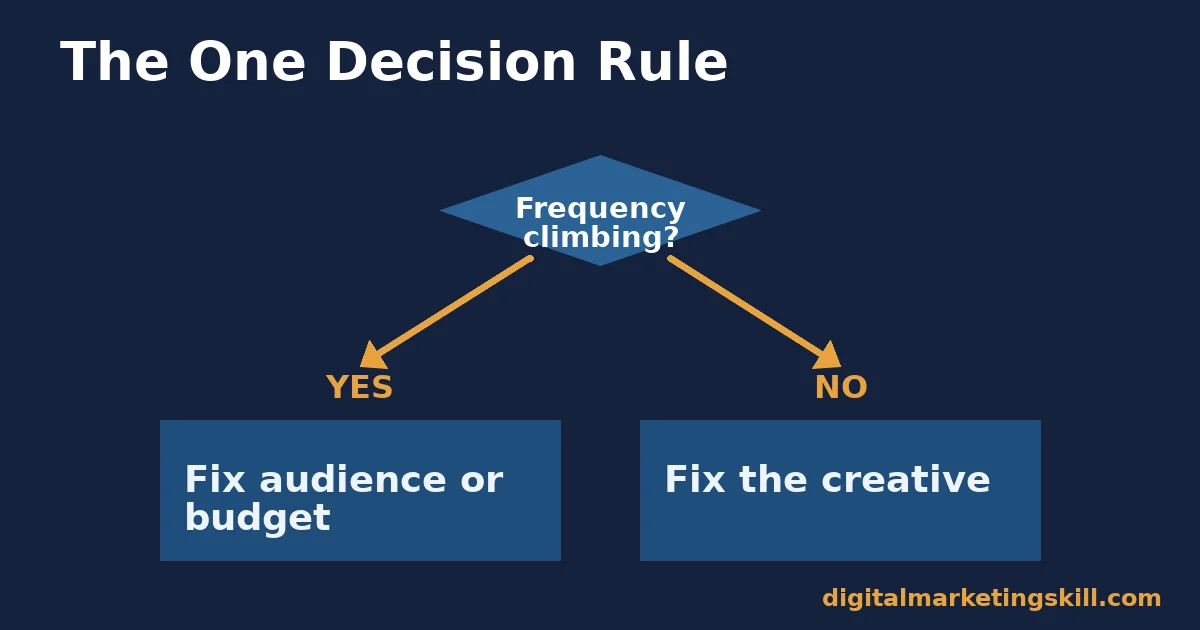
If frequency is climbing alongside cost per result, fix the audience or budget before touching creative. If frequency is stable but cost per result is still climbing, fix the creative before touching the audience. Frequency is the cleanest signal for telling these two failure modes apart, because it isolates whether the same people are simply seeing the ad too often.
Illustrative, invented example: an account sees cost per result rise from $20 to $35 over three weeks. Frequency climbed from 1.8 to 4.1 in the same window. Under the rule above, that points at audience fatigue, not weak creative. Refreshing or expanding the audience comes before writing new ad copy.
A Real Case: A Small, Documented Test
Digital Marketing Skill Institute student Ayooluwa Osemi ran a small, deliberately tracked Facebook and Instagram ad test. $14 in spend produced $878 in sales, a figure published on the Institute’s student reviews page. The campaign was not large enough to need every technique in this guide. But it used the core discipline behind all of them: a defined audience, one clear offer, and a tracked result instead of a guess.
That discipline is what separates advanced Facebook advertising from expensive trial and error, whatever the budget size: define the audience, then track the specific result before scaling spend. It is the same discipline taught across Digital Marketing Skill Institute’s paid media coursework.
Limits: this reflects one small campaign, on one small budget, for one product category, and is not typical or guaranteed for every account, market or offer. See the Institute’s earnings disclaimer before treating any single case as a forecast. The techniques in this guide exist to extend that same discipline to larger budgets and more complex accounts, not to replace it.
Frequently Asked Questions About Advanced Facebook Advertising
What makes Facebook advertising “advanced” rather than basic?
Basic Facebook advertising usually means boosting a post or running one ad set with default settings. Advanced Facebook advertising means structuring audiences, testing creative systematically, managing budget deliberately and running a real retargeting funnel, with a clear diagnostic process behind each decision rather than a guess.
Why is my cost per result rising even though I haven’t changed anything?
Audiences fatigue over time as frequency climbs, and the broader auction can also get more competitive as other advertisers bid for the same people. Check frequency first; a rising number there usually explains a rising cost even with no changes on your end.
How big should a lookalike audience’s seed list be?
A smaller, high-quality seed list, your actual best customers, usually produces a sharper lookalike than a large, mixed list. Quality of the seed matters more than its raw size.
Should retargeting and prospecting campaigns share a budget?
No. They target different intent levels and usually have very different costs and conversion rates. Keeping them in separate campaigns makes it possible to read performance correctly and avoids one quietly starving the other.
How often should ad creative be refreshed?
Refresh creative when frequency climbs and performance drops, not on a fixed calendar. For instance, some audiences tolerate the same ad for a long stretch; others fatigue within days, depending on audience size and budget.
Does campaign budget optimization always perform better than manual budgets?
Not always. It performs well when ad sets have enough volume to be compared fairly. However, with very small budgets or very few ad sets, manual allocation can be easier to control and read.
What is the single biggest mistake in advanced Facebook advertising?
Changing several variables, audience, creative and budget, at the same time after a bad week. That makes it impossible to tell which change actually caused any improvement or decline afterward.
Is a high click-through rate always good?
Not on its own. A high click-through rate with a low conversion rate often means the ad promises something the landing page does not deliver. Read click-through rate alongside the conversion rate, not in isolation.
Can advanced Facebook advertising work with a small budget?
Yes, but small budgets need tighter focus: fewer ad sets, a narrower audience and less simultaneous testing, since a small budget cannot generate enough data to judge many variables at once.
What is audience overlap, and why does it matter?
Audience overlap happens when two ad sets in the same account target largely the same people, which forces them to compete against each other in the auction instead of against outside advertisers. Checking for overlap before scaling a campaign avoids quietly bidding against your own account.
Should I trust automatic placements over manual ones?
In most cases, yes. Automatic placements let the system find the cheapest, best-performing spots across Facebook, Instagram and Audience Network. Manual placement selection is useful mainly when a specific format, like Stories only, is a deliberate creative choice rather than a cost decision.
Build This Skill Set With Structured Training
Advanced Facebook advertising is one part of a broader paid media and marketing skill set. Diagnosing a campaign well depends on strategy, analytics and creative skills that go beyond any single platform’s settings. A platform’s interface can teach the buttons; it rarely teaches the diagnostic habits behind using them well.
Digital Marketing Skill Institute’s Master Diploma in Digital & AI Marketing is built around four AI-powered tracks: AI-Powered Social Media Management and Advertising, AI-Powered Lead Generation and Email Automation, AI-Powered Google Specialist, and AI-Powered WordPress and SEO Specialist. The advertising track covers paid social campaigns in more depth than any single guide can, with real accounts and real feedback.
Together they cover ten courses, with a Full Stack option to complete all four. Every track includes unlimited 1-on-1 coaching and mentoring, a U.S. Project Internship with a verified U.S. Work Reference Letter, and dual US and UK accreditation recognised in more than 100 countries. The program runs 100% online, so you can build these skills from anywhere in your country.
Read verified outcomes like the one above on the reviews page, browse more guides on the digital marketing blog. When you’re ready, see the full program on the Master Diploma page, or start your application at Digital Marketing Skill Institute.
Wherever you live, the training runs fully online, so your location never has to be the obstacle. The same diagnostic discipline behind the case study above is what the coaching is built to teach, on your own ad accounts, not just in theory.
Every figure in this guide was checked against its original source before publication. Figures marked as illustrative are invented examples, not real results.
![9 Amazing Digital Marketing Skills to Make Money Online [With Proof]](https://digitalmarketingskill.com/wp-content/uploads/2019/07/9-Amazing-Digital-Marketing-Skills-to-Make-Money-Online-With-Proof-17.png)






