
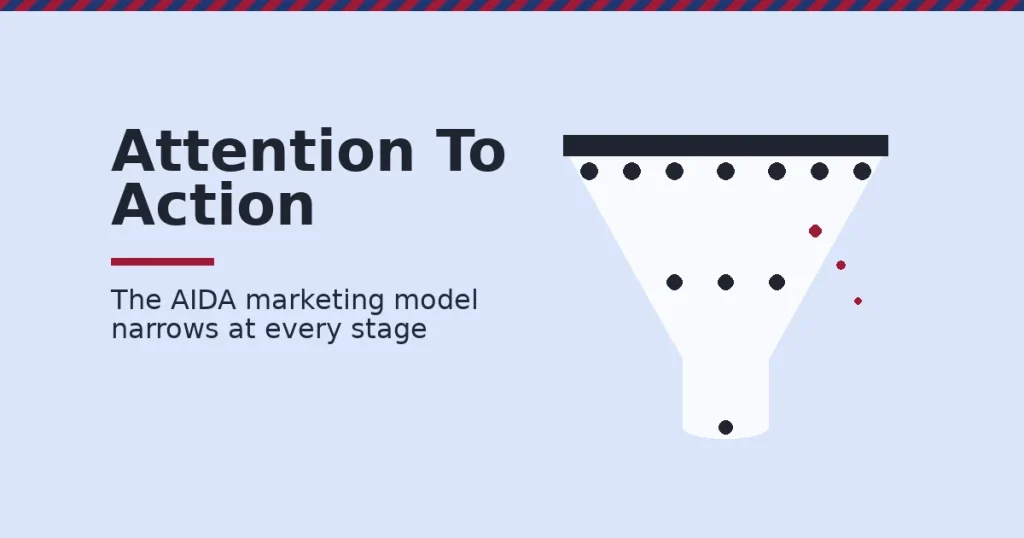
The AIDA marketing model maps how a stranger becomes a customer. It has four stages: attention, interest, desire and action. Marketers use it to find exactly where a campaign loses people. A weak stage anywhere in that chain sinks the whole funnel, no matter how strong the rest is.
Key Takeaways
- Attention has seconds to work. Nielsen Norman Group’s eye-tracking study of 232 users found that readers scan the top of a page, then a shorter line, then down the left side. That F-shaped pattern means the opening has to carry the message.
- People trust people over ads. Nielsen’s trust-in-advertising research found that recommendations from people they know are the most trusted form of advertising. That is why the desire stage leans on proof, not claims.
- Personalising the action step pays off. HubSpot analysed more than 330,000 calls-to-action. It found that personalised CTAs converted 202% better than basic, one-size-fits-all CTAs.
- A single clip can carry all four stages. Dollar Shave Club’s founder spent around $4,500 on one homemade video. It brought in 12,000 orders within 48 hours, enough to crash the company’s servers, as NBC News reported.
- The AIDA marketing model is over a century old and still taught. It is widely credited to the American marketer Elias St. Elmo Lewis. It still appears in current marketing and conversion-optimisation research.
In this guide
- What Most Advice About the AIDA Marketing Model Misses
- How the AIDA Marketing Model Works
- How the AIDA Marketing Model Differs by Channel
- How to Lead With Each Channel
- How to Measure Each Stage of the AIDA Marketing Model
- The One Decision Rule: Fix the Weakest Stage First
- A Real Case: How a $4,500 Video Used the Full AIDA Marketing Model
- Frequently Asked Questions About the AIDA Marketing Model
- Put the AIDA Marketing Model to Work in Your Own Funnel
What Most Advice About the AIDA Marketing Model Misses
Most explanations of the AIDA marketing model stop at the definition. Attention, interest, desire, action: four neat boxes. That is accurate, but it skips a harder question. Each stage behaves differently depending on the channel carrying your message.
This guide treats the AIDA marketing model as a diagnostic tool, not a slogan. It names what differs between a search ad, a social video and an email at each stage. It shows how to lead with each one, and how to measure which stage is actually failing. For the fuller picture first, see our guide to what digital marketing is.
Ground Rules and What This Model Cannot Do
A few ground rules first. The model itself is a framework. It is an informed way to think about a buying decision, not a scientific law. The figures below come from named studies, stated with their own scope and limits. Treat each one as a snapshot from its own sample, not a permanent rule.
Every statistic, source link and case here was checked against its original study, report or news article before publication. The research is credited to Digital Marketing Skill Institute’s editorial team, not to any invented author or credential. Where a number is illustrative rather than real, it is labelled that way at the point it appears.
It also helps to know what the AIDA marketing model is not. It is not a replacement for audience research, and it cannot fix a product or offer that nobody wants. What it does well is simpler: it shows exactly where one piece of marketing, one ad, one email or one video, loses the people who already saw it.
One more limit is worth naming. AIDA describes a single exposure, not the many small touches a real buyer often needs before they act. A prospect might see your hook three or four times across different channels before interest even begins. Do not expect one perfect asset to carry a stranger through all four stages in one sitting.
How the AIDA Marketing Model Works
The AIDA marketing model describes a sequence, not a single moment. A prospect must clear each stage before the next one matters, so a brilliant desire-building story is wasted on someone who never noticed the ad. Likewise, a loud, attention-grabbing hook is wasted if nothing interesting follows it.
That order is also why the model survives everything from print ads to short-form video. It describes the psychological order of a decision, not one specific medium. Each new channel just changes how long each stage lasts, and what proves it worked.
The Narrowing Path
Picture the four stages as a narrowing path, not four equal boxes. A large audience notices your headline or hook, then a smaller slice develops real interest, and a smaller slice again moves to desire. Only a fraction of those complete the action.
Each stage only keeps a portion of the stage before it. That is why a small gain near the top of the model, where the audience is largest, often moves more total outcomes than the same percentage gain at the action stage.
This is also why you should diagnose the AIDA marketing model stage by stage, not optimise a whole campaign at once. A marketer who only watches the final conversion number cannot tell what actually went wrong. Maybe too few people noticed the message, or interest never built. Perhaps desire was weak, or the final step was confusing. Splitting the stages turns one vague problem into four specific, fixable ones.
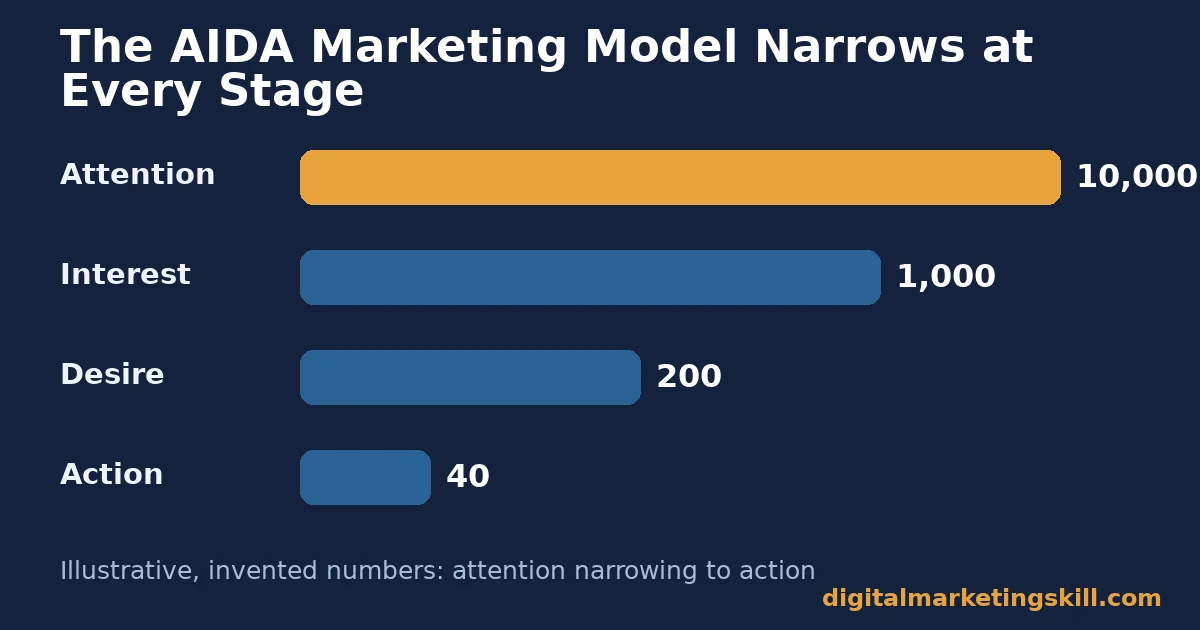
Here is an illustrative version, with invented numbers. An ad reaches 10,000 people: that is attention. 1,000 of them stop to read or watch further: that is interest. 200 develop real desire for the offer, and 40 complete the purchase: that is action.
As stage-to-stage rates, that is 10% from attention to interest, 20% from interest to desire, and 20% from desire to action. Written this way, the attention-to-interest step is clearly the weakest link. A single overall conversion rate of 0.4% would never have shown you that.
The Four Stages, Defined
- Attention. The moment a prospect notices your message exists. It is usually measured in seconds, or a single scroll.
- Interest. The point where the prospect decides your message is relevant enough to keep reading, watching or listening.
- Desire. The shift from “this is relevant” to “I want this.” It is usually built with proof, specifics or a story the prospect can see themselves in.
- Action. The concrete next step you ask for. It is the only stage with a directly measurable outcome: a click, a sign-up, a purchase.
How the AIDA Marketing Model Differs by Channel
The four stages stay fixed. But what captures attention, builds interest, creates desire and triggers action is not the same on a search page, inside a social feed or in an inbox. Treating every channel the same way is the most common reason the AIDA marketing model fails in practice.
Search Ads: Built on Immediate Intent
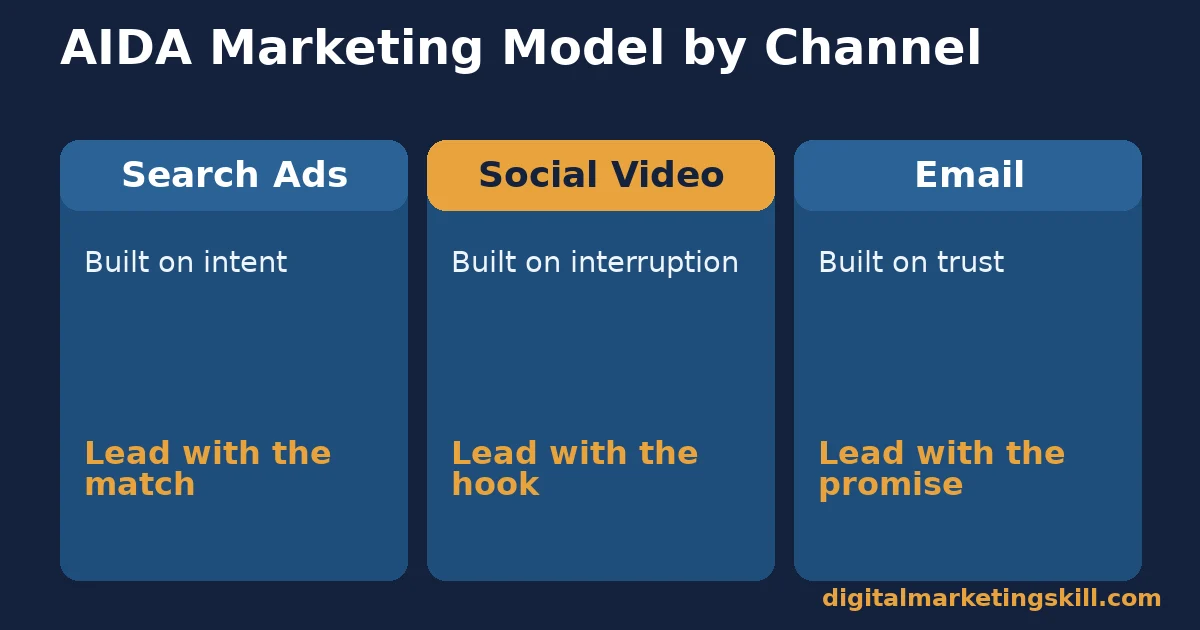
A searcher has already stated what they want, just by typing a query. So attention is less about novelty and more about relevance: does this headline match my exact words?
Interest and desire then have to happen fast, inside a few lines of ad copy. The searcher is comparing several results at once, not committing to one. Our guide to pay-per-click advertising covers how that ad copy and bidding work together.
Social Video: Built on Interruption
Nobody searched for your social video. It interrupted something else they were doing. Attention here depends on the first few seconds: a visual hook, or an unexpected line. The viewer has not yet decided you are worth their time. Interest and desire then build through story and personality, not a feature list. A feed is not the place for a dense pitch.
Email: Built on Existing Trust
A subscriber already said yes once. So attention starts with the subject line and sender name, before they see a word of the content. Once opened, interest and desire can move faster than in cold channels, because some trust already exists from every email that came before.
The common mistake across all three channels is copying a script that worked somewhere else, without asking which stage it was actually built for. A search ad headline dropped into a social caption usually falls flat, because it answers a question nobody asked there.
A chatty social hook dropped into a search ad wastes the two seconds a searcher has to confirm relevance. Match the AIDA marketing model to each channel’s own strengths, instead of reusing one formula everywhere.
How to Lead With Each Channel
Each channel above needs a different first move. The sections below mirror the three channels above, so you can match the fix to the one that is actually underperforming in your own funnel.
Search Ads: Lead With the Match
Put the searcher’s exact phrase, or a very close variant, in the headline. Then use the description line for one specific, concrete detail, not a general claim. Specifics do more to build interest and desire in the two or three seconds a searcher spends scanning results than a broad promise does.
Social Video: Lead With the Hook
Write or film the hook last, once you know the strongest point in the message. Then put it in the first three seconds, not saved for a reveal. Desire in a social video usually comes from personality and story. Let a real voice carry the message, not a formal pitch.
Email: Lead With the Promise
Tell subscribers what they will get, and keep that promise every single time. A broken pattern erodes the trust email relies on faster than almost any other channel. For the action step, make the single next click obvious: one clear button, not three competing links. That same clear-next-step thinking drives our guide on lead generation strategies for turning that click into a qualified lead.
How to Measure Each Stage of the AIDA Marketing Model
Treating AIDA as a diagnostic means tracking a metric for each stage, not just a final conversion number. Each metric below is defined in one sentence, with a note on how to read it.
Four Metrics That Map to Attention, Interest, Desire and Action
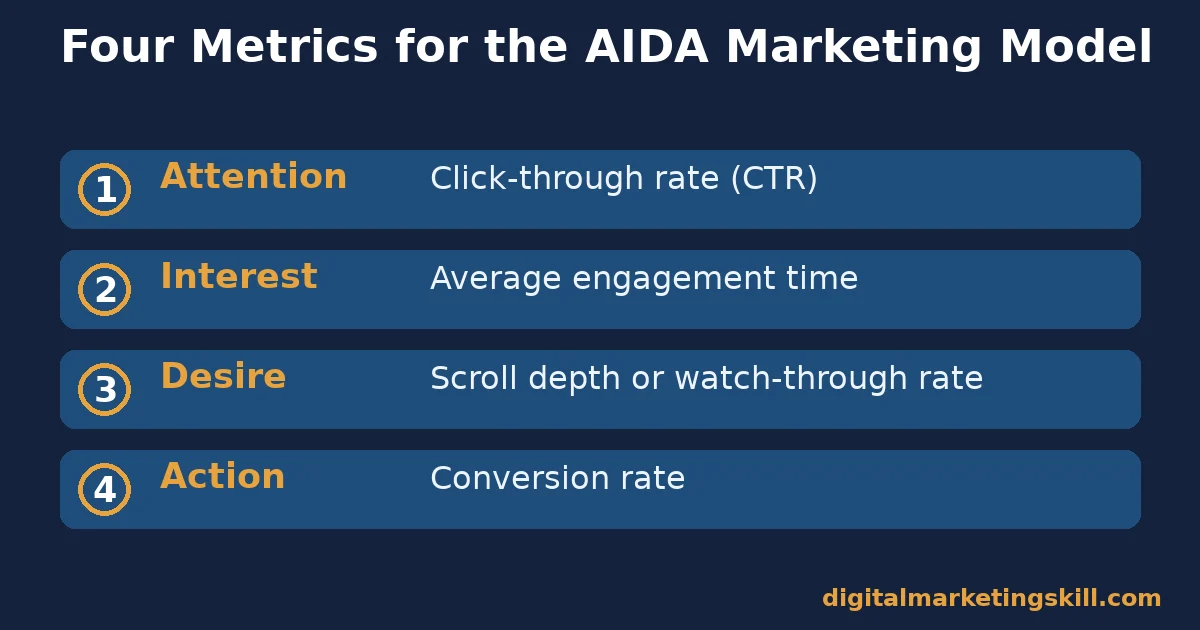
- Attention: click-through rate (CTR). The share of people who saw your ad, post or subject line and clicked or opened it. A low CTR against a large audience usually points to the attention stage, not the offer.
- Interest: average engagement time. How long a visitor keeps the page or video in view after arriving. A fast exit right after the click means the page does not match what the headline promised.
- Desire: scroll depth or watch-through rate. The share of visitors who reach the proof section of a page, or the point in a video where the main benefit appears. A drop before that point means the desire-building content is not landing.
- Action: conversion rate. The share of visitors who complete the specific action you asked for, such as a purchase, sign-up or form submission. This is the only stage HubSpot’s 202% CTA figure speaks to directly. Do not read it as a measure of the whole funnel.
How to Read These Metrics Together
Read the four metrics in sequence. A weak number downstream is often caused by a stage further up. If conversion rate is low but engagement time and scroll depth look healthy, the problem is usually the final ask itself. If CTR is strong but engagement time collapses right after the click, the attention hook probably overpromised.
Track each stage against your own past campaigns, not an industry average. Format, audience and channel all shift what a “good” number looks like. A search ad and a social video for the same offer can post very different click-through rates while both doing their job well, simply because the two audiences arrive with different levels of intent.
Keep the comparison window consistent too. A metric measured over a single day can swing for reasons that have nothing to do with the AIDA marketing model, such as a platform outage or a one-off traffic spike. Compare at least a week of data against the previous week before deciding a stage has genuinely changed.
The One Decision Rule: Fix the Weakest Stage First
If you take one rule from this guide, make it this one. Find the single weakest stage in your own funnel. Fix only that stage before touching anything else. Strengthening a stage that already works rarely moves the overall result.
Here is an illustrative example, with invented numbers. A freelance designer’s email list opens 40% of emails: strong attention. But only 4% of openers click through to the portfolio link: weak interest or desire. Rewriting the subject line further would not help. Rewriting the first two lines of body copy, to state a specific, provable result, matches the actual weak stage.
The same rule applies in reverse. Say a small business’s social video gets strong views and comments, so attention and interest are both working. But very few people tap the link in the bio, so action is weak.
The fix here is not a better hook, since the hook already works. The fix is a simpler, more obvious next step, such as one pinned link instead of a vague “link in bio” with several options behind it.
A Real Case: How a $4,500 Video Used the Full AIDA Marketing Model
Dollar Shave Club’s founder, Michael Dubin, could not afford a traditional ad campaign. So he self-funded a short, irreverent homemade video and posted it to YouTube.
The video worked through all four stages in roughly ninety seconds. Attention came from an unexpected opening line and visual gags that did not look like a typical razor ad. Interest held because Dubin, speaking straight to camera, named a specific problem: razors were overpriced and over-engineered.
Desire built around a blunt promise, that the blades were “f***ing great” at a fraction of the price, backed by a tour of the company’s actual warehouse. Action was one simple next step: subscribe for a few dollars a month.
The video drew millions of views, and the company took in 12,000 orders within 48 hours, enough unexpected traffic to crash its servers in the first hour alone, as reported by NBC News. The founder later sold the company to a major consumer goods group for a reported $1 billion. This kind of scrappy, story-led launch is exactly what our guide to content marketing for startups is built around.
What Generalises and What Doesn’t
Treat the scale of that outcome as specific to one founder, one product and one moment in internet culture. It is a clear illustration of all four AIDA stages working in sequence. It is not a guarantee that a low-budget video repeats those numbers for a different brand.
What generalises better than the dollar figures is the structure. Dubin did not try to build desire before he had earned attention. He did not ask for a complicated action once he had desire. Each stage of the AIDA marketing model got exactly one job, in order, and nothing was skipped.
Frequently Asked Questions About the AIDA Marketing Model
What does AIDA stand for in marketing?
AIDA stands for Attention, Interest, Desire and Action. These are the four stages a prospect typically moves through, from first noticing a message to acting on it.
Who created the AIDA marketing model?
The model is widely credited to Elias St. Elmo Lewis, an American marketer who began using it around the turn of the 20th century. It has been taught and adapted in marketing ever since.
Is the AIDA marketing model still relevant today?
Yes. Current marketing and conversion-optimisation research still uses the same four stages. They help diagnose where search ads, social content and email campaigns lose people, even though the channels themselves are new.
What is the difference between AIDA and a sales funnel?
A sales funnel usually describes stages of a business relationship, such as awareness, consideration and purchase, often with marketing-qualified and sales-qualified steps in between. AIDA is narrower. It describes the psychological shift inside one piece of marketing communication, like one ad, one email or one video.
Which stage of AIDA do most campaigns get wrong?
There is no single answer, which is the point of measuring each stage separately. A campaign with strong attention and weak action often just needs a clearer, simpler next step. One with weak attention needs a stronger hook before anything else changes.
Can the AIDA marketing model work for a single email or ad, not just a whole campaign?
Yes. The four stages apply at any scale, from a full marketing campaign down to one subject line and one paragraph of body copy. That is why it works for quick, individual edits as well as full strategy.
Does the AIDA marketing model work the same way for B2B and B2C marketing?
The four stages apply to both. But the desire stage usually takes longer in B2B, since a buyer often needs to justify the decision to colleagues with evidence, rather than acting on a personal impulse. Measure the same four metrics either way. Just expect a longer gap between interest and desire in B2B campaigns.
Put the AIDA Marketing Model to Work in Your Own Funnel
The AIDA marketing model is only useful once you know which stage is actually weak in your own numbers. Pick one active campaign. Check its click-through rate, engagement time, scroll depth and conversion rate against each other. Then fix the single weakest stage before changing anything else.
If you want structured, hands-on practice applying frameworks like this across real channels, Digital Marketing Skill Institute teaches it inside live campaign work.
The Master Diploma in Digital & AI Marketing is built from four AI-powered tracks: AI-Powered Social Media Management and Advertising, AI-Powered Lead Generation and Email Automation, AI-Powered Google Specialist, and AI-Powered WordPress and SEO Specialist. Together they cover ten courses, with a Full Stack option to complete all four.
It includes unlimited 1-on-1 coaching and mentoring, plus a U.S. Project Internship with a verified U.S. Work Reference Letter. The diploma is dual US and UK accredited, and recognised in more than 100 countries.
The programme runs 100% online. You can study it, and apply the AIDA marketing model to real campaigns, from anywhere in your country. Browse more guides like this one on our digital marketing blog, see outcomes on our reviews page, or apply for the Master Diploma when you are ready. You can also start exploring from the Digital Marketing Skill Institute homepage.
Every figure in this guide was checked against its original source before publication. Figures marked as illustrative are invented examples, not real results.
![9 Amazing Digital Marketing Skills to Make Money Online [With Proof]](https://digitalmarketingskill.com/wp-content/uploads/2019/07/9-Amazing-Digital-Marketing-Skills-to-Make-Money-Online-With-Proof-17.png)






