
The best social media platforms for a business are not the most popular ones. They are the two or three where your buyer already spends time, and where your content format gets seen. Pick by popularity alone and you waste budget on reach you cannot convert.
Key Takeaways
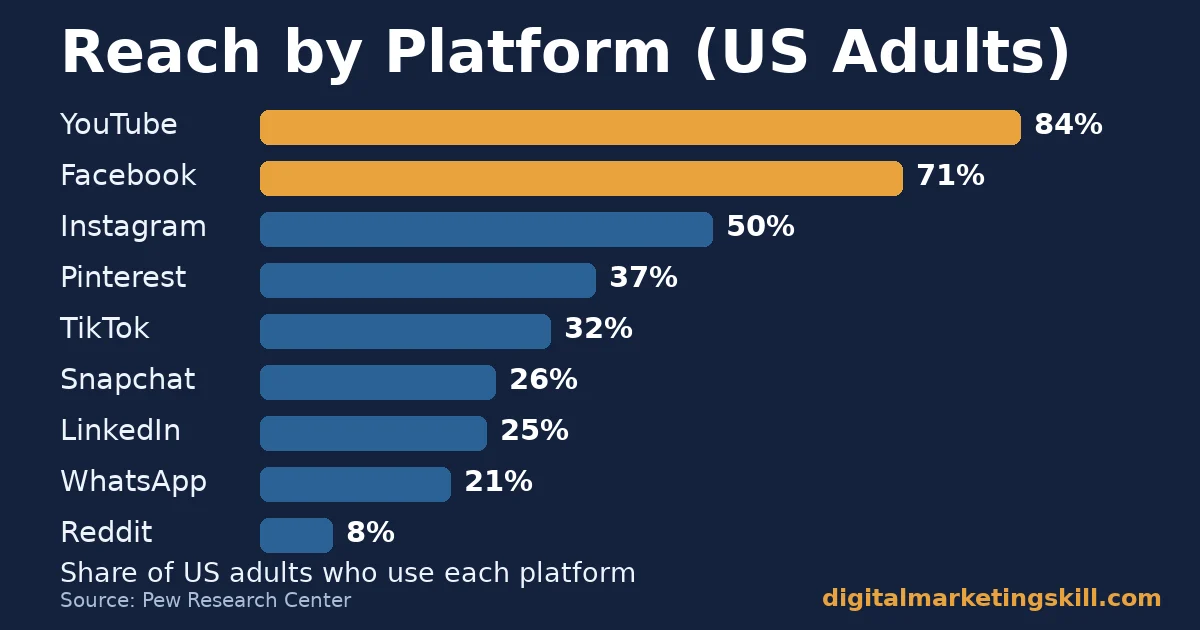
- YouTube (84%) and Facebook (71%) reach the largest share of US adults, per Pew Research. But reach is not relevance. Half of US adults use Instagram. Only 25% use LinkedIn.
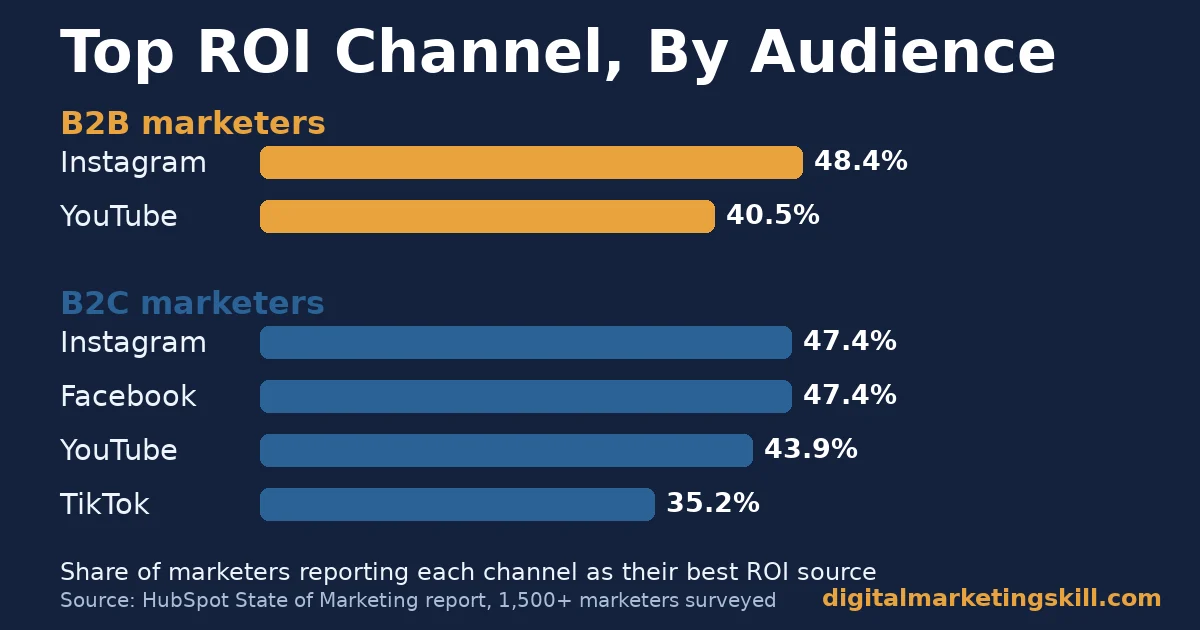
- Among B2B marketers, Instagram gets the highest reported ROI (48.4%), ahead of YouTube (40.5%). That is the finding of HubSpot’s State of Marketing report, and it surprises teams who default to LinkedIn for B2B.
- Among B2C marketers, Instagram and Facebook tie for the top ROI spot (47.4% each). YouTube is close behind (43.9%). TikTok comes fourth (35.2%).
- Short-form video is the single best-performing content format, rated by 48.6% of marketers surveyed. That changes how you should use even a text-first or photo-first platform.
- Worldwide use and US use tell a similar story for TikTok: roughly a third of adults, in both the US survey and the global GWI survey reported by DataReportal. Facebook and YouTube still lead broad reach on both.
In this guide
- The Real Gap: Platform Habit, Not Platform Fit
- How Platform Choice Actually Works
- What Differs Among the Best Social Media Platforms
- How To Lead With Each Platform
- How To Measure Whether a Platform Is Working
- The One Decision Rule for Picking the Best Social Media Platforms
- A Real Case: What a Measurement-First Approach Finds
- Frequently Asked Questions About Choosing Social Media Platforms
- Choosing the Best Social Media Platforms: Where To Go From Here
The Real Gap: Platform Habit, Not Platform Fit
Most small businesses pick a platform the way they picked their first one, years ago. They choose whichever app a founder already used, or whichever one a competitor was active on. That is a habit decision, not a fit decision. It is the single biggest reason social budgets underperform.
Three ground rules keep this guide honest. First, every ranking below is a snapshot, not a permanent order. Platforms reshuffle as algorithms and ad products change. Second, “best” always means best for one audience and one format. It never means best in general. Third, a platform can be huge worldwide and still be wrong for your business, if your buyer is not actually there in meaningful numbers.
This guide treats platform choice as three questions. Who is actually there? What format wins attention there? What can you measure to know if it is working? Skip any one question and the channel choice is a guess, not a decision. Answer all three and you end up with the best social media platforms for your specific business, not just the most-discussed ones.
How Platform Choice Actually Works
Every social platform optimizes its feed for one thing: time spent. That is what it sells to advertisers. The algorithm predicts whether a viewer will stop scrolling, watch, comment or share. It does not predict whether your post is useful to a business. Understanding that single fact changes how you plan content.
Three mechanical facts drive most platform decisions:
- Format beats platform. Short-form video is the top-performing content format across the marketers HubSpot surveyed for its State of Marketing report (48.6%). The choice between video and no video usually matters more than the app you post it to.
- Reach and relevance are different numbers. A platform can reach 84% of adults, as YouTube does per Pew Research, and still deliver a weak return if your buyer is a narrow group that spends attention elsewhere, such as LinkedIn’s 25% reach.
- B2B and B2C audiences reward different channels. HubSpot’s survey found Instagram leads reported ROI for both B2B (48.4%) and B2C (47.4%, tied with Facebook) marketers. That contradicts the common assumption that B2B marketing belongs on LinkedIn by default.
Put together, the mechanism is simple. A platform’s algorithm rewards format fit. Your return depends on whether your audience is there in real numbers, not on the platform’s total size. That single test is how you separate the best social media platforms for your business from the ones that just look impressive on a slide.
This also explains why a strategy that worked two years ago can quietly stop working today, even with the same content. Algorithms change their weighting often, usually without a public announcement, so a platform that once rewarded link posts can start burying them in favor of native video.
Re-checking your own channel-level data every few months catches that shift before it costs you a whole quarter of wasted posting. It is also why this guide ranks the best social media platforms by audience fit and measurement rather than by a fixed list, since a fixed ranking goes stale the moment one platform changes its algorithm.
What Differs Among the Best Social Media Platforms
The five platforms below cover most business use cases. Each has a distinct audience and rewards a distinct thing. Treating them as interchangeable “social media” is where most content plans break down, and it is why no single list of the best social media platforms applies to every business the same way.
Instagram: Built For Visual Discovery
Instagram reaches half of US adults, per Pew Research, and 54.6% of internet users worldwide aged 16+, per DataReportal and GWI. Its audience skews younger and more female than most platforms.
In practice, it rewards short-form video (Reels), carousel posts and in-app product tags, per Meta’s own Business Help Center. It is the single highest-ROI channel reported by both B2B and B2C marketers surveyed by HubSpot. It fits any business with a visual product or a visual story to tell.
For a deeper look at building a following there, see this guide to Instagram marketing specs and cadence.
YouTube: Built For Long-Attention Search
YouTube reaches the largest share of US adults, 84% per Pew Research, and 55.3% of internet users worldwide per DataReportal and GWI. Unlike feed-based platforms, YouTube is also a search engine.
Google’s own creator documentation confirms that videos get indexed and can surface in search results for years. As a result, it rewards depth over novelty: tutorials, comparisons and explainers. That makes it the best fit for any business whose buyer researches before they decide.
TikTok: Built For Reach Without Followers
TikTok reaches about a third of adults, both in the US (32%, Pew Research) and worldwide (36%, DataReportal and GWI), and it skews younger.
Its core mechanic, as TikTok’s own newsroom explains, is that the algorithm can push one video to a huge audience with zero existing followers. It ranks by watch-through behavior, not follower count. Instead, it rewards native, fast-cut, unpolished content over produced ads. It ranks fourth for B2C ROI (35.2%, HubSpot), useful but behind Instagram, Facebook and YouTube for most businesses.
LinkedIn: Built For Professional Audiences
LinkedIn reaches 25% of US adults, per Pew Research, and has passed 1.3 billion registered members worldwide, per LinkedIn’s own newsroom. Its audience skews toward working professionals and decision-makers, not the general population.
Instead, it rewards text posts with a strong opening line, native documents and video from identifiable people rather than brand accounts. It is the channel most B2B teams default to for leads, even though HubSpot’s survey shows Instagram out-performs it on reported ROI.
A related read on when the broader approach pays off: social media marketing principles that grow a page.
Facebook: Built For Community and Local Reach
Facebook reaches 71% of US adults, per Pew Research, and 56.3% of internet users worldwide, per DataReportal and GWI. It has the broadest and oldest audience of the five, skewing older than Instagram and TikTok.
In turn, it rewards Groups, local-area ad targeting and content that drives comments and shares. It ties Instagram for the top B2C ROI spot (47.4%, HubSpot), which makes it a strong fit for local and community-driven brands, not a platform to abandon as “old”.
See also Facebook Pages, Groups and ads explained.
How To Lead With Each Platform
Knowing what a platform rewards only matters once it changes what you post. Here is the practical lead for each one, mirrored to the sections above.
Instagram: Lead With Short Video and Product Tags
Post Reels first, carousels second, static photos last. Tag products directly in posts and Stories so a viewer can buy without leaving the app. Instead, measure saves and shares, not just likes. Instagram’s own ranking signals weight those higher as proof of value.
YouTube: Lead With Search-First Long Video
Write the title and the first sentence of the description for a search engine, not a feed. That is what surfaces the video months later. Build a small library of “how to” and comparison videos around the exact questions your buyers type into search. Evergreen tutorials, not trending topics, carry most of a channel’s long-term traffic.
TikTok: Lead With Native, Unpolished Clips
First, film on a phone. Then keep the hook in the first two seconds. Resist the urge to reuse a polished ad; native-feeling clips out-perform produced ones on watch-through rate. Post often enough to let the algorithm test several ideas. One clip reaching a large audience with no prior following is the platform’s core advantage.
LinkedIn: Lead With a Named Voice
Publish from a named person, not a company page. Open with a strong line and a point of view; personal profiles out-reach brand pages here. Use native documents or video for how-to content aimed at the job titles who buy from you. Treat comments from other professionals as the real distribution mechanism.
Facebook: Lead With Groups and Local Ads
Run or join a Group around your topic, rather than relying only on your Page’s organic reach, which has declined for years. Groups still surface reliably in members’ feeds.
Pair that with narrowly targeted local-area ads for any business with a physical service area. Facebook’s targeting still works well there, even as organic reach has thinned. If reach keeps slipping on one channel, this breakdown of social media marketing risks and how to manage them is worth a read before you walk away from the platform entirely.
How To Measure Whether a Platform Is Working
Pick three to five KPIs before you start. Let the data decide, not your attachment to a platform you enjoy posting on.
- Engagement rate: the share of people who saw a post and reacted, commented, shared or saved it. It shows whether your content is relevant to the audience you reached, separate from how many people saw it.
- Click-through rate: the share of viewers who clicked a link out of the platform. It shows whether a post that got attention also moved people toward your site.
- Cost per result: ad spend divided by the action you targeted, such as a lead or a sale. It shows whether a platform’s ad auction is efficient for your specific goal.
- Follower-to-reach ratio: organic reach on a post divided by follower count. It shows how much of your existing audience the algorithm actually shows your content to.
- Conversion rate from channel traffic: the share of visitors from that platform who complete your target action. It shows whether that traffic converts at a normal rate, or just looks good without buying.
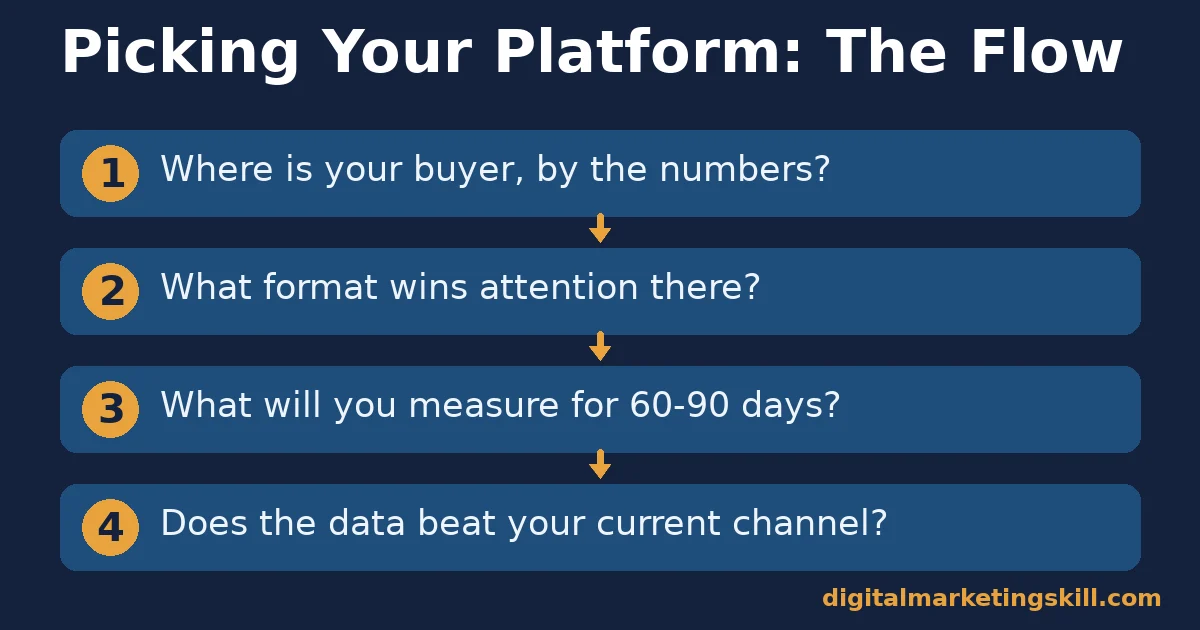
Track these per platform, not blended, for at least 60 to 90 days before you move budget. A single viral post, or one slow week, is noise, not a trend. This is the step most comparisons of the best social media platforms skip, and it is the one that actually settles the argument.
The One Decision Rule for Picking the Best Social Media Platforms
Decision rule: pick the platform where your buyer’s own usage number is highest, then confirm it with 60 to 90 days of your own conversion data before you commit more budget. Never decide from total platform size alone.
Illustrative, invented numbers: a local bakery compares Facebook (71% US adult reach, strong local ad targeting) against TikTok (32% reach, skewed younger) for a $500 monthly test budget. Under this rule, it starts with Facebook, because its buyer (local adults in one area) over-indexes there. It tests TikTok only after the Facebook channel’s conversion rate sets a baseline to beat.
A Real Case: What a Measurement-First Approach Finds
Content Marketing Institute and MarketingProfs surveyed more than 1,000 B2B marketers, mostly in North America, in research sponsored by Storyblok. It found that unclear goals and poor alignment to the buyer journey are named as top reasons content strategy underperforms, ahead of simply picking the “wrong” platform.
That matches the pattern in this guide. Businesses that struggle with social media more often have an unclear KPI and audience definition than a wrong platform choice. Fixing the measurement step, above, usually surfaces the real problem faster than switching platforms on instinct.
Limits on this evidence: the sample is mostly North American and self-selected, since only marketers who chose to respond are counted. Treat the percentages as directional for similar markets, not as a universal rule. The lesson still holds for the best social media platforms question: fix your measurement before you fix your channel list.
In practice, the fix usually looks the same across businesses. A team names one KPI per platform, writes down what “working” means in a number, and gives the channel a fixed test window before judging it. That single habit, more than any platform swap, is what separates teams who grow steadily from teams who jump channels every quarter and never build an audience anywhere.
Frequently Asked Questions About Choosing Social Media Platforms
Which Are the Best Social Media Platforms for a Small Business?
There is no single best platform for every small business. The right one depends on whether your buyer is reached better by Facebook’s broad local audience, Instagram’s visual and shopping features, or another platform’s specific strength. Start from where your actual customers already spend time, not from which platform gets talked about most.
Is LinkedIn always the right choice for B2B marketing?
Not necessarily. LinkedIn is built for professional audiences and is a reasonable default for B2B lead generation. But HubSpot’s survey found Instagram gets a higher reported ROI for B2B marketers than LinkedIn. It is worth testing more than one channel before you assume LinkedIn is automatically best.
Should You Use Every One of the Best Social Media Platforms?
Generally, no. Spreading a small team across five or six platforms usually produces weak content everywhere. Strong content on the two or three best social media platforms for your audience beats thin content on all of them, which the measurement section above helps you identify.
How long should you test a new platform before judging it?
Give a new platform at least 60 to 90 days, with a consistent posting pace, before you decide it does or does not work. Algorithms need time to learn what your content is and who to show it to. One slow week, or one viral one, is not a reliable signal either way.
Does short-form video matter even on text-first or photo-first platforms?
Yes. Short-form video is the top-performing content format across platforms, rated by 48.6% of marketers surveyed by HubSpot. Even a mostly text-based or photo-based plan usually benefits from adding short video wherever the platform supports it.
What is the difference between reach and engagement?
Reach counts how many people saw your content. Engagement counts how many of them reacted, commented, shared or saved it. A platform can have huge reach and weak engagement for your niche, which is why the measurement section above tracks both, plus click-through rate and conversion rate.
Do paid ads change which platform is the right fit?
Yes, sometimes. A platform with weak organic reach for your business can still work well with paid budget, because ad targeting and organic distribution are different systems inside the same app.
Facebook is the clearest example: organic reach has thinned for years, but its ad targeting by location, interest and behavior remains strong, which is why many local businesses still get results there through ads even when their unpaid posts barely get seen.
That is one more reason a shortlist of the best social media platforms should separate an organic test from a paid test, since the same app can fail one and pass the other for the same business.
Choosing the Best Social Media Platforms: Where To Go From Here
Choosing among the best social media platforms is one skill inside a much larger discipline. It works best next to clear measurement, content planning and paid strategy, not on its own.
Digital Marketing Skill Institute’s Master Diploma in Digital & AI Marketing can help, if you want that full skill set built with structured guidance instead of trial and error. It includes dedicated AI-Powered Social Media Marketing & Analytics and AI-Powered Social Media Advertising courses.
It comes with unlimited 1-on-1 coaching and mentoring, plus real project work inside a U.S. partner company. The program is dual US and UK accredited, and recognised in more than 100 countries. It runs 100% online, so you can study anywhere in your country on your own schedule.
Learn more about the full program and its nine other practical courses on the Master Diploma in Digital & AI Marketing page. Browse more guides like this one on the digital marketing blog, or read student outcomes on the reviews page.
When you are ready, apply here — wherever you live, the coaching and project work are built to run the same way online. Learn more at Digital Marketing Skill Institute, or start your application at digitalmarketingskill.com.
Every figure in this guide was checked against its original source before publication. Figures marked as illustrative are invented examples, not real results.
![9 Amazing Digital Marketing Skills to Make Money Online [With Proof]](https://digitalmarketingskill.com/wp-content/uploads/2019/07/9-Amazing-Digital-Marketing-Skills-to-Make-Money-Online-With-Proof-17.png)






