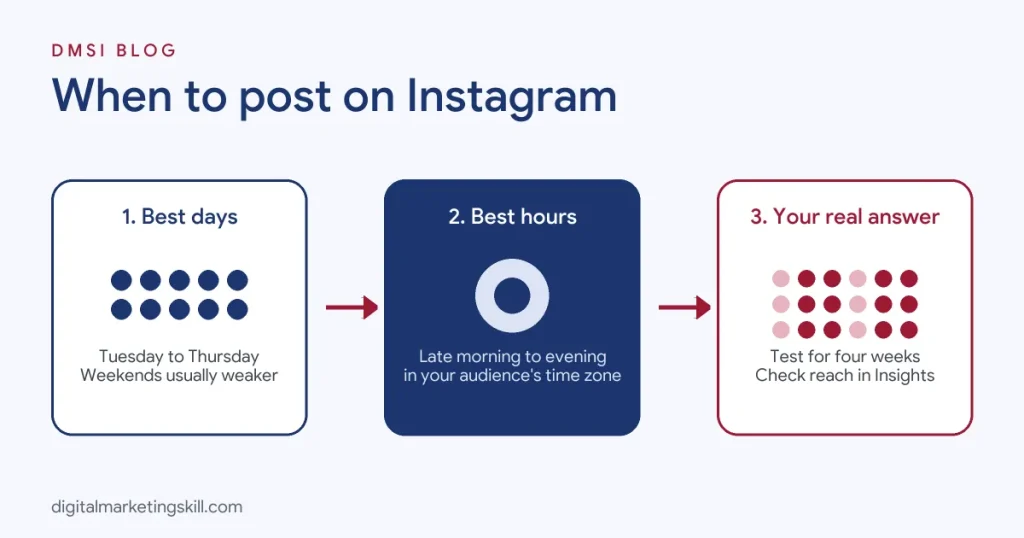
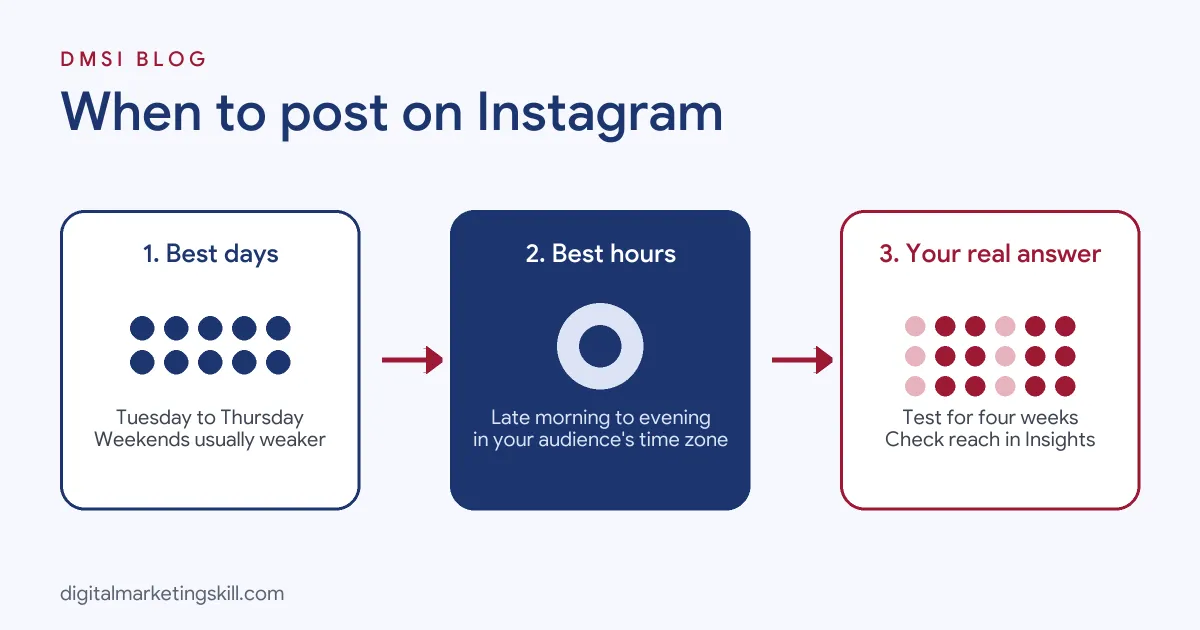
The best time to post on Instagram is midweek, roughly late morning to evening in your audience’s local time. Buffer’s analysis of 9.6 million posts ranked Thursday at 9 a.m., Wednesday at 12 p.m. and Wednesday at 6 p.m. as the top slots, while Sprout Social’s UK data points to 5 to 9 p.m. GMT, Monday to Thursday. However, these are starting points, not rules. Your own followers’ habits matter more, so the real answer comes from a short test using Instagram Insights.
This guide shows what the major studies found, why they disagree, how time zones change the answer and a simple four-week test to find your own best times. For the wider plan, read our Instagram marketing strategy guide.
Key Takeaways
- Buffer’s study of 9.6 million Instagram posts found Thursday at 9 a.m., Wednesday at 12 p.m. and Wednesday at 6 p.m. were the top three time slots.
- Sprout Social’s global data names Mondays 2 to 4 p.m., Tuesdays 1 to 7 p.m., Wednesdays 12 to 9 p.m. and Thursdays 12 to 2 p.m.
- For UK audiences, Sprout’s analysis of over 230 million UK engagements points to 5 to 9 p.m. GMT, Monday to Thursday.
- Instagram’s head, Adam Mosseri, has said the top ranking signals are watch time, likes and sends, so timing helps only if the post earns those.
- Buffer’s separate study of 2.1 million posts found accounts that posted more often each week tended to grow faster.
In this guide
- What Most Advice on Posting Times Misses
- How Posting Time Actually Affects Reach
- Best Time to Post on Instagram by Day
- Best Times by Format and Goal
- Time Zones: Post for Where Your Audience Lives
- How to Find Your Own Best Time: A Four-Week Test
- How to Schedule Instagram Posts for Your Best Times
- Common Mistakes With Posting Times
- What to Measure
- The One Rule for Instagram Timing
- An Illustrative Case
- Frequently Asked Questions About the Best Time to Post on Instagram
- Your Next Step
What Most Advice on Posting Times Misses
Search for the best time to post and you will find a dozen confident answers that do not match. One study says 9 a.m., another says 6 p.m., another says lunchtime. That is not because anyone is lying. Each tool studies its own customers, in its own mix of countries and industries, and measures success slightly differently.
So a published “best time” tells you when the average account in that study did well. It does not tell you when your followers are scrolling. A Lagos fashion brand, a London accountant and a US fitness coach have very different audiences.
There is a second point most lists skip. Timing only helps a post that is already good. If people do not watch, like or share it, posting at the perfect minute will not save it. Treat timing as the last ten per cent of the job, after the content itself.
How Posting Time Actually Affects Reach
Instagram does not show posts in time order any more. Instead, it ranks posts for each person based on how likely they are to engage. In a video series early in 2025, Mosseri said the three signals that matter most are watch time, likes and sends, and he suggested checking them per person reached.
Timing matters because of those early reactions. When you post while many followers are active, more of them see it quickly. If they watch, like and share it, Instagram has an early sign the post is worth showing to more people, including those who do not follow you. If you post while most followers are asleep, the post may get a slower start.
In practice, this means two things:
- Post when your followers are online, so the post can collect early engagement.
- Make content that earns engagement, so the early audience actually reacts. Our guide to engagement rate explains how to read those reactions.
Best Time to Post on Instagram by Day
The table brings together three large studies. Buffer and Sprout’s global figures are in the audience’s local time. Sprout’s UK figures are in GMT.
| Day | Sprout Social (global) | Buffer (global) | Sprout Social (UK, GMT) |
|---|---|---|---|
| Monday | 2 to 4 p.m. | Evening slots | 5 to 9 p.m. |
| Tuesday | 1 to 7 p.m. | Evening slots | 5 to 9 p.m. |
| Wednesday | 12 to 9 p.m. | 12 p.m. and 6 p.m. | 5 to 9 p.m. |
| Thursday | 12 to 2 p.m. | 9 a.m. (top slot) | 5 to 9 p.m. |
| Friday | No strong peak | Lower engagement | Weaker |
| Weekend | Weaker | Sunday 8 to 10 p.m. best of the weekend | Saturday weakest |
Three patterns show up in all of them. First, Tuesday to Thursday are the strongest days. Second, early mornings before about 7 a.m. are usually weak. Third, weekends tend to be quieter, although Sunday evening can work for some audiences.
Best Times by Format and Goal
Different formats behave differently, and so do different goals. Use these as starting points.
Reels: Built for Reach
Reels can keep finding viewers for days, so the exact minute matters less. Sprout Social found the best Reels windows match its overall Instagram windows. Post when your followers are active, so the Reel gets a strong first hour, then let it run.
Carousels: Built for Saves
Carousels work well for tips and how-to content that people save. Many audiences save useful posts during work breaks, so lunchtime and early evening often suit them.
Stories: Built for Your Existing Followers
Stories mainly reach people who already follow you, and they last 24 hours. Timing matters less, but spreading several Stories through the day keeps you near the front of the Stories bar.
Sales Posts: Built for Clicks
If the goal is a purchase or a sign-up, post when people have time to act. Evenings and lunch breaks usually beat early mornings, when people scroll quickly on the way to work.
Time Zones: Post for Where Your Audience Lives
Every study above uses the audience’s local time. That matters if you live in one country and sell to another.
- UK audience: Sprout’s UK data suggests 5 to 9 p.m. GMT on weekdays.
- Nigerian audience: Lagos is one hour ahead of GMT, so a 7 p.m. post in Lagos lands at 6 p.m. in London in winter.
- US audience: New York is five hours behind London. A post at 2 p.m. New York time goes out at 7 p.m. in London and 8 p.m. in Lagos.
If you manage accounts for overseas clients, schedule posts for the client’s audience, not your own day. To check where your followers are, open Instagram Insights, tap Total followers and look at Top locations and Most active times.
How to Find Your Own Best Time: A Four-Week Test
- Check your Insights. On a professional account, Instagram shows the hours and days your followers are most active. Write down the top three windows.
- Pick three time slots. For example, 12 p.m., 6 p.m. and 8 p.m. in your audience’s time zone.
- Keep the content similar. Use the same format, such as Reels, so time is the main thing you change.
- Rotate the slots. Post at least three times a week for four weeks, spreading posts across the three slots.
- Record the results. After 48 hours, note reach, likes, shares, saves and average watch time for each post.
- Compare averages per slot. Look at engagement per person reached, not raw totals.
- Keep the winner, test the next idea. Make the best slot your default, then test a new slot against it next month.
A scheduling tool helps you stick to the plan. Many free tools, including Meta Business Suite, let you schedule Instagram posts ahead.
How to Schedule Instagram Posts for Your Best Times
Once you know your best slots, scheduling makes them easy to hit, even when you are busy or asleep. Here is a simple routine that works for most small teams and freelancers:
- Batch your content. Set aside one session a week to plan, write captions and edit Reels for the next seven days.
- Use a scheduler. Meta Business Suite is free and can schedule Instagram feed posts and Reels. Paid tools such as Buffer, Hootsuite and Sprout Social add team features and reports.
- Set the time zone first. In your scheduler, choose your audience’s time zone, so slots match their day, not yours.
- Leave room to reply. Plan to check comments and messages in the first hour after each post. Fast replies keep conversations going and show followers someone is there.
- Keep a simple log. Note the slot, format and results for each post in a sheet. After a month you will have your own data, which beats any general chart.
Common Mistakes With Posting Times
Copying a Chart Without Testing
A chart from a big study is an average. Your audience might be night owls, shift workers or in another country.
Posting in Your Own Time Zone by Habit
If your followers live elsewhere, posting at a time that suits you can mean posting while they sleep.
Changing Too Much at Once
If you change the time, the format and the topic together, you cannot tell which change made the difference.
Judging One Post
One post can do well or badly for many reasons. Compare averages over several weeks.
Posting Rarely
Buffer’s study of 2.1 million posts found that accounts posting more often each week grew followers faster. Consistency usually matters more than perfect timing.
What to Measure
Instagram Insights gives you everything you need for a timing test. Focus on these:
- Reach: how many accounts saw the post.
- Likes per reach: likes divided by reach, as Mosseri suggests.
- Sends per reach: shares by DM divided by reach. This matters most for reaching new people.
- Average watch time: for Reels, how long people keep watching.
- Saves: a sign the post is useful enough to come back to.
- Profile visits and link clicks: the numbers closest to sales.
Our social media report guide shows how to turn these numbers into a simple monthly summary.
The One Rule for Instagram Timing
Post when your own followers are active, then let the data decide. Use the big studies to choose where to start, use Instagram Insights to see when your audience is online, and run a short test to confirm it. Above all, remember that timing amplifies good content. It cannot replace it.
An Illustrative Case
Imagine a freelance social media manager in Abuja who runs Instagram for a small London candle brand. She had been posting at 9 a.m. Abuja time, which is 8 a.m. in London, because it suited her routine.
She checks the brand’s Insights and sees that most followers are in the UK and most active from 6 p.m. to 9 p.m. London time. She sets up a four-week test with three slots: 12 p.m., 6 p.m. and 8 p.m. London time, scheduling Reels in advance.
After four weeks, the 8 p.m. Reels have the highest sends per reach and the longest average watch time. She makes 8 p.m. London time the default and adds a 12 p.m. carousel on Wednesdays. She also includes the test in her monthly report, which shows the client exactly why the change was made. This case is an illustrative example, not a real result.
Frequently Asked Questions About the Best Time to Post on Instagram
What is the best time to post on Instagram?
Midweek, late morning to evening in your audience’s time zone. Buffer’s top slot was Thursday at 9 a.m., and Sprout Social’s widest window was Wednesday from 12 to 9 p.m.
What is the best time to post on Instagram in the UK?
Sprout Social’s UK data suggests 5 to 9 p.m. GMT, Monday to Thursday. Test it against your own Insights.
What is the best day to post on Instagram?
Wednesday and Thursday usually perform best across the major studies. Saturday is often the weakest.
What is the best time to post Reels on Instagram?
The same windows as other posts are a good start. Reels can keep gaining views for days, so watch time and sends matter more than the exact minute.
Does posting time really matter on Instagram?
It helps a post get early engagement, but it matters less than the content. Instagram ranks posts mainly on signals such as watch time, likes and sends.
How do I find my best time to post?
Check Most active times in Instagram Insights, choose three slots, post at each for four weeks and compare engagement per person reached.
How often should I post on Instagram?
Buffer’s data suggests posting several times a week helps growth. Choose a pace you can keep up with good-quality posts.
Should I post at the same time every day?
A regular schedule helps you stay consistent, but test different slots first. Once you know your best times, keep to them.
Which time zone should I use if my followers are in another country?
Always your audience’s time zone. Check Top locations in Insights and schedule for the place most of your followers live.
Your Next Step
Knowing when to post is one small part of running Instagram well. Planning content, creating Reels, reading Insights and running ads all matter more. The Master Diploma in Digital & AI Marketing at Digital Marketing Skill Institute includes an AI-powered Social Media Management and Advertising track that teaches all of them, alongside tracks in Lead Generation and Email Automation, Google, and WordPress and SEO.
From day one, you work on a real U.S. company’s project through the U.S. Project Internship, so you finish with real results and a verified U.S. work reference letter. You also get unlimited one-on-one coaching. The program carries dual US and UK accreditation, is recognised in more than 100 countries, and runs 100% online over three months.
You can build those skills wherever you live, anywhere in your country. Read student reviews, then apply for the 65% partial scholarship to see if you qualify.
Every figure in this guide was checked against its original source before publication: Buffer, Sprout Social (global and UK data) and Adam Mosseri’s statements as reported by Social Media Today. Posting-time studies are updated often, so check your own Insights too. The case above is an illustrative example, not a real result.