
Most blogs fail quietly. They publish content, wait for traffic, and nothing happens. Blogging fundamentals explain why: a handful of structural choices decide whether a blog compounds into a real audience or stays invisible. Get the fundamentals right first. Style and voice can follow once the structure is working.
This guide skips the generic advice. It covers how search engines and readers actually judge a blog post. It shows what separates a post that compounds from one that gets buried, then closes with the one habit worth building before any other.
Key Takeaways
- Readers scan more than they read. Nielsen Norman Group’s study of naturalistic browsing found users have time to read at most 28% of the words on an average page visit, often closer to 20%.
- Length correlates with depth, not rank by itself. Backlinko’s analysis of 11.8 million search results found the average top-10 page runs about 1,447 words, a correlation tied to thoroughness, not a direct ranking rule.
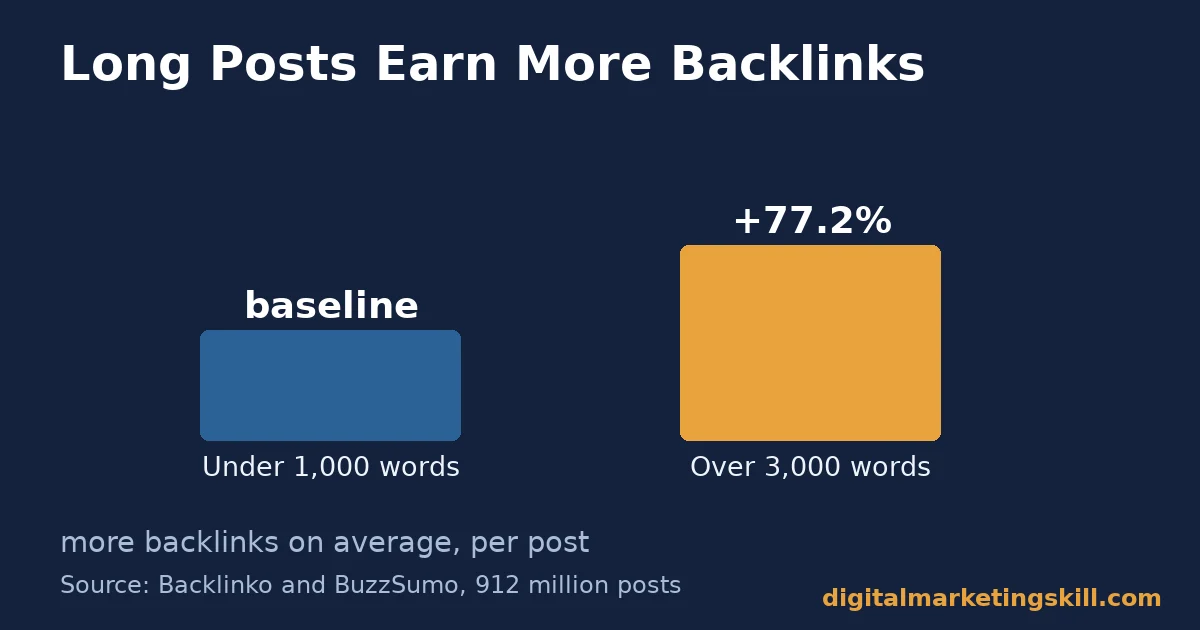
- Long posts earn more links. A Backlinko and BuzzSumo analysis of 912 million blog posts found content over 3,000 words earns 77.2% more backlinks than content under 1,000 words.
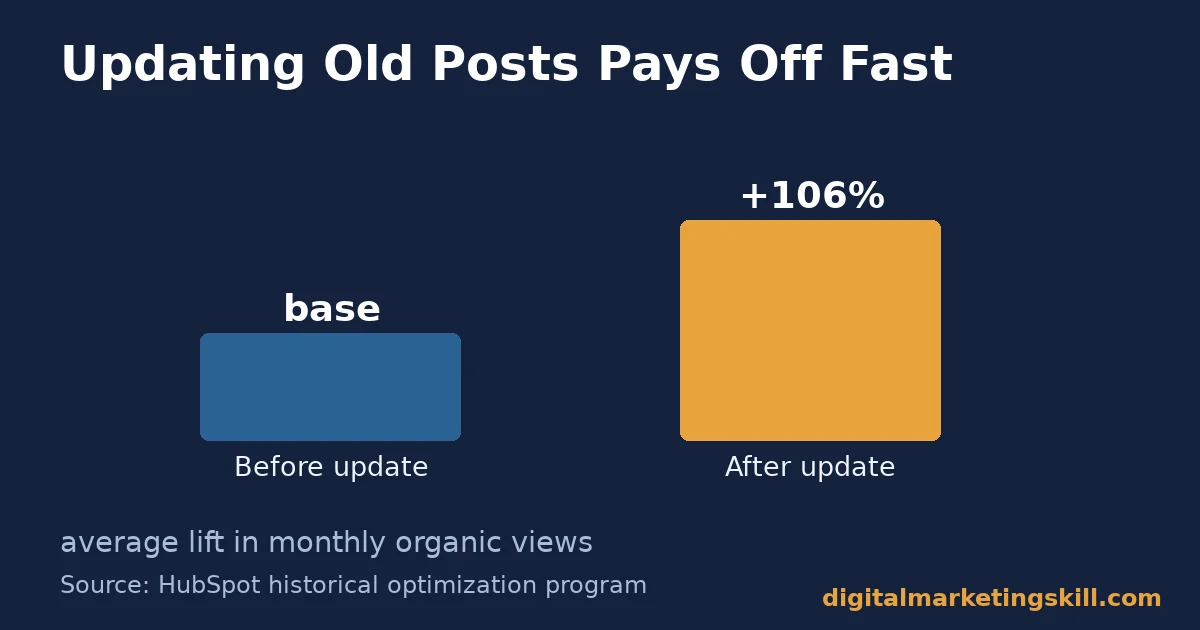
- Updating beats publishing more, eventually. HubSpot’s historical optimization program lifted monthly organic views on updated old posts by 106% on average.
- A small core of posts carries most of the traffic. HubSpot’s own data found compounding posts generate 38% of its blog’s total traffic, despite being a minority of what gets published.
In this guide
- Why So Many Blogs Skip the Fundamentals
- How Blogging Fundamentals Actually Earn Attention
- What Differs By Post Type
- How To Strengthen Each Post Type
- How To Measure Whether Blogging Fundamentals Are Working
- The One Decision Rule for Blogging Fundamentals
- Why Blogging Fundamentals Are Only the Foundation
- A Real Case: What Changed When One Blog Fixed Its Fundamentals
- Common Mistakes That Undermine Blogging Fundamentals
- Frequently Asked Questions About Blogging Fundamentals
- Build This Skill Properly
Why So Many Blogs Skip the Fundamentals
A blog can look complete and still fail at the fundamentals. The posts exist. The design is fine. Yet traffic stays flat month after month. That gap usually traces back to a handful of decisions made before a single word gets written.
Three ground rules keep this guide honest about blogging fundamentals before the specifics start. First, the figures below come from specific studies and specific companies. They describe patterns, not guarantees for any one blog.
Second, backlink and traffic figures skew toward sites already getting meaningful search visibility. A brand-new blog will not see the same scale right away, even while applying the exact same fundamentals correctly. Third, any number marked illustrative is an invented example, not a measured result.
The real blogging fundamentals are not secret. Writers rarely apply them consistently. That inconsistency is the actual gap most blogs never close.
None of this requires a large team or a big budget. A single writer, working through the same checklist on every post, can apply these fundamentals as reliably as a large editorial team. The constraint is rarely resources. It is usually just a missing checklist.
How Blogging Fundamentals Actually Earn Attention
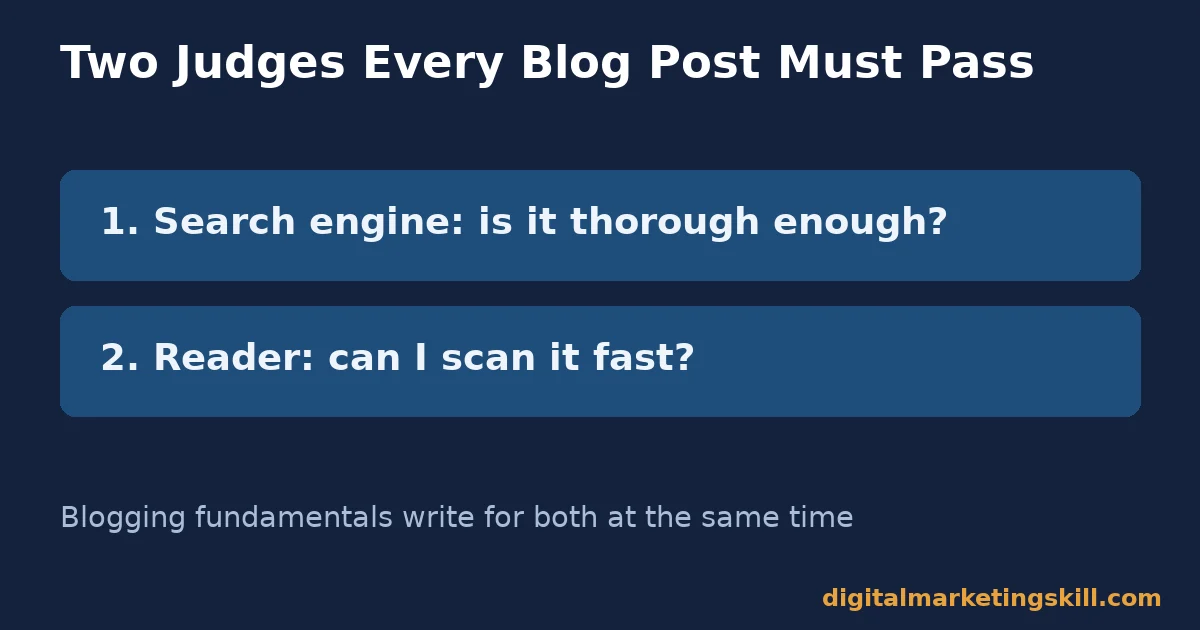
A blog post has to clear two separate judges before it earns a reader. The first is a search engine. It decides whether the post deserves to be shown at all. The second is the person who actually lands on the page. They decide whether to stay.
The Search Judge: Depth Over Word Count
Search engines do not reward length directly. They reward pages that answer a question completely. A searcher should not need to click back and try again. Longer posts often do this better. That is why Backlinko’s research finds a correlation between length and ranking, without word count itself causing the result.
The Reader Judge: Scanning, Not Reading
Most visitors do not read a blog post top to bottom. They scan headings, bolded phrases and the first line of each paragraph. Then they decide whether to slow down. Nielsen Norman Group’s research backs this up directly. Readers consume a minority of the words on a typical page visit, even when they stay on the page.
Solid blogging fundamentals write for both judges at once. The post answers the question thoroughly for search. It also carries a structure a scanning reader can follow fast.
What Differs By Post Type
Not every blog post is trying to do the same job. Three common types dominate most blogs, and each succeeds or fails on a different fundamental.
Evergreen Guides: Built to Compound
An evergreen guide answers a question that keeps getting asked, with no expiry date built into the content. It keeps earning search traffic long after publication. It is the type most likely to become one of the compounding posts that eventually carry most of a blog’s traffic. Most blogs underinvest in this type relative to how much of their long-term traffic it will eventually carry.
Timely Posts: Built for a Short Spike
A timely post rides current interest in a trend or announcement. It can bring a fast spike in traffic and shares. That traffic usually fades once the topic cools. These posts are worth publishing. They should never be the whole strategy, though, since they rarely compound the way an evergreen guide does.
Pillar Pages: Built to Organize a Topic
A pillar page covers a broad topic at a high level and links out to narrower posts that go deeper on each part. It helps both search engines and readers understand how a blog’s content fits together. It also gives every supporting post somewhere relevant to link back to, which strengthens the whole cluster rather than just one page.
How To Strengthen Each Post Type
Each post type needs a different fix, not the same generic advice applied everywhere.
Evergreen Guides: Lead With Completeness
Answer the full question, not just the easy part of it. Cover the follow-up questions a reader would naturally have next, inside the same post, rather than making them search again. Our blog content strategy guide covers how to plan that scope before writing. Planning the full list of sub-questions before drafting, rather than discovering them mid-write, keeps the structure clean from the first paragraph.
Timely Posts: Lead With a Fast Publish, Then Let Go
Publish quickly while the topic is live, since the value is mostly in timing. Do not over-invest in a timely post expecting long-term traffic from it. Treat the spike as a bonus, not the plan, and put the bulk of the real editorial effort into the evergreen guides that will still be earning traffic much later.
Pillar Pages: Lead With Deliberate Internal Linking
Link from the pillar page down to every supporting post. Link back up from each supporting post to the pillar. Two-way linking signals which page matters most. It also helps a visitor move naturally between related topics without a search detour. Our content marketing strategy guide covers how to map a topic into a pillar and its supporting posts.
How To Measure Whether Blogging Fundamentals Are Working
Five numbers show whether a blog’s fundamentals are actually paying off. Published post counts alone will not tell you that.
- Organic search traffic per post. Search visits divided by published posts, tracked over time. A rising figure per post means older content is compounding, not just accumulating.
- Share of traffic from compounding posts. The percentage of total blog traffic coming from posts published more than a few months ago. HubSpot’s own blog found this figure at 38%, a useful reference point for how concentrated traffic can get.
- Average time on page. How long a visitor stays before leaving. A low figure next to decent traffic often means readers find the post but do not find it satisfying once they arrive.
- Returning readership. The share of blog visitors who have been to the blog before. A low share suggests the blog has not yet built the kind of trust that brings readers back on its own.
- Update lift. The traffic change on a post before and after a content refresh. Track this directly whenever an old post gets updated. Do not just assume the refresh helped.
Tagging Posts by Type Before Reading These Numbers
Tag each post as evergreen, timely or pillar before pulling these numbers. A blended average across all three types will hide which one is actually underperforming, since each has a different normal pattern.
A timely post that fades fast is not a failure. It did its job in the window it was published. Judging it against an evergreen guide’s long-term curve would send the wrong signal entirely, so keep the comparisons inside each type, not across them.
The One Decision Rule for Blogging Fundamentals
Decision rule: before writing anything new, update the handful of old posts already getting some traffic. New posts take months to earn ranking. A brand-new URL has no history for a search engine to trust yet, no matter how well it is written.
Updated posts that already rank can see a lift within weeks, because the search engine already trusts the URL and simply needs a reason to rank it higher. That difference in speed is why this decision rule leads with updating, not publishing, whenever both are competing for the same limited time.
Worked example, illustrative, invented numbers: a blog publishes four new posts a month, each earning about 50 monthly visits after a few months, for 200 new visits.
Updating five older posts already ranking on page one, instead of writing two of those new posts, lifts each one by roughly 80 extra visits, for 400 additional visits, in less time than writing from scratch. The content existed. The fundamentals around it did not.
Why Blogging Fundamentals Are Only the Foundation
Getting the fundamentals right does not guarantee a blog succeeds on its own. It removes the structural reasons a good post fails to be found or read. That is a real win, but it is not the whole job on its own.
What happens after publication still has to be done deliberately: promotion, distribution and building an actual audience relationship. A post can be flawless on every fundamental covered above and still sit unread if nobody ever sees the link.
That is why blogging fundamentals work best paired with a distribution plan, not treated as the entire strategy. A perfectly structured post that nobody ever sees still earns nothing. Our guide to growing an email list covers one of the more durable distribution channels, since an email subscriber returns without needing to be found again through search each time.
A Real Case: What Changed When One Blog Fixed Its Fundamentals
HubSpot documented a technology company’s blog that grew traffic by roughly 2,512% within a single year, starting from a very small base. Several concrete changes drove that growth, not one single fix.
The company increased posting frequency, moving from one post every couple of weeks to several posts a week. It shifted from executive opinion pieces to practical, reader-focused content aimed at the people who actually searched for help, not the company’s own leadership.
It applied basic on-page SEO as well: one to two target keywords per post, internal linking between related posts, and clear, search-friendly meta descriptions. None of these changes were advanced technical work. They were blogging fundamentals, applied consistently over a sustained period, with nothing exotic happening behind the scenes.
Read the limits carefully. The percentage looks dramatic because the starting traffic was tiny, so the same absolute gain would look far less impressive on a bigger blog. It is also a single, HubSpot-published case, not an independent audit. The underlying fundamentals, consistency, practical content and basic SEO, are the transferable part, not the exact percentage.
Common Mistakes That Undermine Blogging Fundamentals
Beyond post type and update habits, a handful of recurring mistakes quietly undercut otherwise solid blogging fundamentals. Each one is easy to fix once it is named.
Publishing a Post With No Next Step
A post that answers the question and then just ends gives a satisfied reader nothing to do next. A relevant next-step link, to a related guide or a way to stay in touch, turns a one-time visit into an ongoing relationship instead of a dead end.
Burying the Answer Under a Long Introduction
Many posts spend several paragraphs warming up before reaching the actual point. Scanning readers leave before they ever find it. State the core answer early, then use the rest of the post to support and expand on it.
Skipping Headings and Subheadings
A wall of unbroken text forces every reader into full reading mode. Most will not commit to that. Clear headings let a scanning reader jump straight to the part that matters to them. That scanning pattern is exactly what Nielsen Norman Group found in its research. It is not a minority behaviour. It is how most visitors actually read.
Never Revisiting Old Posts
Treating publication as the finish line leaves real traffic on the table. A post that ranked well a while ago can quietly lose ground as competitors update their own content.
The decline is rarely sudden. It happens slowly enough that nobody notices until the traffic graph has already flattened. Revisiting old posts on a regular schedule is one of the cheaper wins in blogging fundamentals, precisely because that slow decline is so easy to catch early if anyone bothers to look.
Ending Every Post With the Same Generic Pitch
A closing call to action that is identical on every post, regardless of topic, reads as an afterthought rather than a genuine next step. Match the closing suggestion to what the specific post was about.
It should feel like a continuation of the same conversation, not a template dropped at the bottom of the page. A reader who just finished a detailed how-to deserves a different next step than one who just skimmed a quick news roundup on a different part of the site.
Frequently Asked Questions About Blogging Fundamentals
What are the fundamentals of successful blogging?
Knowing who the post is for, answering their question completely, structuring it so a scanning reader can find that answer fast, and updating it later as the topic evolves. Those four habits matter more than any single writing trick.
How long should a blog post be?
Long enough to answer the question completely, and no longer. Backlinko’s research found top-ranking pages averaging around 1,447 words, but that is a correlation tied to thoroughness, not a target to hit artificially.
Does posting frequency matter more than quality?
No. A smaller number of thorough, well-structured posts, kept current through regular updates, usually outperforms a high volume of thin posts. Frequency helps only once each post already meets a reasonable bar for depth and structure.
Is it better to update old posts or write new ones?
Both matter, but updating is often the faster win. HubSpot’s historical optimization data found a 106% average lift in organic views on posts it updated, often faster than a brand-new post can rank from zero. Treat the two as complementary habits, not a choice to make once and stick with forever.
Should a blog post be written for search engines or for readers?
Both, and they are less in conflict than they seem. A post that genuinely answers a question in full, with clear structure, tends to satisfy a search engine’s intent signals and a scanning reader’s need to find the answer fast, at the same time.
Does a blog need to stay narrowly focused on one topic?
Generally yes. A focused blog makes it easier for both search engines and readers to understand what it is an authority on.
It also makes pillar-and-supporting-post structures easier to build cleanly, since every new post has an obvious place to sit inside the existing map of content. A blog that jumps between unrelated topics every week never builds that same clear map, no matter how good any single post happens to be on its own.
Do comments and engagement still matter for a successful blog?
They matter less for ranking than they once did, but they still signal whether content is actually useful to the people reading it. Responding to genuine feedback, positive or critical, is worth the time even if it does not move search metrics directly.
How many posts does a new blog need before it gains traction?
There is no fixed number, but a small set of thorough, well-structured posts on a clearly defined topic tends to outperform a large volume of thin ones. Focus on covering a handful of core questions completely before expanding into adjacent topics.
Should every blog post follow the same structure?
Not rigidly, but a consistent pattern, a direct opening answer, clear headings, and a logical build toward supporting detail, helps both scanning readers and search engines understand a post quickly. Consistency in structure is one of the simpler blogging fundamentals to apply across an entire blog.
Build This Skill Properly
Blogging fundamentals are one piece of a much larger content and marketing skill set. Digital Marketing Skill Institute’s Master Diploma in Digital & AI Marketing builds that skill set through nine practical courses, including content marketing and SEO.
It is backed by unlimited one-on-one coaching and mentoring, plus real project work inside a U.S. company. The program is dual US and UK accredited and recognised in more than 100 countries, 100% online, so you can study and apply it anywhere in your country.
Blogging fundamentals are a repeatable system once learned properly, not a list to memorise once and forget. Structured training tends to compress the time it takes to build that system.
Figuring it out alone, through trial, error and guesswork, usually takes far longer to reach the same result.
Wherever you live, the fastest way to see how the courses connect to work like this is to look at the curriculum yourself. Our guide to blog readership is a good next read if traffic is already arriving but readers are not staying.
Browse more practical breakdowns on the digital marketing blog, read outcomes on reviews, and when you are ready, apply through https://digitalmarketingskill.com/. The Institute keeps its full program details current at https://digitalmarketingskill.com/.
Every figure in this guide was checked against its original source before publication. Figures marked as illustrative are invented examples, not real results.
![9 Amazing Digital Marketing Skills to Make Money Online [With Proof]](https://digitalmarketingskill.com/wp-content/uploads/2019/07/9-Amazing-Digital-Marketing-Skills-to-Make-Money-Online-With-Proof-17.png)






