Branding vs marketing comes down to identity versus action. Branding is the consistent identity, personality and promise your business stands for. Marketing is the set of activities that communicates that identity to a specific audience and prompts them to act. Branding answers who you are. Marketing answers how people find out.
Key Takeaways
- A brand is a legal and perceptual identifier. The American Marketing Association defines a brand as a name, term, design, symbol or feature that identifies one seller’s offerings as distinct from others (American Marketing Association).
- Marketing is the wider activity set. The AMA defines marketing as the activities and processes for creating, communicating, delivering and exchanging offerings of value (American Marketing Association).
- Brand value is measurable, and it is enormous. Kantar’s BrandZ ranking puts the combined value of the world’s top 100 brands at $13.1 trillion, up 22% on the prior ranking (Kantar BrandZ).
- That valuation rests on large-scale consumer research. Kantar’s methodology draws on more than 4.6 million interviews across 54 markets and 22,392 brands (Kantar BrandZ).
- The two disciplines split a marketing budget unevenly. Research on 996 effectiveness-award campaigns found a common starting split of roughly 60% toward brand-building and 40% toward short-term activation (IPA Databank, Binet and Field).
In this guide
- What Most Branding vs Marketing Advice Gets Wrong
- How Branding and Marketing Actually Relate
- What Differs Between Branding and Marketing
- How to Lead With Each Side of Branding vs Marketing
- Common Mistakes That Blur Branding vs Marketing Decisions
- Who Owns What: Branding vs Marketing Roles
- How to Measure Branding and Marketing Separately
- When Branding and Marketing Signals Disagree
- The One Decision Rule for Branding vs Marketing
- A Real Case: What Decades of Campaign Data Show About the Split
- Frequently Asked Questions About Branding vs Marketing
- Build Both Sides, Starting With Identity
What Most Branding vs Marketing Advice Gets Wrong
Most explainers treat branding vs marketing as a dictionary exercise. They define each word, give an example, and stop. That skips the real question. Most people asking about branding vs marketing want to know which to build first, and when.
This guide treats branding vs marketing as a sequencing and budget question. It covers what each one is built to do, how to lead with each, how to measure them, and one rule for which comes first.
A few ground rules. The budget-split figures here come from research on larger, award-submitted campaigns and self-reported surveys. Read them as informed benchmarks, not a guarantee for your business. Brand valuations like Kantar’s are estimates built from a stated methodology, not audited financial fact.
None of this means branding vs marketing has one universal correct split either. Category, business age and how quickly you need measurable results all shift the right answer. Treat every number here as a current snapshot, not a permanent rule, and recheck it against your own results before committing a full budget cycle to it.
How Branding and Marketing Actually Relate
Branding comes first in theory, even when the two happen together in practice. The American Marketing Association defines a brand as a name, term, design, symbol or other feature that identifies one seller’s goods or services as distinct from another’s. That identity, once set, becomes the thing every later marketing message has to carry consistently.
Marketing, by contrast, is the wider activity. The AMA defines marketing as the activities, institutions and processes for creating, communicating, delivering and exchanging offerings that have value for customers and society. Branding supplies the identity; marketing supplies the reach. Our companion guide to marketing vs advertising covers how that wider marketing activity then splits into its own paid and unpaid tools.
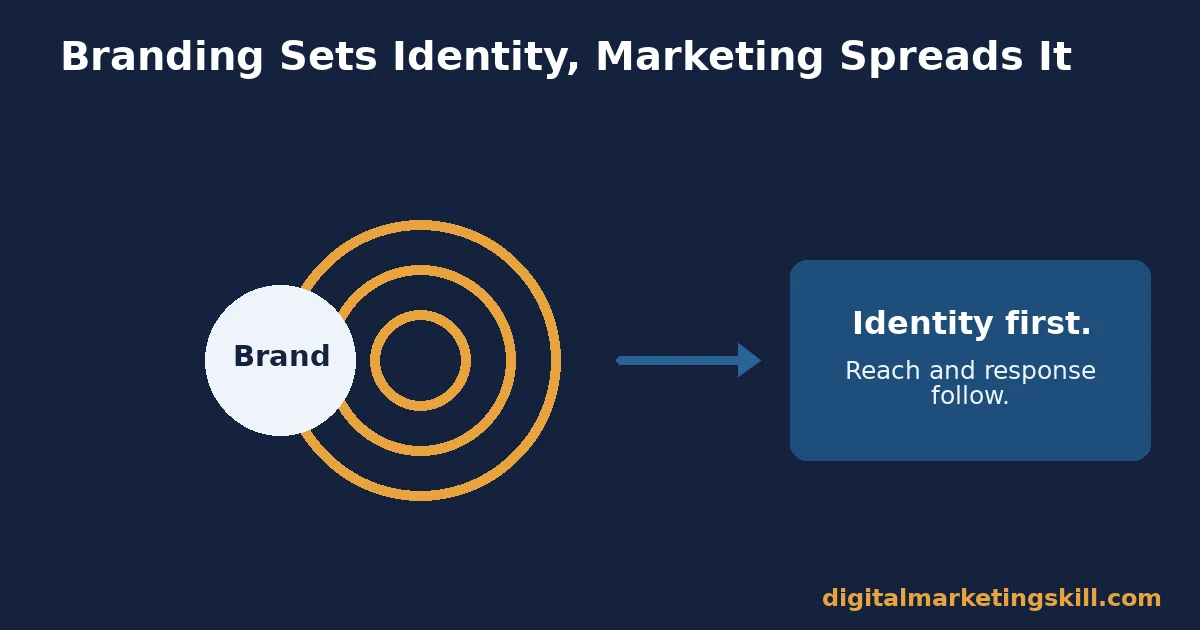
This relationship explains a common failure mode. A team runs ad campaigns before anyone has written down the brand’s identity, tone or promise. Every campaign then has to reinvent the message from scratch, which wastes budget and confuses the audience over time.
The reverse failure happens too, though less often. A business spends months refining its identity and never ships a single campaign to test it against a real audience. Branding without marketing stays a private document; marketing without branding becomes noise that nobody remembers.
The Money Behind Branding vs Marketing Is Measurable
Brand value is not just a feeling. Kantar’s BrandZ ranking puts the world’s top 100 brands at a combined $13.1 trillion, up 22% on the prior ranking. That figure comes from a stated BrandZ methodology combining financial analysis with consumer research across more than 4.6 million interviews in 54 markets.
Marketing spend is measured separately, mostly as media activity. Global advertising spend, the paid arm of marketing, is forecast to grow 11.9% to $1.34 trillion, according to WARC’s global ad spend forecast. Branding and marketing are measured on different scales because they are, functionally, different kinds of asset.
What Differs Between Branding and Marketing
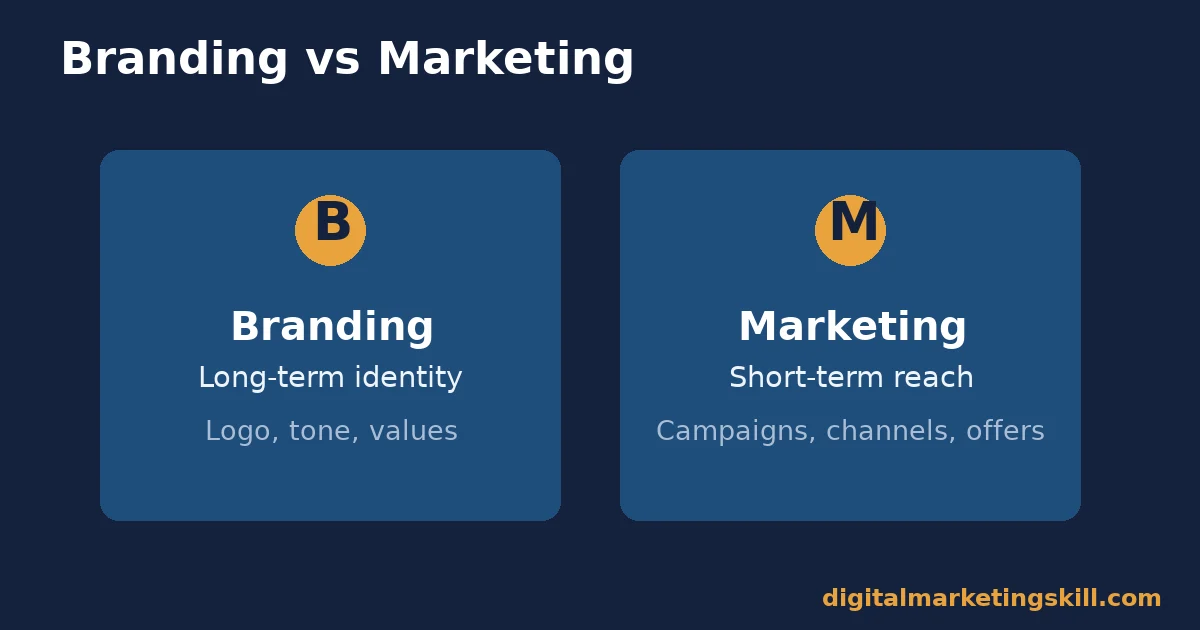
Branding and marketing differ on timeline, consistency, and what each one is built to protect. The two sections below mirror each other, so you can compare branding vs marketing side by side.
Branding: Built for Long-Term Identity
Branding is built to stay the same. A logo, a tone of voice, a set of values: these are meant to hold steady for years, so customers recognise the business instantly across every touchpoint. Our guide to brand advertising covers how that identity shows up in paid campaigns specifically.
Because branding is built for consistency, its return is slow to show up and hard to isolate. It shows up in recognition, trust and willingness to pay a premium, not in a single campaign’s click-through rate. That slow payoff is exactly why branding is easy to under-invest in, and expensive to rebuild once customers stop recognising what the business stands for.
Marketing: Built for Reach and Response
Marketing is built to change. A campaign runs, is measured, and is replaced by the next one. Channels, offers and creative all shift with the audience and the season, while the brand identity underneath stays fixed.
Because marketing is built for response, it is also the easier side to measure directly. Clicks, leads and conversions can usually be tied to a specific campaign, channel and date, unlike brand perception. That precision is exactly why branding vs marketing debates so often default to marketing’s numbers, even when the real gap sits upstream in identity.
How to Lead With Each Side of Branding vs Marketing
The sections below mirror the two roles above. Lead with branding to decide who you are. Lead with marketing to decide how people find out, this week and every week after.
Branding: Lead With a Written Identity Before Any Campaign
Write down your brand’s identity before you brief a single campaign: the audience you serve, the tone you use, and the one promise you keep. Skipping this step is why many marketing campaigns feel inconsistent from one quarter to the next, even from the same company.
Keep that written identity short enough that a new hire could apply it correctly without asking. A one-page brand guide beats a fifty-page deck nobody rereads, because nobody actually reopens the deck before briefing the next campaign.
Marketing: Lead With the Channel and the Offer
Once the identity is written, marketing’s job is distribution. Pick the channel that matches where your audience already spends time, and build an offer specific enough to act on. Our guide to media marketing covers how to pick the right channel mix for a given goal.
Keep every campaign’s creative and tone traceable back to the written brand identity. Marketing that drifts from that identity might still perform in the short term, but it erodes the very recognition branding spent months building.
Common Mistakes That Blur Branding vs Marketing Decisions
A few recurring mistakes explain most branding vs marketing confusion inside real teams.
- Running campaigns before identity exists. Teams launch marketing to hit a deadline, then discover every campaign says something slightly different about who the business is.
- Treating a logo as a finished brand. A visual mark is one piece of branding, not the whole identity; tone, values and consistency matter just as much.
- Judging branding by campaign metrics. Click-through rate and cost per acquisition say nothing about whether customers actually recognise or trust the business.
- Rewriting the identity every quarter. Branding only works if it holds steady; changing the tone or promise with every new campaign undoes the consistency that builds recognition.
Which Mistake to Check in Your Own Team
Start by checking whether a written brand identity exists anywhere your team can actually find it. Many teams have a logo file but no written tone, values or promise. If marketing briefs never reference that document, the gap between branding and marketing is usually the real problem.
A Quick Checklist Before You Brief a Campaign
- Confirm a written brand identity document exists and is current.
- Check that the campaign’s tone matches that document, not just the previous campaign.
- State the one action you want the audience to take.
- Pick the channel that matches that action and your audience’s habits.
- Decide in advance which metric, awareness or conversion, will judge success.
Who Owns What: Branding vs Marketing Roles
Confusion over branding vs marketing often starts with unclear ownership, not just unclear definitions. Naming who owns each decision prevents the same drift from happening twice.
Roles That Sit Inside Branding
Branding roles typically include brand strategy, identity design and messaging. These roles ask broad, slow-moving questions: who are we, what do we stand for, and how do we want to be remembered.
Roles That Sit Inside Marketing
Marketing roles typically include campaign management, media buying and content production. These roles ask narrower, faster-moving questions: which channel, which offer, and which creative performs best this cycle.
Small teams often merge both sets of roles into one person. That is workable, provided that person still protects time for identity work, instead of letting the next campaign deadline quietly consume it.
Agencies usually split the same way internally, even when a client hires just one agency for everything. A brand strategist or creative director handles the identity side, writing the tone, values and visual rules. A media buyer and campaign team then handle marketing, turning that identity into running, measurable activity.
Knowing this split helps you ask the right question of an agency pitch. Do not only ask what the campaign will look like. Ask who owns the identity it is built from, and whether that identity work happened before the campaign or alongside it.
How to Measure Branding and Marketing Separately
Branding vs marketing needs two different scorecards, because one protects a long-term asset and the other drives short-term response. Mixing the two hides which side actually needs attention.
Five Metrics, Split by What They Actually Protect
- Brand awareness (branding). The share of your target audience who recognise your name or logo unprompted. It moves slowly and reflects years of consistent exposure, not one campaign.
- Brand equity or perceived value (branding). How much trust and willingness to pay a premium your name alone carries. Kantar and Interbrand estimate this at scale using their own stated methodologies.
- Click-through rate (marketing). The share of people who saw a campaign and clicked it. It tells you whether that single piece of creative and targeting worked.
- Cost per acquisition (marketing). What you paid, across a channel, to win one customer. It is a campaign-level number, not a brand-level one.
- Return on ad spend, or ROAS (marketing). Revenue generated per dollar of ad spend. It is the clearest short-term payback measure marketing has.
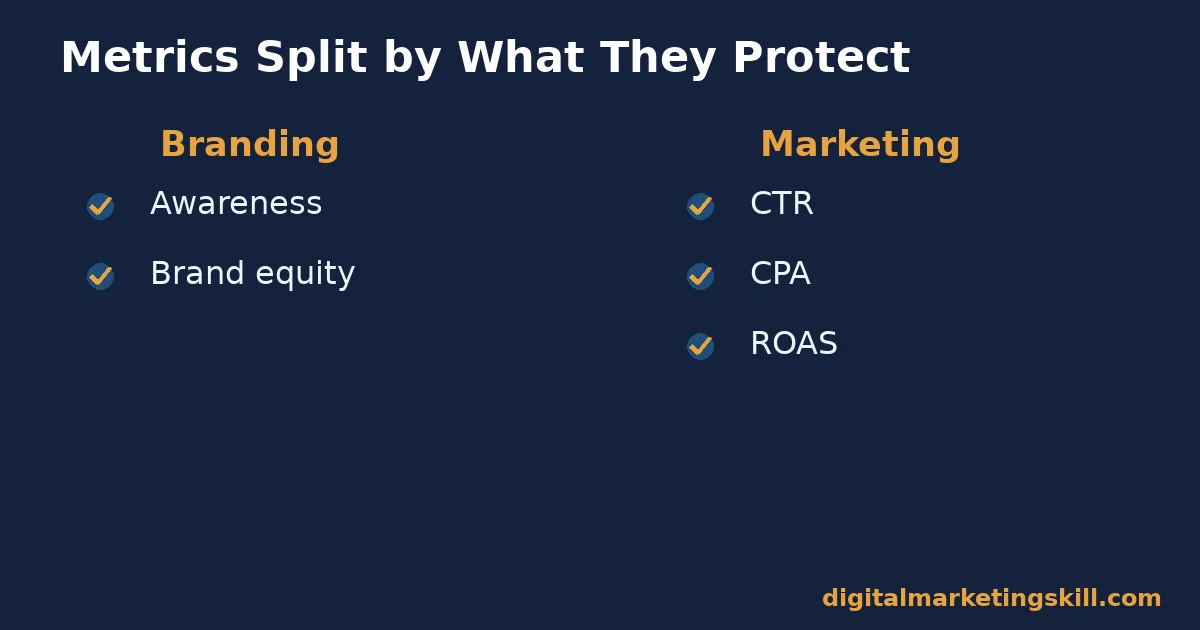
Measuring ROI is still marketers’ single biggest reported struggle, cited by 33.0% of respondents in HubSpot’s State of Marketing survey. Splitting metrics this way makes that struggle easier: branding metrics judge the asset, and marketing metrics judge the campaign.
When Branding and Marketing Signals Disagree
Sometimes campaign metrics look strong while brand awareness stays flat, or the other way round. That mismatch is useful information, not a contradiction to dismiss.
If click-through rate and conversions look healthy but unprompted brand recognition is not moving, the campaigns are working, but they may not be reinforcing a consistent identity. Because customers cannot describe what makes the business different, each campaign effectively starts from zero again.
If brand awareness is strong but campaign performance is weak, the identity is probably sound. The marketing execution, however, needs work: channel choice, offer clarity, or creative quality may be off.
Reading both scorecards together, rather than just one, usually points straight at which side of branding vs marketing needs attention first. Teams that only check one number tend to fix the wrong half of the problem, then wonder why results stay flat.
The One Decision Rule for Branding vs Marketing
When resources are limited, follow this order. First, confirm a written brand identity exists and is actually used in briefs. Second, size your marketing spend to the channels and offers that match that identity. Third, revisit the split every quarter, since marketing tactics shift faster than identity should.
Illustrative, invented numbers. Picture two businesses with the same $8,000 monthly budget. One spends it all on paid ads with no written identity behind them. Clicks look fine, but customers cannot describe what makes the business different a week later.
The other spends $2,000 writing and testing a brand identity, then $6,000 on marketing built from that identity. The second business typically sees stronger repeat purchase rates, because every touchpoint now reinforces the same recognisable promise. Over several campaigns, that consistency tends to lower acquisition costs too, since returning and referred customers need less convincing than first-time strangers.
A Real Case: What Decades of Campaign Data Show About the Split
Clear, documented evidence on branding vs marketing balance comes from the IPA’s effectiveness databank research by Les Binet and Peter Field. It analysed 996 campaigns submitted for the Institute of Practitioners in Advertising’s effectiveness awards.
Brand-building work and short-term marketing activation operate on different timelines, the research found. Activation produces a sharp but short-lived uplift. Brand-building produces a slower, more durable, compounding effect instead.
A commonly cited starting split from that research puts about 60% of budget toward brand-building and 40% toward activation. Later work shows this varies by category, from roughly 80:20 in financial services to closer to balanced in B2B.
Treat this as a well-documented pattern from mostly larger, award-submitted campaigns, not a universal rule for every business size. Still, it is strong evidence on branding vs marketing: the data shows identity-building and response-driving working together, on different clocks.
A smaller business without that kind of award-campaign data can still apply the underlying lesson. Protect some budget for identity work, even while marketing activation carries most of the near-term pressure to perform. That balance, more than any single ratio, is what the research actually recommends.
Frequently Asked Questions About Branding vs Marketing
Is branding part of marketing, or separate from it?
Branding is often treated as a specialised discipline inside the broader marketing function. In practice, branding usually comes first, setting the identity that every later marketing campaign then communicates to an audience.
Which costs more, branding or marketing?
Marketing usually costs more in ongoing spend, since it includes continuous paid media, content and campaigns. Branding work, like identity design and messaging, is often a smaller upfront investment with a much longer payback period.
Can a business market itself without strong branding?
Yes, in the short term. Campaigns can still generate clicks and leads without a defined identity behind them. Over time, though, inconsistent messaging makes customers less likely to recognise or trust the business, which raises the cost of every future campaign.
What is the main difference between branding and marketing goals?
Branding aims to build a consistent identity that earns recognition and trust over years. Marketing aims to prompt a specific, often immediate action, such as a click, a sign-up or a purchase, from a defined audience.
Do branding and marketing use different metrics?
Yes. Branding metrics like awareness and brand equity track a slow-moving asset. Marketing metrics like click-through rate, cost per acquisition and ROAS track the performance of individual campaigns.
How much of a budget should go to branding versus marketing activation?
There is no fixed number, but effectiveness research from the IPA found a commonly cited starting split of roughly 60% toward brand-building and 40% toward short-term activation, varying by category and business stage.
Does the branding vs marketing balance change for a new business?
Often, yes. Newer businesses frequently lean more on marketing activation because they need fast, measurable traction with little existing brand recognition to rely on. Established businesses can usually afford to weight more spend toward branding, since they already have steadier demand.
What happens if marketing spend grows faster than brand identity work?
Campaign costs tend to rise over time without a clear payoff. More spend without a consistent identity behind it usually means each new campaign has to work harder to explain who the business is, since nothing from the last campaign is reinforcing recognition. Growing the budget rarely fixes a problem that sits in the branding layer.
Build Both Sides, Starting With Identity
Branding vs marketing is not a competition between two disciplines. It is a sequence. Branding sets a consistent identity first. Marketing then reaches a defined audience and prompts a specific action, campaign after campaign, without losing that identity along the way.
Strong results need both sides working together, built in the right order and measured separately. The Digital Marketing Skill Institute’s Master Diploma in Digital & AI Marketing builds both sides of this skill set. It runs on four AI-powered tracks totalling ten courses, including AI-Powered Social Media Management and Advertising and AI-Powered Lead Generation and Email Automation, with a Full Stack option for completing all four.
Every track includes unlimited one-on-one coaching and mentoring, a U.S. Project Internship with a verified U.S. Work Reference Letter, and dual US and UK accreditation recognised in more than 100 countries, wherever you live in your country. The program runs 100% online, so you can apply both the identity and execution sides of this guide to a real brand as you learn.
See the full program on the Master Diploma page, read real outcomes on student reviews, browse more guides on the digital marketing blog, or go straight to the application page to start anywhere in your country. Learn more about the Institute at digitalmarketingskill.com, or visit digitalmarketingskill.com directly for details on every track.
Every figure in this guide was checked against its original source before publication. Figures marked as illustrative are invented examples, not real results.