Online sales grow fastest when you fix proof and friction, not just traffic. Five tactics move the needle with evidence behind them: simpler navigation, a sharper headline, clearer call-to-action wording, exit-intent recovery, and visible reviews. Each one has a named, checkable result. Test one at a time on your highest-traffic page, and the same visitors buy more often.
Key Takeaways
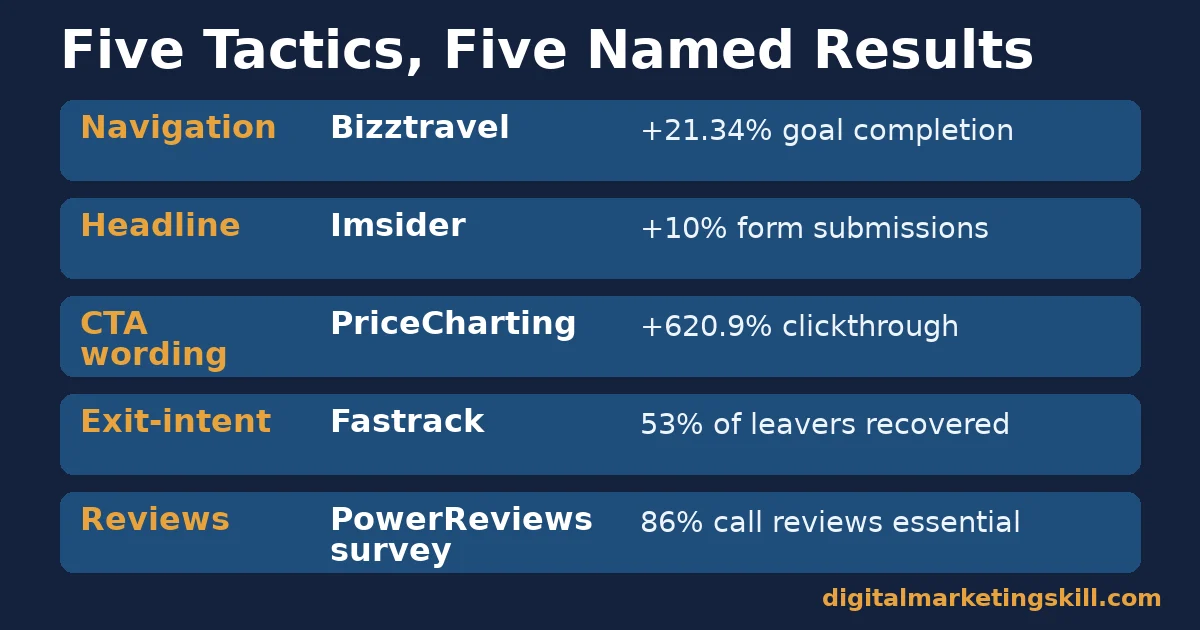
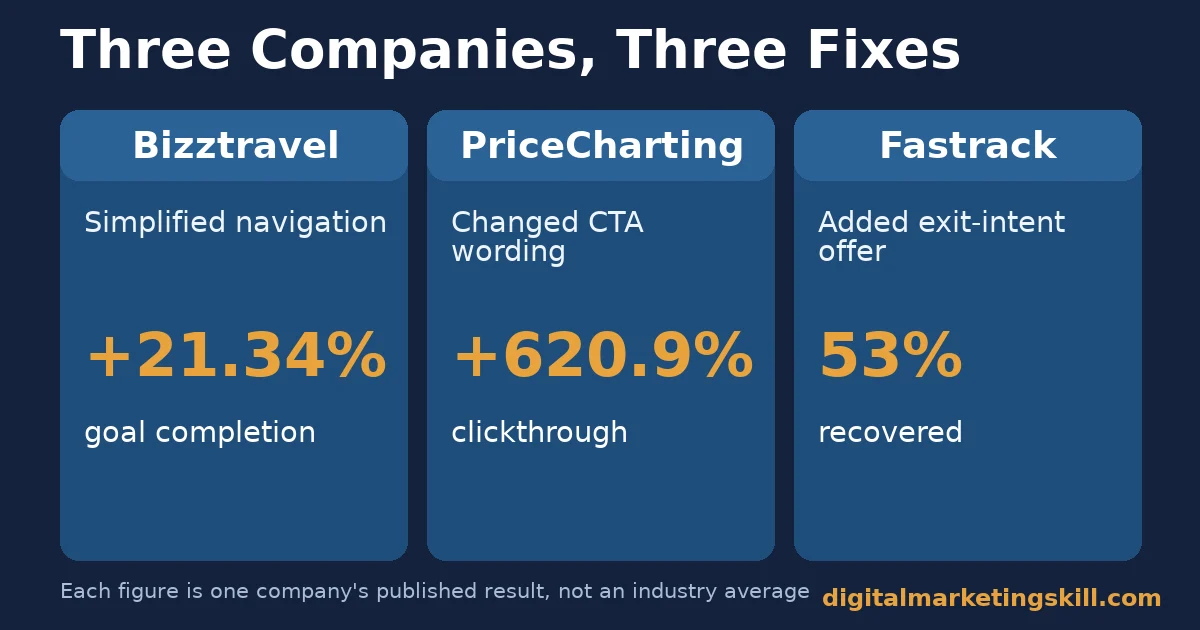
- Bizztravel simplified its website navigation and recorded 21.34% higher goal completion, at 97% confidence, according to VWO’s published case study.
- PriceCharting changed one CTA button’s wording and saw a 620.9% jump in clickthrough conversion within about a week, per VWO’s case study.
- Imsider rewrote its landing page headline to promise a specific, time-bound outcome and form submissions rose 10%, at 99.99% statistical significance, per VWO’s case study.
- Fastrack, a hotel booking site, recovered 53% of visitors who had started but not finished a booking using one exit-intent popup, per OptinMonster’s case study.
- 86% of consumers say reviews are essential to their purchase decision, according to a PowerReviews-commissioned survey, though this figure is self-reported.
In this guide
- Most “Boost Online Sales” Lists Skip the Evidence
- The Mechanism: A Sale Needs Attention, Trust and a Reason to Act Now
- What Differs By Tactic: Five Levers With Named Results
- Lead With the Change That Matches Your Signature
- Measuring Online Sales Tactics: The Four Numbers That Matter
- The One Decision Rule: Test the Tactic That Matches Your Weakest Link, Not the Easiest One
- A Four-Week Plan to Test These Tactics Without Guessing
- Common Mistakes That Undo These Tactics
- What This Looks Like in Practice
- Frequently Asked Questions About Online Sales Tactics
- Next Step: Diagnose Your Weakest Link, Then Test One Tactic
Most “Boost Online Sales” Lists Skip the Evidence
Search “how to increase online sales” and you get the same list everywhere. Add urgency. Build trust. Write better headlines. The advice is not wrong, but it rarely shows a real result from a real business. Without that, you cannot tell which tactic is worth your time.
This guide only uses tactics with a named company and a published number behind them. Every case below is a single business, so treat each result as a reasonable indication, not a guarantee for your site. Where a stat is self-reported, that limit is stated plainly. None of these cases involve a secret trick; each one fixes a plain, specific point of confusion or missing trust signal that was already costing the business sales.
The Mechanism: A Sale Needs Attention, Trust and a Reason to Act Now
A visitor buys when three things line up. They understand the offer fast. They believe the business and the product are credible. And they have a reason to act today rather than later. Weaken any one of the three and the sale stalls, even if the other two are strong. Most sites focus all their effort on the first part, understanding, and assume trust and urgency will take care of themselves. They rarely do.
That is why five very different tactics, simplifying a menu, rewriting a headline, recovering an exit, adding reviews, and changing one button’s words, all move online sales. Each one strengthens a different link in that same three-part chain.
Most online sales advice treats these tactics as a single bucket called “conversion optimisation.” That blurs an important distinction. A navigation fix helps a visitor understand the offer faster. A review fix helps them trust it. An exit-intent offer gives them a reason to act today instead of bookmarking the page and never returning. Picking the wrong bucket to fix wastes the test.
What Differs By Tactic: Five Levers With Named Results
These tactics are not interchangeable. Each fixes a different part of the chain above, and each has its own signal in your analytics.
Simplify Navigation: Fewer Choices, Faster Decisions
Bizztravel, a ski-holiday travel site, redesigned its navigation so visitors could reach popular destinations directly instead of clicking through a country, then a region, then a village. The simplified version recorded 21.34% higher goal completion, at 97% confidence, in VWO’s published case study. Too many choices slow visitors down and some leave before deciding at all.
Signature in analytics: a high exit rate from the homepage or category pages, and a long path (many pages per session) before checkout.
Rewrite the Headline: Promise a Specific, Time-Bound Outcome
Imsider changed its landing page headline from a vague process description to a specific, time-bound promise. Form submissions rose 10%, at 99.99% statistical significance, per VWO’s case study. A headline that names the outcome and the time it takes beats one that only describes a process.
Signature in analytics: visitors arrive and leave within seconds, with almost no scroll, on a page that otherwise has a clear offer.
Change the CTA Wording: Match the Words to What the Visitor Actually Gets
PriceCharting changed one button’s text from “Download” to “Price Guide” and removed a price shown next to it. Clickthrough conversion rose 620.9%, at 99.9% significance, per VWO’s case study. The old wording and price made the button look like an ad, not an offer. The words on a button can matter more than its colour or size.
Signature in analytics: a page gets traffic and attention but very few clicks on the one button that matters.
Recover the Exit: Catch Visitors Before They Leave
Fastrack, a hotel booking site, added one exit-intent popup offering a limited-time loyalty-club discount to visitors about to abandon a booking. It recovered 53% of those abandoning visitors, according to OptinMonster’s published case study. The offer worked because it was specific, time-bound and shown only to visitors already about to leave.
Signature in analytics: a high rate of started-but-not-finished checkouts or forms, visible in your funnel reports.
Show Real Reviews: Let Other Buyers Carry the Trust Argument
A PowerReviews-commissioned survey found 86% of consumers say reviews are essential to their purchase decision. That figure is self-reported, so treat it as a sentiment measure, not a conversion guarantee. Still, it lines up with a simpler fact: your own sales copy cannot make the trust argument as well as another buyer’s words can.
Signature in analytics: a product or service page with strong traffic but a conversion rate well below similar pages that already display reviews.
Lead With the Change That Matches Your Signature
Pick the one tactic that matches the signature you found above. Running all five at once makes it impossible to tell which change actually moved online sales.
Navigation: Lead With Your Most-Wanted Destinations
List your most visited products, categories or destinations directly in the main menu. Do not nest them inside two or three levels of clicks. Move secondary information, like company history or policies, to the footer. Test the new menu against the old one for at least a week of normal traffic before deciding. The same focus principle applies to a standalone landing page design, where fewer competing links usually convert better than a full navigation menu.
Headline: Lead With the Outcome and a Time Frame
State what the visitor gets and how long it takes, in the first few words. “A step-by-step plan for X” describes a process; “Get X done in one evening” promises a result. Test the specific, time-bound version against your current headline on your highest-traffic page first. Our guide on copywriting that converts covers the same outcome-first principle for body copy, not only headlines.
Call-to-Action Wording: Lead With What the Visitor Receives
Write the button text as the thing the visitor gets, not the mechanism behind it. “Price Guide” tells a visitor what they receive; “Download” only describes an action, and can look like an ad. Remove any price or detail next to the button that makes it look like a banner rather than your own offer.
Exit Recovery: Lead With One Specific, Time-Bound Offer
Show a single offer, not a general newsletter signup. Time it to the moment a visitor’s cursor signals they are about to leave a cart or booking form. Make the offer time-bound and specific, the way Fastrack’s loyalty discount was. A vague “stay in touch” popup converts far worse than one concrete reason to finish now. If the offer collects an email address, our guide on growing your email list covers what to send next so the capture is not wasted.
Reviews: Lead With Real Customer Words on the Page That Needs Trust Most
Put real reviews or testimonials directly on the product or service page, not only on a separate reviews page. Prioritise the pages with the weakest conversion rate relative to their traffic, since that is where the missing trust signal costs you the most sales. Keep every review attributed to a real customer; invented or unverifiable testimonials risk the trust they are meant to build, and most review platforms can detect and flag them anyway.
Measuring Online Sales Tactics: The Four Numbers That Matter
Track these four numbers for any tactic you test. Each isolates a different part of the attention, trust and urgency chain described above.
- Goal completion rate: the share of sessions that reach your defined conversion goal. Compare the week before and the week after a single change, on the same page.
- Clickthrough rate on your primary button: clicks on the one action you most want, divided by visitors who saw it. A low rate with high page traffic points at weak CTA wording.
- Exit-popup recovery rate: the share of visitors shown an exit-intent offer who complete the original action afterward. Compare this against Fastrack’s 53% cautiously, since that figure is one company’s result, not an industry average.
- Conversion rate by page, with and without reviews: compare similar pages that do and do not show reviews. A persistent gap signals that trust, not traffic, is your constraint on that page.
The One Decision Rule: Test the Tactic That Matches Your Weakest Link, Not the Easiest One
With five tactics and limited time, the temptation is to start with whichever is easiest to ship, usually the CTA wording. The better rule is to match the tactic to the weakest link in the attention, trust and urgency chain on your specific page.
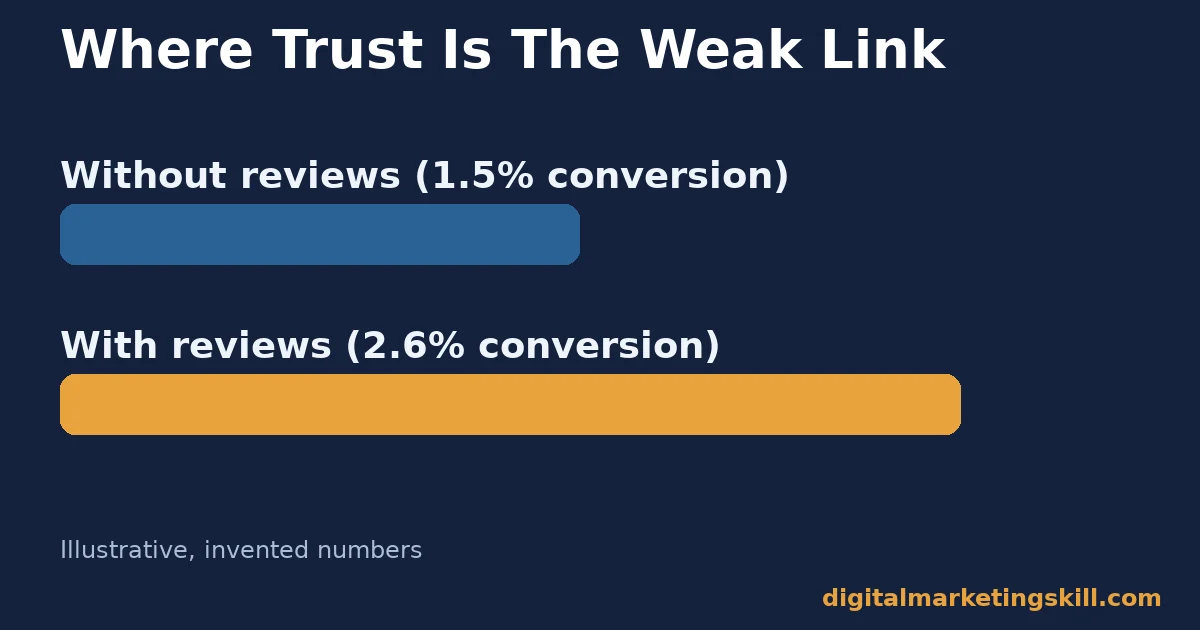
Illustrative, invented numbers: a product page gets 2,000 visits a month and a 1.5% conversion rate. Time on page is high and scroll depth is strong, so attention is not the problem. The page has no reviews, and a similar page with reviews converts at 2.6%. Here, trust is the weakest link, so reviews are the fix to test first, not a new headline.
A Four-Week Plan to Test These Tactics Without Guessing
You do not need every tactic at once to grow online sales. This plan spreads the five tactics over a month, in the order most sites get the fastest signal.
- Week one: find your weakest link. Pull your highest-traffic page’s bounce rate, clickthrough rate on its main button, and cart or form completion rate. Match the weakest number to one of the five tactics above.
- Week two: ship one change. Rewrite only the headline, only the CTA wording, or add only the exit-intent popup, whichever matches week one’s weakest number. Do not touch anything else on the page.
- Week three: measure against your baseline. Compare the same four numbers from before the change. A real shift should be visible within a week of normal traffic on a reasonably trafficked page.
- Week four: keep or revert, then pick the next tactic. Keep the change if the number moved in the right direction, revert it if not, and move to the tactic matching your next weakest link.
Repeating this cycle, rather than redesigning the whole page at once, is what turns five tactics into a steady, measurable lift in online sales.
Common Mistakes That Undo These Tactics
Four mistakes repeat often enough to call out directly, and each one hides whether a tactic actually worked for your online sales.
- Testing on low-traffic pages. A page with too few visitors cannot reach statistical confidence in a reasonable time. Start with your highest-traffic page so a real result shows up within weeks, not months.
- Running every tactic at once. Change the headline, the CTA and the popup together and you cannot credit any one of them for the result. Ship one change, measure it, then move to the next.
- Treating a vendor case study as a universal law. Bizztravel, PriceCharting, Imsider and Fastrack are each one company. Use their results as a reason to test a tactic on your own site, not as a promised outcome.
- Chasing the tactic, not the number. A headline rewrite that does not raise goal completion is not a success just because it was shipped. Judge every change by the measurement numbers above, not by whether it felt like an improvement.
Avoid these four and the tactics above get a fair chance to show their real effect. Otherwise their effect on online sales gets lost in noise from unrelated changes happening at the same time.
What This Looks Like in Practice
Of the five tactics above, CTA wording is the easiest to copy and the easiest to get wrong, so it deserves a closer look. PriceCharting’s CTA test shows why, because the mechanism is so plain. The button said “Download” next to a price, which made it resemble a paid banner ad rather than the company’s own free offer. Changing the text to “Price Guide” and removing the price turned the same pixels into a recognisable, trustworthy action. Clickthrough conversion rose 620.9%, reaching 99.9% statistical significance within about a week, according to VWO’s published case study.
The honest limit: this is one business, on one page, with one specific confusion to fix. A button that already reads clearly will not see a result anywhere close to this. The lesson worth keeping is the method: look for the exact word or image that visitors could be misreading, not just the overall page design.
The same method applies off that one button. Walk through your own highest-traffic page as a first-time visitor and note every place a word, image or price could be misread. Each one is a small, testable fix, and the online sales gain from clearing up a genuine point of confusion is usually far larger than the gain from a cosmetic redesign.
Frequently Asked Questions About Online Sales Tactics
What is the fastest way to increase online sales?
Match the tactic to your weakest link. Fix the headline when visitors arrive and leave fast. Fix the CTA wording when they click little. Add exit-intent recovery or reviews when they rarely complete carts. Testing the wrong tactic wastes the most time.
Do exit-intent popups actually work?
They can, when the offer is specific and time-bound. Fastrack recovered 53% of abandoning visitors with one targeted loyalty discount, per OptinMonster’s case study, though that figure is one company’s result, not a guaranteed rate for every site.
How much does a headline change really affect conversion?
It can be significant. Imsider’s rewritten, time-bound headline lifted form submissions 10% at very high statistical confidence. The gain came from naming a specific outcome and timeframe, not from clever wording alone.
Should I add reviews even if I have very few?
Yes. A PowerReviews-commissioned survey found 86% of consumers say reviews are essential to their decision, so even a handful of real reviews likely helps more than none, though the exact lift depends on your product and audience.
How many tactics should I test at once?
One. Testing several changes together makes it impossible to know which one produced the result, good or bad. Ship a single tactic, measure it against a clear baseline, then move to the next.
Is a big percentage increase in a case study realistic for my site?
Treat the percentage as directional, not a promise. A 620.9% or 53% jump reflects one company fixing one specific, badly performing element. Your starting point and audience will produce a different number, even with the same fix.
What should I measure before I start testing?
Your current goal completion rate, clickthrough rate on your primary button, and conversion rate on pages with and without reviews. Without a clear baseline, you cannot tell whether a change actually helped.
Can small businesses use these tactics without a big budget?
Yes. A headline rewrite, a CTA wording change, and adding real customer reviews all cost time, not money. Exit-intent tools and most review-collection plugins also offer free tiers, so none of the five tactics above require a large budget to test on a small site.
Do these tactics work for services as well as physical products?
Yes. Fastrack is a hotel booking service, Imsider sells a course, and Bizztravel sells travel bookings, so none of the four named cases here are physical ecommerce products. The same attention, trust and urgency chain applies to any online sales process that ends in a form, a booking or a checkout.
Next Step: Diagnose Your Weakest Link, Then Test One Tactic
Pick your highest-traffic page that is meant to sell. Check whether visitors arrive and leave fast, click little, abandon the cart, or convert worse than similar pages with reviews. That signature points to one of the five tactics above. Test it alone, measure the four numbers, and only then test the next one. Online sales rarely improve from one big redesign; they improve from a series of small, measured fixes to the exact point where visitors were stalling.
If you want structured practice building and measuring tactics like these, consider the Master Diploma in Digital & AI Marketing from Digital Marketing Skill Institute. It covers nine practical courses, including conversion optimisation and analytics, with unlimited 1-on-1 coaching and mentoring and real project work inside a U.S. company. The diploma is dual US and UK accredited, recognised in more than 100 countries, and delivered 100% online, so you can study and apply it anywhere in your country.
Explore the curriculum on digitalmarketingskill.com, or go straight to the application page to get started wherever you live. For the diagnostic approach behind this guide applied to a whole page, see our guide on website optimisation. You can also browse more practical guides on the Digital Marketing Skill Institute blog, or read verified outcomes on the reviews page. Come back to digitalmarketingskill.com any time you need the next guide in this series.
Every figure in this guide was checked against its original source before publication. Figures marked as illustrative are invented examples, not real results.
![9 Amazing Digital Marketing Skills to Make Money Online [With Proof]](https://digitalmarketingskill.com/wp-content/uploads/2019/07/9-Amazing-Digital-Marketing-Skills-to-Make-Money-Online-With-Proof-17.png)