Choosing a marketing strategy is hard. The “best” strategy is never universal. It depends on your stage, your budget and your customers. This guide gives you a repeatable framework for choosing a marketing strategy: set one clear goal, understand your stage, pick the strategy that fits, then measure it honestly.
Key Takeaways
- Documentation correlates with success. CoSchedule’s own multi-year marketer surveys have repeatedly found that marketers who document their strategy are far more likely to report success than those who do not, though the exact multiplier shifts from year to year.
- Customer focus pays off. According to McKinsey’s research, companies placing customer experience at the core of their operations achieve roughly twice the revenue growth of less customer-focused peers.
- Budgets stay tight even at the top. Gartner’s CMO Spend Survey of 401 senior marketers found marketing budgets sitting at just 7.8% of company revenue, with 56% saying they lack the budget to deliver their strategy, as reported here.
- The goal decides the channel. The specific objective behind a strategy, awareness, retention or conversion, determines which channel deserves the budget, not the other way round.
- Real pivots can pay for themselves fast. p.o.p candy co. pivoted from live events to digital ads and online sales. According to the U.S. Chamber of Commerce, the new ad campaign paid for itself within a month.
In this guide
- What Most Advice on Choosing a Marketing Strategy Gets Wrong
- How Choosing a Marketing Strategy Actually Works
- Choosing a Marketing Strategy Differs by Business Stage
- How to Choose the Right Strategy for Your Stage
- How to Measure Whether Your Marketing Strategy Is Working
- The One Decision Rule for Choosing a Marketing Strategy
- A Real Case: A Fast Pivot That Paid for Itself
- Frequently Asked Questions About Choosing a Marketing Strategy
- Start Choosing a Marketing Strategy That Fits Your Stage
What Most Advice on Choosing a Marketing Strategy Gets Wrong
Most lists of “marketing strategies” are really lists of tactics. Post on social media. Start an email list. Run ads. None of that is wrong. But a tactic without a strategy behind it rarely works. Nobody decided which problem it was meant to solve.
Search for “marketing strategies” and you will mostly find numbered lists of channels, with little guidance on which one fits your specific business. That approach treats every reader as if they were at the same stage, selling the same thing, to the same audience, which is rarely true.
This guide treats choosing a marketing strategy as a decision process, not a tactic list. It covers how a strategy actually gets built. It explains why the right choice differs by business stage. And it shows how to measure whether a strategy is working.
A few ground rules first. The Gartner and McKinsey figures below come from large, established companies. So read them as directional evidence for small businesses, not a direct match.
The CoSchedule figures are self-reported by survey respondents, and the multiplier has varied across editions of the same survey. Treat the direction, not the exact number, as the finding. The case near the end is one business’s reported outcome, not a controlled study.
How Choosing a Marketing Strategy Actually Works
A marketing strategy is a business’s overall plan for reaching the right people and turning them into paying customers. It sits above individual tactics. A tactic such as “post three times a week” only makes sense once the strategy has defined who you are trying to reach and why.
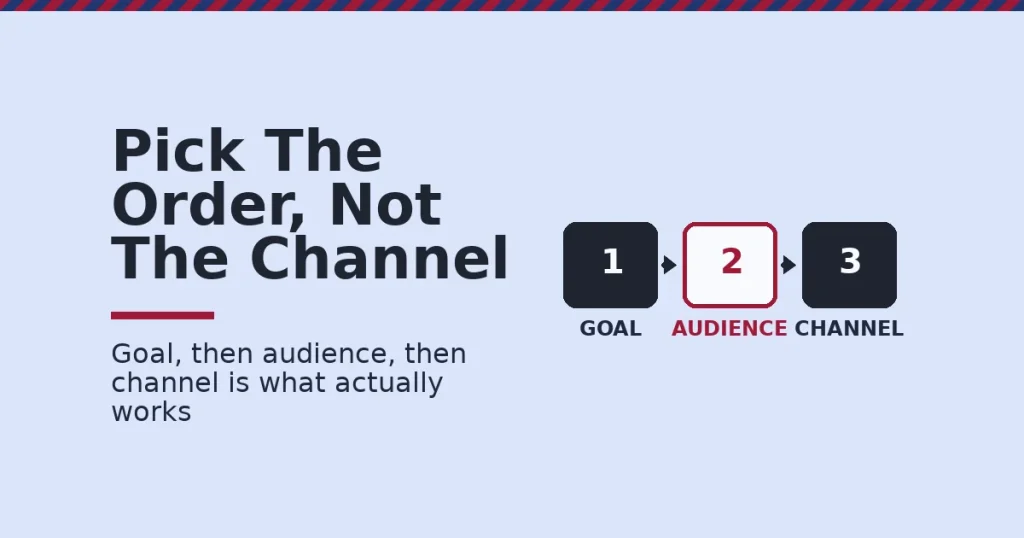
Choosing a marketing strategy is therefore a sequencing problem before it is a creative one. The order matters: goal, audience, channel, then tactic. Reverse that order, and even a well-executed tactic can miss the people it needed to reach.
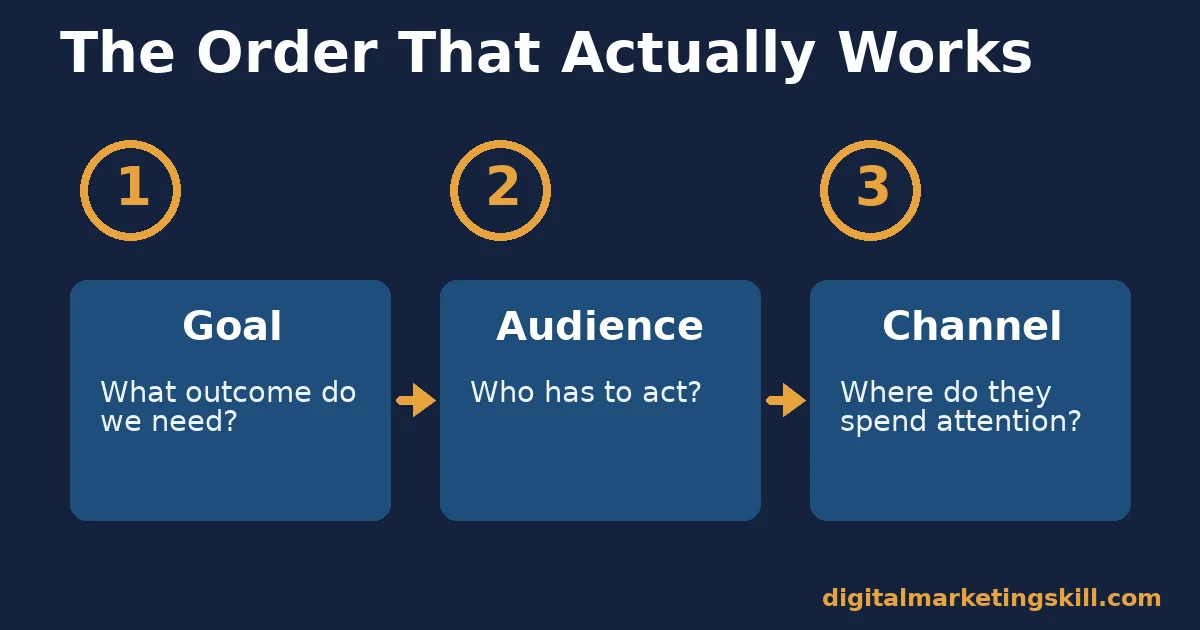
Every working strategy answers the same three questions in order. First, what outcome does the business actually need right now? Second, who has to take action for that outcome to happen? Third, which channel reaches that specific person most efficiently? Only after those three are answered does it make sense to pick a specific tactic, a format, a posting schedule or an ad type.
Skipping straight to channel selection is the most common reason a strategy fails. It happens when a business picks a channel before answering the first two questions.
The order matters because each answer narrows the next decision. A clear outcome narrows down which audience segment actually matters right now. A clear audience narrows down which channel is worth testing first. Skip a step, and the next decision becomes a guess dressed up as a plan.
Why the Goal Has to Come First
A goal such as “increase awareness” calls for a different channel mix than a goal such as “improve retention.” Setting the goal first prevents a business from copying a competitor’s channel choice. That copy only works if the competitor is solving the same problem.
A useful goal is specific and time-bound, not vague. “Grow the business” is not a goal a strategy can be built around. “Add 50 repeat customers in the next quarter” is. The U.S. Small Business Administration’s guidance on marketing planning makes the same point: a plan is only useful once it names a specific, costed objective.
Why the Audience Comes Before the Channel
Once the goal is set, the next question is who has to act. A target audience is the specific group of people a product is built for. It is defined by their interests and their pain points, not just their age or location.
Age and location are easy to write down, which is exactly why so many businesses stop there. But two 35-year-olds in the same city can have completely different buying triggers. The useful version of a target audience names the problem that pushes someone to search for a solution in the first place.
Reviewing past orders, assessing who already follows the business on social media, and reading the questions customers actually ask are all faster ways to define this audience than guessing. The audience then determines which channel is worth the budget, because different audiences spend their attention in different places.
This step is also where many strategies quietly go wrong. A business skips straight to “we should be on TikTok” without first checking whether its actual customers spend meaningful time there, or whether they are more likely to search Google with a specific question in mind.
Choosing a Marketing Strategy Differs by Business Stage
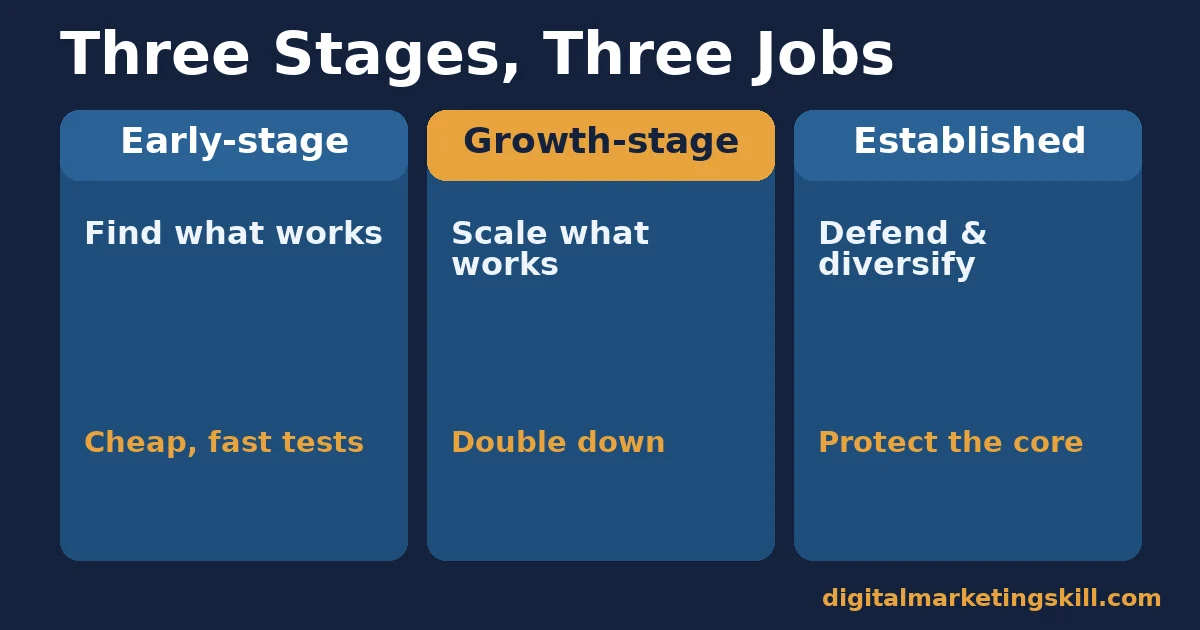
Not every business should run the same strategy. A business with no paying customers yet has a different job to do than one trying to scale a channel that already works. Treating all three stages the same way is one of the most common reasons a strategy that worked for someone else fails when copied directly.
Early-Stage Businesses: Built to Find What Actually Works
A business with little or no sales history does not yet know which message or channel converts. Its real job is cheap, fast experimentation, not scale. Spending heavily on one channel before any evidence exists is a common and costly mistake at this stage.
Choosing a marketing strategy at this stage means accepting that most tests will fail, and treating that as useful information rather than wasted budget. A test that proves a channel does not work is still a result worth having.
Growth-Stage Businesses: Built to Scale a Working Channel
A business that already has at least one channel producing customers should focus on scaling that channel further. It should not split the same budget across many unproven new ones. Evidence beats novelty at this stage.
Established Businesses: Built to Defend and Diversify
A business with a dependable channel still carries a risk: that channel can change or decline. Established businesses need to protect their core channel while testing one or two new ones. That way, no single platform change can threaten the whole business.
This is the stage where choosing a marketing strategy well matters most, because the cost of a wrong move is highest. A business with real revenue at stake cannot afford to treat every new platform as worth testing equally.
How to Choose the Right Strategy for Your Stage
Each stage above calls for a different first move. Match the guidance below to where your business actually is today, not where you want it to be.
Early-Stage: Lead With Direct Customer Conversations
Talk to real or likely customers directly before committing a budget to any channel. Short, cheap tests across two or three channels will tell you more in a month than a large spend on one unproven channel. Keep each test small enough that a failed one does not threaten the business, and track the result of every single test, even the ones that go nowhere.
Document what you learn as you go. Our guide on keyword research tools is a fast way to check whether your audience is even searching for what you plan to offer, before you build a full campaign around it.
Growth-Stage: Lead With Doubling Down on What Works
Identify the one channel already producing customers at an acceptable cost. Increase its budget before adding new channels. Resist the urge to chase every new platform; depth in one working channel usually outperforms thin coverage across five.
It helps to put a number on “working.” Decide in advance what an acceptable customer acquisition cost looks like for your business, then only increase spend on a channel once it is reliably hitting that number, not just once it feels like it is going well.
At this stage, content becomes a multiplier. Our guide to content marketing strategies covers how to extend a working channel’s reach without constantly paying for new traffic.
Established: Lead With Diversifying Without Losing Focus
Protect the budget for your core, proven channel first. Only then allocate a smaller, clearly bounded budget to testing one new channel at a time. A failed experiment should never threaten the channel that already pays the bills. A reasonable starting split is to keep testing budgets at a small, fixed share of total spend, so experimentation never crowds out the channel that is actually paying for it.
If your core channel is organic reach, local discovery is often the next logical test. Our guide on using Facebook Marketplace to grow a business shows one practical way small businesses diversify into a second, low-cost channel.
How to Measure Whether Your Marketing Strategy Is Working
A strategy that cannot be measured cannot be improved. Track the four metrics below, each defined in one sentence, with a note on how to read it. Measuring is also where choosing a marketing strategy well pays off, because it tells you whether to keep a channel, scale it or quietly retire it.
- Customer acquisition cost. This is your total marketing spend divided by the number of new customers it produced. Compare it against the value of an average customer, not against last month’s number alone.
- Conversion rate. This is the share of people who take the action you wanted, out of everyone who saw the offer. A low conversion rate with healthy traffic usually points to a mismatch between the audience and the message.
- Marketing-driven revenue. This is the share of total revenue you can trace back to a specific marketing effort. It separates marketing’s real contribution from revenue that would have happened anyway.
- Repeat-purchase rate. This is the share of customers who buy again within a set period. A strategy that wins new customers but keeps none of them is rarely sustainable.
Review these four together, not in isolation. A strong conversion rate with a weak repeat-purchase rate usually means the product experience, not the marketing, needs attention next. None of these require expensive software; a simple spreadsheet, updated weekly against your actual sales, is enough to start.
The One Decision Rule for Choosing a Marketing Strategy
If you take one rule from this guide, make it this one. Choose the strategy that fits your current stage and your single clearest goal, not the strategy that is trending.
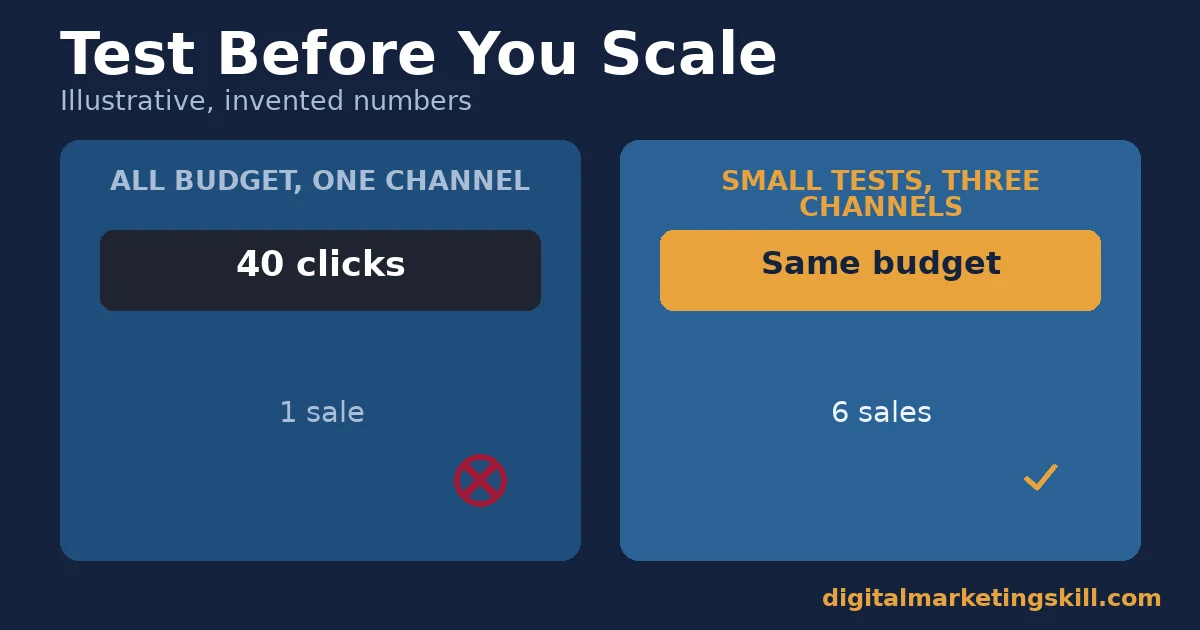
Here is an illustrative example, with invented numbers. A new online store spends its entire first-month budget on paid social ads, chasing a competitor’s channel. It gets 40 clicks and 1 sale.
The next month, the owner instead spends half that budget on direct customer conversations and small tests across three channels. That same budget now produces 6 sales. The business finally knows which message and channel its actual buyers respond to.
The lesson is sequencing, not spending more. Testing before scaling consistently outperforms scaling before testing, at any budget size. The same pattern shows up at every stage described in this guide: the businesses that learn fastest from a small test tend to out-perform the ones that commit a large budget to an untested assumption.
A Real Case: A Fast Pivot That Paid for Itself
p.o.p candy co., a small business built around in-person events, had to pivot when its usual sales channel stopped being viable. According to the U.S. Chamber of Commerce, co-founders Rachel Flores and Bill Waiste shifted to digital advertising and an online sales platform.
The new ad campaign paid for itself within a month. The shift also expanded the business’s customer base beyond people it could reach in person.
Keep the limits in mind. This is one business’s self-reported outcome, published through a platform partner’s growth content, not an independently audited case study. Still, the sequence it followed matches the decision rule described above: a forced change in circumstances, a fast test of a new channel, and a quick measurement of whether it worked.
What makes this case useful is not the exact dollar figure, which was not disclosed. It is the shape of the decision: a small business tested a new channel quickly, set a clear point at which it would judge the test, and only then decided whether to keep going.
Frequently Asked Questions About Choosing a Marketing Strategy
What are the four Ps of marketing?
Product, price, place and promotion. They form a checklist for testing whether a strategy is coherent. The product, its price, where it is sold and how it is promoted all need to point at the same target customer.
How do I know which marketing strategy is right for my business?
Start with your stage, not a list of tactics. An early-stage business should test cheaply across channels. A growth-stage business should scale what already works. An established business should protect its core channel while testing one new one at a time.
Do I need a documented marketing strategy, or can I just try things?
A documented strategy is strongly associated with better reported outcomes in CoSchedule’s own surveys of marketers, year after year. Writing it down forces you to state the goal and the audience before you pick a channel.
How much should a small business spend on marketing?
There is no single correct figure. Spending comparisons from large companies, such as Gartner’s CMO survey, describe enterprise budgets rather than small businesses. Set your budget against a specific goal, then measure customer acquisition cost before increasing it.
What is the biggest mistake businesses make when choosing a strategy?
Picking a channel before deciding the goal and the audience. A channel that works brilliantly for one goal can waste a budget entirely when the real goal is something else.
How long should I test a marketing strategy before judging it?
Long enough to gather a meaningful number of results, not just a few days. A small, time-boxed test, for example one month, with a clear metric defined in advance, gives a fair read without risking a large budget.
Should a small business copy a competitor’s marketing strategy?
Not without first checking whether that competitor shares the same goal, audience and stage. A strategy built for an established competitor with a large budget rarely transfers cleanly to an early-stage business.
What is the difference between a marketing strategy and a marketing plan?
A strategy is the overall decision about who to reach and why; a plan is the detailed schedule of tactics, dates and budget that carries that decision out. Choosing a marketing strategy comes first, because the plan only makes sense once the strategy is set.
Can a marketing strategy change over time?
Yes, and it should. The right strategy for an early-stage business is rarely the right one once that business reaches the growth or established stage. Revisit your strategy whenever your stage, budget or core channel changes meaningfully, rather than treating it as a one-time decision.
Do I need a different strategy for every channel I use?
No. One strategy, built around a single goal and audience, can guide several channels at once. What changes between channels is the tactic, not the underlying goal or the audience you are trying to reach.
What’s the fastest way to tell if a new channel is worth testing?
Check whether your defined audience already spends meaningful time there, and whether you can run a small, time-boxed test without risking the budget your core channel depends on. If either answer is no, it’s not ready to test yet.
Start Choosing a Marketing Strategy That Fits Your Stage
Choosing a marketing strategy comes down to sequencing. Set one clear goal, define the audience that goal depends on, then pick the channel that reaches them most directly. Test small before you scale, and measure honestly once you do. For the difference between the strategy work covered here and day-to-day execution, see our guide on the difference between sales and marketing.
If you want hands-on practice building and running a real strategy, Digital Marketing Skill Institute teaches it through the Master Diploma in Digital & AI Marketing. The programme is built around four AI-powered tracks covering ten execution-first courses in total. These include AI-Powered Lead Generation and Email Automation and AI-Powered Social Media Management and Advertising, with a Full Stack option for completing all four.
It also includes unlimited 1-on-1 coaching and mentoring and a U.S. Project Internship with a verified U.S. Work Reference Letter. The diploma is dual US and UK accredited and recognised in more than 100 countries.
The programme is fully online, so you can study from anywhere in your country. Explore more guides on the Digital Marketing Skill Institute blog, browse student reviews, and when you are ready, apply for the Master Diploma or start from the Digital Marketing Skill Institute homepage.
Every figure in this guide was checked against its original source before publication. Figures marked as illustrative are invented examples, not real results.