Facebook Marketplace lets anyone list a product for free. It reaches shoppers who already plan to buy. But a free listing alone will not grow a business. Growth comes from matching your category, photos and reply speed to how shoppers actually search and decide on Facebook Marketplace.
Key Takeaways
- Reach is real and growing. Over one billion people shop on Facebook Marketplace every month. About 40% of Facebook’s users shop there regularly, according to Capital One Shopping research.
- Competition is huge. Around 250 million sellers already list on Marketplace. A generic listing competes with a vast number of similar ones (Capital One Shopping research).
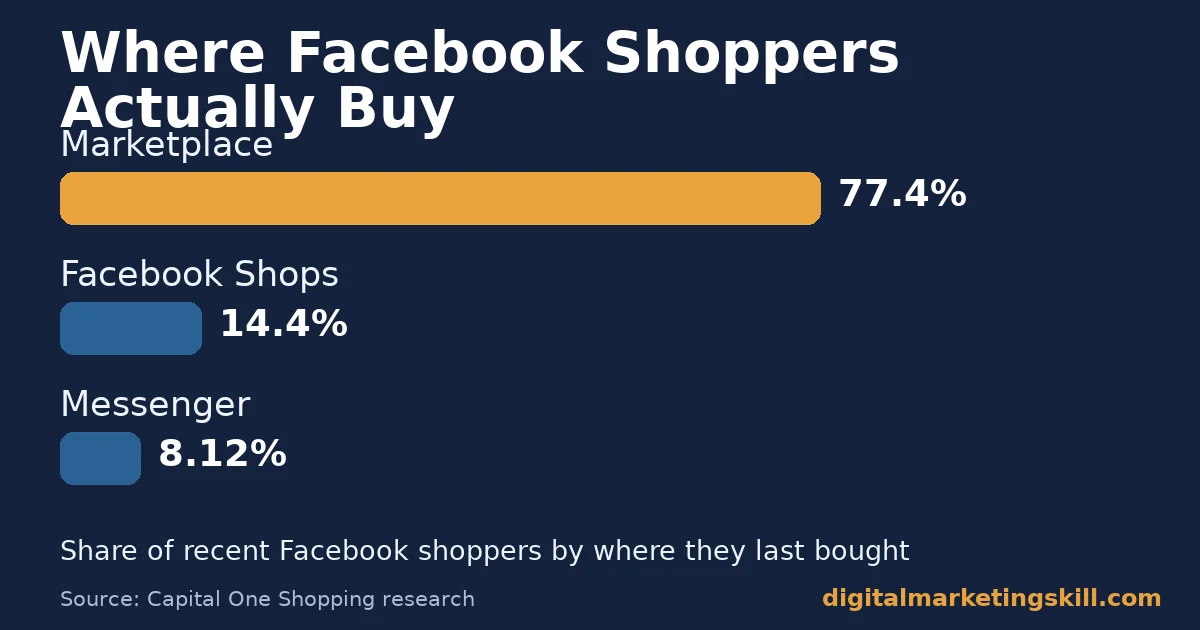
- Marketplace dominates Facebook shopping. Among people who recently bought something through Facebook, 77.4% bought through Marketplace. Facebook Shops took 14.4%, and Messenger took 8.12% (Capital One Shopping research).
- Scams make trust the real currency. The FTC found that shoppers lost billions of dollars to social media scams recently. Shopping scams were the most common type. Sellers who visibly address this stand out.
- Real sellers see real gains. Sweetums Signatures, a small stickers-and-decals business, grew sales by 33% after listing on Marketplace (data from BigCommerce, reported by the U.S. Chamber of Commerce).
In this guide
- What Most Advice on Facebook Marketplace Gets Wrong
- How Facebook Marketplace Actually Works for Sellers
- Facebook Marketplace Serves Three Very Different Sellers
- How to Win Each Kind of Seller
- Why Trust Signals Decide More Facebook Marketplace Sales Than Price
- How to Measure Whether Facebook Marketplace Is Growing Your Business
- The One Decision Rule for Facebook Marketplace Sellers
- A Real Case: Growing Sales Through Facebook Marketplace
- Frequently Asked Questions About Facebook Marketplace
- Start Selling on Facebook Marketplace the Right Way
What Most Advice on Facebook Marketplace Gets Wrong
Most guides on Facebook Marketplace stop at one tip. They say: create a listing, add photos, done. That advice is not wrong. But it treats every seller the same way. It also ignores why so many listings get views and no messages.
This guide treats Marketplace as a storefront, not a free classified ad. It covers how listings actually get seen. It explains why three kinds of seller need three different approaches. And it shows how to measure whether Marketplace is truly growing your business.
A few ground rules first. The reach and seller figures below come from Capital One Shopping’s research. That research pulls from sources such as SEC filings, Statista and Pew Research. So read every figure as a snapshot, not a permanent ranking.
Also note that the seller case later in this guide is self-reported through a platform partner, not an independent audit. The scam figures, meanwhile, come from the FTC and the Better Business Bureau. Both describe patterns seen in the United States. Therefore, treat them as a worldwide-relevant warning, not a claim about one country alone.
How Facebook Marketplace Actually Works for Sellers
Facebook Marketplace is a shopping destination built into the Facebook app. People use it to discover, buy and sell items, mostly within their local area. A listing is not confined to one page. It can surface in the Marketplace tab, in Facebook search, in buy-and-sell groups you belong to, and even off Facebook through search engines.
That wide distribution changes how Marketplace works compared with a typical online store. Buyers are not browsing a catalogue you fully control. Instead, they arrive already searching, with intent already formed. So they decide whether your listing matches that intent within seconds, often before reading your full description.
What a Listing Needs Before It Can Sell
Every listing needs the same core fields. These are clear photos, a specific title, a price, the right category, the item’s condition and a full description. You also state whether the item is still available.
Facebook also lets you add optional tags and a stock-keeping unit. You can hide a listing from friends while keeping it visible to everyone else. Skipping or rushing any of these fields is the single biggest reason listings underperform. A vague title or the wrong category removes you from the searches that would have found you.
A stock-keeping unit, often shortened to SKU, is simply a short code that identifies a product’s manufacturer, style, colour and size. Retailers use it to track inventory internally, so it rarely matters to a buyer. But for a seller running many listings, consistent SKUs make it much easier to tell which exact item sold when a message comes in asking about availability.
Where Your Listing Actually Gets Seen
Marketplace blends search, local browsing and groups. That means the same listing can reach very different audiences. The difference usually comes down to how precisely it is categorised and described. A listing filed under the correct category and location shows up for buyers who are actively searching that category, not just people scrolling past.
Listings must also follow Facebook’s commerce policies. These set rules on prohibited items, accurate descriptions and seller conduct. Policy violations are the fastest way to lose visibility entirely, no matter how good the listing looks.
A listing can also be posted into any relevant buy-and-sell group a seller already belongs to, which effectively multiplies its visibility without any extra cost. However, each group usually has its own rules on posting frequency and allowed categories, so check them before cross-posting a listing everywhere at once. A single well-targeted group often outperforms several loosely related ones.
Facebook Marketplace Serves Three Very Different Sellers
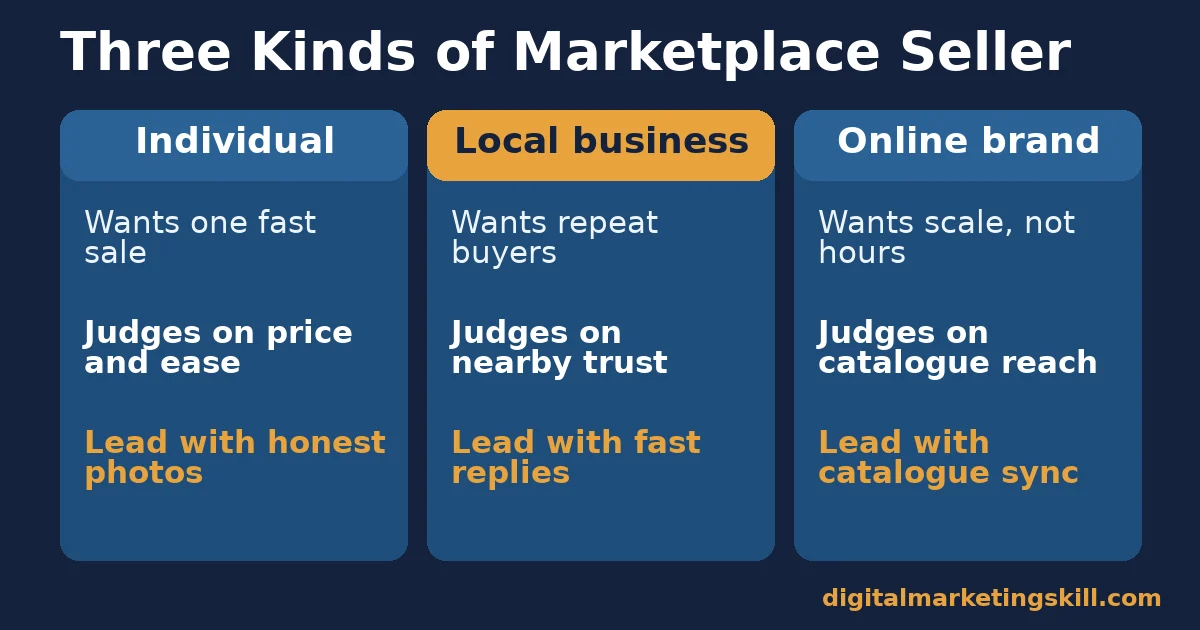
Not every seller on Marketplace wants the same outcome. An individual clearing out a closet, a local shop with a storefront, and an online brand running thousands of products all use the same platform. However, each one needs a different approach to succeed on it, because each is judging success by a different outcome.
Individual Sellers: Built for One Fast, Local Sale
Individual sellers usually list a small number of items once. They want a quick local sale. They judge success by whether the item sold at a fair price with minimal hassle. Speed and trust matter more to them than brand building.
Local Businesses: Built for Repeat, Nearby Buyers
A local business, such as a shop or a service provider, lists regularly. It wants the same nearby buyers to return again and again. For this seller, Marketplace works as a recurring channel, not a one-off sale. Therefore, consistency across listings matters as much as any single item, since a buyer who had a good experience once will often check that seller’s other listings next.
Online Brands: Built for Scale Through Catalogue Sync
An online brand selling many products cannot list items one by one without burning hours every week. Instead, these sellers need their product catalogue to sync into Marketplace automatically. That way, new stock, prices and sold-out items stay accurate without manual re-entry, even as the underlying store changes daily.
How to Win Each Kind of Seller
Each seller type above needs a different first move. Match the approach below to the type that best describes you. Do not follow one-size-fits-all advice.
Individual Sellers: Lead With Honest Photos and a Fair Price
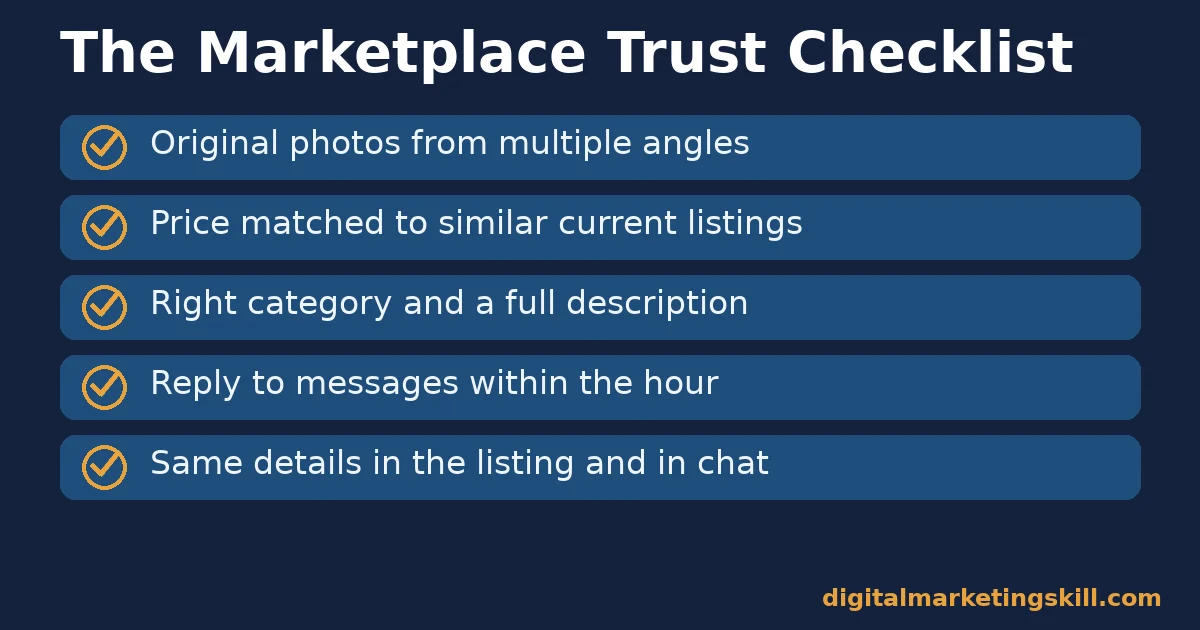
Use your own photos of the actual item. Shoot them in good light, from multiple angles. Avoid photos taken from other websites; buyers can often tell, and it damages trust immediately. Research what similar items are listed for right now before you set your price. This keeps you from over- or under-pricing.
Price slightly above your minimum acceptable amount. That leaves room for buyers to negotiate and still feel satisfied. Respond to messages quickly. A buyer who does not hear back soon will usually move on to a seller who does. Our guide on choosing the right keyword research tools covers the same category-naming thinking: list under the words buyers actually search for, not the words you would use internally.
Local Businesses: Lead With Category Precision and Fast Replies
List consistently. File every item in the most specific category available, rather than a broad catch-all. Buyers who are actively searching that category can then find you. Join relevant local buy-and-sell groups related to what you sell. This extends your reach beyond Marketplace search alone.
Keep your stated price, payment options, location and delivery details identical across your listing and your replies in Messenger. Mismatched information at the point of conversation is one of the fastest ways to lose a buyer who was ready to purchase.
It also helps to photograph and list new stock the same day it arrives, rather than batching listings for later. A buyer searching a specific category responds to freshness, and a steady trickle of new listings keeps a local business visible to repeat browsers in a way that one large weekly batch does not.
Online Brands: Lead With Catalogue Sync, Not Manual Listings
If you already run an online store, connect your product catalogue to Marketplace through a supported e-commerce platform. Do this instead of creating listings by hand. It keeps stock levels, pricing and product details accurate as your store changes.
Prioritise your best-selling or most visually strong products for Marketplace first. Catalogue sync still benefits from the same honest, high-quality photos that individual sellers rely on. If paid distribution is also part of your plan, our breakdown of how the Facebook Ads delivery system works explains how the same platform prioritises paid reach alongside organic Marketplace visibility.
Why Trust Signals Decide More Facebook Marketplace Sales Than Price
Buyers on Marketplace are more cautious than they once were, and the data explains why. The FTC reported billions of dollars in losses to social media scams, with losses rising sharply in recent tracking. Shopping scams, where someone ordered an item they saw advertised and it never arrived, were the single most common type. Facebook specifically saw more reported losses than any other platform.
Separately, the Better Business Bureau’s Scam Tracker Risk Report found that online purchase scams made up more than 28% of all scams reported to it. Among targeted buyers, 89.3% reported an actual dollar loss, though the typical loss reported was modest, close to $93.
The practical lesson for sellers is simple. Visible honesty now works as a competitive advantage. Original photos, an accurate description, a consistent price and a real local pickup option all signal “not a scam” before a buyer even has to wonder.
The FTC’s consumer advice hub also publishes current guidance for buyers on spotting marketplace scams. So sellers who read that same guidance can anticipate buyer hesitation and address it directly inside their own listing description, rather than waiting for a cautious buyer to ask.
How to Measure Whether Facebook Marketplace Is Growing Your Business
Views are not sales. Track the four metrics below instead. Each is defined in one sentence, with a note on how to read it. Together they show whether Marketplace is contributing to revenue, not just generating impressions. None of these require a paid tool; you can track all four in a simple spreadsheet, updated weekly, against the listings you post.
- Message rate. This is the share of listing views that turn into a message from a buyer. A low rate on a well-viewed listing usually means the price, photos or description are not convincing.
- Response time. This is how quickly you reply once a buyer messages. Slower response consistently correlates with lost sales, since interested buyers often message more than one seller at once.
- Completion rate. This is the share of buyer conversations that end in an actual sale, rather than going quiet. A healthy message rate with a weak completion rate usually points to a mismatch between the listing and the real item.
- Repeat-buyer rate. This is the share of buyers who come back to purchase again. It matters most for local businesses and brands that depend on Marketplace as a recurring channel, not a one-off sale.
Review these four together every month. First, if message rate is low, fix the listing itself. Next, if message rate is healthy but completion rate is weak, fix your response speed and consistency instead.
Finally, if both are strong but repeat-buyer rate stays flat, the real gap is in your follow-up after the sale, not the listing. For paid campaigns, our guide to advanced Facebook advertising techniques covers a similar diagnose-first approach, step by step, so you can apply the same logic to ads that support your listings.
The One Decision Rule for Facebook Marketplace Sellers
If you take one rule from this guide, make it this one. Treat every listing like a small storefront window, not a disposable classified ad. A storefront window gets cleaned, re-photographed and updated often. A classified ad gets posted once, then forgotten.
Here is an illustrative example, with invented numbers. A local furniture seller lists twenty items a month. Each listing has one blurry phone photo and a one-line description. That generates about 400 views, 12 messages and 3 sales.
The seller then switches to three well-lit photos per item, a full description, and replies within the hour. The same twenty listings now generate 600 views, 40 messages and 14 sales. No extra money was spent on promotion.
Notice what changed and what did not. The seller did not post more often, did not lower prices, and did not pay for ads. Every gain in this illustrative example came from removing friction inside listings the seller was already creating.
The lesson is not that photos alone caused the jump. Each small fix removed one reason a ready buyer might hesitate. Those small fixes compound across every listing a seller posts.
A Real Case: Growing Sales Through Facebook Marketplace
Sweetums Signatures, a small business that sells stickers and decals, began listing its products on Facebook Marketplace. Sales grew by 33%, according to data from BigCommerce reported by the U.S. Chamber of Commerce. A separate case in the same report describes Hats Unlimited, a seven-store Southern California retailer. It attributed a sales increase of 20% to 30% directly to Marketplace.
Keep the limits in mind. Both figures come from a platform partner’s own data, not an independently audited study. Neither report breaks down exactly which listing practices drove the increase. Treat them as evidence that Marketplace can meaningfully grow sales for small retailers. They are not a guaranteed outcome for any specific business.
Still, the pattern across both cases lines up with the mechanism described earlier in this guide. Each business already had a working product and an existing audience. Marketplace simply gave that audience, and new local buyers beyond it, an easier way to find and purchase what the business was already selling.
Frequently Asked Questions About Facebook Marketplace
Is Facebook Marketplace free to use?
Yes. Creating a listing costs nothing beyond having a Facebook account. That same account is what you use to access Marketplace, so no separate sign-up is required.
How do I get more views on Facebook Marketplace?
List in the most specific category available. Use your own clear, well-lit photos from multiple angles. Write a full and accurate description. Price competitively based on similar current listings in your area.
Why are people viewing my listing but not messaging?
This usually means the photos or price are not convincing enough to prompt a message, even though the listing is being found. Compare your message rate against similar listings, then adjust photos, price or description first.
How do I avoid scams when selling on Facebook Marketplace?
Favour in-person, local transactions. Verify payment before handing over an item. Never share financial account details through Messenger. The FTC’s consumer advice hub publishes current scam patterns buyers and sellers should recognise.
Can a business sell on Facebook Marketplace, not just individuals?
Yes. Marketplace supports both individual listings and business selling. It includes catalogue sync from supported e-commerce platforms for sellers who want to list many products without manual entry.
What are the main listing types on Facebook Marketplace?
Items for sale, vehicles, property for sale or rent, and job openings are the main public listing types. Each one has its own category and fields for the information buyers expect to see.
How fast should I respond to Marketplace messages?
As fast as realistically possible. Buyers often message several sellers for the same type of item at once. A slow reply frequently loses the sale to a faster-responding competitor, regardless of price.
Does Facebook Marketplace charge sellers a fee?
Standard local listings carry no fee. Some shipped sales processed through Facebook’s own checkout may carry a selling fee, so check the current terms for your listing type before you rely on the full sale price. Local, in-person sales remain the simplest way to avoid shipping and payment-processing costs altogether.
Do I need a business account to sell on Facebook Marketplace?
No. A personal Facebook account is enough to list items as an individual seller. A dedicated business presence becomes useful once you list regularly, mainly because it keeps your personal profile and your selling activity separate for buyers and friends alike.
Start Selling on Facebook Marketplace the Right Way
Facebook Marketplace rewards sellers who treat it like a real storefront. That means honest photos, a fair price, the right category and fast replies. So pick your next listing, then run it against the checklist in this guide.
After that, track your message and completion rates for a month before you change anything else. And if you also publish photos or product descriptions elsewhere, our guide to content creation fundamentals covers the same clarity-first writing this guide recommends for listings.
If you want to build these skills properly, alongside the other channels that drive sales, Digital Marketing Skill Institute teaches them hands-on. Its Master Diploma in Digital & AI Marketing is built around four AI-powered tracks, covering ten execution-first courses in total.
These tracks include AI-Powered Social Media Management and Advertising and AI-Powered Lead Generation and Email Automation, with a Full Stack option for completing all four. The diploma also comes with unlimited 1-on-1 coaching and mentoring, plus a U.S. Project Internship with a verified U.S. Work Reference Letter. In addition, it is dual US and UK accredited and recognised in more than 100 countries.
The programme is fully online, so you can study from anywhere in your country. Explore more guides on the Digital Marketing Skill Institute blog, browse student reviews, and when you are ready, apply for the Master Diploma or start from the Digital Marketing Skill Institute homepage.
Every figure in this guide was checked against its original source before publication. Figures marked as illustrative are invented examples, not real results.