
Content writing is the craft of producing text for a website or publication. It informs or persuades a specific reader, rather than simply filling a page with words. Most advice treats it as a grammar problem. The real gap is structure: how a piece earns the first two sentences, then the next two, then a finish.
Key Takeaways
- Most content writing is never found. Ahrefs studied about 14 billion pages and found that 96.55% get zero traffic from Google.
- Readability does not move rankings, but it changes who stays. Portent’s study of 5.8 million pages found no correlation between reading level and ranking position. Yet about 50% of US adults read below a 9th-grade level.
- Effort is up, results are down. Orbit Media’s survey of 1,042 content marketers found the average post now takes 3 hours 20 minutes to write. Yet only 13.9% of marketers report strong results, an all-time low in their tracking.
- Readers scan before they read. Nielsen Norman Group’s eye-tracking research found people scan web content in an F-shaped pattern. The most important points belong in the first two paragraphs.
- Google judges intent, not polish. Google’s own helpful content guidance asks whether a piece was made for an audience that would find it useful. It also asks whether the content exists primarily to attract search visits.
In this guide
- What Most Content Writing Advice Misses
- How Content Writing Actually Earns Attention
- Writing for Keywords First vs Writing for Readers First
- How to Structure a Piece of Content Writing That Gets Read
- How to Measure Whether Your Content Writing Is Working
- The One Rule: Write for the Reader Who Already Clicked
- A Real Case: Why Portent Crawled 5.8 Million Pages
- A Four-Week Plan to Fix Your Weakest Pages
- Frequently Asked Questions About Content Writing
- Start With Your Most Visited Page’s Opening
What Most Content Writing Advice Misses
Most guides to content writing focus on grammar, tone and keyword placement. None of that is wrong. But it skips the part that decides whether anyone finishes reading. That part is structure: what comes first, how it is broken up, and whether a scanning reader can find the point.
This guide treats readability and structure as separate from each other, because confusing the two leads to the wrong fix. Ground rules first. Portent’s finding is correlational, drawn from one large crawl, not a controlled experiment. Read it as evidence about current rankings, not a permanent law of search. Treat every figure here as a snapshot from the source named beside it, not a fixed industry constant that holds forever.
How Content Writing Actually Earns Attention
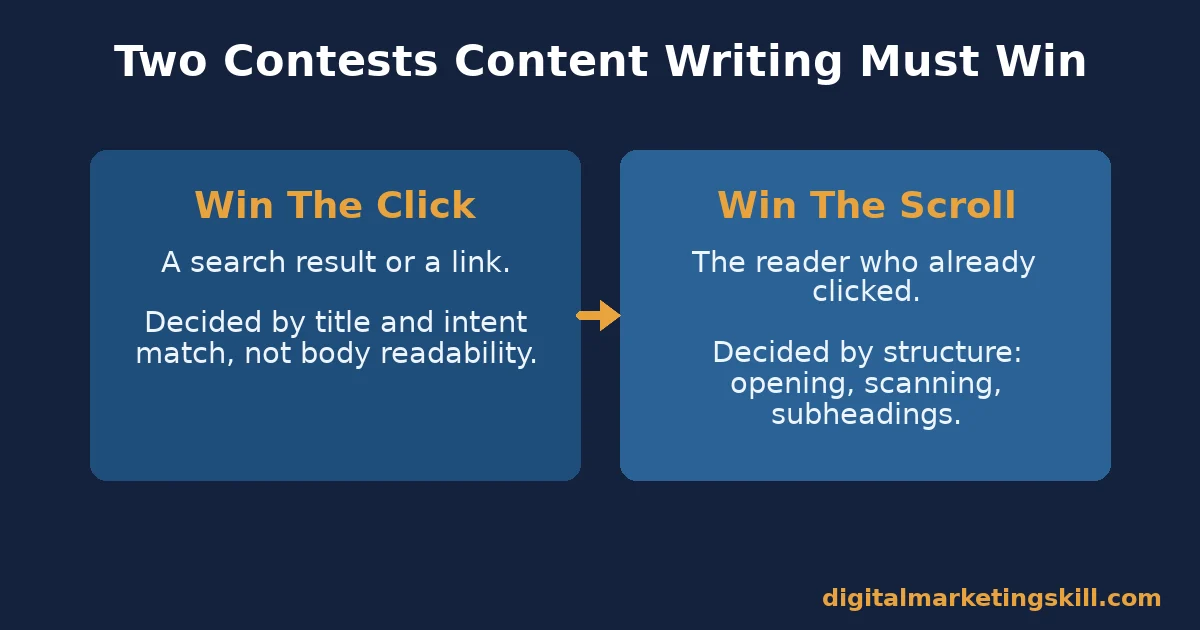
A piece of content writing competes for attention in two separate contests. First, it has to earn a click from a search result or a link. Then, once a reader lands, it has to earn each additional sentence. Readability affects the second contest, not the first. Confusing the two is the single most common mistake behind weak content writing results.
What Readers Actually Do When They Land
Nielsen Norman Group’s eye-tracking research recorded how people look at web pages. Readers move across the top of the content first. They then make a second, shorter horizontal sweep lower down. Then they scan down the left side. The resulting shape looks like the letter F, which is why researchers call it the F-pattern.
The practical implication is blunt. Put the most important point in the first two paragraphs, because many readers never move past that shape. A clever conclusion at the bottom of the page reaches only the minority who scan all the way down.
Why Readability Doesn’t Move Rankings, But Still Matters
Portent crawled 5.8 million web pages across the top 100 results for 30,000 queries. It found no correlation between a page’s reading level and where it ranked. Average reading level across all ranking positions sat around 11th grade. Simpler pages did not rank higher, and harder pages did not rank lower.
That finding surprises people, because it seems to argue against writing simply. It does the opposite. Portent also notes that roughly half of US adults read below a 9th-grade level. A piece written at an 11th-grade level loses real readers even while ranking perfectly well. Write for the reader, not for an imagined ranking signal.
Writing for Keywords First vs Writing for Readers First
Every piece of content writing leans one of two ways before a single sentence gets drafted. The lean shows up immediately in the opening and in how information gets ordered. It also shows in smaller choices: which examples get included, how long each paragraph runs, and whether a claim gets a source or is left to sound authoritative on its own.
Keyword-First Writing: Built For Search Engines
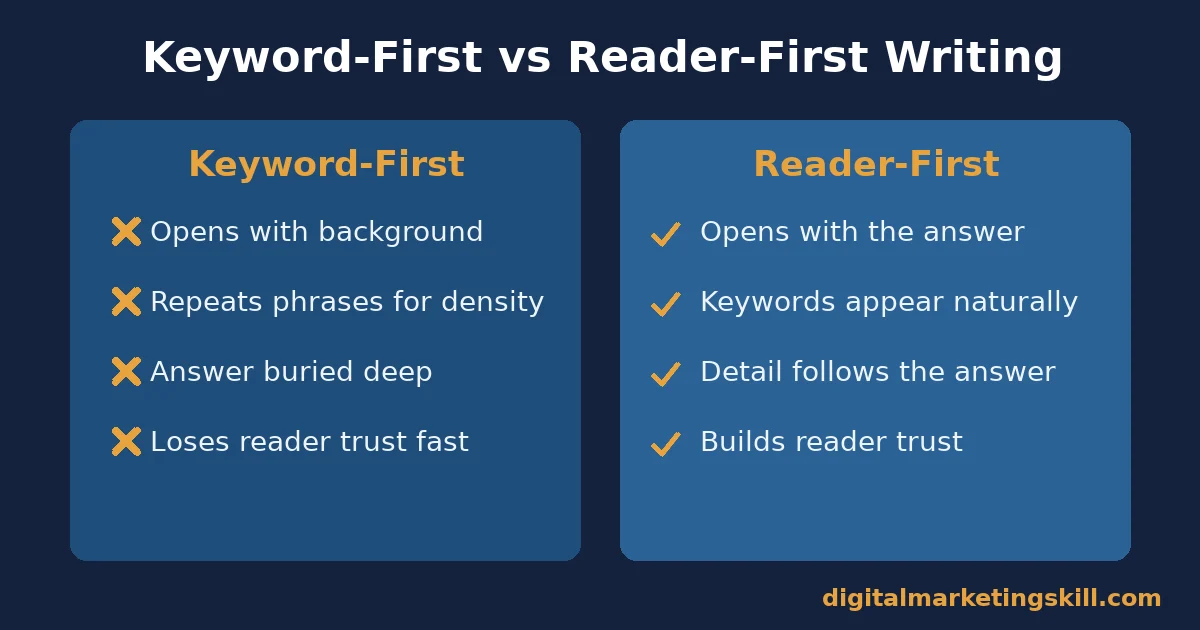
Keyword-first writing opens with background, repeats a phrase for density, and buries the direct answer several paragraphs down. It often reads like a checklist was followed rather than a question answered. Search engines have gotten better at penalising this pattern. Google’s helpful content guidance explicitly asks whether a page exists mainly to attract search visits.
The deeper cost is reader trust, not ranking. A visitor who lands on a keyword-first page notices the padding within seconds and leaves. That is exactly the outcome Nielsen Norman Group’s scanning research predicts.
Reader-First Writing: Built For People Who Stay
Reader-first writing opens with the answer and names who it is for. It only adds supporting detail once the core question is settled. Keywords still appear, because they describe the topic naturally, but they never dictate sentence structure. Keyword-first writing that sacrifices clarity for density tends to lose readers even when it reaches the right audience through search.
This approach tends to produce shorter, more direct openings and more subheadings, since each subheading has to earn a scanning reader’s attention on its own. It also tends to produce shorter sentences overall, since a reader-first writer is constantly checking whether the next sentence is actually needed.
Our guide to SEO content writing covers how to keep both intent and keywords aligned without falling back into keyword-first habits.
How to Structure a Piece of Content Writing That Gets Read
Structure is the part of content writing that is easiest to fix and most often skipped. Unlike a full rewrite, structural fixes usually take minutes per page, not hours, since the sentences themselves often stay close to their original wording. The two moves below cover most of the gain.
Open With the Answer: Lead With the First Two Paragraphs
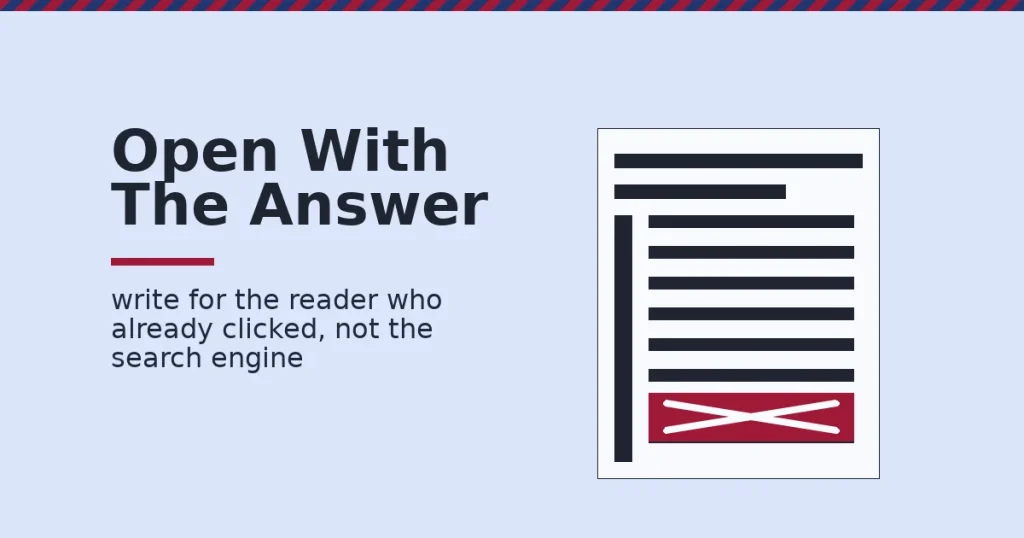
State the direct answer or the main point within the first two paragraphs, before any background or history. A reader who gets the answer immediately decides to stay for the explanation. A reader kept waiting usually never finds out there was an answer at all.
Match the opening to what brought the reader there. Someone who searched a question wants that question answered plainly. Someone who clicked a social link wants the promise from that post delivered immediately, not after three paragraphs of setup.
Structure for Scanning: Lead With Subheadings and Short Paragraphs
Write subheadings that state a real claim, not a vague label. “Why Readability Doesn’t Move Rankings” tells a scanning reader more than “Readability” ever could. Keep paragraphs short, since a wall of text fails the F-pattern test before a reader even starts.
Use one visual, list or example per major section wherever it genuinely explains something. Decoration without explanation adds load time without adding clarity, so every element in a piece of content writing should earn its place. Our guide to content writing tools covers what can check structure and readability as you draft, not only grammar.
A few structural habits cause most of the damage, and each one is easy to check on your own pages:
- The answer arrives after the third paragraph. By then, most scanning readers under the F-pattern have already decided whether to keep reading.
- Subheadings describe a topic instead of making a claim. “Benefits” tells a reader nothing; “Why This Cuts Setup Time in Half” tells them exactly what the section delivers.
- Paragraphs run past 100 words. Long blocks look like effort to read before a single word is parsed, which pushes scanning readers to skip ahead or leave.
- Every section reads the same length. Real arguments compress some points and expand others; uniform section lengths usually mean padding somewhere.
How to Measure Whether Your Content Writing Is Working
Measurement for content writing should separate whether people arrive from whether they stay, since those are different problems with different fixes. Mixing the two together often leads to the wrong edit: rewriting sentences on a page that nobody is finding, or chasing keywords on a page readers already abandon early.
Five Metrics That Show Real Reading
- Organic impressions. How often the page appears in Google results, tracked in Search Console. Rising impressions show the topic and keywords are being found at all.
- Click-through rate. The share of impressions that become clicks. A low rate with strong impressions usually points to a weak title or meta description, not the body content.
- Engagement rate. Google Analytics counts a session as engaged when it lasts over 10 seconds, has a key event, or includes two or more page views. This is the clearest signal that the opening paragraphs worked.
- Scroll depth. With enhanced measurement on, Google Analytics logs a scroll event once a reader reaches 90% of the page. The share who trigger it shows how many finish the piece.
- Average engagement time. How long the page stayed in view and focused. Compare it with a rough reading-time estimate for the word count to see whether people are actually reading or skimming past.
How to Read These Numbers Together
Read impressions and click-through rate first, because a piece nobody finds or clicks cannot be fixed by better writing. If those look healthy but engagement rate is weak, the opening two paragraphs are the first place to look, not the middle of the piece. This order matters because fixing prose on a page nobody opens wastes the exact effort this guide is trying to save.
If engagement looks fine but scroll depth drops early, the structure in the middle is probably the wall-of-text problem the F-pattern research warns about. Fix structure before you rewrite sentences, since structure usually explains more of the drop than word choice ever does.
The One Rule: Write for the Reader Who Already Clicked
If you take one decision rule from this guide, make it this one. Once someone has clicked, stop writing for search engines and start writing only for that reader’s next two sentences. Every ranking battle is already over by the time a real person is on the page.
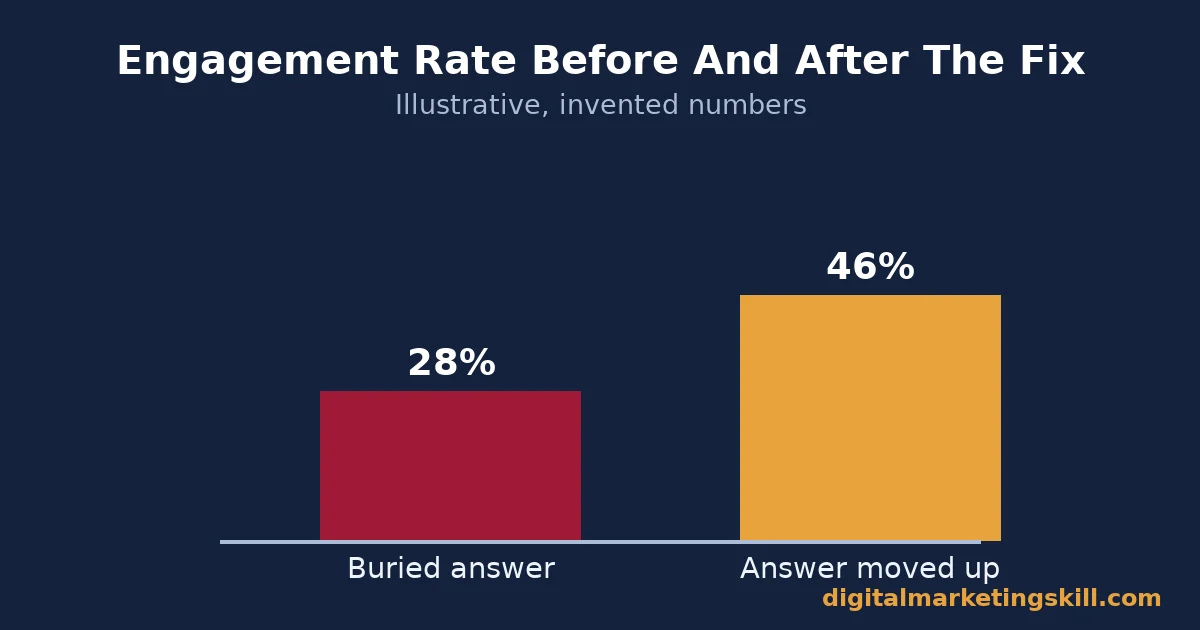
Here is an illustrative example, with invented numbers. A small business blog publishes a 1,500-word guide that opens with three paragraphs of company history before the actual answer. Engagement rate sits at 28%.
The team moves the direct answer to the first two paragraphs and cuts the history to one sentence near the end. Engagement rate rises to 46% over the following month, with no change to rankings or traffic.
The lesson is that structure, not word count or keyword density, moved the number that mattered. The page did not get easier to find. It got easier to stay on.
A Real Case: Why Portent Crawled 5.8 Million Pages
Portent’s study is a useful real case because it set out to settle a long-running argument directly, rather than relying on opinion. The team started with 756,297 pieces of content across 30,000 desktop queries, then expanded to 5.8 million pages across the top 100 results, specifically to test whether reading level predicted ranking position.
It found no meaningful correlation. Average reading level held around 11th grade across every ranking position studied, from first place to the bottom of the sample. Simpler writing did not climb, and denser writing did not fall.
The limit on this case is what it does not measure. Portent’s crawler ignored anchor text and tested linkless versus full-text scores, finding the difference negligible, but the study says nothing about engagement, time on page or conversions. Read it as evidence on rankings specifically, not as proof that readability is unimportant overall.
That gap matters for how you use the finding. A site owner who reads only the headline conclusion, “readability doesn’t affect rankings,” could reasonably decide readability is not worth the effort.
The fuller picture points the opposite way. Add the F-pattern research and the reading-level gap among US adults, and readability turns out to be solving a different problem than ranking. That problem still costs you real readers every day it goes unfixed, even on a page that ranks first.
A Four-Week Plan to Fix Your Weakest Pages
You do not need to rewrite your whole site at once. This plan spreads the work over a month, starting with the pages most likely to pay off first, so the effort shows a return before the month is even over.
Weeks One and Two: Diagnose and Open
- Week one: find your weak pages. In Search Console, list pages with strong impressions but a low click-through rate or a low engagement rate once visitors arrive.
- Week two: fix the opening. For each page, move the direct answer into the first two paragraphs. Cut any history, background or definition the reader already knows.
Weeks Three and Four: Restructure and Confirm
- Week three: fix the structure. Break long paragraphs apart. Write subheadings that state a real claim, not a vague label, so a scanning reader can follow the argument.
- Week four: check the five metrics. Compare engagement rate and scroll depth with the month before. Keep the changes that moved the numbers, then repeat with the next batch of pages.
This cycle compounds. Each page you fix already has visitors, so the gain shows up immediately, unlike a brand-new piece that starts from zero traffic. After a few rounds, most sites find a handful of pages that account for a disproportionate share of total engagement, and those become the pages worth revisiting every few months as the rest of the site grows around them.
The plan works whether the content writing is handled in-house or outsourced, as long as whoever writes understands the audience and has access to real data or sources, not just a topic brief. The structural rules in this guide apply the same way regardless of who holds the pen, and they are easier to check in an editing pass than most grammar rules.
Frequently Asked Questions About Content Writing
What is content writing?
Content writing is the practice of producing written material, articles, guides, web pages, for a specific reader and purpose, usually published on a website rather than printed or broadcast.
Does better readability improve Google rankings?
Not directly. Portent’s large-scale study found no correlation between reading level and ranking position. Readability still matters for engagement, since roughly half of US adults read below a 9th-grade level.
How long should a piece of content writing be?
Long enough to answer the question completely, and no longer. Orbit Media’s survey puts the average blog post at 1,312 words, but length should follow the topic’s complexity, not a target number.
What is the biggest mistake in content writing?
Opening with background, history or a definition the reader already knows, instead of the direct answer. The F-pattern scanning research shows most readers never make it past the first two paragraphs.
How do I know if my content writing is actually working?
Track engagement rate and scroll depth alongside impressions and clicks. Strong impressions with weak engagement point to the opening; strong engagement with an early scroll drop points to the structure further down. Checking all four together, rather than any single number alone, is what keeps you from fixing the wrong part of the page.
Is AI-written content writing effective?
It depends entirely on whether the result follows the same structural rules as strong human writing: a direct opening, genuine scanning structure and a clear audience. Google’s own guidance judges content on helpfulness and intent, not on how it was produced.
What reading level should content writing target?
Portent’s research and general best practice both point toward roughly an 8th-grade reading level for general audiences, since about half of US adults read below 9th grade. Specialised, technical audiences can read comfortably at a higher level, so match the level to the actual reader, not a fixed rule.
How many subheadings does a piece of content writing need?
Enough that a reader scanning only the subheadings can follow the whole argument. As a rough guide, aim for a new subheading every 200 to 300 words, and make each one state a real point rather than a one-word label like “Overview” or “Details.”
Start With Your Most Visited Page’s Opening
Content writing improves fastest when you fix structure on a page that already gets visitors, rather than starting a new piece from scratch. Pick your best-performing post, check whether its first two paragraphs deliver the answer, and rewrite the opening before you touch anything else.
If you want structured, hands-on practice, Digital Marketing Skill Institute teaches content writing inside the Master Diploma in Digital & AI Marketing. The programme is built from ten courses across four AI-powered tracks: AI-Powered Social Media Management and Advertising, AI-Powered Lead Generation and Email Automation, AI-Powered Google Specialist, and AI-Powered WordPress and SEO Specialist, with a Full Stack option for completing all four.
The diploma includes unlimited 1-on-1 coaching and mentoring, plus a U.S. Project Internship with a verified U.S. Work Reference Letter. It is dual US and UK accredited, and it is recognised in more than 100 countries.
Studying is 100% online, so you can build these skills from anywhere in your country. For a deeper look at the related craft of persuasive writing, see our guide to copywriting. For keeping readers coming back, see our guide to blog readership.
Browse more guides on the Digital Marketing Skill Institute blog, and read real outcomes on our reviews page. When you are ready, apply for the Master Diploma directly from the Digital Marketing Skill Institute homepage.
Every figure in this guide was checked against its original source before publication. Figures marked as illustrative are invented examples, not real results.
![9 Amazing Digital Marketing Skills to Make Money Online [With Proof]](https://digitalmarketingskill.com/wp-content/uploads/2019/07/9-Amazing-Digital-Marketing-Skills-to-Make-Money-Online-With-Proof-17.png)






