
toc items: 15
Customer service automation skills decide who keeps a frontline job and who doesn’t. AI now handles the scripted half of support work. The representatives who learn to read engagement data, run retention campaigns, and make the judgment calls a chatbot can’t are the ones employers keep.
Key Takeaways
- Customer service representative employment in the United States is projected to decline 5% over the coming decade. Even so, about 289,500 openings appear every year, mostly from replacement need, not growth (U.S. Bureau of Labor Statistics).
- Enterprise adoption of AI agents in service teams rose from 39% to 66% in one year. AI-resolved cases are projected to climb from 30% to 50% within a few years (Salesforce State of Service).
- 75% of customer experience leaders expect AI to resolve 80% of interactions without a human soon. Yet 90% of the strongest-performing teams say AI’s real payoff is freeing agents for complex work, not cutting headcount (Zendesk CX Trends).
- Acquiring a new customer costs 5 to 25 times more than retaining an existing one. That is why retention and support skills carry more weight than most frontline staff realize (Harvard Business Review).
- About three-quarters of consumers expect a brand to reply on social media within 24 hours or sooner. Scripted bots routinely miss that bar on nuanced complaints (Sprout Social Index).
In this guide
- The Real Gap: Automation Isn’t Replacing Customer Service, It’s Re-Sorting It
- How Customer Service Automation Skills Divide The Work
- What Differs Depending On The Channel You Work
- How To Lead Each Channel Instead Of Being Replaced By It
- How To Measure Your Customer Service Automation Skills
- The One Rule For Deciding What To Learn Next
- A 30-Day Plan For Building Customer Service Automation Skills
- Common Mistakes That Weaken Customer Service Automation Skills
- A Real Case: Moving From Scripted Tickets To Measurable Retention Work
- Frequently Asked Questions About Customer Service Automation Skills
- Build The Skills Automation Can’t Take
The Real Gap: Automation Isn’t Replacing Customer Service, It’s Re-Sorting It
Most coverage of AI and customer service treats the job as one role with one future. It isn’t. Every support team runs two different jobs under one title.
The first job is high-volume, low-ambiguity ticket handling. The second is judgment-heavy relationship work. As a result, automation is absorbing the first job fast while leaving the second job short-staffed.
This is an informed reading of the data, not a settled fact about any single company. For instance, the split plays out differently by industry and by channel mix. Therefore, treat the figures here as a snapshot of where service teams stand right now, not a permanent ranking.
In other words, the practical question is narrower than “will AI take my job.” It is this: which half of my job is AI already doing, and have I built customer service automation skills strong enough on the other half to be worth paying for?
How Customer Service Automation Skills Divide The Work
Chatbots are good at the things that made first-line support repetitive. They answer the same fifteen questions, route tickets, and pull order status in seconds. Then they follow a script that never has to flex.
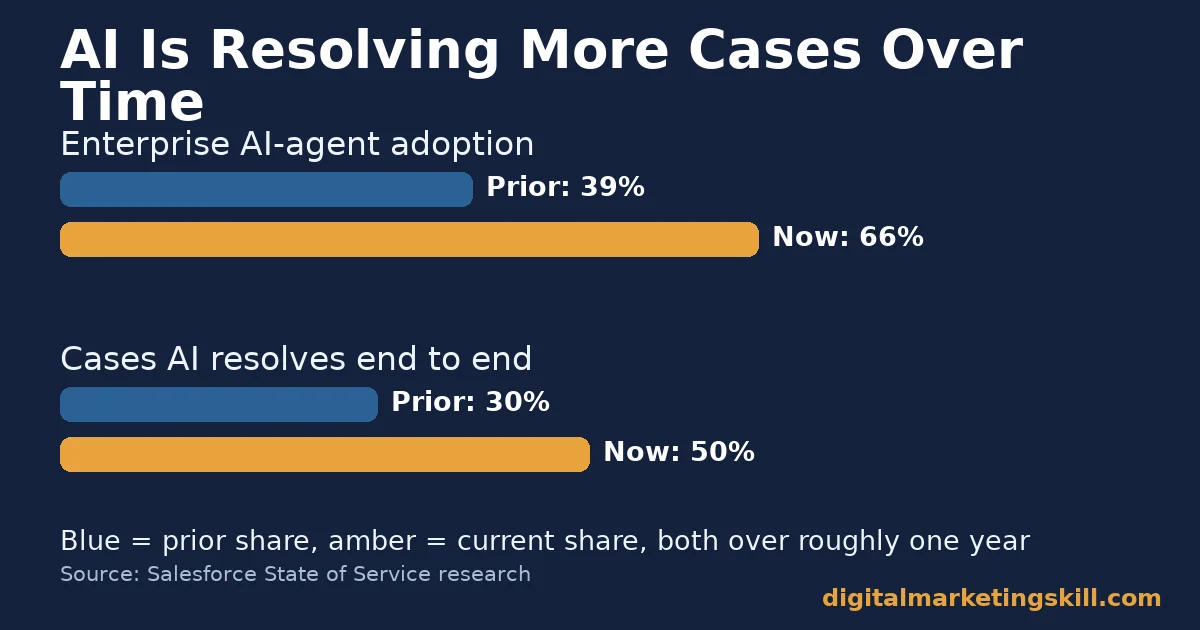
Salesforce’s State of Service research found enterprise AI-agent adoption climbing from 39% to 66% of service organizations in a single year. AI-resolved case volume is projected to rise from roughly 30% today to 50% within a few years. That is the volume layer of the job. It is being absorbed fast, and building customer service automation skills in this layer mostly means learning to supervise the tools, not compete with them.
AI is not good at the ambiguous case: a long-time customer quietly disengaging, a complaint spanning three channels, or a retention save that depends on tone, not keywords.
Specifically, Zendesk’s CX Trends research found that 75% of leaders expect AI to resolve 80% of interactions without a human soon. But the 90% of “trendsetter” teams reporting the strongest AI return say the gain comes from giving agents more room for complex work. It does not come from cutting agents out.
The mechanism is simple. Automation compresses the time and headcount needed for routine volume. That compression either eliminates the role or reallocates the freed capacity toward retention and judgment work. Which outcome you get depends on whether you can do that second kind of work.
The U.S. Bureau of Labor Statistics projects a 5% decline in customer service representative employment over the next decade. Still, the agency counts about 289,500 average annual openings over the decade, mostly from people leaving the field. In short, the jobs are not disappearing overnight. They are being filtered by exactly the customer service automation skills described in this guide.
Going further, Forrester analysts Kate Leggett and Laura Ramos predict that within the next few years AI will reshape 49% of current customer service jobs beyond recognition. Treat that as one firm’s forward-looking prediction, not a certainty. Nonetheless, it points the same direction as the BLS numbers.
What Differs Depending On The Channel You Work
Not every support channel automates at the same speed. For that reason, the customer service automation skills worth building depend heavily on where you sit.
Chat And Email: Built For Scripted Volume
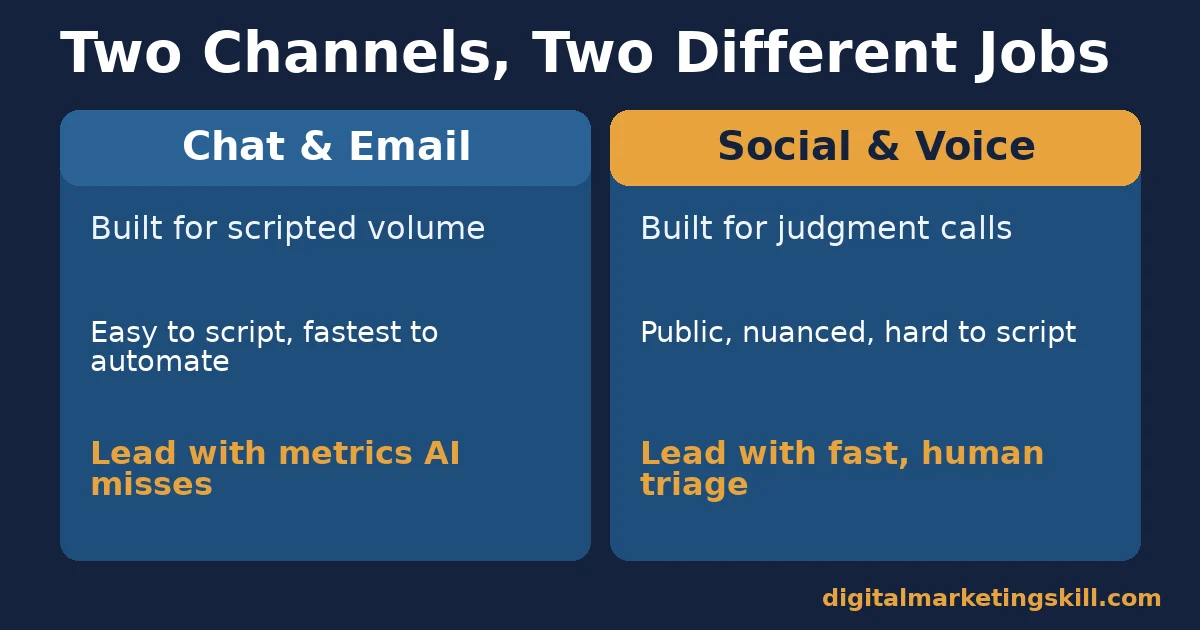
Live chat and first-line email are easy to script. That is exactly why they were automated first. A bot can answer “where is my order” with no ambiguity and no need for empathy. If your day runs mostly on this kind of ticket, you compete directly with the fastest-growing layer of enterprise AI adoption. A script-only skill set has a shrinking market here.
Social Media And Voice: Built For Judgment Calls
Social media customer care behaves differently. So does a phone escalation. A public complaint thread, a confused first-time buyer, or a long-term customer threatening to churn all need context. A script can’t capture that context.
By contrast, the Sprout Social Index found that about three-quarters of consumers expect a brand to respond on social media within 24 hours or sooner. Missing that window on a judgment-heavy complaint does more brand damage than a slow chatbot reply ever would. For this reason, these channels are where human skill, and real customer service automation skills, still carry the most weight.
How To Lead Each Channel Instead Of Being Replaced By It
The fix is not resisting automation on either channel. It is moving your value upstream of what the script can do.
Chat And Email: Lead With The Metrics AI Can’t Read Alone
Automation handles the routine volume on chat and email. The skill that protects you is reading what the automated layer misses. Why is a click-through rate on a retention email falling? Why do open rates drop for one segment, and what makes a “resolved” ticket keep reopening?
Average cross-industry email click-through rate sits around 2.62%, with open rates around 35.63% (Mailchimp benchmarks). Knowing how to read a campaign against that baseline, and act on the gap, is a skill no chatbot script performs. Pair it with basic customer retention management mechanics. Find where a customer’s buying path breaks down. Place the next offer or answer at exactly that point, not generically.
Social Media And Voice: Lead With Judgment AI Can’t Fake
On judgment-heavy channels, the skill that matters is fast triage. Separate a routine complaint from a real retention risk within seconds. Escalate correctly. Write a human reply that a template can’t fake.
Brand-monitoring tools that flag mentions across social platforms help here, but only if the person reading the alert can measure social media performance well enough to tell a one-off gripe from a real pattern. That triage judgment is built from experience, not a flowchart. Consequently, it is the part of the job hardest to automate, and the part most worth building on purpose as a core customer service automation skill.
How To Measure Your Customer Service Automation Skills
Four numbers tell you, concretely, whether your customer service automation skills are still ahead of what AI in your workplace can do.
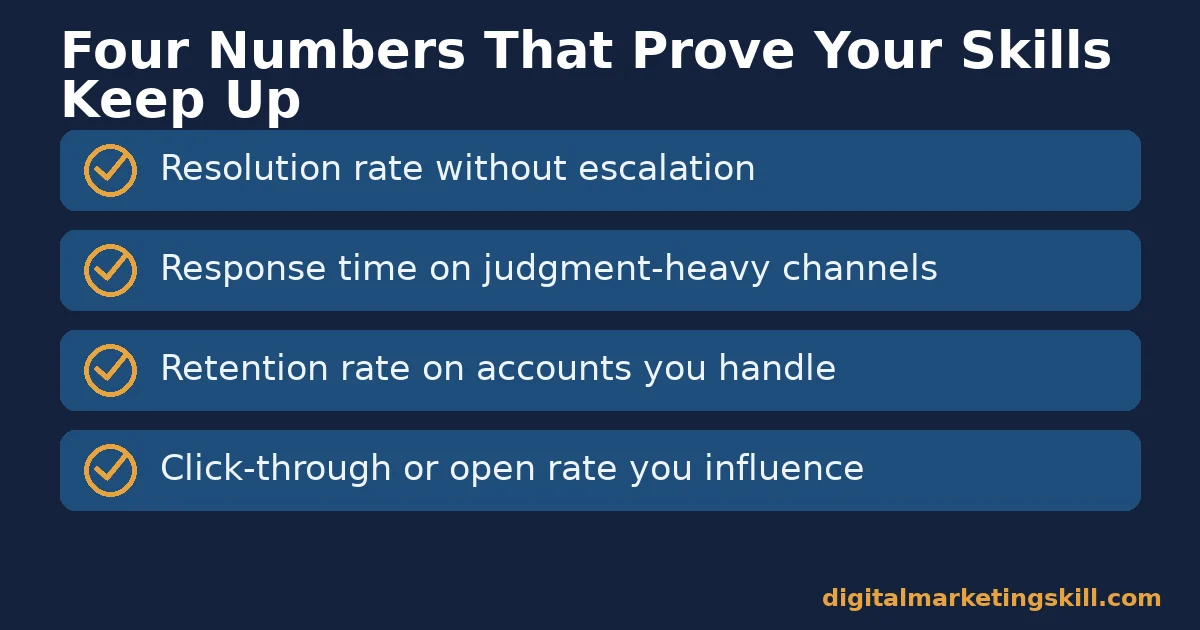
Resolution rate without escalation. This is the share of your tickets or calls that close without a supervisor or another team stepping in. A rising rate on hard cases, not just easy ones, shows your judgment is improving, not just your typing speed.
Response time on judgment-heavy channels. Measure how long it takes you to reply to a social or escalated complaint against the roughly 24-hour bar most consumers hold. Beating that bar on hard cases is a defensible, reportable skill.
Retention rate on accounts you personally handle. This is the share of customers you’ve supported who are still active after a set period. It ties directly to the 5-to-25x acquisition-versus-retention cost gap that Harvard Business Review reports. It is the easiest number to put in front of a manager.
Click-through and open rate on any campaign you influence. Even a frontline agent who suggests copy or timing for a retention email can track whether it beat the roughly 2.62% average click-through rate. Tracking this turns a support task into a measurable marketing contribution.
Track these four numbers for a full quarter. If none of them improves, you are likely still doing only the scripted half of the job automation is built to take.
The One Rule For Deciding What To Learn Next
Here is the decision rule. If a task can be fully described in a flowchart with no judgment calls, assume automation will take it within a few years. Stop specializing in it. If a task needs context a flowchart can’t capture, specialize in it now.
Illustrative, invented numbers: picture a support agent spending 70% of their week on scripted password resets and order-status replies, and 30% on retention saves and social escalations. Applying the rule, they would shift effort toward the 30%. Specifically, they would learn to read campaign metrics, triage brand mentions, and run a retention conversation, until the ratio flips.
Getting faster at the 70% that a bot will eventually absorb anyway is the wrong investment. The exact split will vary by employer. Even so, the direction of the shift will not. Building a track record in the judgment-heavy half also helps you market yourself online for the next role, inside or outside your current employer. That record works better with concrete customer service automation skills to point to, rather than a vague claim of being good with people.
A 30-Day Plan For Building Customer Service Automation Skills
Turning the decision rule into customer service automation skills takes a short, structured push, not a long course nobody finishes.
Week 1: audit your ticket mix. Tag every ticket or call for one week as scripted or judgment-heavy. This gives you the real percentage split, not a guess.
Week 2: learn one metric tool. Pick the tool your team already has, whether that is email analytics, a help-desk dashboard, or a social listening tool, and learn to read its retention and click-through numbers without help.
Week 3: run one retention save end to end. Pick one at-risk customer. Diagnose why they are disengaging, design a fix, and track whether it worked. Document the before-and-after numbers.
Week 4: report the result. Bring the resolution-rate, response-time, retention-rate and click-through numbers from this guide to a one-on-one with your manager. Ask what judgment-heavy work they would hand you if you kept improving on them.
None of these steps needs a technical background. Each one builds a skill that shows up in the four measurement numbers above. That is exactly what keeps a role on the human side of the automation line. Repeat the cycle every quarter. The audit from week one will keep shrinking as a share of your time, which is the clearest sign the plan is working.
Common Mistakes That Weaken Customer Service Automation Skills
Even motivated agents slow their own progress on customer service automation skills with a few repeat mistakes. Here is what to watch for.
Mistake one: getting faster at the wrong half of the job. For example, an agent who shaves ten seconds off an average scripted chat has improved a metric automation will soon own anyway. Instead, that effort should go toward the judgment-heavy tickets a bot cannot close.
Mistake two: tracking activity instead of outcomes. Counting tickets closed per hour feels productive, but it says nothing about whether customers stayed. Retention rate and resolution-without-escalation are the numbers that actually matter, so track those instead.
Mistake three: treating social media as a complaints inbox. Many agents only reply when a customer is already angry. As a result, they miss the quieter signals, a slow unfollow, a drop in replies, that predict churn before it happens. Reading those signals is a core customer service automation skill, not an extra.
Mistake four: avoiding the tools that generate the data. Some agents never open the analytics dashboard behind their email or social platform, assuming it belongs to the marketing team. However, the skill gap this guide describes closes fastest for people who learn to read that dashboard themselves, because it turns a vague sense of “things feel fine” into a number a manager can act on.
In short, the agents most exposed to automation are not the ones in the hardest jobs. They are the ones who never measured which half of their job was replaceable in the first place. Overall, measurement, not effort alone, is what separates an agent who survives the next round of automation from one who doesn’t.
A Real Case: Moving From Scripted Tickets To Measurable Retention Work
Olajire Jacob, a Digital Marketing Skill Institute graduate, priced early client work around $500 per client. After learning email flow design and campaign measurement, he scaled that service to $5,000 a month, as described on the Institute’s reviews page.
The shift matches the pattern in this guide. He moved from handling requests as they arrived to designing and measuring a retention mechanism, an email flow, that kept producing results without being rebuilt from scratch each time. Results vary by person, market and effort. See the Institute’s earnings disclaimer for the standard caveats on any income figure.
Frequently Asked Questions About Customer Service Automation Skills
Will AI fully replace customer service jobs?
Not fully. It is already absorbing the scripted, repetitive share of the work. The U.S. Bureau of Labor Statistics projects a 5% decline in customer service representative employment over the next decade. However, hundreds of thousands of annual openings still appear every year from people leaving the field. In other words, the role is shrinking, not disappearing, and it is shrinking fastest for workers who never build the judgment and measurement skills this guide describes.
Which customer service skills are hardest for AI to automate?
Context-heavy judgment calls are hardest. For example, triaging an ambiguous complaint, reading whether a customer is at risk of churning from tone rather than keywords, or handling a public social media escalation where brand reputation is on the line. These tasks need pattern recognition built from real experience, not a fixed script, which is exactly why they sit at the center of any serious customer service automation skills plan.
Do I need to learn coding or data science to keep a customer service job?
No. The more useful skills are reading campaign and retention metrics, basic use of social listening tools, and structured triage judgment. None of this requires a technical background. Instead, it requires repetition: reading the same dashboards and the same kinds of complaints often enough to spot patterns quickly.
How can I tell if my current role is at high risk of automation?
Track how much of your week goes to tasks you could write as a yes-or-no flowchart. If that share is high and growing, and your resolution, retention and response-time numbers are not improving, your role carries higher automation risk. On the other hand, a growing share of judgment-heavy work, paired with improving numbers, is a sign your customer service automation skills are already paying off.
Is customer retention really more valuable than acquiring new customers?
Yes, by a wide margin. Harvard Business Review reports that acquiring a new customer typically costs 5 to 25 times more than retaining an existing one. That is why skills that improve retention carry outsized value, even inside a job titled “support” rather than “marketing.” As a result, an agent who can move that number has real, demonstrable leverage in any performance conversation.
What should I measure to prove my skills are keeping pace with automation?
Track four numbers: resolution rate without escalation, response time on judgment-heavy channels, retention rate on the accounts you personally handle, and click-through or open rate on any campaign you influence. Improvement across these over a full quarter is concrete, reportable evidence, and it is far more persuasive to a manager than a general claim of being “good with customers.”
Can social media customer care skills really protect a support job?
Yes, because social complaints are public and judgment-heavy, which is exactly what current automation handles worst. Consumers expect a reply within about 24 hours on social media, and getting that response right on a hard case is a skill employers notice. Meanwhile, an agent who consistently misses that window, or hands every escalation upward without triage, is doing the one part of the job hardest to automate the least well.
Build The Skills Automation Can’t Take
If your role is mostly scripted ticket handling, the fastest way to move to the judgment-and-retention side of customer service is structured, practical training, not trial and error on the job. After all, the 30-day plan above only works if you also learn the underlying tools properly, rather than guessing at a dashboard under deadline pressure.
The Digital Marketing Skill Institute’s Master Diploma in Digital & AI Marketing is built around four AI-powered tracks, including AI-Powered Lead Generation and Email Automation and AI-Powered Social Media Management and Advertising, covering ten courses in total, with a Full Stack option for completing all four tracks. The program includes unlimited one-on-one coaching and mentoring, a U.S. Project Internship with a verified U.S. Work Reference Letter, and dual US and UK accreditation recognized in more than 100 countries, delivered 100% online. For a broader view of why these skills pay off beyond any one job title, see the benefits of learning digital marketing.
Explore the Master Diploma program, browse more guides on the digital marketing blog, read verified outcomes on the reviews page, and when you’re ready, apply here. Wherever you live, the training is built to be completed online, at digitalmarketingskill.com, and to turn scripted support experience into a measurable, automation-resistant skill set anywhere in your country, at digitalmarketingskill.com.
Every figure in this guide was checked against its original source before publication. Figures marked as illustrative are invented examples, not real results.
![9 Amazing Digital Marketing Skills to Make Money Online [With Proof]](https://digitalmarketingskill.com/wp-content/uploads/2019/07/9-Amazing-Digital-Marketing-Skills-to-Make-Money-Online-With-Proof-17.png)






