
You market yourself online by building proof, not just presence. A profile with no recent posts reads like an empty shop window, while consistent, specific content turns strangers into people who already trust you before they ever message you. This guide names the channels that build that trust fastest, and the metrics that show it is working.
Key Takeaways
- Consistency beats volume. Buffer’s analysis of 4.8 million channel-week observations found accounts posting 10 or more times a week averaged 32 more followers a week than their own silent weeks.
- Format changes engagement sharply. The same Buffer dataset found LinkedIn carousels earned 21.77% median engagement, roughly three times video or single-image posts.
- Guest content earns links, not crowds. Ahrefs analysed 239 guest posts and found average referral traffic of only about 50 visits each, so the real payoff is the backlink, not direct readers.
- Networking still gets people hired. In LinkedIn’s survey of professionals, about 80% considered networking important to career success, and 70% of a recent hiring cohort joined a company where they already had a connection.
- Google rewards relevance over payment. Google states plainly that local ranking is based on relevance, distance and prominence, and that there is no way to pay for a better local ranking.
In this guide
- What Most Advice on How to Market Yourself Online Gets Wrong
- Why Trust, Not Reach, Is What Actually Moves
- The Channels Differ in What They Prove
- How to Market Yourself Online on Each Channel
- Five Mistakes That Undo How You Market Yourself Online
- How to Measure Whether You Market Yourself Online Well
- The Most Useful Rule: Publish Where You Can Be Specific
- A Four-Week Plan to Market Yourself Online
- A Real Case: Turning $14 of Visibility Into $878 in Sales
- Frequently Asked Questions About How to Market Yourself Online
- Start With One Channel, Prove It Works, Then Expand
What Most Advice on How to Market Yourself Online Gets Wrong
Most lists on how to market yourself online repeat the same eight or ten tips: post often, optimise your profile, network, write guest posts. None of that is wrong. But it skips the mechanism underneath: why some content builds trust fast while similar content gets ignored.
This guide names that mechanism, shows which channel proves what, and gives you metrics to check whether people actually trust you more, not just whether they saw you. Here are the limits too. Buffer and Ahrefs are vendors analysing their own user data, LinkedIn’s figures come from its own surveys, and the four-channel comparison below is an informed framework, not a settled ranking. Treat every figure as a snapshot, not a permanent fact.
Why Trust, Not Reach, Is What Actually Moves
Reach tells a stranger you exist. Trust tells them you can be relied on. Marketing yourself online works when you stop optimising for the first and start building the second. Trust is what turns a view into a reply, a client or a job offer.
Most people learn how to market yourself online from checklists that mix the two goals together, so it is worth separating them before you plan anything. A view counts reach. A reply, a save or an unprompted message counts trust. Only one of those two numbers predicts whether someone will actually hire you, buy from you or refer you.
Proof Beats Polish
A polished headline promises something, while a specific result proves it. Our guide to digital marketing benefits that actually move revenue makes the same point about businesses: the number that can survive a follow-up question is worth more than a generic claim.
That is why a single named result, with its limits stated, beats a long list of vague adjectives. Readers and recruiters both discount claims they cannot check.
Consistency Compounds Quietly
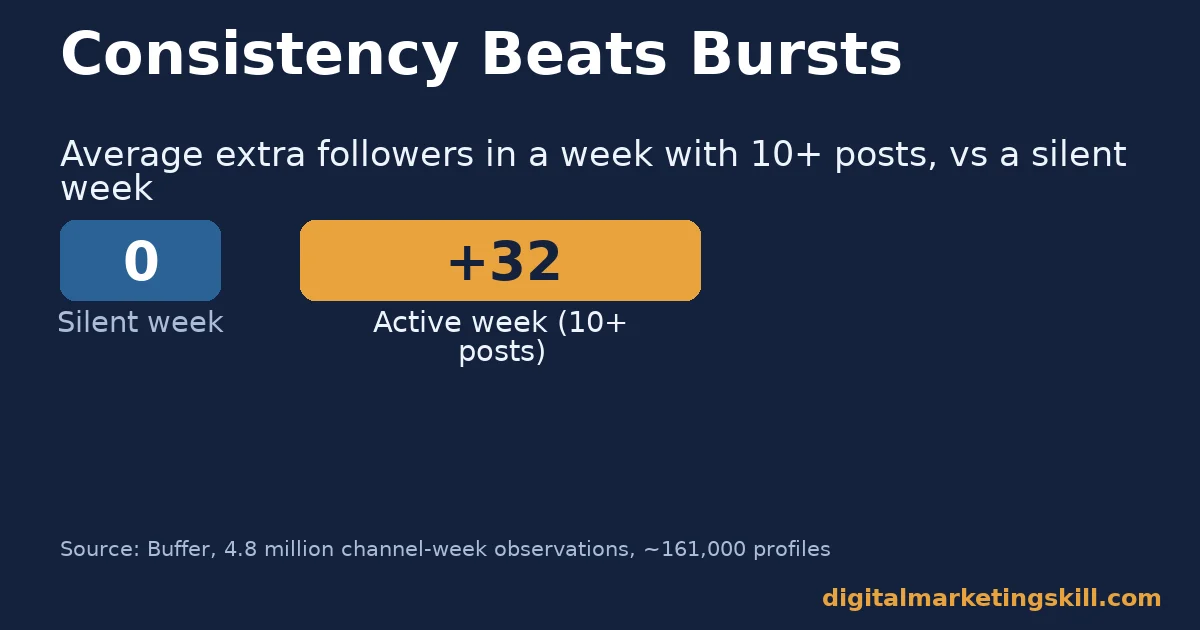
Buffer’s analysis of 4.8 million channel-week observations across roughly 161,000 profiles found accounts posting 10 or more times a week averaged 32 more followers a week than their own quiet weeks. The effect was not about going viral. It was about simply staying visible.
That single number explains why so much advice on how to market yourself online says “post consistently” without saying why. Consistency is not a virtue signal. It is what keeps you inside the algorithm’s rotation and inside a contact’s memory.
Consistency only pays off where your real audience already spends time, though. Pew Research Center’s survey of US adults found YouTube used by 84%, Facebook by 71%, Instagram by 50% and LinkedIn by 25%. Those figures are US-only and will differ in your own market. Posting daily on a platform your audience ignores wastes the consistency effect described above.
The Channels Differ in What They Prove
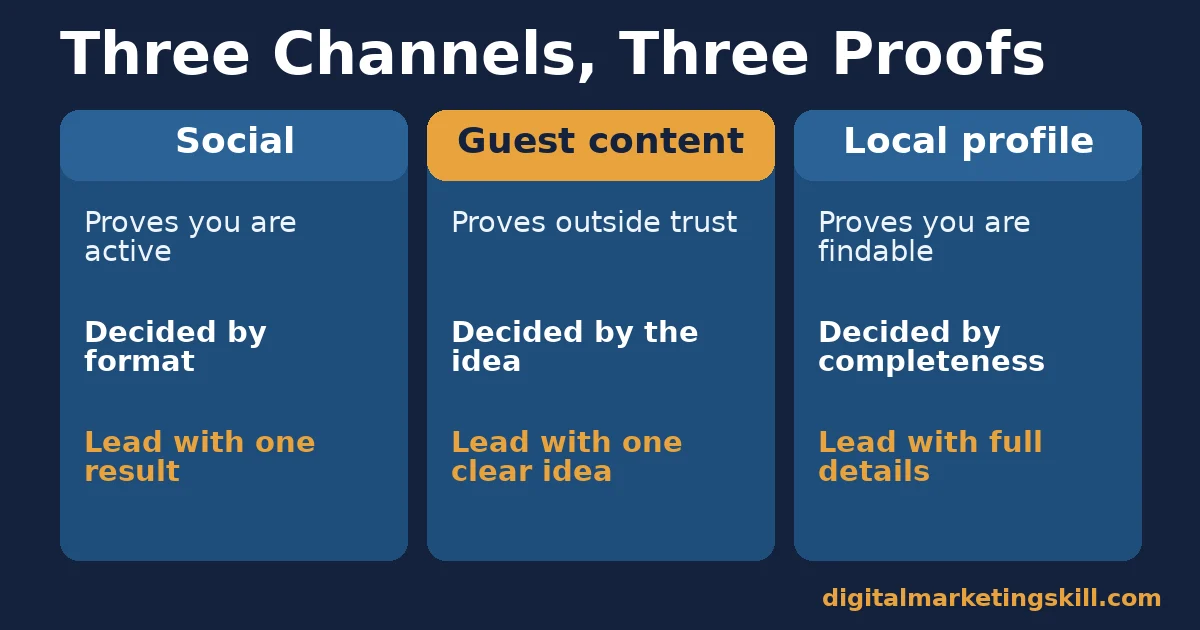
Not every channel proves the same thing. Social posts prove you are active and current. Guest content proves other publishers trust your expertise enough to lend you their audience. A complete local profile proves you are findable and real. Each channel earns a different kind of trust.
Social Posts: Built For Familiarity
Social platforms build familiarity through repetition, so the format matters as much as the message. Buffer’s dataset found LinkedIn carousels earned 21.77% median engagement, roughly three times what video or single-image posts earned on the same platform.
Familiarity fades fast without upkeep, though. The same research found reply-driven posts lifted engagement on LinkedIn by about 30%, which means a post that starts a conversation works harder than one that simply announces something.
Guest Content: Built For Authority by Association
Ahrefs analysed 239 guest posts and a survey of more than 500 bloggers. It found the average guest post brought only about 50 referral visits. That sounds discouraging until you see what it actually proves: an editor at another site judged your expertise worth publishing, and readers notice that even when few of them click through immediately.
So judge guest content by the relationship and the link it earns, not by direct traffic. Google’s own spam policies warn against guest posts built purely to manipulate links, which is one more reason to write for the editor’s readers first.
A Local Profile: Built For Being Found
If you offer services locally or by region, a complete business profile proves you are real and reachable. Google states plainly that local ranking depends on relevance, distance and prominence, and that there is no way to pay for a better position.
Prominence rewards activity you can control: reviews, complete details and regular updates. Google’s own guidance on business profile posts names updates, offers and events as the formats it surfaces in search and maps results, so an idle profile misses a free, built-in distribution channel.
Our guide to identifying your target audience covers how to decide which details and keywords actually matter to the people searching for you.
How to Market Yourself Online on Each Channel
Knowing what each channel proves is only half the work. The sections below mirror the three channels above, with the specific move that earns the proof rather than just the post.
Social: Lead With a Specific Result
Replace a generic update with one specific result, number or lesson. Specificity is what makes a scrolling stranger stop, because a vague claim blends into every other post in the feed.
Reply to every comment within a day while the post is still live. That single habit is what drove the 30% engagement lift Buffer measured on reply-driven LinkedIn posts, and it costs nothing but attention.
Guest Content: Lead With One Clear Idea
Pitch one specific, well-argued idea rather than a broad topic. Editors reject vague pitches fast, and a sharp idea is also what makes an editor’s own readers remember your name afterward.
Put a short, honest bio with one link at the end, not three. A single clear next step converts better than a list of competing calls to action. For more on building that nurture path once someone clicks through, see our lead generation tips that actually increase ROI.
Research groups that study content marketing, including Content Marketing Institute’s annual surveys, consistently find that a documented plan outperforms ad hoc publishing. Our own guide to building a content marketing strategy covers how to turn a single guest post into a repeatable system instead of a one-off favour.
Local Profile: Lead With Complete, Current Details
Fill in every field your profile allows: hours, services, photos and a real address if you have one. Missing fields are missed chances for the prominence signal Google already rewards.
Ask recent clients for a specific review, naming the result they got. A review that names an outcome works like the specific social post above: it proves instead of just asserting.
Five Mistakes That Undo How You Market Yourself Online
Most people who feel invisible online are not failing at effort. They are repeating one of five fixable mistakes.
- Posting only announcements. A feed of launches and promotions reads as a billboard, not a person. Mix in lessons, opinions and specific results.
- Disappearing after a burst. A week of daily posts followed by a month of silence loses the consistency effect Buffer measured. Steady beats intense.
- Writing for everyone. Content aimed at nobody in particular convinces nobody in particular. Name the exact person you want reading it.
- Chasing platforms instead of people. Being everywhere thinly is weaker than being specific and consistent on the one or two channels your audience actually uses.
- Never asking for the next step. A great post with no way to follow up wastes the trust it just built. End with one clear, low-pressure next step, such as an email sign-up you actually own.
Which Mistake to Fix First
Check your last ten posts against this list before writing an eleventh. If you cannot name the one person each post was written for, that is usually the mistake costing you the most, because it quietly weakens everything else you publish.
Write the fix down, not just the diagnosis. A one-line note such as “name one client industry in every post this month” turns a vague intention into something you can actually check against your next ten posts.
The fifth mistake deserves extra weight, because a social following is rented, not owned. A platform can change its algorithm overnight, but an email list stays reachable regardless. Industry estimates compiled by Omnisend put average email marketing return at roughly $36 to $42 per $1 spent, which is why a social post that converts even a few readers into subscribers compounds far past that single post’s reach.
How to Measure Whether You Market Yourself Online Well
Each mechanism above has a matching metric. Track these alongside the follower counts you already watch, and treat a number you cannot define in one sentence as one to stop reporting. Follower count alone cannot tell you whether you market yourself online effectively, because it rises even during the silent weeks Buffer’s data flagged as costly.
Five Metrics That Show Real Trust Building
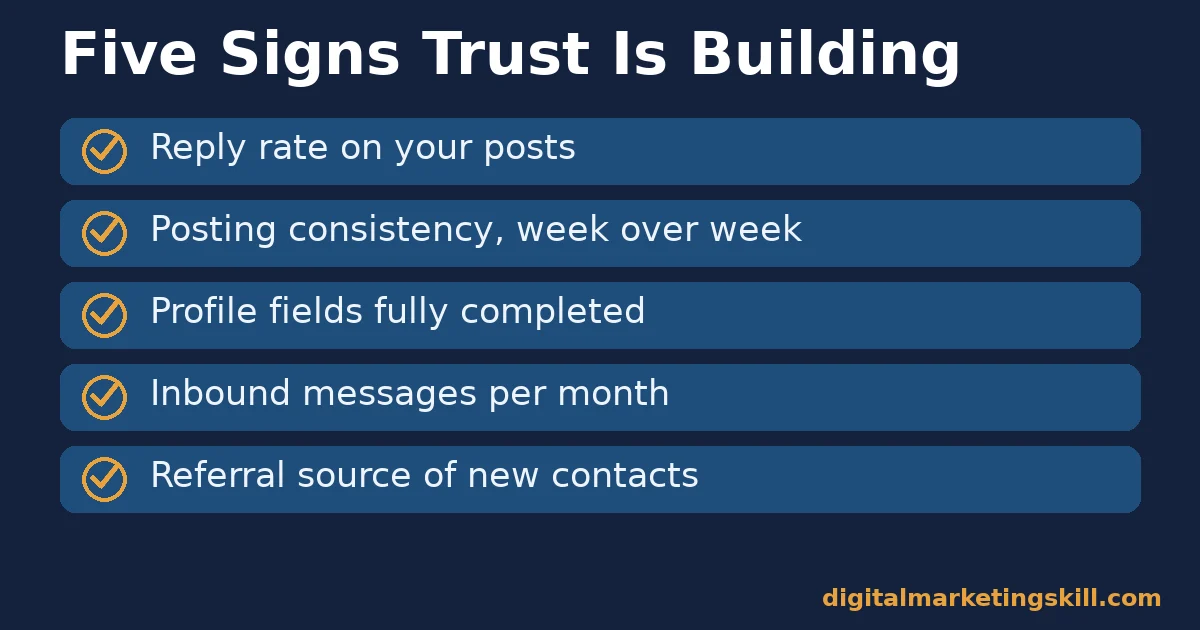
- Reply rate. The share of your posts that get at least one genuine comment, not just a reaction. This shows whether people feel invited to respond, not just scroll past.
- Posting consistency. The share of weeks in the past quarter where you posted at least once. Compare it against Buffer’s 32-follower gap between active and silent weeks.
- Profile completion. The share of fields filled in on your main profiles. An incomplete profile caps the prominence and trust signals every other tactic is trying to build.
- Inbound messages per month. The number of unprompted messages, not counting replies you initiated. Rising inbound interest is the clearest sign that trust is compounding.
- Referral source of new contacts. Ask new contacts how they found you, and log the answer. This tells you which channel is actually converting attention into relationships.
Reading the Metrics Together
Read reply rate and posting consistency together first. A low reply rate with steady posting usually means the content is not specific enough, not that the channel is wrong. Read profile completion and inbound messages together next, because an incomplete profile quietly caps every other effort, even strong content.
Track one change at a time. When you switch to more specific posts or finish your profile, note the date and compare the following four weeks with the four before it. A spreadsheet with five rows is enough; the discipline of checking it weekly matters more than the tool.
The Most Useful Rule: Publish Where You Can Be Specific
If you take one decision rule from this guide, make it this one. Choose the channel and topic where you can name a real number, a real client or a real lesson, and publish there first. General advice posted everywhere loses to specific proof posted somewhere.
Here is an illustrative example, with invented numbers. A freelance designer posts generic tips for two months and gains 40 followers with almost no replies. She switches to posting one specific project result each week, naming the client’s industry and the result. Replies rise within three weeks, and two inbound project enquiries follow in the next month, from people who say they recognised her work from a specific post.
The lesson is about specificity, not volume. The designer posted less often in the second phase but earned more trust, because every post gave a stranger something concrete to judge.
A Four-Week Plan to Market Yourself Online
You do not need a rebrand to start seeing results. This plan works with the channels you already use.
- Week one: audit your last ten posts and your main profile. Mark which posts named a specific result, and which profile fields are incomplete.
- Week two: fix the profile and pick one channel. Complete every field on your main profile, then choose the one channel your real audience already uses most.
- Week three: publish three specific posts. Each should name one result, lesson or number, and ask one clear question to invite replies.
- Week four: pitch one piece of guest content. Pitch a single clear idea to one relevant site or publication, with a short bio and one link.
At the end of the month, compare reply rate and inbound messages with the month before. Keep what moved the numbers, drop what did not, and repeat with a second channel.
A Real Case: Turning $14 of Visibility Into $878 in Sales
Ayooluwa Osemi, a graduate of Digital Marketing Skill Institute’s training, described on the Institute’s reviews page spending $14 on Facebook and Instagram ads and generating $878 in sales from that single campaign. The spend bought visibility for a specific, trackable offer rather than a vague announcement.
The case illustrates the core argument of this guide. Here, the result came from specificity at a small scale, not from a large, unfocused push. Treat this as one documented result, not a guaranteed outcome. Results vary by product, audience and effort, and Digital Marketing Skill Institute’s earnings disclaimer applies to every figure like this one.
The same principle scales up from a single ad to an entire online presence. Whether the channel is a $14 ad or a free weekly post, the pattern that works is the same: a small, specific, trackable move beats a large, vague one every time you market yourself online.
Frequently Asked Questions About How to Market Yourself Online
What is the fastest way to market yourself online?
Pick one channel your real audience already uses, complete your profile fully, and publish one specific result or lesson a week. Specific, consistent content beats broad, occasional content.
How often should I post to build trust online?
Buffer’s research found accounts posting 10 or more times a week averaged 32 more followers a week than their own silent weeks. Aim for steady weekly posting over occasional bursts.
Does guest posting actually work to market yourself online?
Yes, but judge it by the relationship and backlink, not traffic. Ahrefs found the average guest post brings only about 50 referral visits, so direct readers were never the main benefit.
Do I need to be on every social platform?
No. Being specific and consistent on one or two platforms your audience actually uses beats a thin presence spread across many. Pick based on where your real audience spends time.
How do I know if my personal brand content is working?
Track reply rate, posting consistency, profile completion and inbound messages per month. Rising unprompted messages are the clearest sign that people trust you enough to reach out first.
Is a complete online profile really worth the effort?
Yes. Google states that local ranking depends on relevance, distance and prominence, and prominence is built partly through complete, accurate, active profiles, not paid placement.
What is the biggest mistake people make trying to market themselves online?
Writing for everyone instead of one specific person. Content aimed at nobody in particular tends to convince nobody in particular, no matter how often you post it.
Should I build an email list if I already post on social media?
Yes. A social following lives on a platform you do not control, while an email list stays reachable even if an algorithm changes overnight. Industry estimates put average email marketing return at roughly $36 to $42 per $1 spent, well above most social advertising.
Start With One Channel, Prove It Works, Then Expand
You market yourself online by proving something specific, consistently, on the channel your real audience already uses. Pick that one channel, complete your profile, and run the four-week plan above before you add a second channel on top of an unproven one. Revisit the five-mistakes checklist every month, because the mistakes that undo how people market themselves online tend to creep back in once the initial push fades.
If you want structured, hands-on practice with these skills, Digital Marketing Skill Institute teaches them directly. The Master Diploma in Digital & AI Marketing is built around four AI-powered tracks, including AI-Powered Social Media Management and Advertising and AI-Powered Lead Generation and Email Automation, with a Full Stack option for completing all four. It comes with unlimited 1-on-1 coaching and mentoring, plus a U.S. Project Internship with a verified U.S. Work Reference Letter.
The programme is dual US and UK accredited, recognised in more than 100 countries, and fully online, so you can study and build your presence from anywhere in your country. Browse more guides on the Digital Marketing Skill Institute blog, read real outcomes on the reviews page, and when you are ready, apply for the Master Diploma or start from the Digital Marketing Skill Institute homepage.
Every figure in this guide was checked against its original source before publication. Figures marked as illustrative are invented examples, not real results.
![9 Amazing Digital Marketing Skills to Make Money Online [With Proof]](https://digitalmarketingskill.com/wp-content/uploads/2019/07/9-Amazing-Digital-Marketing-Skills-to-Make-Money-Online-With-Proof-17.png)






