
Customer win-back strategies work when a business spots a quiet buyer early. Group lapsed buyers by why they likely left. Then send a message that answers that reason, not one generic discount for everyone. Reactivating a lapsed buyer costs far less than finding a new one. Most unhappy customers never complain first. This guide shows the mechanism, the groups that need different messages, and how to measure a real win-back result.
Key Takeaways
- Most lapsed customers never complain first. A Coveo customer service survey found that 56% of customers rarely or never complain about a bad experience. They simply stop buying instead.
- One bad experience can be enough. Zendesk’s benchmark research found that more than half of consumers switch providers after a single poor experience. After several, 73% leave.
- Reactivation is cheap next to new acquisition. Harvard Business Review reports that a new customer costs five to twenty-five times more than keeping one, citing Bain & Company’s Frederick Reichheld. A 5% rise in retention can lift profit by 25% to 95%.
- Existing and lapsed buyers are easier sales. The odds of selling to someone who already knows your business run 60% to 70%. A brand-new prospect converts at only 5% to 20%.
- Timing and segmentation beat one blanket email. Programmes that group lapsed buyers by likely reason, and act early in the lapse, tend to outperform a single discount sent to everyone.
In this guide
- What Most Customer Win-Back Strategies Get Wrong
- Why Customers Go Quiet Before They Cancel
- What Differs by Why a Customer Lapsed
- Customer Win-Back Strategies for Each Group
- How to Measure Customer Win-Back Strategies
- The One Decision Rule for Customer Win-Back Strategies: Segment Before You Discount
- A Real Case: What a 5% Retention Gain Is Worth
- A Simple Starting Checklist
- Frequently Asked Questions About Customer Win-Back Strategies
- Build Customer Win-Back Strategies Into a Repeatable System
What Most Customer Win-Back Strategies Get Wrong
Most win-back advice says the same thing. Send a “we miss you” email with a discount. That can work. But it treats every lapsed buyer the same way, and it usually arrives only after the account has gone cold for months.
This guide fills that gap. It explains why customers go quiet before they officially cancel. It shows how to split lapsed buyers into groups that need different messages. Then it gives one decision rule that should come before any discount. Good customer win-back strategies start with that split, not with the offer.
Treat the figures here as named research, not a law of your own market. Several come from self-reported industry surveys. Your exact numbers will depend on your product and price point.
Here is one useful benchmark. A well-run win-back email flow typically converts 2% to 5% of lapsed recipients, reports a direct-to-consumer marketing analytics firm. The strongest programmes reach 5% to 10%. Read this as an industry benchmark, not a guarantee for your own list.
Why Customers Go Quiet Before They Cancel
Very few customers announce that they are leaving. Instead, the gap between purchases simply grows, then stops. A Coveo customer service survey found that 56% of customers rarely or never complain about a bad experience. They just leave, without telling you why. Zendesk’s benchmark research adds a timing detail: more than half of consumers switch providers after just one poor experience. After several, 73% leave. This is exactly why customer win-back strategies cannot wait for a complaint to show up first.
That silence is the real problem a win-back programme has to solve. If you wait for a cancellation notice, you are working with the smallest, angriest slice of lapsed buyers. Most of the rest left quietly, weeks or months earlier, for a reason you were never told.
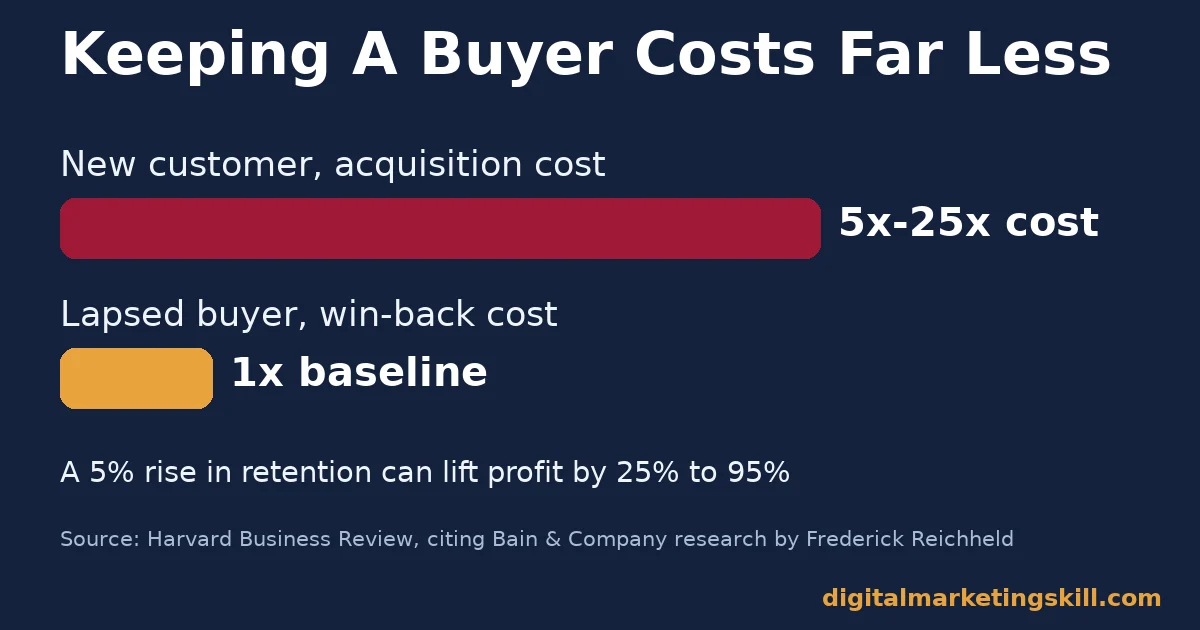
The reward for solving this early is real. Harvard Business Review cites research by Frederick Reichheld of Bain & Company. A new customer costs five to twenty-five times more than keeping one. Raising retention by just 5% can lift profit by 25% to 95%. Good customer win-back strategies follow the same economics as retention. You already know a lapsed buyer’s name and order history. A message to them costs far less than a cold campaign aimed at a stranger.
Timing matters too. Benchmark data on lapsed-customer outreach suggests a win-back message sent soon after a purchase gap opens converts better than one sent much later. Waiting until the account is fully cold removes your easiest window to reach someone.
What Differs by Why a Customer Lapsed
Not every quiet customer left for the same reason. One win-back email cannot speak to all of them. Two broad groups cover most lapses: buyers who left over price, and buyers who left after a specific bad experience. The sections below are paired on purpose. Match your own lapsed list to one before you write anything.
Price-Lapsed Customers: Built to Respond to Value
Some customers simply found the cost hard to justify against what they got. They did not have a bad experience. The maths stopped working for them, often after a price rise, a change in their own budget, or a cheaper option they found elsewhere.
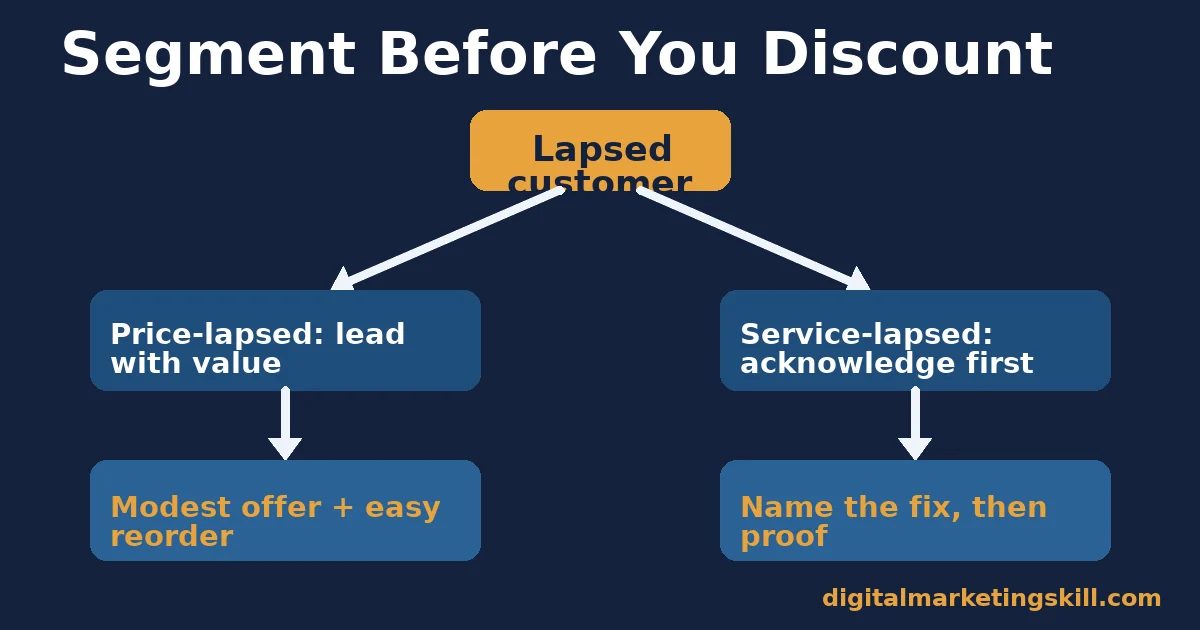
This group is usually the easiest to win back, because the relationship itself was fine. The risk is a discount so steep that it teaches every future customer to wait for one. A moderate, time-limited offer paired with a clear statement of value works better. It reactivates the customer without resetting what they expect a normal order to cost.
Service-Lapsed Customers: Built to Respond to Acknowledgment
Other customers left after a specific breakdown. A late delivery, an unanswered question, or a product that did not do what they expected. For this group, a discount offered without any acknowledgment reads as tone-deaf. It ignores the actual reason they left.
This group is slower to win back, and more valuable to get right. A second bad handling of the same complaint usually ends the relationship for good. They need to hear that the problem was understood before they hear about any offer. If it has genuinely been fixed, say so plainly and briefly. A long justification reads as defensive. A short, confident statement of what changed reads as credible.
A rough, honest split often works better than a perfect one. Use support tickets or cancellation notes if they exist. If not, order history can still hint at the reason. A customer who lapsed right after a price change likely belongs in the price-lapsed group. One who lapsed right after a support ticket likely belongs in the service-lapsed group.
Customer Win-Back Strategies for Each Group
These two sections mirror the groups above. Match your lapsed list to one, then use the approach that fits. Mixing them into one email usually serves neither group well.
Price-Lapsed Customers: Lead With Renewed Value
Open by naming what changed since they left. A feature added, a process improved, or a clearer explanation of what the price covers. Only then mention an offer. Keep it modest, so it reads as a welcome-back gesture, not a plea.
Give them an easy way back in. A short, no-obligation call to action, such as a one-click reorder of what they bought before, removes the friction a lapsed customer feels about starting over.
Service-Lapsed Customers: Lead With a Direct Acknowledgment
Name the kind of problem plainly, even without their exact case details. Try something like: “If a late delivery or a slow reply is why you stopped ordering with us, here’s what changed.” A specific, honest acknowledgment outperforms a generic apology every time.
Follow the acknowledgment with proof, not just a promise. A real example of the fix, a tighter guarantee, or a named point of contact for problems rebuilds trust better than any discount code.
Sequence matters for both groups. Klaviyo’s benchmark work on lifecycle email suggests a short escalation of two to four messages, spaced a few days apart, recovers more lapsed buyers than one single send. Different people respond at different points in the sequence. Stop once someone reactivates, rather than continuing to message a customer who already returned. Email deliverability research from Validity notes that many subscribers who ignore the first message still open later ones in the same sequence.
How to Measure Customer Win-Back Strategies
Win-back results need their own measures, separate from general marketing metrics. The audience and the goal are different. The four below are each defined in one sentence.
- Lapse rate. The share of active customers who cross your defined inactivity window, such as ninety days without a purchase, in a given period. A rising rate is the earliest sign that something upstream needs fixing.
- Win-back response rate. The share of contacted lapsed customers who take any action, from opening a message to replying. Compare this across segments, not just overall.
- Reactivation rate. The share of contacted lapsed customers who make a new purchase within a set window after contact. Track it separately for each lapse reason.
- Reactivated-customer repeat rate. The share of reactivated customers who buy a second time afterward. A low repeat rate here means the win-back worked once, but did not fix the reason they left.
Read lapse rate and reactivation rate together. A high lapse rate with a low reactivation rate points to a deeper problem worth fixing at the source. It is rarely just a messaging problem you can fix with better copy. Put these four measures on one simple dashboard, even a basic spreadsheet. Check it monthly, not once a quarter. Early warning is the whole point of tracking lapse rate at all.
The One Decision Rule for Customer Win-Back Strategies: Segment Before You Discount
If you take one rule from this guide, make it this one. Before you send any win-back discount, split your lapsed list by likely reason, even roughly. Use your own purchase and support records. A single blanket discount treats a price objection and a broken promise as the same problem. It rarely fixes either one well.
Here is an illustrative example, with invented numbers. A small subscription business has four hundred lapsed customers. It sends one generic “come back” discount to all of them, and gets eighteen customers back. The next quarter, it splits the same list into a price group and a service group. Each gets a message matched to its likely reason. This time, fifty-one customers come back, with no larger discount than before.
The lesson is about fit, not effort. The second campaign did not try harder. It matched the message to the reason, which a blanket discount always skips.
A Real Case: What a 5% Retention Gain Is Worth
The clearest public illustration of this economics comes from Bain & Company research, summarised by Harvard Business Review in “The Value of Keeping the Right Customers.” Led by Frederick Reichheld, the research found that raising retention by just 5% raised profit by 25% to 95% across the businesses studied. It also found that a new customer costs five to twenty-five times more to acquire than one you already have.
Reactivation sits on the same curve as retention. A won-back customer is cheaper to serve than a brand-new one. You already hold their contact details, order history and rough preferences, so the cost to reach and convert them is closer to a retention cost than an acquisition cost.
The limit is worth stating plainly. This is cross-industry research summarised in a business publication, not a controlled study of one win-back campaign. The exact lift you see will depend on your margins, how long customers had lapsed, and how well your message matches the real reason they left. Treat the range as a direction, not a promise. No single business should expect the top end of it on the first attempt.
It is worth separating two numbers that often get blended together. The broad retention-to-profit relationship above explains why reactivation is worth pursuing at all. The narrower, email-specific benchmark, that a win-back flow converts a few percent of a lapsed list per send, is a more realistic planning number for a single campaign.
A Simple Starting Checklist
You do not need new software to start. Most of this fits inside a spreadsheet and the order data you already have.
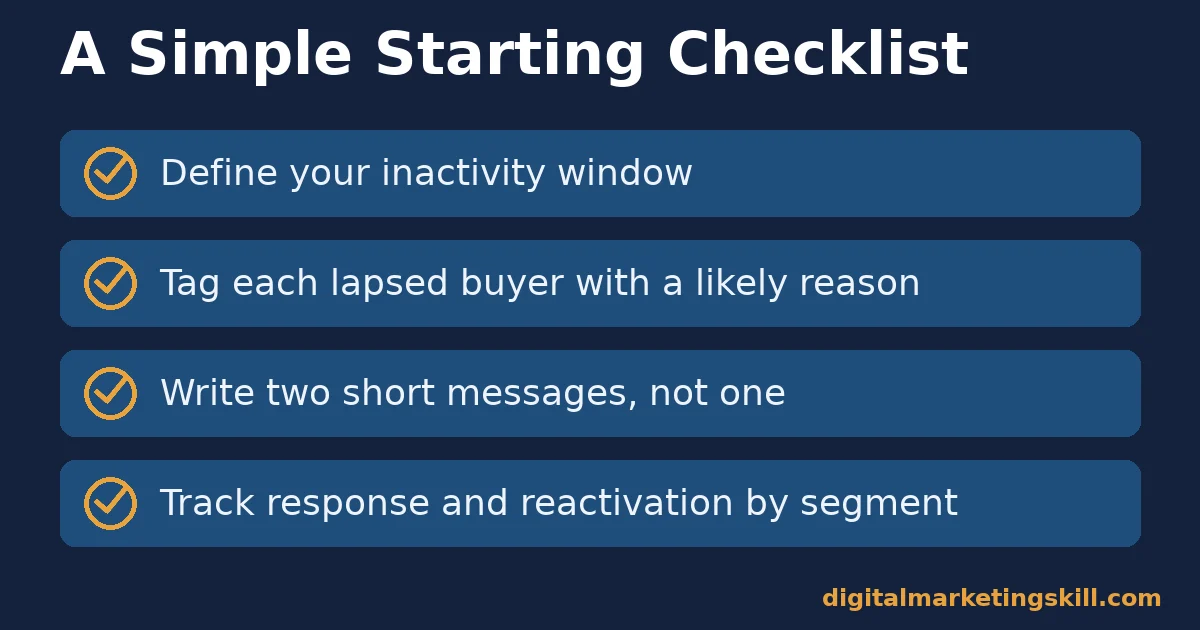
- Define your inactivity window. Pick a gap that fits your typical buying cycle, such as sixty or ninety days without a purchase. Treat anyone past it as lapsed.
- Pull the list and tag a likely reason. Use support tickets, cancellation notes, or the timing of a price change to sort buyers into price-lapsed and service-lapsed groups.
- Write two short messages, not one. Draft a value-led message for the price-lapsed group, and an acknowledgment-led message for the service-lapsed group.
- Track results separately by segment. Compare the two groups after one send. Let the stronger message guide the next round, rather than guessing.
Review the list again after thirty days. New customers will have crossed into your inactivity window. Some people you contacted will have reactivated, so remove them from the lapsed list. Treating this as a standing habit, rather than a one-off campaign, is what turns customer win-back strategies into a repeatable source of revenue.
Frequently Asked Questions About Customer Win-Back Strategies
What is the first step in customer win-back strategies?
Pull the list of customers who have crossed your inactivity window. Then sort them by the likely reason they lapsed, such as price or a specific bad experience, before writing any message. Segmenting first is the step most blanket win-back emails skip.
How long should a business wait before trying to win back a lapsed customer?
Act as soon as a customer crosses your defined inactivity window, rather than waiting for a formal cancellation. Most unhappy customers never complain. A Coveo survey found 56% rarely or never do, so waiting for a complaint means missing most of your lapsed buyers.
Does a discount always work to win back a lapsed customer?
No. It can backfire for customers who left after a bad experience rather than a price objection. Acknowledging the specific problem usually matters more to that group than the size of any offer.
How much does winning back a customer cost compared to acquiring a new one?
Harvard Business Review, citing Bain & Company, found that a new customer costs five to twenty-five times more to acquire than one you already have. Reactivation follows similar economics, because you already hold the customer’s contact and purchase history.
What should a win-back message say to a customer who left over a service problem?
Name the kind of problem plainly, even without their exact case details, and follow it with proof it was fixed. A real example or a tighter guarantee works better than a generic apology. Lead with acknowledgment before any offer.
How do I know if my win-back campaign is working?
Track response rate and reactivation rate for each lapse segment separately. Then check reactivated-customer repeat rate to see whether the real reason they left was actually fixed. A customer who returns once and lapses again signals an unsolved problem.
Should every lapsed customer get the same win-back message?
No. Price-lapsed and service-lapsed customers respond to different messages. Grouping your list by likely reason, even roughly, outperforms one blanket email sent to everyone.
Can a small business run customer win-back strategies without special software?
Yes. A spreadsheet of lapsed customers, a defined inactivity window and two short, differentiated messages cover the basics. Dedicated email tools help at scale, but the segmentation habit matters more than the tool.
Build Customer Win-Back Strategies Into a Repeatable System
Customer win-back strategies work best as an early, segmented habit, not a once-a-year discount blast. Define your inactivity window. Split lapsed buyers by likely reason. Match the message to the reason before you ever offer a discount. Track response rate and reactivated-customer repeat rate, so you can tell a real fix from a short-lived bounce.
If you want to build these skills with guided practice, Digital Marketing Skill Institute teaches them hands-on inside the Master Diploma in Digital & AI Marketing. The programme runs four AI-powered tracks, including AI-Powered Lead Generation and Email Automation and AI-Powered Social Media Management and Advertising. All four total ten courses, with a Full Stack option for completing them together. It includes unlimited 1-on-1 coaching and mentoring, plus a U.S. Project Internship with a verified U.S. Work Reference Letter. It is dual US and UK accredited, and recognised in more than 100 countries.
See our related guides to customer retention strategies for keeping buyers before they lapse, why most customer loyalty programmes fail to pay off, and how to start email marketing for the mechanics of sending segmented campaigns. The programme is fully online, so you can study from anywhere in your country. Browse more guides on the Digital Marketing Skill Institute blog, and when you are ready, apply for the Master Diploma or start from the Digital Marketing Skill Institute homepage.
Every figure in this guide was checked against its original source before publication. Figures marked as illustrative are invented examples, not real results.
![9 Amazing Digital Marketing Skills to Make Money Online [With Proof]](https://digitalmarketingskill.com/wp-content/uploads/2019/07/9-Amazing-Digital-Marketing-Skills-to-Make-Money-Online-With-Proof-17.png)






