Social media content promotion decides whether your best work ever gets read. Most content fails for a simple reason. It never reaches the right feed at the right moment. This guide covers eleven proven tactics, the channels that work, how to measure reach, and one decision rule to use before your next post.
Key Takeaways
- Reach is contested. DataReportal’s global overview report counts 5.66 billion social media user identities worldwide. That is 68.7% of the global population.
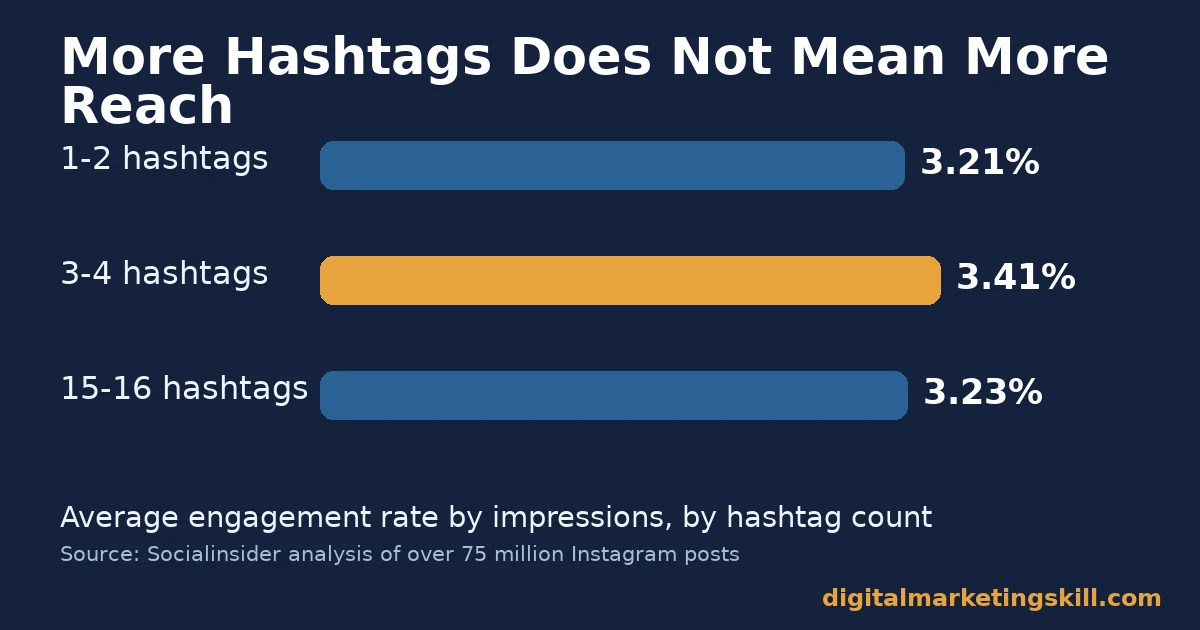
- Hashtag volume is a weak lever. A Socialinsider analysis of over 75 million Instagram posts, reported by YouGov, found three to four hashtags drove the highest engagement rate at 3.41%. One or two hashtags scored 3.21%.
- Timing has a real pattern. Sprout Social’s analysis of billions of social interactions found Tuesdays and Wednesdays, 11 a.m. to 6 p.m. local time, produce the most consistent engagement.
- Most pages are never found. Ahrefs studied roughly 14 billion pages and found 96.55% get no traffic from Google. Promotion decides who sees your content, not publishing alone.
- Recommendations beat ads. A global Nielsen survey of more than 28,000 internet respondents across 56 countries found 92% trust recommendations from people they know above every other form of advertising.
In this guide
- What Most Social Media Promotion Advice Gets Wrong
- How Social Media Content Promotion Actually Works
- What Differs by Promotion Channel
- 11 Tactics That Actually Promote Content on Social Media
- Common Social Media Content Promotion Mistakes
- How to Measure Social Media Content Promotion
- The Most Useful Rule: Promote for the Channel You Are Posting On
- A Four-Week Plan to Build a Promotion Habit
- A Real Case: How Duolingo Built Reach Without Relying on Its Own Feed
- Frequently Asked Questions About Social Media Content Promotion
- Start With Your Next Piece of Content
What Most Social Media Promotion Advice Gets Wrong
Most advice repeats the same three lines. Post more. Use more hashtags. Share everywhere. None of that is false. But it skips the real bottleneck. Billions of other posts compete for the same seconds of attention.
This guide names that gap. Then it shows what actually works for social media content promotion: picking the right channel for each piece, matching format to platform behaviour, and measuring reach with numbers you can act on.
A quick ground rule first. The Socialinsider, Sprout Social and Ahrefs figures below come from large studies of real posts. Read them as evidence from those specific datasets, not universal laws. Treat every number as a snapshot, not a permanent ranking, since platform algorithms change often.
How Social Media Content Promotion Actually Works
At its core, social media content promotion is the bridge between finishing content and someone new seeing it. Without that bridge, strong content sits unseen. Most platforms show only a small fraction of followers your content by default.
Three forces decide whether a post travels. First, the platform’s own distribution algorithm. Second, the audience’s existing trust in you. Third, the match between your content and the format that platform’s users expect. Get one wrong, and the other two cannot fully compensate.
The Algorithm Decides Who Sees It First
Every major platform shows a new post to a small sample of your audience first. It then expands distribution based on how that sample reacts. A slow start caps reach, no matter how good the content is. So the first engagement window matters more than most creators realise.
Existing Trust Decides Whether People Act
Nielsen’s global survey found 92% of consumers trust recommendations from people they know over any advertising. That is why a smaller, engaged following often outpromotes a larger, passive one. Genuine replies and consistent value build that trust over time.
What Differs by Promotion Channel
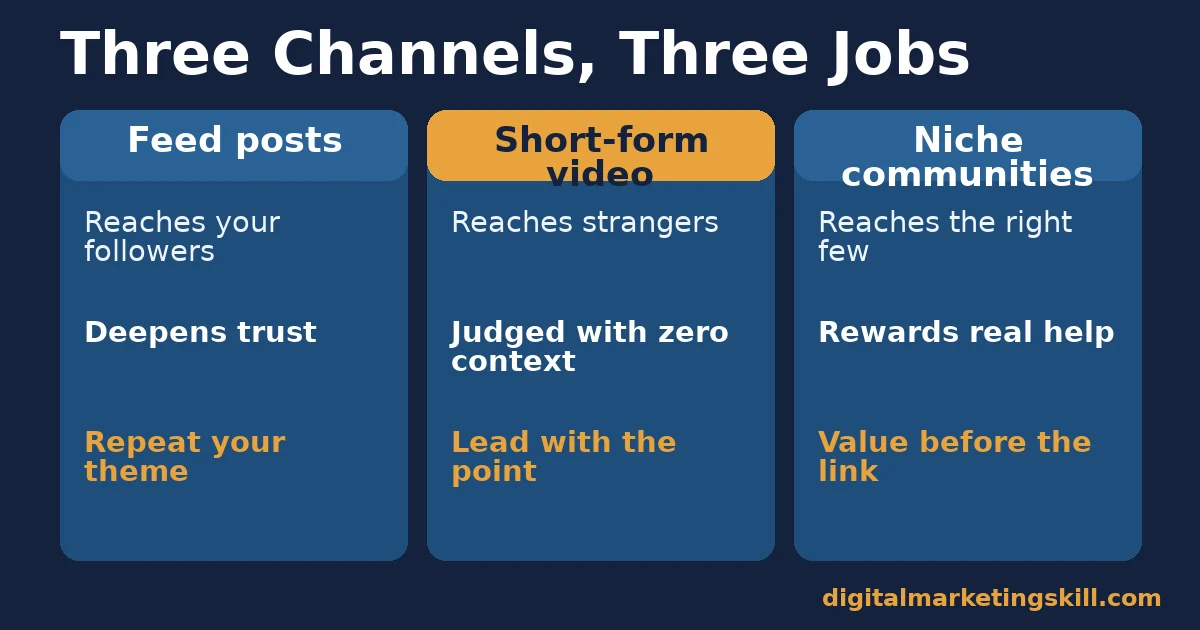
Not every channel promotes content the same way. A feed post, a short video and a niche community each reward a different kind of content. Treat them identically, and you waste the content you already made.
Feed Posts: Built for Familiar Audiences
Feed posts on Facebook, Instagram and LinkedIn mostly reach people who already follow you. They work best for deepening a relationship. Think behind-the-scenes updates, clear takeaways, and direct questions that invite comments.
Feed posts lean on existing trust. The strongest ones repeat a theme your audience already associates with you. A one-off topic that breaks from your usual focus tends to underperform here, even when the content itself is strong.
Short-Form Video: Built for Strangers
Short-form video on TikTok, Instagram Reels and YouTube Shorts gets shown heavily to people who have never followed you. The platform decides based on what they watched before. That makes it the best channel for reaching new audiences. But the content has to work with zero context.
A short video needs a visible point within its first few seconds. Most viewers can swipe away instantly. Content that explains one idea clearly travels further here than content that assumes prior familiarity with your brand.
Niche Communities: Built on Relevance, Not Reach
Groups, forums and topic-specific communities are the least obvious channel for social media content promotion, and they rarely reach millions. But the people inside them are actively looking for exactly your subject. A genuinely useful answer shared in the right community can outperform a much larger broadcast, because the audience fit is almost perfect.
The trade-off is strict moderation. Most communities police self-promotion closely. Content that reads as an advertisement gets removed or ignored. Content that solves a real problem first, with your link as a secondary mention, tends to be welcomed.
11 Tactics That Actually Promote Content on Social Media
The tactics below apply the channel differences above. Use the ones that fit the content you already have. You do not need all eleven on every post.
Five Tactics for Matching Format and Timing
- Match the platform to the content format. Visual, finished work suits Instagram and Pinterest. Data-led or opinion pieces suit LinkedIn and X. Short, demonstrable ideas suit TikTok and Reels.
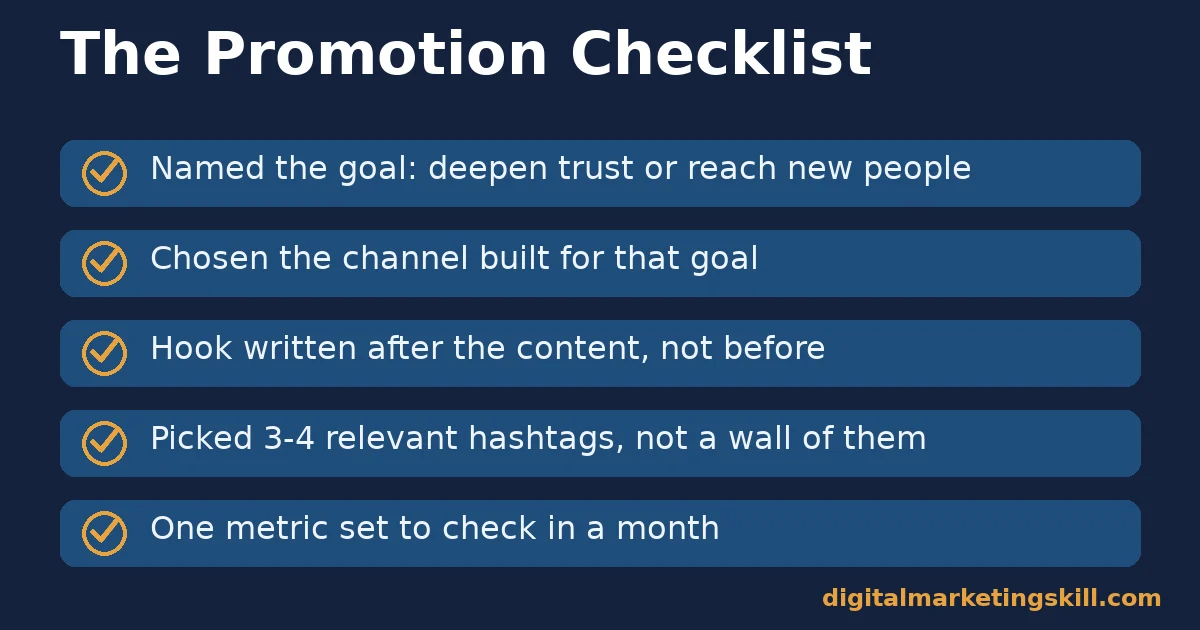
- Write the social post after the content, not before. Pull the single strongest point from the finished piece. Make that the hook, so the destination delivers exactly what was promised.
- Post inside the real engagement window. Sprout Social’s data points to Tuesday and Wednesday afternoons as the most reliable window. Confirm it against your own account’s past performance before relying on it.
- Use a handful of relevant hashtags, not a wall of them. The Socialinsider study of over 75 million posts found three to four well-chosen hashtags outperformed both one or two and a crowded fifteen or sixteen.
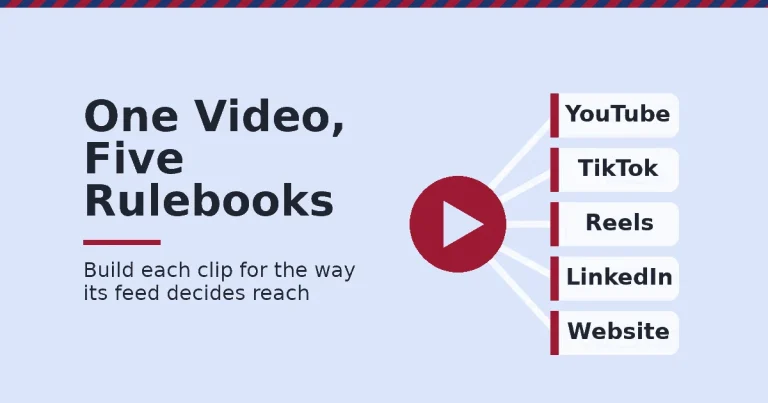
- Repurpose one piece into several native formats. Turn a long article into a short video script, a carousel and a discussion question. Each platform then gets content built for how it actually distributes posts, not the same link pasted three times.
Six Tactics for Involving Other People
- Add social-sharing buttons and a related-posts link. This turns every reader into a potential distributor. It also keeps engaged visitors reading a second piece instead of leaving.
- Work with micro-creators whose audience matches your topic. A smaller, highly relevant audience with real trust in the creator often converts better than a broad, disengaged one.
- Test a small paid budget behind your best organic post. Paid distribution on Facebook and LinkedIn lets you target by interest and behaviour. Boosting a post that already proved itself is safer than guessing with a brand-new one.
- Revisit and repromote your strongest older content. A well-performing piece from months ago can earn a second wave of attention with a fresh angle or format.
- Share inside relevant groups and communities, value first. Answer the actual question being asked. Mention your content only as a natural follow-up, not the headline of your comment.
- Reply to every comment in the first hour. Early engagement signals to most platform algorithms that a post deserves wider distribution. Genuine replies also build the trust that drives future shares.
Common Social Media Content Promotion Mistakes
Even strong content underperforms when promotion repeats the same few mistakes. Check your last five posts against this list before you plan the next round of social media content promotion.
- Posting the same link everywhere, unchanged. A caption built for LinkedIn rarely works on TikTok. Rewrite the hook for each platform’s audience, even when the destination link stays the same.
- Treating every post as a broadcast. Promotion that never replies to comments or asks a question signals to the algorithm, and to real people, that engagement is not wanted. Two-way posts travel further than one-way announcements.
- Chasing virality instead of fit. A post that reaches the wrong audience, even at scale, rarely converts. A smaller, well-matched audience usually produces more clicks, sign-ups or sales than a much larger, mismatched one.
- Ignoring the data from your last ten posts. Each platform shows you reach, engagement and click-through for free. Reviewing that data before planning new promotion is faster and cheaper than guessing again.
- Promoting once and moving on. Most content earns most of its lifetime reach across several promotion windows, not one. A single post that performed well a few weeks ago is often worth a second, differently framed push.
How to Measure Social Media Content Promotion
Likes and shares feel like proof of success. But they do not show whether promotion reached new people or drove a result. The metrics below separate reach from impact. Each is defined in one sentence.
Six Metrics That Show Whether Social Media Content Promotion Is Working
- Reach. The number of unique accounts that saw your post at least once. Rising reach on the same content type shows a channel is working.
- Engagement rate. Total interactions divided by reach or followers. It shows whether the people you reached cared enough to respond.
- Click-through rate. The share of viewers who clicked a link in your post. This number connects promotion to real traffic.
- Referral traffic by platform. Google Analytics shows exactly how many sessions on your site came from each social platform, separating real traffic from vanity metrics.
- New-follower rate. New followers gained per post or per week. A tactic that drives engagement but no new followers is reaching the same people again, not expanding your audience.
- Share-of-voice in a community. How often your content is the one people reference inside a group or forum. It is a rough but useful signal that a niche tactic is building real authority.
Reading These Numbers Together
Review these six numbers monthly rather than after every single post. A single post can spike or flop for reasons unrelated to your strategy, such as a platform outage or an unrelated trending topic crowding feeds. A monthly pattern across ten or more posts is a far more reliable guide to what is actually working.
Start with reach. When reach is flat, the channel or timing is the problem, not the content. When reach is healthy but engagement is low, reconsider the format or the hook instead. And when engagement is strong but click-through stays flat, the post entertains without converting, so add a clearer next step for the social media content promotion to pay off.
Track these numbers by content type, not just by post. Over a month, you will usually see which combination of channel, format and timing drives your strongest promotion results.
The Most Useful Rule: Promote for the Channel You Are Posting On
Take one decision rule from this guide: before you promote a piece of content, decide your goal. Are you deepening trust with an existing audience, or reaching a genuinely new one? Choose the channel and format that matches that goal.
Here is an illustrative example, with invented numbers. A small consultancy publishes one in-depth guide a month. It historically shares the guide once on LinkedIn, reaching about 400 existing connections.
The team then turns the guide into a short video for short-form platforms, and shares one takeaway inside two relevant professional groups. As a result, the same content now reaches roughly 6,000 new accounts across the three channels, with the video driving most of the new reach.
So the lesson is not that video beats everything. Rather, the three channels served three different goals. As a result, splitting one piece across formats built for each channel multiplied its reach, far more than repeating one link everywhere would have for this kind of social media content promotion.
A Four-Week Plan to Build a Promotion Habit
You do not need new tools to improve social media content promotion. This plan takes about an hour a week and works with whatever platforms you already use.
- Week one: audit your last ten posts. List their reach, engagement rate and click-through rate. Note which channel, format and time produced the strongest numbers.
- Week two: match content to channel. For your next three pieces of content, assign each one to the channel built for its goal, feed, short-form video or community, based on the audit.
- Week three: build the promotion sequence. For each post, write the hook last, choose three to four relevant hashtags, and schedule it inside your platform’s real engagement window.
- Week four: add the follow-up. Reply to every comment within the first hour, then revisit the post two weeks later to decide whether it deserves a second promotion push.
At the end of the month, compare reach and engagement rate with the month before. Keep whatever moved the numbers, and repeat the plan with the next ten posts. This steady cycle builds social media content promotion into a habit rather than a scramble before each launch.
A Real Case: How Duolingo Built Reach Without Relying on Its Own Feed
Duolingo’s social media team built content specifically for a platform’s distribution behaviour, not for an existing follower base. According to an interview with the brand’s global social media manager in The Drum, the brand’s TikTok account grew from around 50,000 followers to roughly 16 million over a little over four years.
The team’s own account of the strategy, reported in Contagious, describes content built around recurring characters and cultural moments, not product promotion. The team approves and publishes its own posts within an hour of an idea, so content stays relevant to that day’s platform conversation.
Treat this as a model for channel-specific thinking, not a universal result. The figures are self-reported in interviews, not published in an audited report. Duolingo is a large brand with a dedicated team. A strategy built for TikTok will not transfer directly to LinkedIn or a niche B2B community.
Frequently Asked Questions About Social Media Content Promotion
What is social media content promotion?
Social media content promotion is the deliberate work of getting existing content in front of a wider audience. This happens through posts, ads, communities and creator partnerships, rather than publishing and hoping it is found.
Which social media platform is best for promoting content?
It depends on the content and the goal. Feed-based platforms like Facebook, Instagram and LinkedIn suit deepening trust with an audience you already have. Short-form video on TikTok, Reels and Shorts reaches people who have never followed you.
How many hashtags should I use to promote content?
A Socialinsider study of more than 75 million Instagram posts found three to four relevant hashtags produced the strongest engagement rate. There was little benefit from using many more. Relevance matters more than quantity.
What is the best time to post for maximum reach?
Sprout Social’s research points to Tuesday and Wednesday afternoons, local time, as the most consistently strong window. But your own account’s past performance is a more reliable guide than any general benchmark.
Does repurposing old content still work for promotion?
Yes. Revisiting a strong older piece with a new format or a connection to a current conversation can earn it a fresh wave of reach, without the cost of creating something new.
Do I need to pay for ads to promote content on social media?
No. But a small paid budget behind content that already performed well organically can extend its reach efficiently. You are backing a result you have already seen, not guessing.
How do I know if my social media promotion is working?
Track reach, engagement rate, click-through rate and new-follower rate together. When reach is flat, fix the channel or timing. When engagement is low, fix the content or hook instead. And when clicks stay flat even so, add a clearer next step.
Should I promote the same piece of content more than once?
Yes. A single promotion window rarely reaches everyone who would value the content. Reshare a strong piece with a new angle, a different format or a seasonal connection, spaced weeks apart, rather than treating one push as the only chance it gets.
Does the size of my following matter for social media content promotion?
Less than most people assume. The Duolingo case above shows large followings are built, not inherited, and the Nielsen trust data shows people act on recommendations from people they know and trust, not necessarily the account with the most followers. A smaller, engaged audience that trusts you can outpromote a larger, passive one.
Start With Your Next Piece of Content
Social media content promotion works best when you plan it before you publish, not after. Pick your next piece of content. Decide if the goal is deepening trust or reaching new people, then choose the channel and format to match.
For the groundwork that makes a piece worth promoting, see our guide to building a content marketing strategy. For keeping every post’s quality consistent, read our guide on what makes content genuinely high quality. And for a full distribution plan beyond organic social, see our guides to content distribution channels and paid media.
For guided, hands-on practice building and promoting content like this, Digital Marketing Skill Institute teaches it inside the Master Diploma in Digital & AI Marketing. The programme runs four AI-powered tracks, including AI-Powered Social Media Management and Advertising, built from ten execution-first courses, with a Full Stack option to complete all four.
It also includes unlimited 1-on-1 coaching and mentoring, plus a U.S. Project Internship with a verified U.S. Work Reference Letter. And it is dual US and UK accredited, recognised in more than 100 countries.
The programme is fully online, so you can study and apply these skills from anywhere in your country. Explore more guides on the Digital Marketing Skill Institute blog, and when you are ready, apply for the Master Diploma or start from the Digital Marketing Skill Institute homepage.
Every figure in this guide was checked against its original source before publication. Figures marked as illustrative are invented examples, not real results.