
A digital marketing career is worth pursuing because demand keeps rising, and the field stays open without a traditional degree. Marketing manager roles are projected to grow 6% over the next decade in the United States, faster than average (BLS). This guide shows the roles inside the field, how to pick one, and how to prove you are ready.
Key Takeaways
- Demand is genuinely rising. Marketing manager roles are projected to grow 6% over the next decade in the United States, faster than the average for all occupations (BLS).
- Pay can be strong. The median annual wage for marketing managers in the United States is $166,790 (BLS).
- The market keeps expanding. Global digital advertising spending is forecast to exceed $950 billion (Statista).
- The audience is worldwide. More than 6 billion people are online globally, so a digital marketing career is not limited to one country or language (DataReportal).
- Freelancing is a real path. 38% of skilled US knowledge workers now freelance, up from 28% a year earlier (Upwork).
In this guide
- Why “Is It Worth It” Questions Miss the Real Picture
- How a Digital Marketing Career Actually Works
- The Roles Inside a Digital Marketing Career
- Common Mistakes People Make Choosing a Digital Marketing Career
- How to Start Building Each Path
- How to Measure Whether Your Digital Marketing Career Is Paying Off
- The One Rule: Build Proof Before You Apply
- A Real Case: Skilled Freelancing Is Growing
- Your Next Step
- Frequently Asked Questions About a Digital Marketing Career
Why “Is It Worth It” Questions Miss the Real Picture
Most answers to “should I start a digital marketing career” are either a blanket yes or a blanket no. Neither is useful. A digital marketing career is worth it for some roles and situations. It is a poor fit for others. The difference usually comes down to what you actually enjoy doing day to day, not the job title.
This guide treats that gap directly. The figures below come from named sources. Each one has its own scope. Some are US government data. Some are global market forecasts. Treat every number as a snapshot, not a guarantee for your own results. Check the source notes before you act on any single figure.
Honesty matters here too. US marketing job postings on Indeed were still about 25% below their pre-pandemic baseline, according to a Federal Reserve Bank of St. Louis data series that tracks Indeed’s postings. So a digital marketing career is not a guaranteed easy hire right now. The longer-range outlook still stays positive. Both facts can be true at once, and a careful plan accounts for both.
How a Digital Marketing Career Actually Works
A digital marketing career is built on one core skill: using digital channels to move a stranger toward becoming a customer, then proving it happened. That proof is what separates marketing from most other creative fields. You can usually show a number for your work, not just an opinion.
That measurability is also why a digital marketing career scales well. A business of any size needs the same core functions, whether it sells software or coffee. You can build a digital marketing career inside one company, across many clients as a freelancer, or somewhere between the two.
Because of that flexibility, no two digital marketing careers look identical. One person spends a decade inside a single company, moving from specialist to manager. Another serves ten small clients at once and never takes a traditional job. Both are valid versions of the same underlying career.
Two Forces Driving Demand
Demand backs this up. Marketing manager roles are projected to grow 6% over the next decade in the United States, faster than the average for all occupations, according to the US Bureau of Labor Statistics. That is one country’s data. The underlying driver, rising digital ad spend, is global.
Related specialist roles show an even sharper trend. The US government’s own O*NET occupational database rates market research analysts and marketing specialists as “much faster than average” growth, with about 82,000 projected openings over the decade. That is a second, independent US data point pointing the same direction as the broader marketing manager figure above.
Global digital advertising spending is forecast to exceed $950 billion, according to Statista’s internet advertising research. Every dollar in that figure funds a role somewhere in a digital marketing career path, from strategy down to execution.
Reach matters as much as spend. More than 6 billion people are online worldwide, according to DataReportal’s global digital research. That scale is why a digital marketing career rarely depends on one local market. Clients and employers exist almost anywhere there is an internet connection, which is also why so many people now treat this as a genuinely international career rather than a local trade.
What the AI Shift Means for Demand
AI tools now draft copy, summarise data and suggest campaign ideas in seconds. That has not removed the need for marketers. Someone still has to direct the tools, judge the output and connect it to a real customer need, and that judgment is harder to automate than the drafting step.
That shift changes which skills matter most inside a digital marketing career. Mechanical tasks, like drafting a first version of an email or resizing an image, increasingly happen faster with AI assistance. Judgment tasks, like deciding what to say and to whom, still need a person.
Build your career around the second category. Treat AI tools as a way to do the first category faster, not as a replacement for strategy. People who make that shift tend to stay valuable longer than people who only learned to execute one tool.
The Roles Inside a Digital Marketing Career
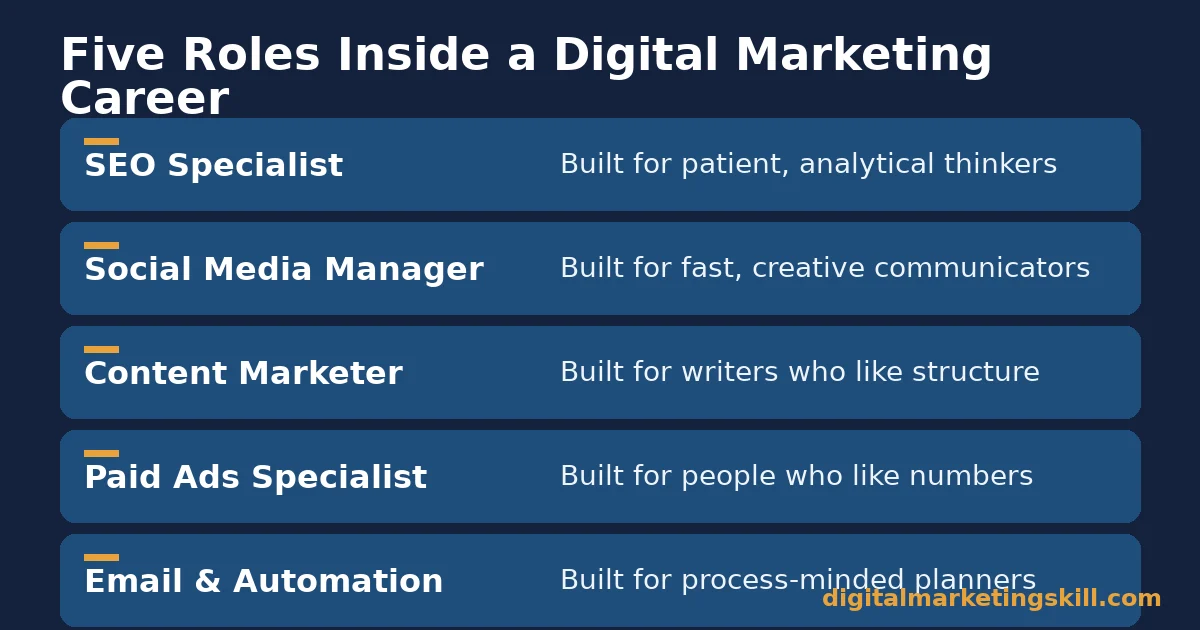
A digital marketing career is not one job. It is a set of roles, and each one suits a different kind of person. Pick based on the work itself, not only the title. If you are still unsure where you fit, our guide on finding your digital marketing niche walks through a simple way to narrow the choice.
SEO Specialist: Built for Patient, Analytical Thinkers
An SEO specialist improves how a website ranks in search results. The work rewards patience, because results take months. It also rewards analytical thinking, because you are testing hypotheses against data. If you like solving a puzzle slowly, this role suits a digital marketing career focused on search.
Social Media Manager: Built for Fast, Creative Communicators
A social media manager plans and runs a brand’s presence across platforms. The work moves fast and rewards a creative, conversational voice. If you enjoy reacting to trends and writing for an audience daily, this path fits a digital marketing career built around community. Our step-by-step guide on how to become a social media manager covers the exact skills employers look for in this role.
Content Marketer: Built for Writers Who Like Structure
A content marketer plans, writes and distributes content that answers real customer questions. The work rewards clear writing and a structured approach to planning. This role suits a digital marketing career for people who like research and long-form thinking, more than quick reactive posts.
Paid Ads Specialist: Built for People Who Like Numbers
A paid ads specialist manages budgets across platforms like search and social advertising. The work rewards comfort with spreadsheets and quick decisions, because budgets shift daily. This role suits a digital marketing career for people who enjoy measurable, fast feedback over slower, longer-term projects.
Email and Automation Specialist: Built for Process-Minded Planners
An email and automation specialist builds the sequences that turn a new contact into a repeat customer, without a person sending each message by hand. The work rewards planning ahead and testing small changes carefully. This role suits a digital marketing career for people who like designing a system once, then watching it run.
These five roles are not the only ones. Analytics, conversion optimisation and marketing operations each support a distinct digital marketing career path too. Most people end up combining pieces of more than one role as they grow, rather than staying in a single lane forever.
Common Mistakes People Make Choosing a Digital Marketing Career
Before you pick a path, check whether one of these mistakes applies to you. Each one is common. Each one is also fixable once you notice it.
Learning Without Building a Portfolio
Courses and certificates teach concepts. They rarely prove you can apply them. A digital marketing career needs visible proof, such as a real campaign, a personal blog’s traffic growth, or a documented case study, not just a certificate on a resume.
Learning Only One Skill
Specialising too early, before you know which role fits you, can box you in. Most strong digital marketing career paths start broad. They cover SEO, content, social and paid channels together, then narrow once you find your strength.
Ignoring Whether the Daily Work Fits Your Personality
A high salary means little if the daily tasks drain you. Someone who dislikes writing should not force a content marketing career just because it pays well. A different role inside the same digital marketing career path will usually fit better and produce stronger results.
Applying Without Any Measurable Result to Show
Employers increasingly want evidence, not only a resume. A single, honestly documented result, like a 20% traffic increase on a practice website, can matter more than an extra certificate when you are starting a digital marketing career. If formal work experience feels out of reach, our guide on landing a digital marketing internship covers routes that do not require a prior job.
Ignoring How AI Is Changing Day-to-Day Work
Treating AI tools as optional is a growing mistake. Employers increasingly expect comfort with AI-assisted research, drafting and analysis as a baseline skill, not a bonus. A digital marketing career built only on manual execution will age faster than one built on judgment plus AI fluency.
How to Start Building Each Path
Knowing the roles only helps once you start doing the work. These moves mirror the four roles above, one practical first step for each.
SEO Specialist: Lead With One Ranked Page
Pick one low-competition keyword and rank a single page for it, even on a personal site. One real ranking, documented with before-and-after screenshots, proves more than a course certificate for this branch of a digital marketing career.
Social Media Manager: Lead With One Growing Account
Run one account, your own or a volunteer project, for three months with a consistent schedule. Growth numbers, even modest ones, show you can execute. That matters more than follower count alone.
Content Marketer: Lead With Three Published Pieces
Write three pieces that each answer a real question your target reader has. Publish them anywhere, your own blog or a guest spot, and track how people respond. Three finished pieces beat ten unfinished drafts.
Paid Ads Specialist: Lead With a Small Test Budget
Run a small test campaign, even a modest personal budget, and document what you changed and why. Being able to explain a decision, not just report a result, is what interviewers for this digital marketing career path actually test for.
Email and Automation Specialist: Lead With One Working Sequence
Build one welcome sequence, even for a practice project or a friend’s small business, and track how many people complete it. One working sequence, with real open and click numbers attached, shows more than a list of email platforms you have used.
How to Measure Whether Your Digital Marketing Career Is Paying Off
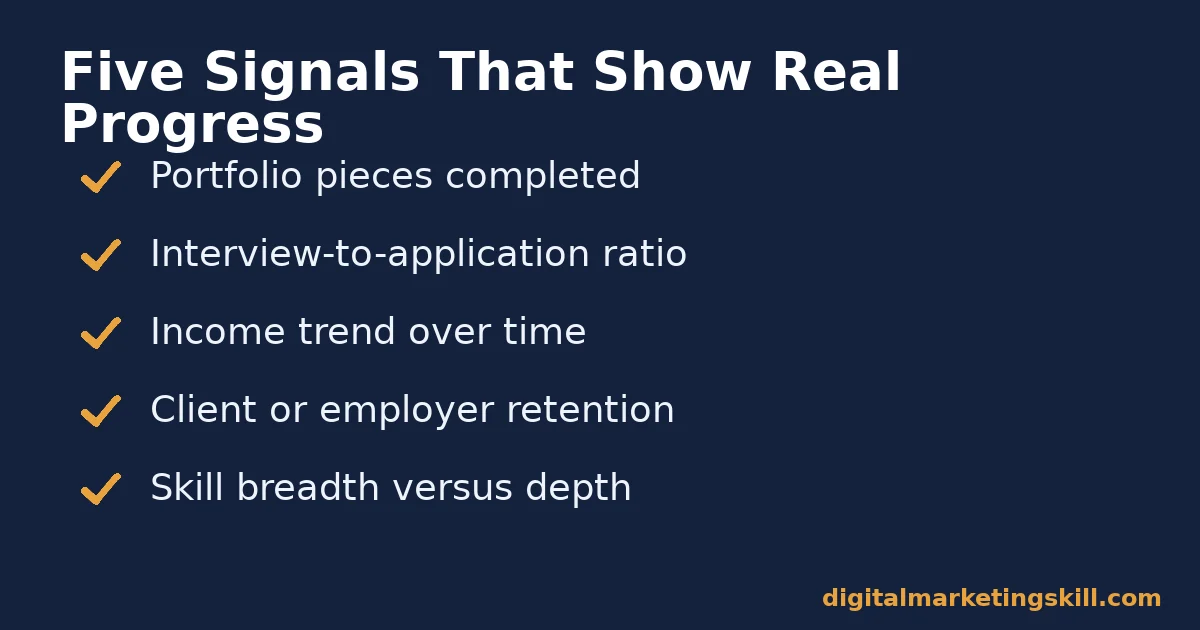
Busy learning is not the same as career progress. These five signals show whether your digital marketing career is actually moving forward, instead of just staying busy.
- Portfolio pieces completed. The number of finished, documented projects you can show, not courses started. Aim for steady growth, not a single burst.
- Interview-to-application ratio. The share of applications that lead to an interview. A rising ratio means your portfolio and positioning are working.
- Income trend. Your earnings over time, whether salaried or freelance, tracked every few months rather than compared month to month.
- Client or employer retention. Whether clients renew or employers extend your role. This signals real, repeated value, not just a single good pitch.
- Skill breadth versus depth. Whether you are deepening one role or still spread thin across many. Either can work, but you should know which one you are doing on purpose.
Reading the Signals Together
Read these five together, not one at a time. A rising interview ratio with flat income usually means your pricing or negotiation needs work, not your portfolio.
Falling retention with strong new client flow usually points to delivery, not marketing. That pattern is exactly the kind of thing a growing digital marketing career needs to catch early, before it quietly shrinks your income.
The One Rule: Build Proof Before You Apply
If you follow only one idea here, use this one: build one piece of visible proof before you apply for your first role. A certificate shows you studied. A documented result shows you can actually work.
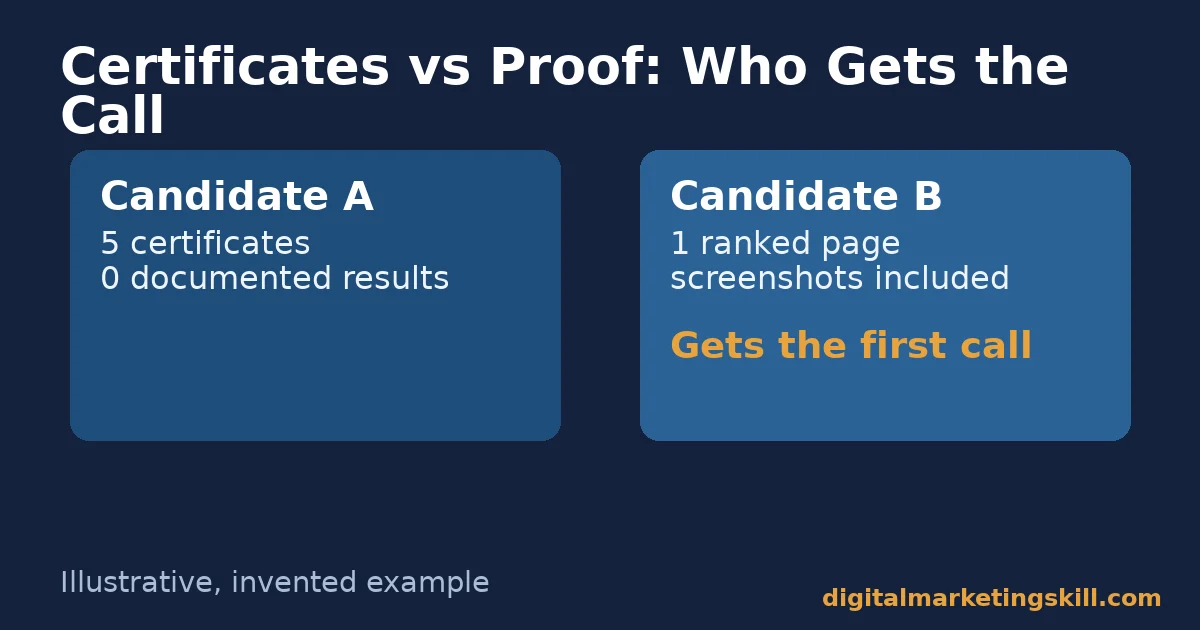
Here is an illustrative, invented example. Say two candidates apply for the same junior role. Candidate A lists five certificates and no results. Candidate B shows one blog post that reached page one of search results for its target keyword, with screenshots.
Most hiring managers call Candidate B first. The proof answers the real question: can this person get results. This rule applies at every stage of a digital marketing career, not just the first job.
Therefore, before you send your next application, pause and ask what proof you are attaching. If the honest answer is “none yet,” spend one week building a single small, documented result instead of sending ten more applications with the same resume.
A Real Case: Skilled Freelancing Is Growing
Upwork’s Future Workforce Index found that 38% of skilled US knowledge workers now freelance, up from 28% a year earlier, with marketing named among the in-demand skill categories, according to Upwork’s own research.
This is self-reported survey data from a freelance platform, and it covers the United States only. Read it as directional rather than a global guarantee.
The underlying pattern still matters. A growing share of skilled professionals, including marketers, now build income outside a single full-time employer. That trend supports a digital marketing career built on multiple clients rather than one job. Our guide on transitioning from a full-time job to freelancing covers the practical steps for making that switch safely.
Your Next Step
You do not need to master every role to start a digital marketing career. Pick one path that matches your personality. Build one piece of visible proof. Track the five signals above every few months.
If you want structured, practical training to build that proof faster, the Master Diploma in Digital & AI Marketing from Digital Marketing Skill Institute is built from ten execution-first courses across four AI-powered tracks: AI-Powered Social Media Management and Advertising, AI-Powered Google Specialist, AI-Powered WordPress and SEO Specialist, and AI-Powered Lead Generation and Email Automation, with a Full Stack option for completing all four.
Every track includes unlimited 1-on-1 coaching and mentoring, a U.S. Project Internship with a verified U.S. Work Reference Letter, and dual US and UK accreditation recognised in more than 100 countries. The program is 100% online, so you can build a digital marketing career from anywhere in your country.
Explore the full Master Diploma program structure, browse more guides on the Digital Marketing Skill Institute blog, or read student reviews before you apply. You can start today at https://digitalmarketingskill.com/, wherever you live.
Frequently Asked Questions About a Digital Marketing Career
Is a digital marketing career still worth it?
Yes, for people who enjoy measurable, fast-moving work. Demand keeps rising and the field stays open to people without a traditional degree. It still rewards those who build visible proof of results, not only certificates.
Do I need a degree to start a digital marketing career?
No. Most employers and clients care more about demonstrated results than formal education. A documented project or campaign often carries more weight than a degree alone.
Which role in a digital marketing career pays the most?
It varies by company, location and experience, so there is no single highest-paying role. Paid advertising and SEO leadership roles often command strong pay, because they are tied directly to measurable revenue.
How long does it take to start a digital marketing career?
Many people land a junior role within three to six months of focused learning and portfolio building. This varies by prior experience and how much time you can commit each week.
Can I build a digital marketing career as a freelancer?
Yes. A growing share of skilled professionals now freelance, and marketing is consistently named as one of the most in-demand freelance skill categories.
What skills matter most early in a digital marketing career?
Start with one channel, such as SEO, content or paid ads, and learn it well enough to produce one real, documented result. Breadth matters later. Depth in one area matters first.
Is digital marketing a stable career?
It is more stable than many creative fields, because the underlying skill, measurable persuasion, transfers across industries and company sizes. Specific tools and platforms change often, so ongoing learning is part of the job.
Is AI making a digital marketing career riskier?
AI changes the tools, not the underlying goal. It can draft content and analyse data faster, but someone still has to set strategy, judge quality and understand the customer. A digital marketing career that leans on judgment, not just execution, stays valuable as the tools change.
Can I switch into a digital marketing career from an unrelated field?
Yes, and many people do. Skills from teaching, sales, customer service and writing all transfer into a digital marketing career, because each one trains communication and understanding an audience. The portfolio-first approach in this guide works especially well for a career switch, since it lets your work speak for itself instead of your previous job title.
Every figure in this guide was checked against its original source before publication. Figures marked as illustrative are invented examples, not real results.
![9 Amazing Digital Marketing Skills to Make Money Online [With Proof]](https://digitalmarketingskill.com/wp-content/uploads/2019/07/9-Amazing-Digital-Marketing-Skills-to-Make-Money-Online-With-Proof-17.png)






