
Digital marketing benefits reach past likes and clicks. They show up as cheaper customer acquisition, faster testing and measurable revenue. A small retailer can track a sale back to one ad, then cut what fails within days. This guide names the specific benefits, shows where each is strongest, and shows how to measure it.
Key Takeaways
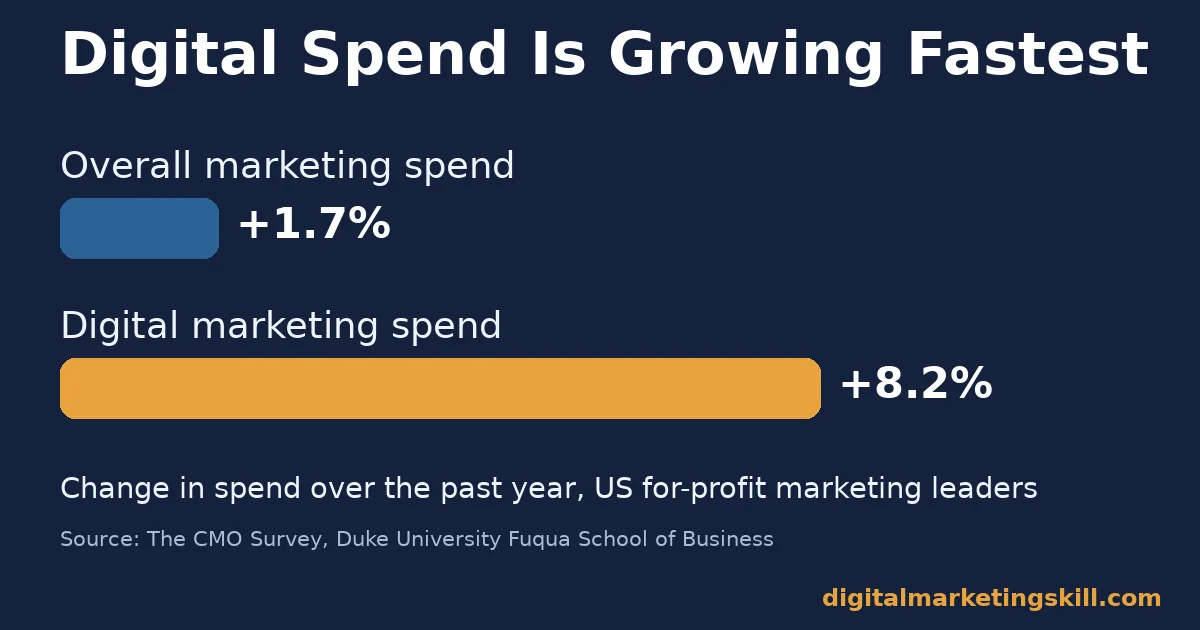
- Budgets are shifting fast. The CMO Survey found overall marketing spend rose 1.7% over the past year. Digital marketing spend rose 8.2% in the same period, nearly five times faster.
- Most small businesses already feel the pull. Meta’s Global State of Small Business report found 77% of surveyed small businesses increased their use of digital tools. 2 in 5 surveyed consumers discovered a small business through a social media ad, page or post.
- Cost is still the main benefit. LocalIQ’s cross-industry benchmark puts the average cost per lead from search ads at $66.69, with an average conversion rate of 8.18%.
- Few small businesses measure what matters. SurveyMonkey’s research found 62% of surveyed US small business owners said they never survey their own customers.
- Knowledge, not budget, is the real gap. The OECD’s D4SME survey of small firms found digital marketing and SEO was the most urgent training need, named by 42% of respondents.
In this guide
- What Most Digital Marketing Benefits Advice Gets Wrong
- Why Digital Marketing Changes the Economics of Growing a Business
- Digital Marketing Benefits Differ by Channel
- How to Get the Benefit From Each Channel
- Five Underrated Digital Marketing Benefits Beyond More Traffic
- How to Measure Digital Marketing Benefits You Are Actually Getting
- The Most Useful Rule: Fund What You Can Measure
- A Four-Week Plan to Capture These Digital Marketing Benefits
- A Real Case: Turning a Small Ad Budget Into Tracked Revenue
- Frequently Asked Questions About Digital Marketing Benefits
- Start With One Channel, Measure It, Then Expand
What Most Digital Marketing Benefits Advice Gets Wrong
Most lists of digital marketing benefits repeat the same lines. Digital marketing is cheap. It reaches everyone. It builds your brand. None of that is false. But it skips the part that actually changes a small business’s numbers: how fast you can test, measure and redirect spend toward what works.
This guide names the digital marketing benefits that move revenue. It shows where each is strongest by channel, and gives you metrics that prove whether you are getting them. Here are the limits too. The CMO Survey covers only US for-profit firms. Meta’s report is self-reported by the businesses surveyed. The three-channel comparison below is an informed framework, not a settled ranking. Treat every figure as a snapshot, not a permanent fact.
Why Digital Marketing Changes the Economics of Growing a Business
The CMO Survey, run out of Duke University’s Fuqua School of Business, tracks exactly this shift among US marketing leaders. Traditional advertising sells attention in bulk. A billboard or a print ad reaches everyone who passes, whether or not they want what you sell. Digital marketing sells attention by intent and interest instead, so a small business pays mostly for people who already fit its customer profile.
That shift changes two things at once: who you reach, and how fast you find out whether reaching them paid off. Both changes are digital marketing benefits a billboard cannot offer.
Targeting Replaces Guessing
Search and social platforms let you define an audience by what people search for, where they are, and what they have already shown interest in. A local service business can show ads only to people within a set distance who searched for that exact service.
That is one of the clearest digital marketing benefits: you stop paying to reach an entire city. Getting it right starts with work most businesses skip. Our guide to how to identify your target audience covers the difference between a market and an audience, before you set any targeting.
This is why small businesses with limited budgets can still compete. Meta’s Global State of Small Business report, produced with the OECD and World Bank, found 2 in 5 surveyed consumers discovered a small business through a social media ad, page or post. That route barely existed for small advertisers before targeted platforms.
Measurement Is Built In, Not Bolted On
A newspaper ad cannot tell you which reader bought something. A search ad, a social ad and an email campaign can. Each click, view and purchase is logged and attributable. That single difference is what lets a small business cut a failing campaign in a week instead of a quarter.
The OECD’s D4SME survey of small and medium enterprises found that 39% of respondents already use AI applications in their operations. It also found that digital marketing and SEO was the single most urgent training need, named by 42% of respondents overall and 51% in retail.
The gap most small businesses face is not access to the tools. It is knowing how to read what the tools report. Our guide to building a martech stack your team will actually use covers how to avoid collecting tools nobody reads.
Digital Marketing Benefits Differ by Channel
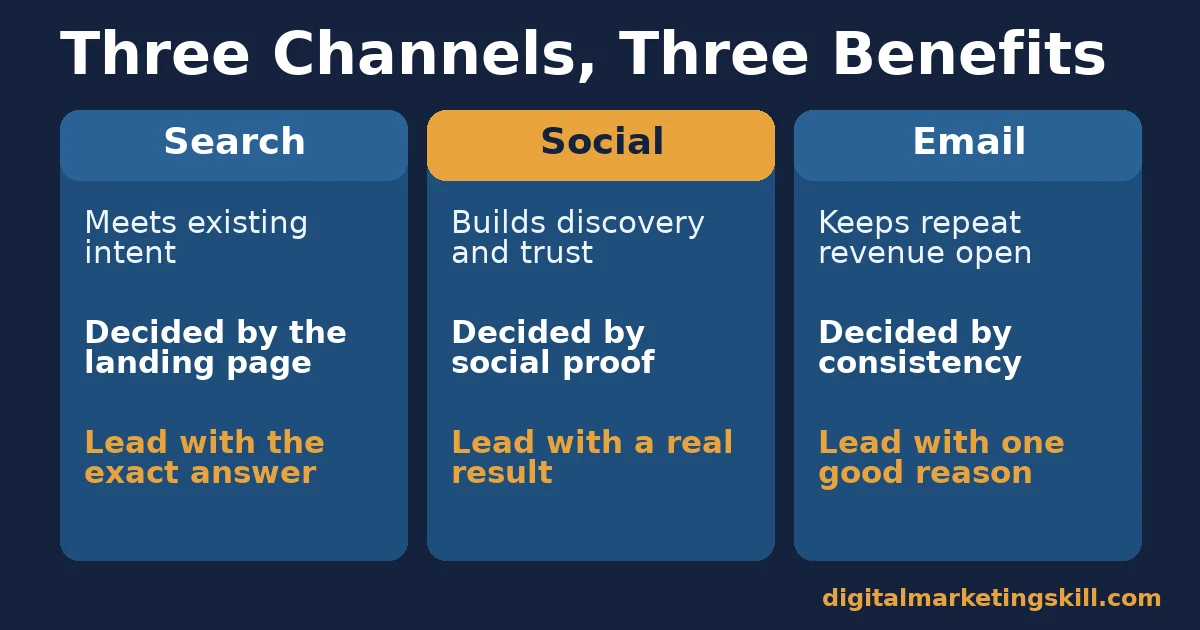
Not every digital channel delivers the same benefit. Search captures people who are already looking for a solution. Social reaches people who were not looking, but who notice and remember you. Email keeps a channel open to people who already bought once. Each one earns its budget differently.
Search: Built For People Already Looking
Search ads and search engine optimisation both meet a buyer at the moment of intent, when they are actively typing a question into a search bar. That timing is why LocalIQ’s cross-industry benchmark, built from data across thousands of advertiser accounts, reports an average conversion rate of 8.18% for search ads. The same benchmark puts the average cost per lead at $66.69 and the average click-through rate at 6.64%.
The catch is competition. That same intent that makes search valuable also makes popular keywords expensive. So search works best when paired with content that earns free, organic visibility over time, rather than relying on paid clicks alone. Our guide to building a content marketing strategy covers how to build that organic side.
Social: Built For Discovery and Trust
Social platforms reach people before they know they have a need. That makes them the main discovery channel for small businesses. The same Meta report found 77% of surveyed small businesses had increased their use of digital tools, with social platforms among the most common entry points.
Trust compounds here too. Research on user-generated content cited by HubSpot found 79% of people say content created by other customers highly impacts their purchasing decisions. 60% consider it the most authentic form of marketing. A small business with real customer photos and reviews on its social pages is borrowing exactly that kind of trust.
Email: Built For Repeat Revenue
Search and social both have to win a stranger’s attention each time. Email keeps a line open to someone who already said yes once. That is why industry estimates compiled by Omnisend put average email marketing return at roughly $36 to $42 per $1 spent. The travel and hospitality sector reports figures near the top of that range.
That return depends on the list staying engaged, not just existing. A list that never hears from you decays fast, and so does a list that hears from you too often with nothing useful. Email’s benefit is really a benefit of consistency, not a one-time setup.
How to Get the Benefit From Each Channel
Knowing what each channel is built for is only half the work. The sections below mirror the three channels above, with the specific move that captures the benefit rather than just the spend.
Search: Lead With Intent-Matched Pages
Send search traffic to a page that answers the exact query, not a generic homepage. Unbounce’s benchmark across 41,000 landing pages found a median conversion rate of 6.6%. Email traffic sent to a landing page converted at 19.3%, the highest of any channel it measured, because that traffic already arrived with context.
Keep the form short, because HubSpot’s research across tens of thousands of customer landing pages found three-field forms converting at over 25%, compared with about 21% at five fields. So every extra field you cut is a direct lift in conversion.
Social: Lead With Proof, Not Just Reach
Reach alone does not convert. Pair every social post that asks for action with a specific proof point: a real result, a real customer, or a specific number, rather than a generic claim. That fits the 79% figure above on how much customer-created content shapes buying decisions.
Post consistently rather than in bursts. HubSpot’s State of Marketing research names “producing consistent, good content” as the top social media challenge for more than half of marketers surveyed. The businesses that solve it have a real, lasting edge over ones that post only when they remember to.
Email: Lead With a Reason to Stay Subscribed
Every email should give the reader one reason it was worth opening: a genuine discount, a useful tip, or news they asked for. Judge your list by click rate on real offers, not open rate alone. Privacy features on major email clients already distort how opens are counted.
Segment before you send. A list split by what someone already bought, or what page they visited, lets you send fewer, more relevant emails. That beats one broad blast that most subscribers ignore.
Five Underrated Digital Marketing Benefits Beyond More Traffic
Most small businesses chase traffic first. These five digital marketing benefits matter just as much. They are easier to miss because they do not show up as a single headline metric.
- Faster course-correction. A failing digital campaign can be paused in a day. A failing print run or billboard runs for its full term regardless of results.
- Lower cost of entry. You can test a new audience or offer with a few dollars of ad spend before committing a full campaign budget.
- Compounding content. HubSpot’s own blog data found that posts published some time ago, not new ones, generate 38% of its total blog traffic. Useful content keeps earning long after you publish it.
- Direct customer feedback. Comments, replies and open rates show what customers actually think, in their own words, often before a formal survey would surface the same issue.
- A documented record of what works. Every campaign leaves data behind. A new hire or a new owner can see which channels and messages performed, rather than relying on memory.
Which Benefit to Chase First
If you are deciding where a limited budget should go first, our guide to small business digital marketing and where to spend first walks through that sequencing.
Start with the digital marketing benefit your business lacks most. A business burning cash on unmeasured ads needs faster course-correction before anything else. A business with no customer insight needs direct feedback more than a bigger budget. SurveyMonkey’s research found 62% of surveyed small business owners never survey their own customers. For most small businesses, that second gap is the one actually holding growth back.
How to Measure Digital Marketing Benefits You Are Actually Getting
Each benefit above has a matching metric. Track these alongside the sales figures you already review. Treat any metric you cannot define in one sentence as one you should stop reporting.
Five Metrics That Separate Real Growth From Noise
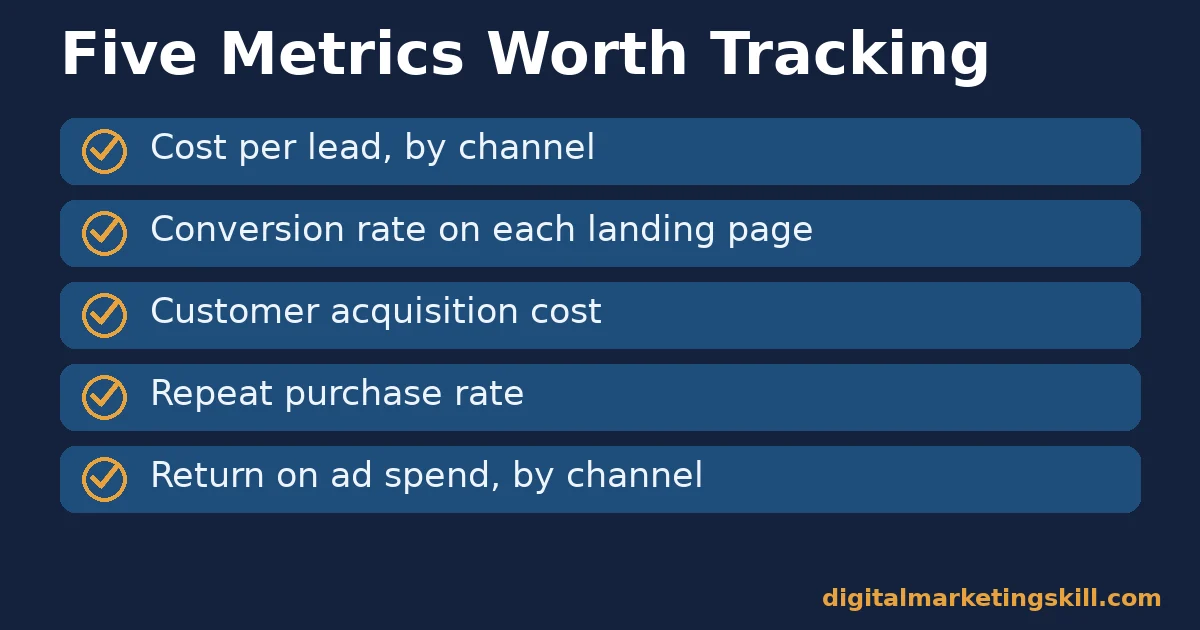
- Cost per lead. Total channel spend divided by the number of qualified leads it produced. Compare it with LocalIQ’s cross-industry average of $66.69 only as a rough guide, since costs vary by industry.
- Conversion rate. The share of visitors or leads who complete the action you wanted, such as a purchase or a booking. A rate well below your channel’s typical range usually points to the page, not the traffic.
- Customer acquisition cost. Total marketing and sales spend divided by new customers gained in the same period. So rising acquisition cost with flat revenue per customer is an early warning sign.
- Repeat purchase rate. The share of customers who buy a second time within a set period. This is the clearest sign that email and loyalty efforts are working.
- Return on ad spend. Revenue generated divided by what you spent to generate it. Track it per channel, not as one blended number. For more ways to lift this number, see our lead generation tips that actually increase ROI.
Reading the Metrics Together
Read cost per lead and conversion rate together first. A low cost per lead with a low conversion rate often means the traffic is cheap but poorly matched. That points back to targeting, not budget. A high cost per lead with a strong conversion rate can still be a good trade, if the customer’s lifetime value supports it.
Then check repeat purchase rate separately from acquisition metrics. A business can look healthy on new customer numbers while losing money, if those customers never return. Digital channels make that number visible, while traditional advertising rarely does.
The Most Useful Rule: Fund What You Can Measure
If you take one decision rule from this guide, make it this one. Move budget toward the channel whose return you can prove. Move it away from the one you can only describe in general terms like “brand awareness,” with no attached number.
Here is an illustrative example, with invented numbers. A small bakery splits its budget evenly between local print ads and social ads. After a month of tracking, the social ads show a $28 cost per customer with a 22% repeat purchase rate, while the print ad cannot be tied to a single sale.
The owner shifts the full budget to social and email. Within two months, measurable new-customer revenue rises by around 40%, because every dollar now goes where it can be tracked and improved.
The lesson is about accountability, not about any single channel being universally best. A channel you cannot measure cannot be improved, no matter how large its potential reach looks.
A Four-Week Plan to Capture These Digital Marketing Benefits
You do not need a new budget to start seeing these benefits. This plan works with whatever you already spend.
- Week one: audit what you can actually measure today. List every active channel and mark which ones report cost per lead, conversion rate and revenue.
- Week two: fix the gaps. Add basic tracking, such as a dedicated landing page or a unique promo code, to any channel that still cannot be measured.
- Week three: send one customer survey. Ask recent customers how they found you and what nearly stopped them from buying. This directly addresses the feedback gap most small businesses have.
- Week four: reallocate a small amount of budget. Move 10 to 15% of spend from your least measurable channel to your best-performing one. Note the date so you can compare the following month.
At the end of the month, compare cost per lead and conversion rate against the month before. Keep what moved the numbers, but drop what did not, and repeat the process with a larger share of budget.
A Real Case: Turning a Small Ad Budget Into Tracked Revenue
Ayooluwa Osemi, a graduate of Digital Marketing Skill Institute’s training, described on the Institute’s reviews page spending $14 on Facebook and Instagram ads and generating $878 in sales from that single campaign. The result came from a small, trackable test, not a large, unmeasured one.
This case illustrates the core argument of this guide. Here, the digital marketing benefit was not the platform itself. It was the ability to see exactly what a small, specific spend produced, then decide whether to repeat it. Treat this as one documented result, not a guaranteed outcome. Results vary by product, audience and effort, and Digital Marketing Skill Institute’s earnings disclaimer applies to every figure like this one.
Frequently Asked Questions About Digital Marketing Benefits
What are the main digital marketing benefits for a small business?
The main benefits are precise targeting, measurable results, a lower cost of entry than most traditional advertising, faster course-correction, and direct access to customer feedback through comments and replies.
Is digital marketing really cheaper than traditional advertising?
Usually, yes, because you pay for a defined audience rather than everyone a billboard or newspaper reaches. LocalIQ’s benchmark puts the average cost per lead from search ads at $66.69, a figure you can track and improve.
Which digital marketing channel gives the best return?
It depends on your goal. Search captures people already looking for a solution. Social builds discovery and trust with people who were not looking yet. Email generates the highest reported return from customers who already bought once. Most small businesses need at least two of the three.
How do I know if my digital marketing is actually working?
Track cost per lead, conversion rate, customer acquisition cost, repeat purchase rate and return on ad spend for each channel separately. If you cannot calculate a number for a channel, you cannot yet judge whether it is working.
Do I need a big budget to see digital marketing benefits?
No. The real requirement is the ability to measure results, not the size of the spend. A small, trackable test tells you more than a larger budget spent on a channel you cannot measure.
How long does it take to see digital marketing benefits?
Search ads and social ads can show measurable results within days. Search engine optimisation and email list growth typically take longer, often weeks to months, because they depend on an audience building up over time.
Can digital marketing replace traditional marketing completely?
Not necessarily, and it depends on your customers and industry. The honest approach is to measure both where possible, then shift budget toward whichever one you can prove is working for your business.
Start With One Channel, Measure It, Then Expand
Digital marketing benefits come from being able to prove what works, not from any single platform or tactic. Pick the channel you already use most. Add the tracking described above, and run the four-week plan before you add a new channel on top of an unmeasured one.
If you want structured, hands-on practice with these skills, Digital Marketing Skill Institute teaches them directly. The Master Diploma in Digital & AI Marketing is built around four AI-powered tracks, including AI-Powered Social Media Management and Advertising and AI-Powered Lead Generation and Email Automation, with a Full Stack option for completing all four. It comes with unlimited 1-on-1 coaching and mentoring, plus a U.S. Project Internship with a verified U.S. Work Reference Letter.
The programme is dual US and UK accredited, recognised in more than 100 countries, and fully online, so you can study from anywhere in your country. Browse more guides on the Digital Marketing Skill Institute blog, read real outcomes on the reviews page, and when you are ready, apply for the Master Diploma or start from the Digital Marketing Skill Institute homepage.
Every figure in this guide was checked against its original source before publication. Figures marked as illustrative are invented examples, not real results.
![9 Amazing Digital Marketing Skills to Make Money Online [With Proof]](https://digitalmarketingskill.com/wp-content/uploads/2019/07/9-Amazing-Digital-Marketing-Skills-to-Make-Money-Online-With-Proof-17.png)






