
Email list building means turning website visitors into subscribers you can email directly. You stop renting attention from a social algorithm. Done well, it compounds: a steady stream of new subscribers, filtered by a double opt-in, beats a large but unengaged list on every revenue metric.
Key Takeaways
- Popups convert about 2.1% of visitors on average. Delaying the ask 6-10 seconds lifts that to 2.4%. Timing beats rushing (Omnisend, 1.24 billion popup displays analyzed).
- Adding one lead magnet roughly doubles incentive-popup conversion. Mobile goes from 3.83% to 7.73%. Desktop goes from 1.84% to 4.70%. It is the highest-leverage change most sites skip (Getsitecontrol).
- Double opt-in costs you 20-30% of raw signups. In return you get about 48% fewer bounces and much higher open and click rates. That trade is why email list building for revenue beats email list building for size (reported by Litmus and Sender).
- A flat subscriber count is not neutral. Unmanaged lists lose 20-30% of contacts a year to churn. A list that stops growing is usually a list that is quietly shrinking (Opensend data).
- A landing page built for one offer clears the 6.6% cross-industry median by a wide margin (Unbounce, 464 million visits analyzed). Generic traffic sent to a generic page converts at a fraction of that.
In this guide
- What Most Email List Building Advice Still Gets Wrong
- How Email List Building Actually Works
- Email List Building Results Differ by Acquisition Channel
- How to Lead With Each Channel’s Strength
- How to Measure Email List Building
- The One Decision Rule for Where to Build Your List First
- A Real Case: Turning Email List Building Into Email Income
- Frequently Asked Questions About Email List Building
- Build Your Email List Building Skills Into a Career
What Most Email List Building Advice Still Gets Wrong
Most guides list twenty tactics side by side. A popup, a landing page and an employee signature link get treated as equals. They are not. Each channel has a different job and a different ceiling on conversion rate. Treating them the same wastes the hours you have for acquisition, hours that could go toward tuning the one or two channels that actually fit your traffic.
Here are the honest ground rules. The benchmarks below come from named analyses of real traffic, not lab tests. Treat them as a snapshot of recent behavior, not a permanent ranking. Every channel’s numbers shift with industry, offer and audience. What does not shift is the mechanism. That is next.
There is also a size trap worth naming early. A bigger list is not automatically a better one. A list built entirely from untargeted popups, with no confirmation step, often has worse open and click rates than a smaller, confirmed list. This guide is about building the second kind on purpose, channel by channel, with the numbers to back each choice.
How Email List Building Actually Works
Email list building sits downstream of a working email marketing foundation. The list is the asset. It is a three-step exchange: you make an offer worth an email address, you ask at a receptive moment, and you confirm the address is real. Skip one step and the math turns against you.
The offer decides whether a visitor wants to say yes at all. Timing decides whether they see the ask while receptive, not annoyed or distracted. The confirmation step, usually double opt-in, decides whether the address is one a real inbox will open later.
A popup with no offer competes against a cart-abandonment popup that has one. It loses, because the visitor’s motivation is different, not just the form’s design. The lesson generalizes: whichever channel you use, the offer and the moment matter more than the format of the form itself.
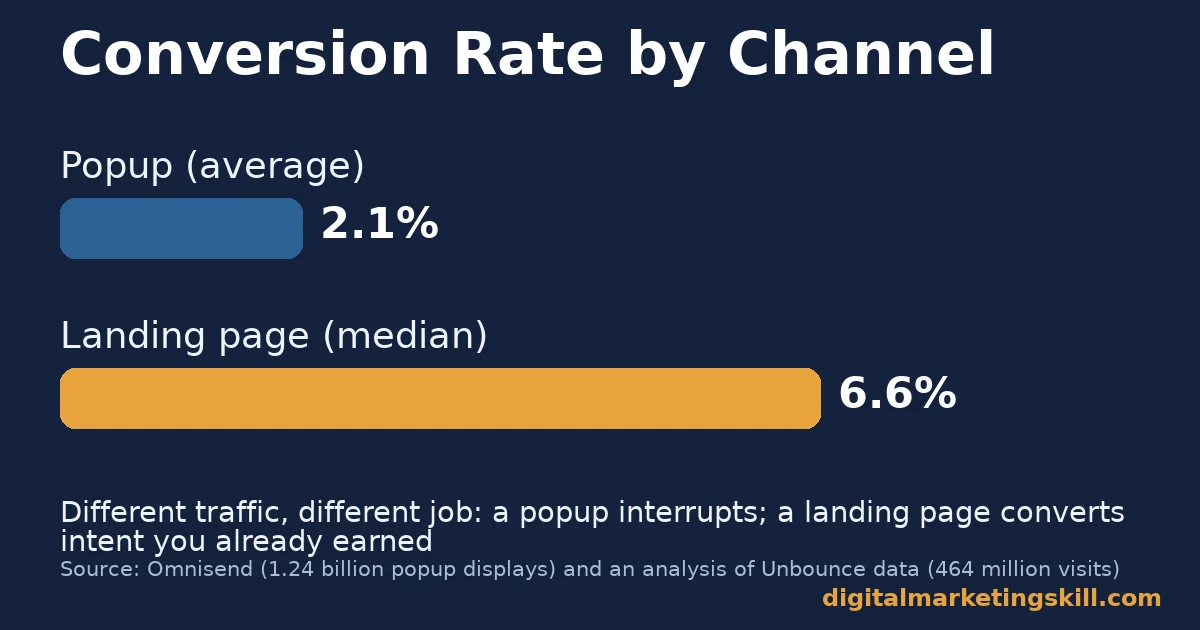
A single “conversion rate” number is almost meaningless on its own. A 2.1% popup average and a 6.6% landing-page median are not measuring the same intent. One interrupts, while the other is a destination the visitor already chose to reach. Comparing the two without naming the channel and the traffic is how list-building advice ends up contradicting itself.
Email List Building Results Differ by Acquisition Channel
Three channels carry almost all practical list-building volume: on-site popups, dedicated landing pages, and inline or embedded forms. Each is built for a different kind of visitor attention.
Decide what “success” means for each page before you pick a channel. A popup on a busy blog post is optimizing for volume. A landing page linked from one paid ad is optimizing for precision. Use the same success metric for both and you will blame the wrong channel for a problem it was never built to solve.
Popups: Built For Speed, Not Precision
Popups interrupt a visitor already on the page. That is why they win on reach: every visitor sees the ask. Omnisend’s analysis of 1.24 billion popup displays puts the average conversion at 2.1%. Mobile-optimized popups (2.2%) run slightly ahead of desktop-only versions (1.4%). Omnisend’s own scale calls under 1.5% underperforming, 1.5-3% average, 3-5% good, and 5% or above excellent.
Timing matters more than most teams assume. Popups delayed 6-10 seconds, letting a visitor read first, convert at 2.4%, the best window in that dataset. Gamified formats such as a spin-to-win wheel pushed conversion to 3.5% or higher against a 2.0% non-gamified baseline.
So the tradeoff is precision, not speed. A popup fires on behavior rules, like time on page or exit intent, instead of real topic interest. Because of that, it captures volume at the cost of some signups who will never open an email.
That cost is still worth paying on high-traffic pages where even a small percentage adds up to a meaningful number of new subscribers each month. On low-traffic pages, the same popup may not be worth the development time, since the raw subscriber count stays small no matter how well it’s tuned.
Landing Pages: Built For Intent, Not Volume
A landing page only reaches visitors you already sent there. Its job is converting intent you already earned, not generating new attention. An analysis of Unbounce’s dataset of 464 million visits across 41,000 landing pages found a 6.6% median conversion rate across industries. That beats a typical popup because every visitor arrived already curious about that specific offer.
The tradeoff is volume. A landing page converts a small, self-selected audience well. It does nothing for the much larger group of visitors who never clicked through to it. That is why a landing page alone is never a complete list-building plan.
The design details matter here more than on a popup. The headline on the page should repeat the exact promise that made someone click, because a mismatched headline makes a visitor doubt they landed in the right place. One clear call to action, not three competing buttons, keeps that same visitor from stalling out at the decision.
Inline Forms: Built For Trust, Not Urgency
Inline and embedded forms sit quietly inside a page’s normal content. They never interrupt anyone and never pressure a decision. As a result, they build trust with visitors who dislike popups. But that also means the form only converts visitors who were already committed enough to keep reading past it.
So inline forms rarely post the headline number in any acquisition report, and that is informative on its own: they are a supporting channel, best judged on list quality rather than raw count.
A practical example makes the difference clear. Consider a how-to article that ends with an inline form offering “the checklist version of this guide.” It converts a small, highly relevant slice of readers.
Now compare that with the same article running a popup at five seconds, before anyone has read a word. It usually converts more raw visitors, but a far less engaged group, because many of them never saw the content that made the offer relevant.
Neither result is wrong on its own. The popup serves a goal of raw reach, while the inline form serves a goal of qualified interest. Pick the inline form when your main aim is a smaller list that opens and clicks at a high rate, and pick the popup when raw subscriber count matters more than early engagement.
How to Lead With Each Channel’s Strength
Once you know what a channel is built for, stop asking it to do another channel’s job.
Popups: Lead With Timing and One Lead Magnet
Delay the popup 6-10 seconds instead of firing it on page load. That single change moved Omnisend’s measured average from 2.1% to 2.4%. Then attach one specific lead magnet, because the offer matters more than the delay.
Getsitecontrol’s analysis of thousands of popups, about 90% from ecommerce sites, found incentive popups converting at 7.73% on mobile and 4.70% on desktop. Without an incentive, those numbers fall to 3.83% and 1.84%, a 102-155% uplift from one offer.
So pick a lead magnet that matches the page’s topic; these lead magnet examples are a reasonable starting list. A generic “join our newsletter” popup, by contrast, is the version most visitors already ignore. A checklist, a template or a short calculator tied to the exact page topic performs far better, because it answers a question the visitor already has.
Landing Pages: Lead With One Offer and One Action
Every landing page should promote exactly one lead magnet and ask for exactly one action. Traffic that lands on a page built for the exact thing it clicked converts near the 6.6% median or higher.
Traffic dumped on a general homepage, by contrast, converts far below it, because the visitor has to guess what to do next. So if you run list building through paid or guest-post traffic, send every click to a matching landing page, never to a general URL.
Inline Forms: Lead With Context and Double Opt-In
Place inline forms where a reader has just finished a section that proves your list’s value, not at the top before you have earned anything. Then pair the signup with double opt-in.
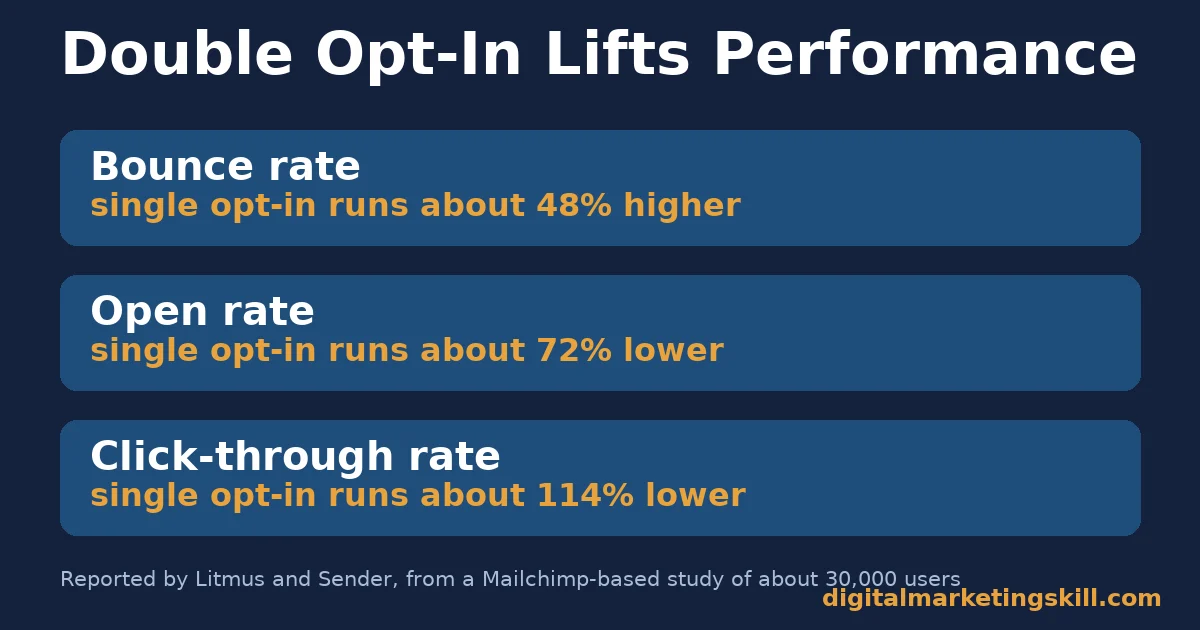
A Mailchimp-based study of roughly 30,000 users, reported secondhand by Litmus and Sender, found double opt-in produced about 48% fewer bounces, about 72% higher open rates, and about 114% higher click-through rates than single opt-in. So you will collect an estimated 20-30% fewer raw signups this way. But almost everyone who confirms will actually read what you send.
None of this needs new tools or a bigger budget. It needs matching the fix to the channel instead of applying generic advice everywhere at once.
How to Measure Email List Building
Four numbers tell you whether email list building is working. Each is defined in one sentence so you can track it beside the metrics you already watch.
- Opt-in rate is the share of visitors who saw a form and subscribed. Compare it to Omnisend’s tiers (under 1.5% underperforming, 5%+ excellent) for that channel, since a popup and a landing page have different ceilings.
- Net monthly growth rate is new subscribers minus unsubscribes and bounces, divided by total list size. A roundup of industry-wide list growth benchmarks puts a healthy steady state at roughly 1-3% a month, with early-stage lists often closer to 5-10%.
- List decay rate is the share of contacts lost each year to unsubscribes, dead addresses and job changes. The same roundup puts unmanaged ecommerce decay at 20-30% a year, with about 40% of subscribers going dormant within a year without active nurturing.
- Bounce rate is the share of sends that fail outright. It is the clearest signal of list quality, and the number double opt-in improves most directly.
Most of these numbers come straight out of whatever email marketing tool you already send from, so check its native reports first.
Revenue Per Subscriber Is the Number That Justifies the Rest
Revenue is the number that ultimately justifies the effort. Omnisend reports its own US merchants see about $76 back for every $1 spent on email.
That figure is specific to one platform’s customer base, not an industry-wide average. Because of that, treat it as a ceiling to aim at, not a guarantee. The sector ranges above (2-5% monthly growth for ecommerce, 3-6% for technology, 1-3% for finance, from the same roundup) matter more for your own planning than any single headline number.
The One Decision Rule for Where to Build Your List First
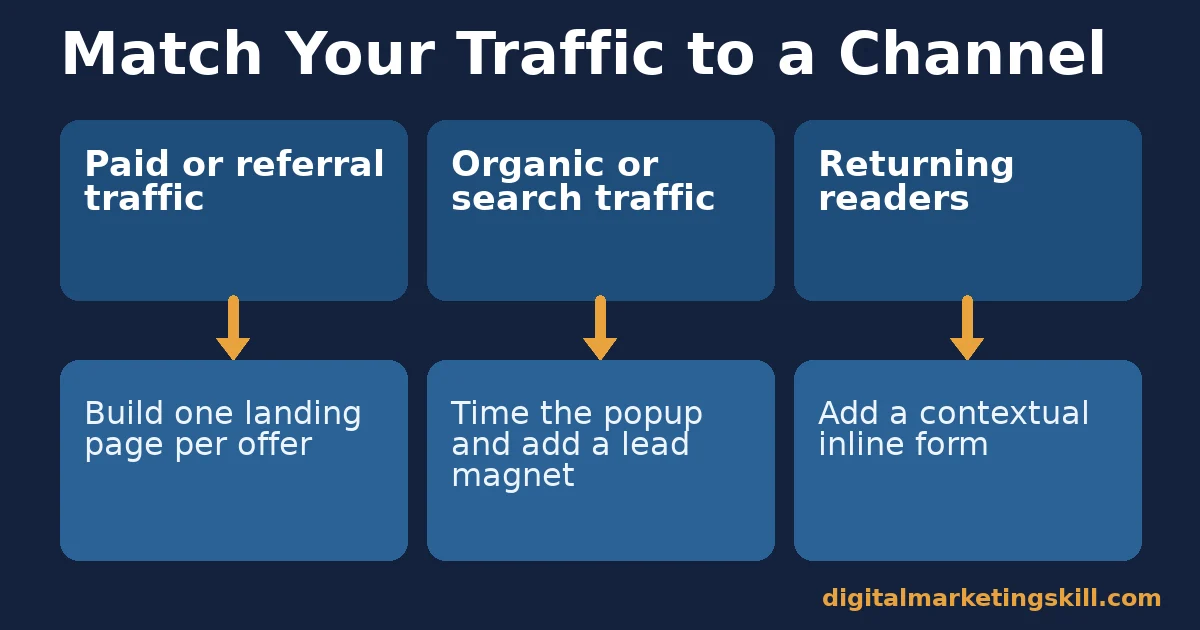
If you only have time to fix one channel this month, fix the one that matches your traffic. Build a landing page for paid or referral traffic. Fix popup timing and add a lead magnet for organic traffic. Add contextual inline forms for returning readers.
Trying to run all three well at once, from a standing start, usually means none of them get the attention that moves conversion. So pick one, fix it, then move to the next.
Here is an illustrative, invented example. A site sending 10,000 monthly organic visitors through an untimed, offer-less popup at roughly 1% conversion collects about 100 subscribers a month.
Now delay the popup and add one matching lead magnet, in line with the ranges above. That could plausibly lift the result into the 3-5% “good” tier: 300-500 subscribers from the same traffic, with no extra spend. That is only an estimate meant to show the mechanism, not a guaranteed outcome for any specific site.
The most common mistake is running all three channels at a mediocre standard instead of one channel well. Picture a popup with no delay and no lead magnet, a landing page shared across five unrelated offers, and an inline form buried above the content it should follow. Run all three at once and you usually underperform a single channel tuned against the benchmarks above.
So fix the channel that matches your traffic first. Confirm the lift with your own numbers. Only then add the next channel.
A Real Case: Turning Email List Building Into Email Income
Olajire Jacob, a Digital Marketing Skill Institute graduate, describes charging an average of $500 to set up email marketing flows, including list-building sequences, for clients in the US, UK and Canada. That service work scaled to about $5,000 a month, as published on the Institute’s reviews page.
The service used the same mechanics covered above: a confirmed list, a working offer, and automation that runs once it is set up. That is why email list building shows up as a billable skill, not only an in-house task. Clients pay for the setup once, then the flow keeps collecting and nurturing subscribers on its own.
Results are self-reported and vary by market and effort. See the Institute’s earnings disclaimer before treating any single case as typical. For the wider case that this pays off beyond one person, see the business case for email marketing.
Frequently Asked Questions About Email List Building
What is a realistic opt-in rate for email list building?
Treat 1.5-3% as an average popup result and 5% or higher as excellent, per Omnisend’s tiered scale from 1.24 billion displays. A well-targeted landing page can run several times higher, because its traffic already chose to be there.
Is double opt-in worth the lower signup count?
For most lists built for revenue, yes. The reported 48% drop in bounces, plus sharply higher open and click rates, usually outweighs collecting 20-30% fewer raw signups. The subscribers you keep are the ones who actually buy.
How fast should a healthy email list grow?
Roughly 1-3% net growth a month is a healthy steady state for an established list. Newer lists from a smaller base often grow faster. Very large lists typically grow slower in percentage terms.
Do popups or landing pages convert better for email list building?
Landing pages built around one specific offer convert far above a popup’s average, but only for traffic you already sent there. Popups reach every visitor on the page. The two channels solve different problems; they do not compete directly.
What is the single most effective change to a list-building popup?
Add one relevant lead magnet. Getsitecontrol’s analysis shows incentive popups converting at roughly double the rate of generic ones, on both mobile and desktop.
How much of an email list disappears naturally each year?
Unmanaged lists lose an estimated 20-30% of contacts a year to unsubscribes, dead addresses and job or platform changes. Ongoing list building offsets that natural decay. It is not only about growth.
Does email list building still pay off compared with other channels?
Email remains one of the higher-return channels available. One platform’s own merchant data put returns at roughly $76 per $1 spent, though that figure reflects a specific customer base, not a universal guarantee.
Should a small site run a popup, a landing page or an inline form first?
Match the channel to the traffic you already have. If most visitors arrive from organic search or social, start with a well-timed popup and a matching lead magnet. If you run paid ads, build one landing page per offer before you touch anything else. Add inline forms once the first channel is tuned and working.
Build Your Email List Building Skills Into a Career
Email list building is one piece of a larger skill set. AI-powered marketers now get paid to run that skill set end to end: offers, automation, deliverability, and the analytics that prove it is working.
The Digital Marketing Skill Institute’s Master Diploma in Digital & AI Marketing is built around four AI-powered tracks across ten courses. One of them, AI-Powered Lead Generation and Email Automation, covers exactly the list-building and automation work in this guide. A Full Stack option covers all four tracks together.
Every track includes unlimited 1-on-1 coaching and mentoring, plus a U.S. Project Internship with a verified U.S. Work Reference Letter. The program carries dual US and UK accreditation, recognised in more than 100 countries. You study 100% online, from anywhere in your country or beyond.
Review the full Master Diploma program, and browse more guides on the digital marketing blog. When you are ready, apply here.
Start with one channel from this guide. Measure it against the benchmarks above. Then expand to the next. Learn more at digitalmarketingskill.com, wherever in your country you are working from, and come back to digitalmarketingskill.com for the next guide in this series.
Every figure in this guide was checked against its original source before publication. Figures marked as illustrative are invented examples, not real results.
![9 Amazing Digital Marketing Skills to Make Money Online [With Proof]](https://digitalmarketingskill.com/wp-content/uploads/2019/07/9-Amazing-Digital-Marketing-Skills-to-Make-Money-Online-With-Proof-17.png)






