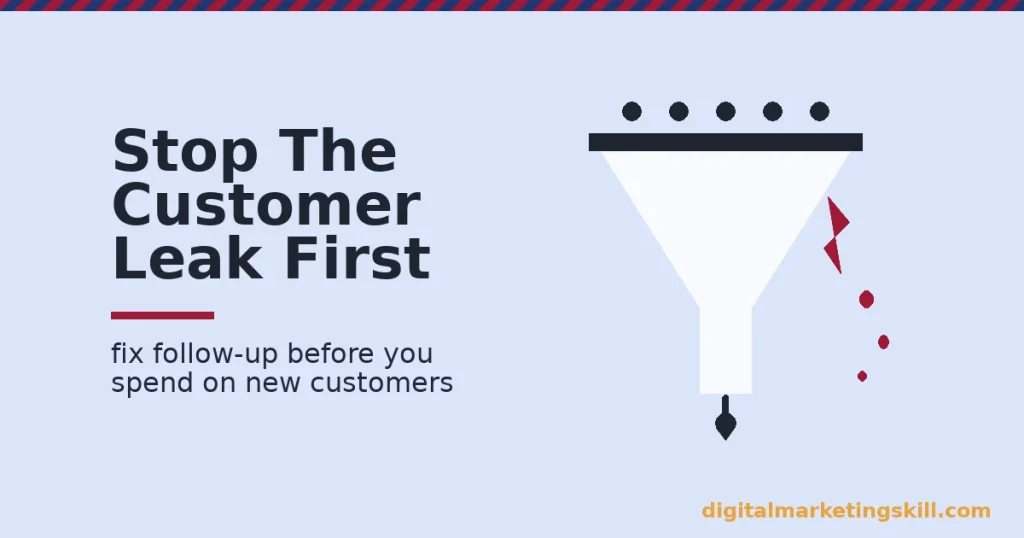
Customer relationship management is the ongoing practice of tracking what each customer needs, following up on time, and rewarding loyalty so people keep buying. Done well, it turns one-time buyers into repeat buyers. Done badly, it quietly bleeds revenue that marketing then has to replace at far higher cost.
Key Takeaways
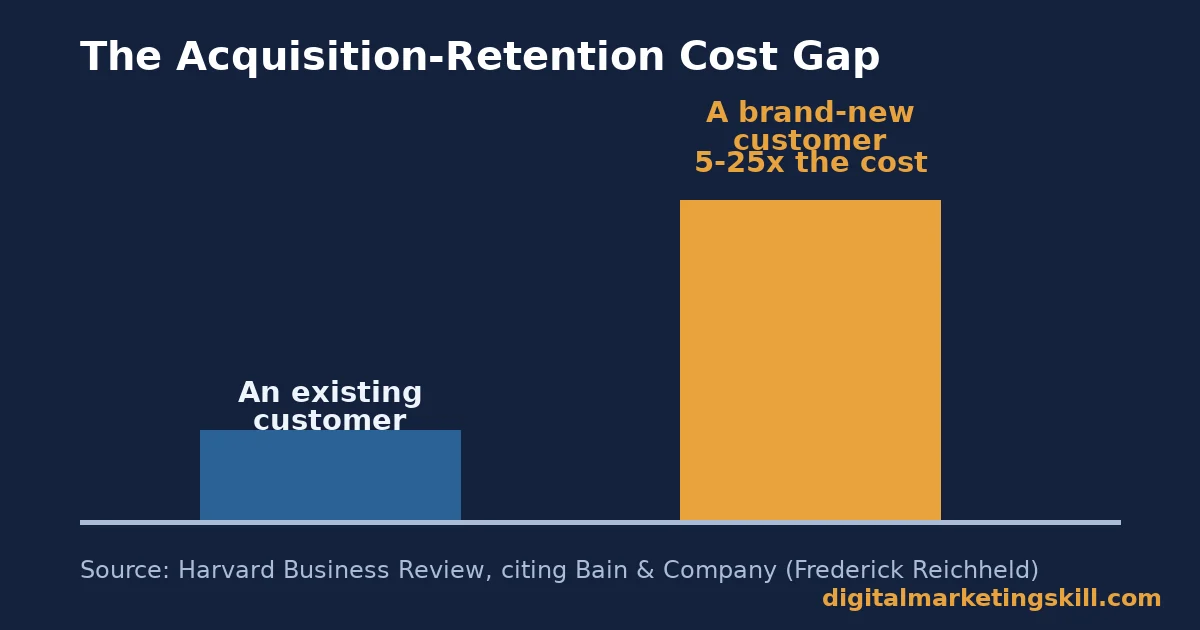
- Harvard Business Review, citing Bain’s Frederick Reichheld, reports that raising retention by 5% can lift profit by 25% to 95%. The same article puts new-customer acquisition at 5 to 25 times the cost of keeping an existing one.
- Salesforce’s 7th Edition State of Sales Report found sales reps spend 60% of their time on non-selling tasks, with teams juggling an average of eight disconnected tools. Scattered data is the main reason customer relationship management slips.
- Zendesk’s Customer Experience Trends research found 72% of customers want immediate service, and over half will switch to a competitor after one bad experience.
- BrightLocal’s latest consumer review survey found 97% of people read reviews before choosing a business, and 80% favor businesses that respond to every one.
- Customer relationship management is not one task. Follow-up, customer research, communication cadence and rewards each need a different fix, and treating them as one job is why most efforts stall.
In this guide
- The Gap Most Advice Misses
- How Customer Relationship Management Actually Works
- What Differs by Relationship Stage
- Fix Each Stage This Way
- Mistakes That Undo Customer Relationship Management
- How to Measure Whether It’s Working
- Local Versus Online: What Changes
- The One Decision Rule
- What Doing This Right Looks Like
- Frequently Asked Questions About Customer Relationship Management
- Put This Into Practice
The Gap Most Advice Misses
Most advice on customer relationship management says “build relationships” without saying how. That leaves owners guessing which action actually keeps a customer, and which one just feels productive.
This guide narrows the focus to four concrete levers: following up after a sale, researching what a customer actually needs, keeping in touch on a schedule, and rewarding loyalty with something real. Each one gets a mechanism, a fix, and a way to measure it.
Two ground rules apply. First, the economics below come from broad studies, not your specific market. Treat the percentages as direction, not a guarantee for your business. Second, no system replaces a product or service people actually want. Customer relationship management keeps good customers longer. It cannot save a bad offer.
This guide is for any owner who sells directly to customers, whether in a shop, a service business, or online. The habits below work the same way in each setting, even though the tools differ.
It also works whether you have ten customers or ten thousand. The habits scale down easily, because each one starts as a manual task before it ever needs automation, and most small businesses never outgrow the manual version.
How Customer Relationship Management Actually Works
Harvard Business Review states plainly that “acquiring a new customer is anywhere from five to 25 times more expensive than retaining an existing one.” The same article cites Reichheld’s finding that raising retention rates by 5% increases profits by 25% to 95%.
That gap is the entire mechanism. Every dollar spent keeping a customer buys more profit than the same dollar spent finding a new one. Customer relationship management is simply the set of habits that capture that gap on purpose, instead of leaving it to chance.
Salesforce defines the software side of this as a system that “unifies all of your company’s data, connects every customer touchpoint… so you can improve relationships.” The point is not the software itself. It is the unified picture: one place that remembers what a customer bought, asked and complained about, so nobody starts from zero.
Salesforce puts a number on the fragmentation problem: the average company manages 897 apps, and only 29% of them are connected to each other. Customer relationship management, at its core, is the discipline of refusing to let that fragmentation reach the customer, even when the business behind the scenes is messy.
Why It Breaks Without a System
Salesforce’s 7th Edition State of Sales Report, cited above, found sales reps spend 60% of their time on non-selling tasks. Teams juggle an average of eight disconnected tools just to do their jobs. When customer data sits in eight places, follow-up depends on memory.
Memory fails first with your best customers. They ask for the least, so they get chased the least, and they are exactly the customers you can least afford to lose. A simple, consistent system fixes this before it ever requires expensive software.
What Differs by Relationship Stage
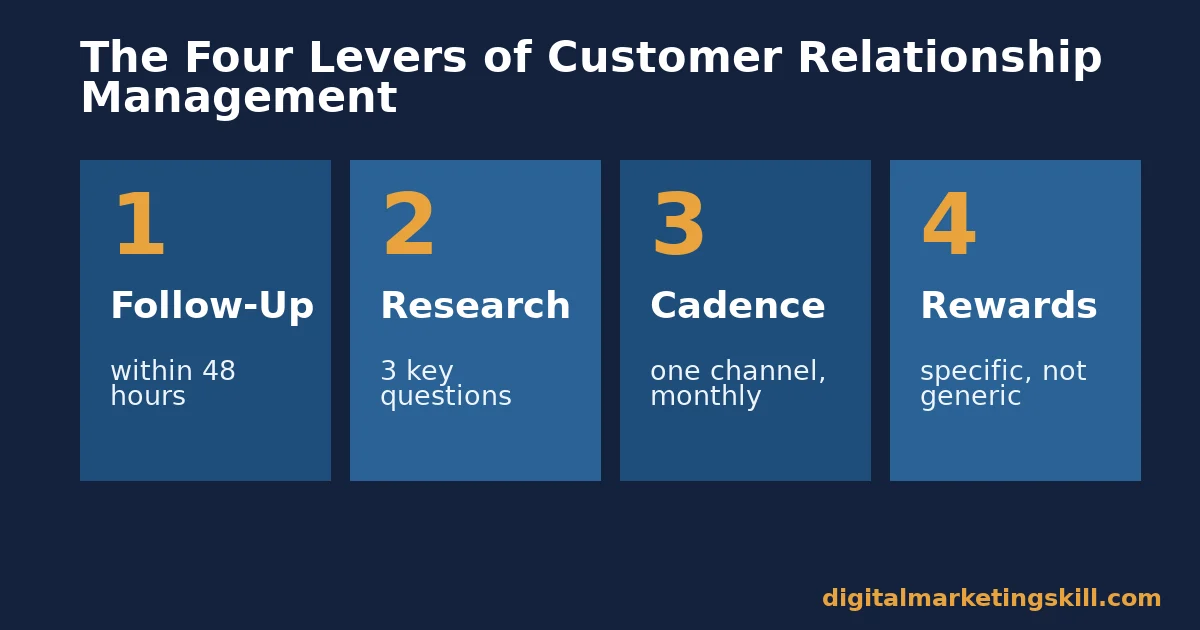
Four habits make up customer relationship management, and each does a different job. Confusing them is why a single “be nicer to customers” push rarely sticks.
Follow-Up: Built for the First 48 Hours
A thank-you call or message right after a sale is a trust signal, not a courtesy. It tells the customer someone is paying attention before any problem has a chance to appear.
Left undone, the first real contact a customer gets is often a complaint-handling call. That sets the whole relationship on the back foot, and it is far harder to recover from than it would have been to prevent.
Customer Research: Built for Relevance
Knowing a customer’s history, their role, and the scale of their need is what lets you offer the right next thing instead of a generic pitch. Without it, every offer is a guess.
Guesses convert far worse than offers built on what you already know about a customer. Research does not need to be elaborate to work; it needs to be specific enough to use. A short note after each conversation is usually enough to build a useful picture over time.
Communication Cadence: Built for Staying Top of Mind
Zendesk’s Customer Experience Trends research found 72% of customers want immediate service, and 59% expect businesses to use the data they collect to personalize contact. A fixed cadence of useful, relevant messages keeps a brand in mind between purchases.
Without a cadence, a brand only appears at the moment of a hard sell, which reads as self-interested rather than attentive. Consistency is what earns the right to be heard later.
Rewards: Built for Loyalty That Compounds
BrightLocal’s consumer review survey found 85% of people are more likely to use a business with positive reviews, and 49% trust reviews as much as a personal recommendation. A loyal customer who feels rewarded is also a customer who talks.
That customer reviews, refers and recommends, which compounds far beyond the value of their own repeat purchase. Rewards are not a cost center; they are the cheapest marketing channel most businesses already have and underuse. A single loyal customer who refers three friends is worth more than most paid ads, and costs nothing beyond the reward itself.
Fix Each Stage This Way
Understanding the four levers only helps if it changes what you do this week. Here is the specific fix for each one, in the order that pays back fastest.
Follow-Up: Lead With a Same-Day Habit
Call or message every new customer within a day of their purchase. Ask one direct question: are they satisfied so far. Log the answer somewhere you will actually see again, even a simple spreadsheet.
The habit matters more than the tool in the first month. Once the habit is solid, a dedicated system can take over the logging, but the habit has to exist first or the system has nothing to track.
Customer Research: Lead With Three Questions
For each active customer, record three things. What industry or context do they operate in. How big is their need, realistically. Who else is involved in the decision.
That is enough to personalize a follow-up without turning research into a project of its own. Add detail over time as a relationship deepens, rather than trying to capture everything on day one.
Communication Cadence: Lead With One Channel, Done Well
Pick a single channel, such as email or messaging, and commit to a fixed cadence, such as monthly. Fill it with one useful tip or update, not a constant sales pitch.
A consistent, modest cadence beats a burst of messages followed by silence. Silence is what makes a customer forget you exist, and forgetting is the first step toward switching to a competitor. Set a recurring reminder if that is what it takes to protect the cadence from a busy week.
Rewards: Lead With Something Specific, Not Generic
Skip vague “thank you for your loyalty” messages. Reward a specific, named behavior, such as a referral or a repeat order, with something the customer can actually use.
Specific recognition reads as sincere. Generic recognition reads as automated, even when a real person sent it, and customers can tell the difference within a sentence or two.
Mistakes That Undo Customer Relationship Management
Four mistakes quietly cancel out otherwise good customer relationship management. Each one is easy to spot once you know what to look for.
Buying Software Before Building the Habit
A dedicated system cannot create a follow-up habit that does not already exist. It can only speed up a habit you already run. Teams that buy software first, then try to build the habit around it, usually abandon both within a few months.
Treating Follow-Up as a One-Time Event
A single thank-you message after the first sale is a good start, but customer relationship management is ongoing, not a one-time checkbox. Without a repeating cadence, the relationship quietly reverts to a plain transaction after the first follow-up fades.
Rewarding Everyone the Same Generic Way
A blanket discount code sent to an entire customer list feels like a reward, but it rarely changes behavior, because it asks nothing specific of the customer. Rewards that recognize a named action, like a referral, work harder for the same budget.
Ignoring Response Time Until It Becomes a Complaint
Zendesk’s research, cited above, found 72% of customers want immediate service, yet many businesses only notice response time once a customer complains about it publicly. By then, the slow response has already cost the relationship, and a public complaint does far more damage than the original delay.
Measuring Only Revenue, Never the Relationship
Revenue is a lagging number. It moves last, after a relationship has already strengthened or weakened. Watching revenue alone means you only find a problem once it has already cost you money.
Track the habits instead. Follow-up speed, contact cadence and response time all move first. Revenue follows a few months later, once the habits have had time to compound.
How to Measure Whether It’s Working
Four numbers tell you whether customer relationship management is paying off, and none of them require expensive software to track.
- Repeat purchase rate. The share of customers who buy a second time within a set window. A rising rate means your follow-up and cadence are landing, not just your first sale.
- Response time to enquiries. How long a customer waits for a reply. Zendesk’s research ties this directly to whether a customer stays or switches, so treat a slipping response time as an early warning, not a minor delay.
- Referral and review rate. The share of customers who refer someone or leave a review without being pushed hard for it. This is the clearest outside signal that a relationship, not just a transaction, took place.
- Time since last contact. For each active customer, how long since your last real touchpoint. A customer who has heard nothing in months is a customer a competitor can quietly take.
The One-Row Habit
Review these four numbers on the same day each month. Write them in one row of a spreadsheet, next to whichever fix you applied that month.
After a few months, the pattern becomes clear. You will see which lever actually moved repeat purchases, so you stop guessing and start repeating what works.
Keep the spreadsheet simple on purpose. A single tab with one row per month is enough. Complexity is what makes most measurement systems die within a quarter, so resist the urge to track more than these four numbers until the habit itself is solid.
Local Versus Online: What Changes
The four levers stay the same whether a business sells in person or online. What changes is where the relationship becomes visible to other people.
A local business lives or dies by its public reputation on a map search, because a customer’s first stop is often a search result before a phone call. An online business lives more on review pages, social proof and email, since there is no physical storefront to walk past.
Either way, customer relationship management shows up publicly through reviews and referrals, not privately through internal notes alone. Treat every review request as part of the same system as your follow-up call, not a separate task bolted on afterward.
The One Decision Rule
If you can only fix one habit this month, fix follow-up speed first. It costs nothing, it takes minutes per customer, and it sets the tone for every interaction that follows.
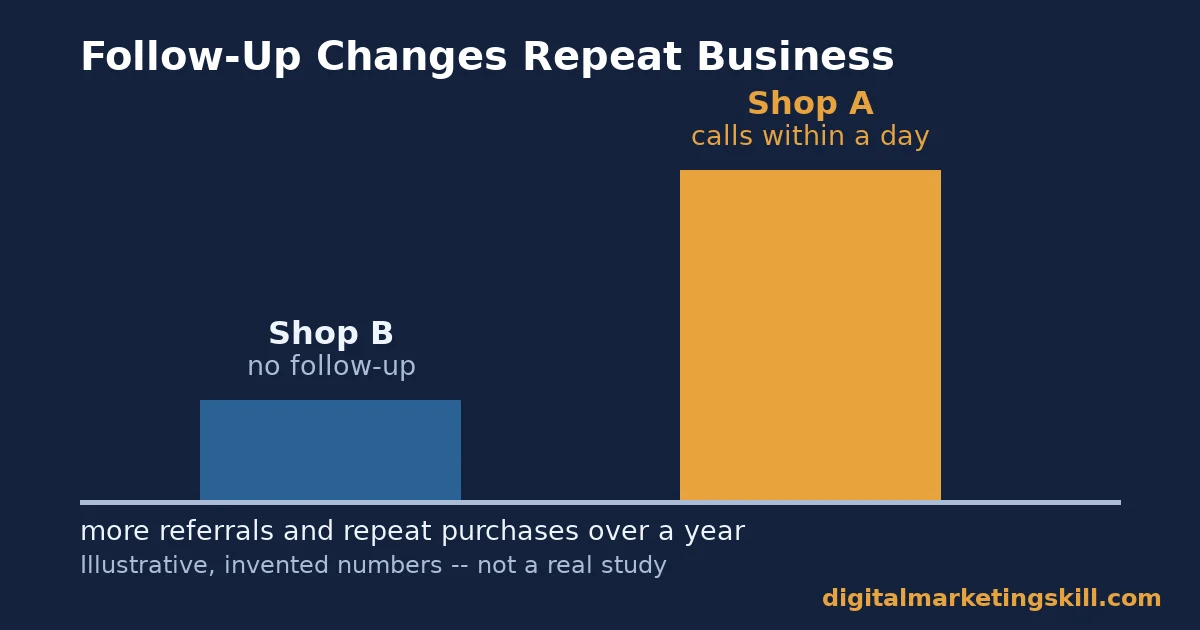
Here is an illustrative, invented example to show the logic, not a real case. Two identical shops sell the same product at the same price.
Shop A calls every customer within a day of purchase. Shop B never follows up at all. Over a year, Shop A’s customers refer friends and return for a second purchase far more often. The product is identical; the difference is that someone made the customer feel noticed. Fix follow-up first, because it is the cheapest lever and it touches every customer you already have.
What Doing This Right Looks Like
Nairn Golf Club, a real golf club, worked with an implementation agency to replace email-only enquiry handling with a system that logged every customer conversation in one place. Treat the figures as the agency’s own published account, not an independently audited result.
Over roughly eight months, the club generated 86 booking and membership enquiries. It built a pipeline worth £99,430 and converted 23 deals into £23,410 of revenue. The club’s general manager credited the change to consistent follow-up and a system his team could actually see and use.
The honest limit: this is one small organization in one sector, and results vary by market and by how consistently the habits are kept up. No outside audit confirmed the figures, so read them as a best case published by the agency that did the work, not a typical result.
What it shows reliably is the mechanism in practice. Centralizing customer data and automating follow-up converted enquiries that a manual, email-only process was likely to lose. The lesson travels well beyond golf clubs: any business juggling enquiries by email alone is probably losing a similar share without ever seeing the gap.
Frequently Asked Questions About Customer Relationship Management
What is customer relationship management, in plain terms?
It is the set of habits and tools a business uses to track customer needs, follow up on time, and stay in touch in a way that earns repeat business. The software is optional. The habits are not.
Does a small business need CRM software to do this well?
No, not at first. A simple spreadsheet can track follow-up and contact history for a small customer base. Our guide on CRM in digital marketing covers when moving to dedicated software starts to pay off.
How often should a business contact customers?
A fixed, modest cadence beats an irregular one. Monthly contact with one useful update is a reasonable default. The right frequency depends on how often customers naturally buy or need support.
Should a small business focus on retention or acquisition first?
Retention, because Harvard Business Review puts new-customer acquisition at 5 to 25 times the cost of keeping an existing one. Our customer retention management guide covers the stage-by-stage system in more depth.
What is the simplest way to measure customer relationship management?
Track repeat purchase rate and time since last contact for each active customer. Both numbers come from records most businesses already keep, and both move quickly once follow-up habits change.
Do customer reviews count as part of customer relationship management?
Yes. A review is a customer choosing to speak publicly about the relationship, not just the product. Our guide on what customer reviews are and how to get good ones covers the request and response habits that strengthen that signal.
Does this apply to a local, in-person business?
Yes, and the local angle matters even more, because a local customer’s first stop is often a search result. Our Google Business Profile optimization guide covers the related habits that keep a local relationship visible before the first sale happens.
How long before customer relationship management shows results?
Follow-up and cadence changes can shift how a customer feels within days. Numbers like repeat purchase rate need a full buying cycle, often a few months, before the trend is reliable enough to act on.
Put This Into Practice
Start with the one decision rule above. This week, call or message every customer who bought in the last 48 hours, and log the answer somewhere you will see again.
Then add a fixed monthly cadence, three research questions per active customer, and one specific reward for a named behavior. None of this requires new software. It requires thirty minutes a week and a habit you keep even when business gets busy.
If you want a complete system for turning customer relationship management into a repeatable part of how you run a business, the Master Diploma in Digital & AI Marketing at Digital Marketing Skill Institute covers it inside a wider growth curriculum. It runs ten practical courses across four tracks, with unlimited one-on-one coaching and real project work inside a U.S. partner company.
The diploma carries dual US and UK accreditation, known in more than 100 countries. It runs 100% online, so you can study from anywhere in your country.
See the full Master Diploma programme, browse more guides on the digital marketing blog, or read real outcomes on the student reviews page. Every guide referenced here lives on the Digital Marketing Skill Institute site. Apply to the programme when ready, or start this week with the follow-up habit above and measure the change yourself.
Every figure in this guide was checked against its original source before publication. Figures marked as illustrative are invented examples, not real results.
![9 Amazing Digital Marketing Skills to Make Money Online [With Proof]](https://digitalmarketingskill.com/wp-content/uploads/2019/07/9-Amazing-Digital-Marketing-Skills-to-Make-Money-Online-With-Proof-17.png)