

Evaluating marketing trends well means testing a new tactic before betting the budget on it. Most teams skip that step. They copy whatever gets attention online. That single habit is why some trends pay off while others quietly waste months of work.
Key Takeaways
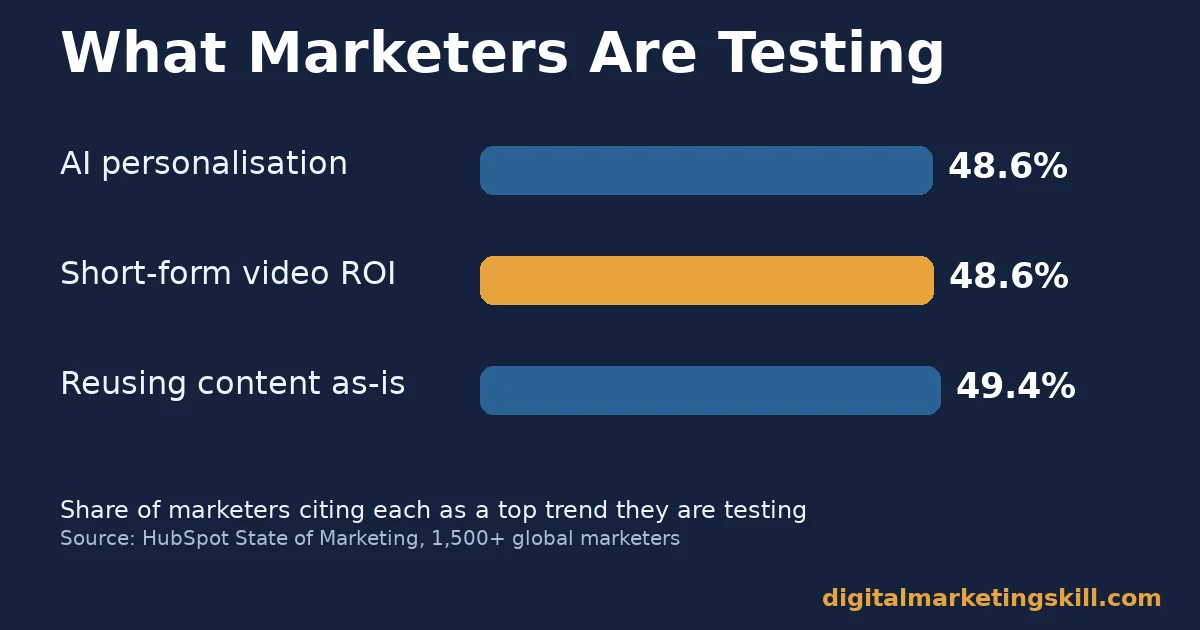
- 48.57% of marketers are exploring AI for personalised content, per HubSpot’s global State of Marketing research (1,500+ marketers). That is the single most-cited trend right now, not a universal requirement.
- 48.6% of marketers say short-form video earns the highest ROI of any content format. Long-form video trails at 28.6%, in the same global research.
- 95% of B2B marketers now use AI somewhere in their process, per Content Marketing Institute and MarketingProfs research. The same research names measuring effectiveness as a top challenge.
- Ahrefs’ own study found AI-assisted content carries no automatic ranking penalty. The penalty falls on low-effort, unedited output, trend or no trend.
- A trend is not a strategy by itself. Evaluating marketing trends against a fixed set of questions beats adopting whatever looks popular this week.
In this guide
- Why Most Marketing Trend Advice Skips The Evaluation Step
- How Evaluating Marketing Trends Actually Works
- How Evaluating Marketing Trends Differs By Trend Type
- How To Lead With Each Trend Type
- How To Measure Whether A Trend Is Working
- The One Decision Rule For Evaluating Marketing Trends
- A Real Case: What The Metaverse Rush Changed
- Frequently Asked Questions About Evaluating Marketing Trends
- Turning Trend-Chasing Into A Repeatable Habit
Why Most Marketing Trend Advice Skips The Evaluation Step
Most trend articles do one thing: list what is popular. They rarely explain how to decide whether a specific trend fits a specific business. That gap is the entire problem with evaluating marketing trends by instinct instead of by method.
A trend list treats every reader the same. A small services business and a global retail brand do not share an audience, a budget or a risk tolerance. The same trend can be the right move for one and a waste of money for the other.
It helps to separate three words that get used interchangeably but mean different things. A fad is a short burst of attention with little lasting behaviour change behind it. A trend is a sustained shift, visible across several sources over time.
By contrast, a best practice is a trend that has already been tested widely enough to become a default, not an experiment. Evaluating marketing trends is really the work of sorting a given tactic into one of these three categories before deciding how much to invest in it.
Two Ground Rules Behind This Guide
Two ground rules keep this guide honest.
First, a trend is an observation about behaviour, not a guarantee of results for any single business. Treat every statistic below as a signal from a named study, not a promise.
Second, evaluating marketing trends is a recurring habit, not a once-a-year list. The questions below apply the same way, no matter which specific trend a team considers.
How Evaluating Marketing Trends Actually Works
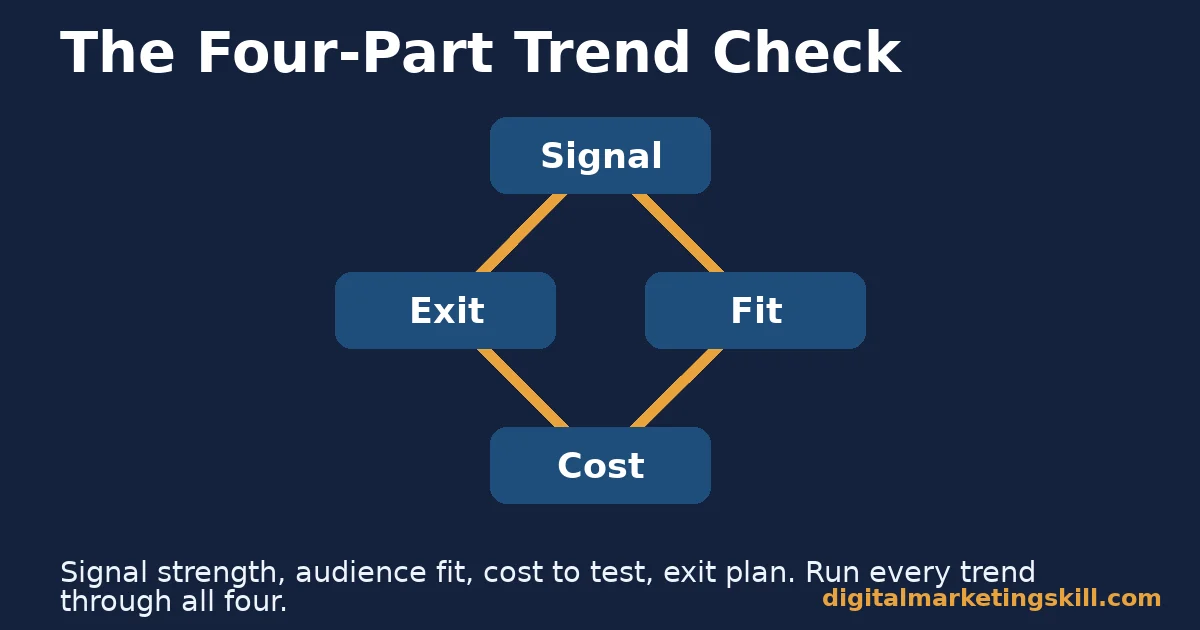
A reliable method for evaluating marketing trends runs through four checks, repeated for every new tactic under consideration.
The Four-Part Check
- Signal strength. How many independent, named sources report the same shift, and over how long a period, rather than one single viral claim.
- Audience fit. Whether the specific audience a business serves actually behaves the way the trend describes, not just audiences in general.
- Cost to test. The smallest version of the trend a team can try without committing the full budget or rebuilding core channels.
- Exit plan. A defined point to judge the test, and a clear next step if it fails: drop it, adjust it, or scale it.
Skip audience fit and a business adopts a trend built for a different market. Skip the exit plan, and a failed test quietly becomes a permanent habit. Nobody ever set a point to stop and judge it.
Signs A Trend Evaluation Needs A Reset
A few patterns show a team is chasing trends instead of evaluating them:
- Every quarter brings a new tactic, and nobody reviews the old ones. There is no exit plan, so nobody ever judges or drops anything.
- A team adopts a trend only because a competitor did it. That is signal strength borrowed from one source, not several, and it says nothing about whether the competitor’s own test actually worked.
- The budget for a test keeps growing before results come in. The cost-to-test check never set a ceiling.
- Nobody can say what the trend was supposed to improve. The team skipped straight to execution without naming a measurable goal.
Evaluating Marketing Trends By Risk Tolerance
A startup with little brand history and a long-established brand carry different amounts of risk into the same trend. A startup often has less to lose from a visible misstep, so it can afford to test louder, more public trends earlier. Its audience also tends to expect more experimentation from a newer company, which lowers the reputational cost of a test that does not land.
An established brand carries more reputation risk per mistake. For that kind of business, the cost-to-test check matters more than speed, and a quieter, smaller test usually beats a loud, public one, even for a trend that looks promising. A failed public test can undo years of consistent brand positioning in a way a quiet, limited test cannot.
How Evaluating Marketing Trends Differs By Trend Type
Not every trend carries the same kind of risk. The type of trend changes which of the four checks matters most.
AI-Driven Trends: Built For Speed, Not Judgment
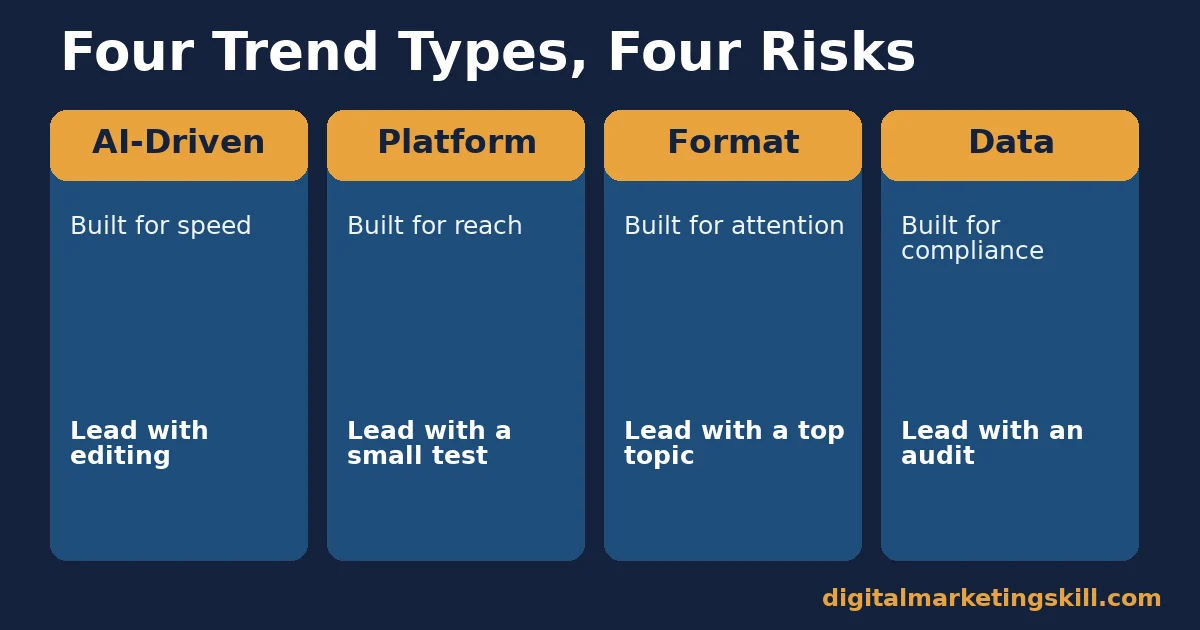
AI-driven trends, like AI-personalised content or AI-assisted drafting, move fast because the tools themselves ship fast. Ahrefs’ study on AI-assisted content found no automatic ranking penalty for AI use itself.
The risk sits in judgment, not the tool. Unedited AI output is what actually underperforms. Ahrefs’ separate study of roughly 14 billion pages found the same pattern: 96.55% earn no monthly Google traffic, mostly because they repeat an existing answer instead of adding one.
Platform-Native Trends: Built For Reach, Not Ownership
Platform-native trends, like short-form video or a new social feature, are one part of a broader online video strategy. They borrow reach from a platform a business does not control. HubSpot’s global research found 48.6% of marketers rate short-form video as the highest-ROI format, which explains the rush toward it.
That reach is also fragile. DataReportal’s global digital research puts active social media users at 5.66 billion people, spread unevenly across dozens of platforms. A platform can change its algorithm or shut a feature down at any time, taking that reach with it.
Content-Format Trends: Built For Attention, Not Depth
Format trends change how content looks: interactive posts, carousel formats, or a new content-format fad. They are usually cheap to test and fast to measure. That makes them the lowest-risk category to experiment with inside an existing content marketing strategy.
Data And Privacy Trends: Built For Compliance, Not Choice
Trends around first-party data and privacy are not optional the way a format trend is. They follow regulation and platform policy, so the real decision is how fast to adapt, not whether to. A business that treats a privacy shift as optional usually ends up making the same change later anyway, under more pressure and with less time to plan it well.
How To Lead With Each Trend Type
Knowing the category is only half the decision. Each type rewards a different starting move.
AI-Driven Trends: Lead With Editing, Not Drafting
Use AI for the first draft or the research pass, then put a human editor between that draft and anything published. Google’s own guidance on people-first content asks one question for any AI-assisted page: does it show depth a reader could not already get elsewhere? That same discipline carries over to generative engine optimization, where depth matters more than speed of output.
Platform-Native Trends: Lead With A Small, Reversible Test
Commit the smallest possible budget first: one format, one campaign, one defined test period. A platform-native trend that fails should cost little enough to walk away from without disrupting the rest of the plan.
Content-Format Trends: Lead With Your Best-Performing Topic
Apply a new format to a topic that already performs well in an existing format, rather than a brand-new topic. That isolates whether the format itself helped, instead of mixing two unknowns together. The Nielsen Norman Group’s eyetracking research found readers scan in predictable patterns regardless of format. That is one reason a format change alone rarely explains a result swing.
Data And Privacy Trends: Lead With An Audit, Not A Rebuild
Map what data the business collects today, and why, before changing any system. Most compliance gaps come from forgotten, redundant data collection, not from a missing fancy tool. An audit usually finds several data points nobody uses, which can simply be dropped rather than migrated into a new system.
How To Measure Whether A Trend Is Working
A trend test needs the same discipline as any other marketing effort. Define a short list of KPIs before the test starts, not after.
- Baseline comparison. Performance on the same metric, for the same audience, from before the team adopted the trend, so the test has something real to compare against.
- Cost per result. The total spend on the test divided by whatever outcome matters (a lead, a sale, an engagement), not raw reach alone.
- Time to signal. How long the test needs to run before the data is reliable. Agree on this in advance, not after seeing early numbers.
- Fit score. A simple yes-or-no judgment on whether the audience that engaged matches the audience the business actually serves.
Content Marketing Institute’s and MarketingProfs’ B2B research surveyed 1,015 marketers, mostly North American. 95% now use AI somewhere in their process, yet they name measuring effectiveness as a top challenge, at 33%. The tool adoption outran the measurement discipline, which is exactly the gap this four-part KPI list is built to close.
Common Measurement Mistakes When Testing A Trend
A few habits quietly undo an otherwise well-chosen trend test:
- Measuring vanity reach instead of the fit score. A trend can rack up impressions from the wrong audience and still fail the business goal behind it.
- Changing the KPI mid-test. Switching from a cost metric to a reach metric partway through makes any result impossible to judge fairly.
- Judging too early. Reading results before the agreed time-to-signal window closes produces a false read in either direction.
- Comparing against no baseline at all. Without a “before” number, a “during” number tells a team almost nothing.
Each of these mistakes shares a root cause: skipping the agreement step before the test starts. A five-minute conversation to fix the KPI, the baseline and the time window in advance prevents all four.
The One Decision Rule For Evaluating Marketing Trends
When a new trend competes for limited budget against proven channels, use one rule. Adopt the trend only if the smallest viable test is cheap enough to fail without damaging anything that already works.
Illustrative, invented numbers: imagine a business considering two moves. Move A rebuilds the entire content calendar around a new format immediately. Move B runs that same format on one topic, for one month, alongside the existing calendar.
Under the rule above, Move B wins. Not because it is more exciting, but because a failed Move B costs one month of one format. A failed Move A costs the whole calendar.
A Real Case: What The Metaverse Rush Changed
Several major brands moved quickly into metaverse marketing during an early wave of hype. The Drum reported that Disney, as a cost-saving measure, later eliminated its entire metaverse department. Other companies pulled back similarly as the format failed to show the reach or spending the early hype promised.
What made this case instructive is less the specific format and more the pattern behind it. Brands moved fast on reach and visibility, the two easiest signals to notice, while spending far less attention on audience fit and a defined exit point, the two checks this guide puts at the centre of evaluating marketing trends.
The limit on this case matters. The Drum’s report does not give exact team size or the full set of reasons behind Disney’s decision. Cost-cutting at a large company often involves more than one factor.
Still, the broader pattern is clear: fast adoption, followed by a fast retreat once results disappointed. That is exactly what evaluating marketing trends is meant to prevent, a trend adopted for its visibility rather than against a measurable test.
Frequently Asked Questions About Evaluating Marketing Trends
How do you tell a real marketing trend from a short-lived fad?
Check signal strength first. A real trend shows up across several independent, named sources over months, while a fad usually traces back to one viral post or a single platform’s push. If only one source reports it, treat it as unverified.
A second useful check: a real trend tends to keep showing up in data even after the initial hype cycle fades. A fad’s mentions drop sharply once the novelty wears off.
Should a small business follow the same marketing trends as a large brand?
Not automatically. Audience fit matters more than trend popularity. A tactic built for a large brand’s budget and reach does not always translate to a small business’s audience or resources, even when the underlying trend is real. A small business usually gets more value from testing a scaled-down version of a trend than from copying a large brand’s full execution of it.
How much budget should go toward testing new marketing trends?
Many teams cap test budgets at a small, fixed share of total marketing spend, often in the 10-20% range, so experimentation continues without threatening proven channels. The exact number matters less than having one agreed in advance. A fixed cap also removes the pressure to justify a growing budget after a test is already underway.
What happens if a marketing trend test fails?
If the team set the exit plan before the test started, failure is simple: drop the tactic and apply what it learned elsewhere. Problems only appear when nobody defines an exit point, and a failing test keeps running on inertia. A failed test still produces useful information about the audience, even when the tactic itself gets dropped.
Does ignoring marketing trends completely put a business at risk?
Ignoring every trend risks missing a genuine shift in audience behaviour. Chasing every trend risks wasting budget on fads. Evaluating marketing trends against a fixed set of checks is the middle path between those two risks, and it is the path that scales, since the same checks work whether a business reviews one trend a year or a dozen.
How often should a business re-evaluate which trends to follow?
A quarterly review fits most teams: frequent enough to catch a genuine shift early, infrequent enough to avoid reacting to short-term noise. The four-part check applies the same way at every review, whether the trend under discussion is brand new or one the team adopted years ago and never revisited.
Is AI itself a marketing trend or a permanent shift?
Current adoption data suggests a permanent shift rather than a passing trend: 95% of B2B marketers already use AI somewhere in their process.
What remains a live, evaluable question is which specific AI use case fits a given business, not whether AI matters at all. A business still gets real value from running each new AI use case through the same four-part check, rather than adopting every new feature a vendor ships.
Can a marketing trend become a long-term channel?
Yes, once it passes its test and earns a place in the regular plan. Short-form video, for many teams, has already made that move from “trend being tested” to “standard channel,” which is the outcome the four-part check is designed to identify early. The same path applies to any trend that clears all four checks with real, measured data behind it.
Turning Trend-Chasing Into A Repeatable Habit
Evaluating marketing trends well is a habit, not a one-time list: signal strength, audience fit, cost to test, and an exit plan, applied to every new tactic that shows up. Marketers anywhere in your country can run the same four checks, because the method does not depend on which specific trend is under review.
The trend itself will keep changing. Short-form video will eventually give way to whatever comes next, and the next AI capability will replace the current one. The four checks in this guide do not expire with any single trend, which is the entire point of building a method instead of memorising a list.
Learn The Method Behind This Guide
Digital Marketing Skill Institute’s Master Diploma in Digital & AI Marketing teaches this kind of evaluation inside four AI-powered tracks across ten courses, including AI marketing tools and influencer marketing. Learners practise the same four-part check on real, current tactics, rather than memorising a static list that ages the day it publishes.
The programme is dual US and UK accredited, recognised in more than 100 countries, and runs 100% online, with unlimited 1-on-1 coaching and mentoring alongside real project work inside a U.S. company.
Explore the Digital and AI Marketing Training Course, read more on the digital marketing blog, or see outcomes on the reviews page. Ready to build a repeatable method for evaluating marketing trends, anywhere in your country? Apply to the program through Digital Marketing Skill Institute, or visit digitalmarketingskill.com to learn more.
Every figure in this guide was checked against its original source before publication. Figures marked as illustrative are invented examples, not real results.
![9 Amazing Digital Marketing Skills to Make Money Online [With Proof]](https://digitalmarketingskill.com/wp-content/uploads/2019/07/9-Amazing-Digital-Marketing-Skills-to-Make-Money-Online-With-Proof-17.png)






