Facebook page engagement is the share of your followers who react, comment, share or click on what you post. Organic reach has fallen for years. Recent analysis puts it at only around 1.25% to 1.37% of followers.
So engagement, not follower count, decides whether your content is seen at all. This guide explains what drives Facebook page engagement, what differs by content format, and how to measure real progress.
Key Takeaways
- Reach keeps shrinking. Facebook’s organic reach has fallen from around 16% in 2012 to roughly 1.25% to 1.37% of followers today, according to recent industry analysis.
- The median bar is low. An organic engagement rate above 0.15% already puts a page at the median. Above 0.30% means content is genuinely resonating.
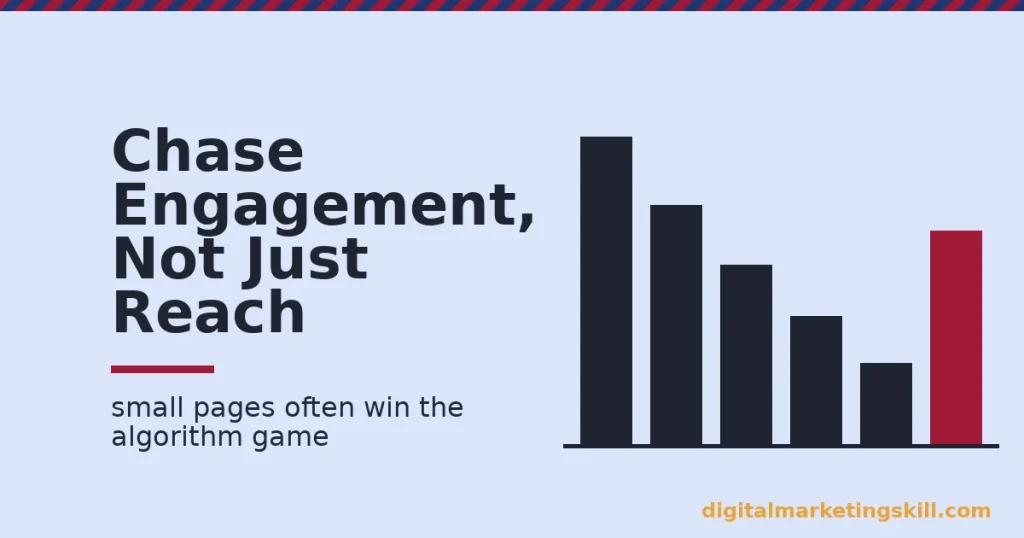
- Smaller pages engage harder. Pages with 0 to 1,000 followers see engagement rates as high as 8.8%. Pages above 1 million followers see roughly 3.8%.
- Format changes the odds. Status updates and Reels currently lead Facebook engagement. Link posts sit at the bottom of the format rankings.
- Consistency beats volume. A review of 14 studies found most brands succeed posting 2 to 5 times a week. Quality and consistency matter more than daily posting.
In this guide
- What Most Facebook Engagement Advice Misses
- Why Facebook Page Engagement Is Harder to Earn Than It Used To Be
- What Differs by Content Format
- How to Improve Facebook Page Engagement by Format
- How to Measure Facebook Page Engagement
- The Decision Rule: Match Format to Your Actual Goal
- What the Algorithm Actually Rewards
- Common Mistakes That Waste Facebook Page Engagement
- Page Setup Habits That Support Facebook Page Engagement
- Frequently Asked Questions About Facebook Page Engagement
- Where to Go From Here
What Most Facebook Engagement Advice Misses
Most lists of Facebook tips repeat the same ten items: post photos, ask questions, run a contest. Few explain why those tactics work, or stopped working, as the algorithm and the format mix changed. A tactic that worked years ago can underperform today simply because the feed now favours different formats.
This guide groups the drivers of Facebook page engagement by mechanism, not by tactic list. It covers why reach fell, what differs between formats, and how to read your own numbers against current benchmarks.
One ground rule first. Published engagement-rate figures vary widely, from 0.063% to 3.8% for the same platform. Different trackers divide by followers, impressions or reach, so treat every benchmark here as a snapshot for comparison, not an absolute target.
Why Facebook Page Engagement Is Harder to Earn Than It Used To Be
Facebook’s feed ranks posts by predicted interest, not by publish time. Early in the platform’s life, nearly everything a page posted reached most of its followers. That changed as the feed filled with more pages, more ads and more competition for the same attention.
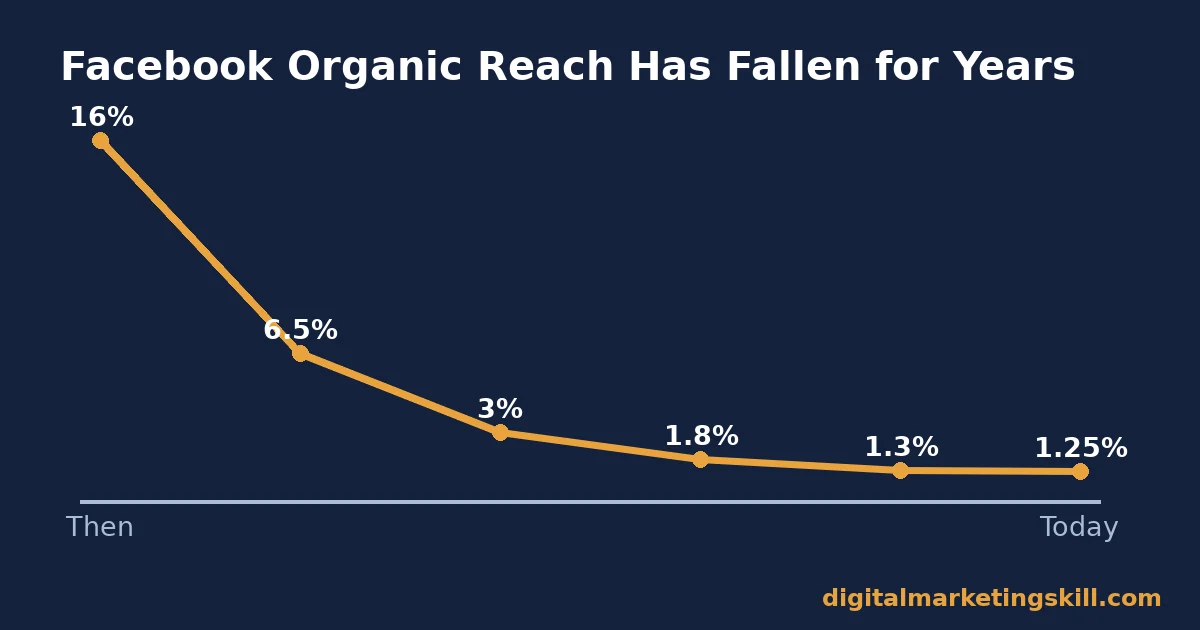
Industry analysis put Facebook’s average organic reach at around 16% of followers in 2012. By 2014 it had fallen to about 6.5%. Current analysis puts it at roughly 1.25% to 1.37%.
The decline is steeper for larger pages. Pages with 100,000 to 1 million followers see a reach rate of around 0.50%. Pages with 1,000 to 5,000 followers still see about 4.35%.
That gap matters for strategy. A large page cannot rely on follower count alone; it needs content the algorithm actively chooses to show. A smaller, newer page has a real advantage here. Its lower reach ceiling is offset by a much higher share of its existing followers actually seeing each post.
What Differs by Content Format
Facebook page engagement is not evenly distributed across post types. The feed algorithm and user behaviour both favour some formats over others. The gap between them is large enough to change which format deserves most of your effort.
Video and Reels: Built for Reach, Not Always for Engagement Rate
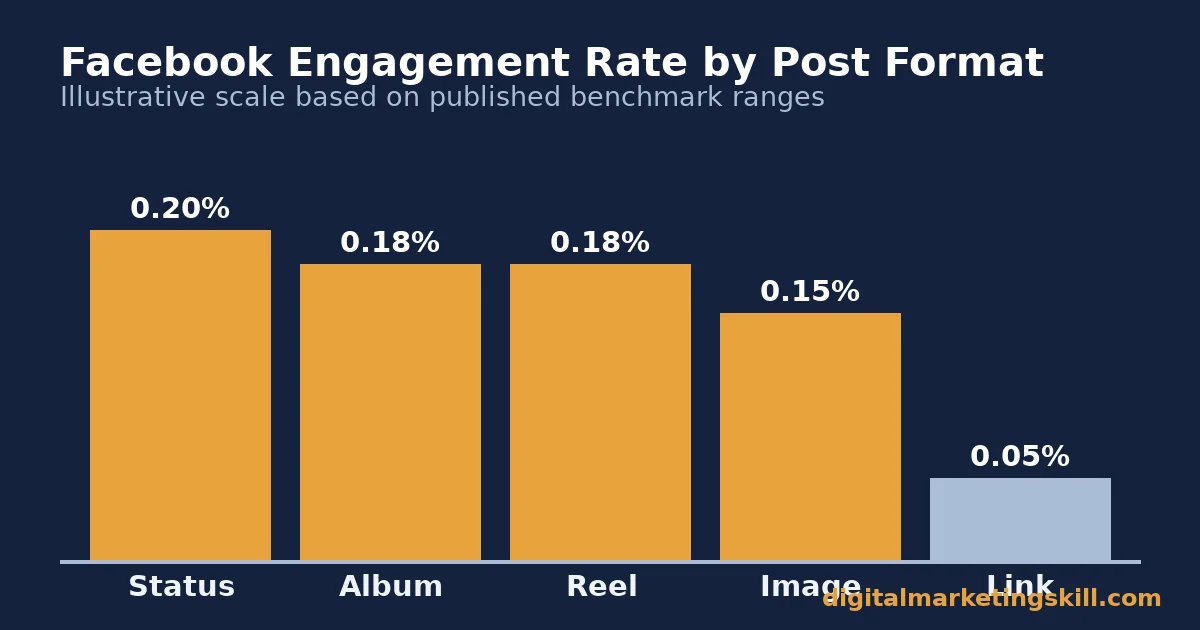
Video posts reach around 135% more users than photo posts, which makes video attractive for visibility. Reels specifically have been gaining ground. Reels engagement rose from about 0.13% to 0.18% between 2024 and 2025, and Reels was the only format to register an engagement increase in one recent quarterly analysis. Some analyses report Reels generating roughly six times the engagement of standard photo posts.
The nuance is that standard video posts do not always beat photos on pure engagement rate. Some analyses still show photo posts slightly ahead of standard video on a like-for-like basis. The format that consistently wins is the short-form Reel, not video in general.
Status Updates and Images: Built for Reliable Engagement
Plain text status updates currently lead Facebook engagement rate in some benchmark sets, ahead of Reels, albums and images. They are quick for a follower to read and react to without leaving the feed. Image posts remain a dependable second choice, consistently outperforming link posts.
Link posts sit at the bottom of nearly every format ranking, often around 0.05% engagement. The likely cause is simple. A link invites someone to leave Facebook entirely, which the platform’s own ranking system treats as a weaker signal of a successful post.
How to Improve Facebook Page Engagement by Format
Knowing which format performs best only helps once you change what you post. The sections below give the specific adjustment for each format category above.
Video and Reels: Lead With Short-Form First
Prioritise Reels over standard long-form video when the goal is engagement rate, since Reels have shown the clearest recent gains. Keep the first two seconds visually interesting. Facebook’s ranking signal depends heavily on whether a viewer stops scrolling.
Use standard video for a message that genuinely needs more time, such as a product demonstration. Accept that its engagement rate may trail photos even while its total reach is higher. Different formats are tools for different jobs, not a single ranked list to always follow in order.
Status and Image Posts: Lead With a Clear Prompt
Write status updates that ask a specific, answerable question rather than a vague one. A concrete prompt is easier for a follower to react to in the few seconds they spend on your post. Pair image posts with a caption that adds information the picture alone does not show, rather than restating what is already visible.
Our guide to landing page design covers the same principle of a clear, single prompt applied to a web page instead of a post.
Link Posts: Use Sparingly and Native-First
Reserve link posts for moments when sending traffic off-platform is genuinely the goal, such as a blog post or a registration page. Do not use them as a default update format. When the goal is simply engagement, post the image or the core message natively, and put the link in a comment or your page’s pinned post instead.
If the goal is a paid push rather than organic reach, our guide to Facebook ad setup covers building that campaign properly.
How to Measure Facebook Page Engagement
Facebook page engagement should be tracked against your own baseline, not just against a published industry average. Each metric below is defined in one sentence, with a note on how to read it.
- Engagement rate by reach. Reactions, comments, shares and clicks divided by the number of people a post reached. This is the most comparable figure to the benchmarks in this guide, since most of them use reach, not follower count, as the denominator.
- Engagement rate by followers. The same total divided by your follower count instead. It is more volatile for small pages, because one post can swing the rate sharply, but it is useful for tracking your own page over time.
- Organic reach rate. The share of your followers who saw a post without paid promotion. A falling reach rate over several months, even with stable engagement, signals the algorithm is deprioritising your content or format mix.
- Format mix performance. Engagement rate broken out by post type. This shows which formats are actually earning attention on your specific page, rather than assuming the general benchmark applies.
- Comment-to-reaction ratio. The number of comments relative to reactions. A rising ratio generally signals deeper engagement, since a comment takes more effort from a follower than a like.
Reading These Numbers Together
Start with organic reach rate. A falling reach rate limits every other metric before engagement even has a chance to happen. Once reach is stable, compare engagement rate across your last ten posts by format. Shift effort toward whichever format is already outperforming on your page, even if it differs from the general benchmark.
The Decision Rule: Match Format to Your Actual Goal
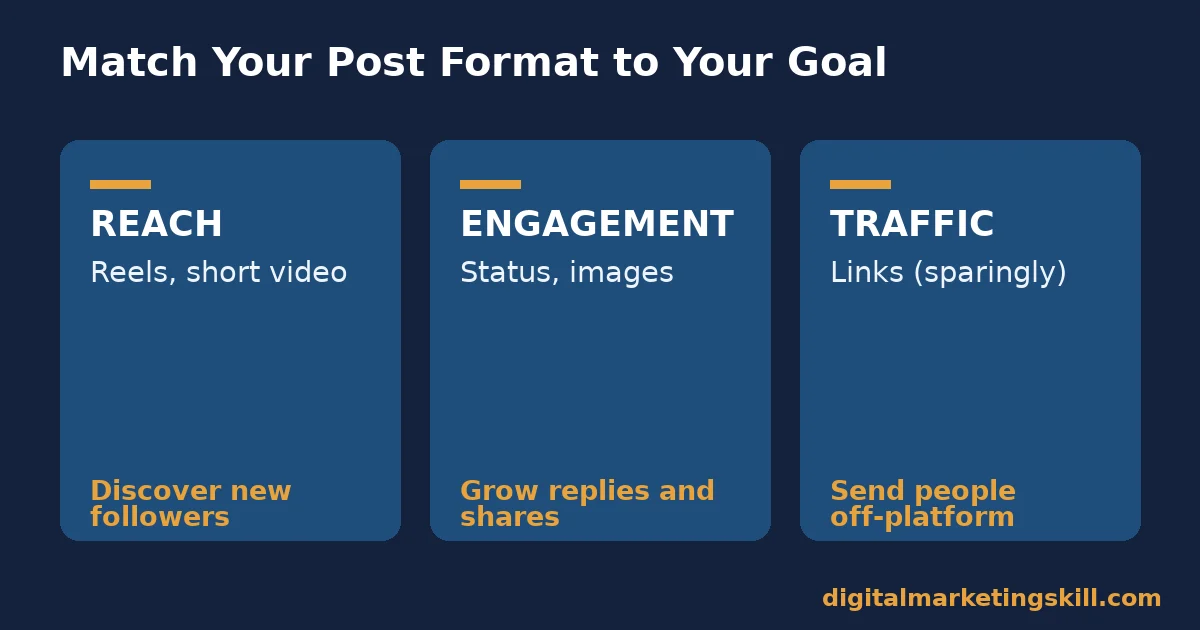
If you remember one rule from this guide, make it this one. Use Reels and short video when the goal is reach and discovery. Use status updates and images when the goal is a reliable engagement rate from an existing audience. Reserve link posts for traffic goals, not engagement, and expect a lower engagement rate in exchange.
Here is an illustrative example, with invented numbers. A page with 5,000 followers posts a mix of five link posts and two images each week. Its average reach rate sits near 2%. It switches to two Reels, two image posts and one status update each week, moving link posts to a pinned comment instead.
Three months later, reach rate rises to roughly 4%, matching what small pages typically see. The comment-to-reaction ratio nearly doubles too, because status updates draw more direct replies than links did.
What the Algorithm Actually Rewards
Facebook’s ranking system does not simply count likes. It weighs how quickly people react after seeing a post, how long they linger on it, and whether they go on to visit the page itself. A post that earns a slow trickle of likes over a week signals far less to the algorithm than one that earns the same number of reactions within the first hour.
That is why the first hour after publishing matters more than most pages treat it. Reply to early comments immediately, and consider timing posts for when your specific audience is already active, rather than a generic recommended time slot. Early signals compound, because a post that performs well in its first hour is more likely to be shown to a wider slice of your remaining followers.
Common Mistakes That Waste Facebook Page Engagement
Most pages lose engagement to a handful of repeatable mistakes rather than to the algorithm alone.
Mistake One: Posting Too Often With Too Little to Say
Research across the posting-frequency studies above found that over-posting leads to scroll-past behaviour. This is especially true when content feels repetitive or promotional. Two genuinely useful posts a week usually outperform seven thin ones, because each post competes with the last for the same follower’s attention.
Mistake Two: Defaulting to Link Posts
Treating Facebook as a traffic-referral channel by default pushes engagement rate toward the weakest format on the platform. Save the link post format for genuine traffic goals. Post the substance of the update natively the rest of the time.
Mistake Three: Ignoring Your Own Format Data
A page that never checks its own format mix keeps repeating whatever format it started with, regardless of whether that format still works. Pull your last ten posts by format once a month and compare their engagement rate directly. A general benchmark can miss what is actually happening on your specific page.
Mistake Four: Not Replying to Comments
A comment that gets no reply signals to both the commenter and the algorithm that the conversation ended. Replying, even briefly, keeps the thread active. It gives the post another chance to surface in the commenter’s own network. Our guide to social media marketing risks covers other engagement habits that quietly damage a page’s standing.
Mistake Five: Chasing Likes Instead of the Comment Ratio
A page fixated on raw like counts often misses a more useful signal. A rising comment-to-reaction ratio shows followers are investing real effort, not just tapping a button. Track that ratio alongside your engagement rate, not instead of it, because both tell a different part of the same story.
Mistake Six: Reusing the Same Caption Style on Every Post
A page that writes every caption the same way, regardless of format, trains its audience to skim rather than read. Vary caption length and tone between a short status update and a longer image caption. Treat each post’s caption as its own decision rather than a template to fill in.
Small variation keeps the feed feeling like a real page, not an automated feed of near-identical posts. That distinction shows up directly in Facebook page engagement over time.
Page Setup Habits That Support Facebook Page Engagement
Format choices matter most, but a handful of page-level habits either help or quietly undercut everything above. These rarely get fixed because they are set once and forgotten.
Keep Your Profile and Cover Images Current
A stale profile or cover image is a small thing that still costs Facebook page engagement, because a follower judges a page’s activity level at a glance before reading a single post. Update the cover image seasonally or around major announcements, even when the change is small, so a returning visitor sees signs of an active page.
Use the Pinned Post Deliberately
The pinned post is the first thing most new visitors see, so treat it as a standing introduction rather than whatever happened to be posted last. Pin a post that explains what the page offers, or the link you want people clicking, and update it every few months rather than leaving the same pin for years.
Watch Your Response Time, Not Just Your Reply Rate
Facebook surfaces a page’s typical response time to visitors, and a slow or badly rated page can quietly cost both trust and Facebook page engagement before a visitor even reads a post. Set a realistic response window, even if it is a day rather than an hour, and stick to it consistently rather than replying in bursts.
Consider a Connected Group for Your Most Engaged Followers
A Facebook Group tied to your page gives your most engaged followers a space with its own, typically higher, engagement norms than the main page feed. It will not replace page-level Facebook page engagement, but it can become a reliable source of comments, shares and early feedback on new content before a wider post goes out.
Frequently Asked Questions About Facebook Page Engagement
What counts as a good Facebook page engagement rate?
An organic engagement rate above roughly 0.15%, measured against reach, puts a page at the current median. Above about 0.30% means the content is genuinely resonating relative to typical pages. Compare your own trend over time too, since published averages vary widely by measurement method.
Why has my Facebook reach dropped even though my follower count is growing?
Organic reach has fallen industry-wide, from around 16% of followers in 2012 to roughly 1.25% to 1.37% today. A growing follower count does not reverse that trend on its own. The algorithm still ranks each post individually based on predicted interest.
Should I post more video or more photos for engagement?
Short-form Reels currently show the clearest engagement gains. Standard long-form video does not always beat photos on engagement rate, even though it reaches more people. Test both formats on your own page and follow whichever is actually outperforming there.
How often should a business post on Facebook?
Most brands succeed posting two to five times a week, according to a review of 14 posting-frequency studies. Consistency and content quality matter more than hitting a specific number. Choose a frequency you can sustain without filler posts.
Do I need to run Facebook ads to get engagement now?
Not strictly, but paid promotion compensates for how far organic reach has fallen, especially for larger pages where organic reach rates can sit near 0.50%. Smaller pages can still earn meaningful organic engagement by focusing on the formats proven to work and posting consistently.
Why do my link posts get so little engagement?
Link posts invite a follower to leave Facebook, which tends to score weaker in the platform’s ranking signals than a native post. Link posts often sit near the bottom of format benchmarks, around 0.05% engagement. Post the core content natively and place the link in a comment instead when traffic is not the primary goal.
Can a small Facebook page actually compete on engagement?
Yes, often more easily than a large one. Pages with 0 to 1,000 followers see engagement rates as high as 8.8%, far above the roughly 3.8% seen on pages above 1 million followers. A smaller page’s advantage is that a much larger share of its existing audience actually sees each post.
Where to Go From Here
Facebook page engagement comes down to matching format to goal and reading your own numbers instead of chasing a single tactic list. Check your last ten posts by format this week. Identify which one is actually outperforming on your page, then shift your next month’s content mix toward it before adding anything new.
If you want a structured way to learn Facebook engagement alongside the rest of paid and organic social strategy, the Digital Marketing Skill Institute’s Master Diploma in Digital & AI Marketing covers social media marketing, content and analytics together. It includes unlimited one-on-one coaching and mentoring, and real project work inside a U.S. company.
The diploma is dual US and UK accredited and recognised in more than 100 countries, so you can study and apply it anywhere in your country, 100% online. Explore the course library at digitalmarketingskill.com, read graduate outcomes on the reviews page, browse more guides on the blog hub, and when you are ready, apply here wherever you live.
Every figure in this guide was checked against its original source before publication. Figures marked as illustrative are invented examples, not real results.
![9 Amazing Digital Marketing Skills to Make Money Online [With Proof]](https://digitalmarketingskill.com/wp-content/uploads/2019/07/9-Amazing-Digital-Marketing-Skills-to-Make-Money-Online-With-Proof-17.png)