Good facebook status ideas are not random one-liners. They follow a small set of wording patterns that make a reply easy to type. Swap a vague line for a narrow prompt. Or add one concrete detail. The same idea then earns more comments, not just more likes. This guide shows which patterns work, and why.
Key Takeaways
- Instagram posts with captions under 30 words earned a higher engagement rate. That finding comes from Social Insider’s analysis of over 9 million posts from more than 82,000 business pages.
- Meta’s own comment-ranking announcement states that comments get shown more prominently when they have interactions from the page or person who posted. That rewards replying, not just posting and walking away.
- Posts where a page replied to comments earned about 9.5% more reactions than posts without replies. Buffer found this across more than 1 million Facebook posts and 97,427 profiles.
- A Zazz Media analysis, compiled by Sendible, found Facebook posts with emojis saw a 57% increase in likes. Comments and shares also rose by 33%.
- One unnamed health brand went from roughly 300 to 3,000 comments a day. The change came from automating a follow-up question on every reply, with the same content output and the same team, per a published replient.ai case study.
In this guide
- The Real Gap in Most Facebook Status Idea Lists
- Why Facebook Status Wording Changes the Reply Count, Not Just the Tone
- How Two Facebook Status Types Differ
- Fix the Weak Spot In Each Status Type
- Measure What a Status Is Actually Doing
- The One Decision Rule For Picking a Status Type
- A Real Case: A US Health Brand’s Comment Volume
- Frequently Asked Questions About Facebook Status Ideas
- Build the Skills Behind Every Status You Write
The Real Gap in Most Facebook Status Idea Lists
Most lists of facebook status ideas are just examples. A reader copies a line, posts it, and gets a handful of likes. Nothing explains why one wording earns ten comments and a near-identical one earns none. The list treats every line as interchangeable, when in practice each one is built around a different mechanism.
That gap matters because the fix is not “write better jokes.” It is picking the right wording pattern for the result you want, then applying one specific adjustment to that pattern. A list of forty examples cannot teach that. A short set of patterns, each with its own fix, can.
This is an informed inference from published platform data, not a guaranteed formula. Results vary by audience size, niche, and posting history. So treat every pattern here as a starting point, not a rule that works the same way every time. Test it on your own page first.
The real skill is narrower than “write something fun.” It is choosing a wording pattern that matches the reaction you actually want. Sometimes that is a comment. Other times it is a share. Even a quick like is fine, as long as you know which one you are aiming for before you write the line.
Why Facebook Status Wording Changes the Reply Count, Not Just the Tone
A like costs a reader one tap. A comment costs typing effort. So the wording of a status decides how much of that effort it actually asks for.
Consider a vague line like “feeling good today.” It gives a reader nothing to respond to. A narrow prompt like “one word for how today is going” gives them a ready-made answer instead. The second version removes the blank-page problem a comment box usually creates. Because the reader already knows what to type, they type it.
Meta’s own description of how it ranks comments backs this up. Its own announcement on public comments states that comments are shown more prominently when they have interactions from the page or person who posted. A status that invites a reply, and then gets a reply back from the page, earns more visibility for the whole thread. So the wording is not just style. It sets up a chain of interactions the platform rewards, and that chain starts with a prompt simple enough to answer in five seconds.
This also explains why so many facebook status ideas that look clever on paper fall flat in practice. A pun can be genuinely funny, yet still give the reader nothing specific to add. The reader smiles, taps like, and moves on. A prompt, by contrast, always leaves a door open for one more reply.
How Two Facebook Status Types Differ
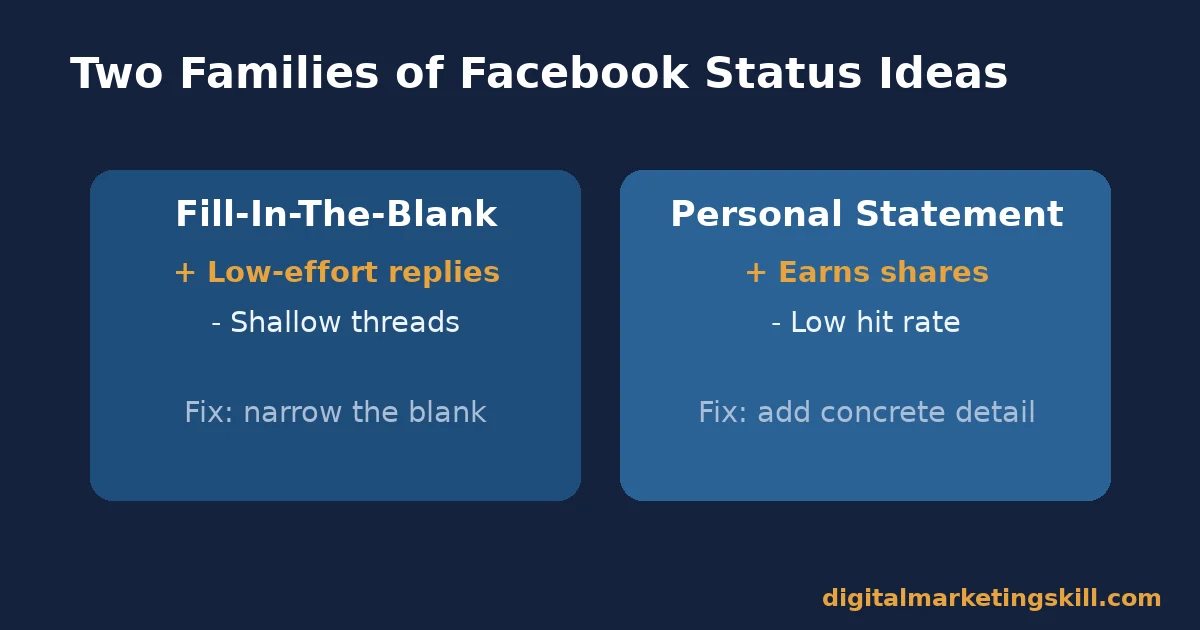
Most facebook status ideas fall into one of two families, even when the surface wording looks different. Knowing which family a line belongs to makes the result far more predictable.
Take two lines built from the same underlying idea, a love of coffee. “What’s your coffee order?” sits in the fill-in-the-blank family. “I have made peace with the fact that I am not a functioning adult until coffee number two” sits in the relatable-statement family. Same topic, two different jobs, two different results.
Fill-In-The-Blank Prompts: Built For Low-Effort Replies
A fill-in-the-blank status hands the reader a sentence with one word missing. “My go-to comfort food is ___.” It works because the reader does not have to invent an opinion from scratch. They just have to type one word into a slot that is already built for them.
The trade-off is depth. These prompts rarely produce a long, thoughtful comment thread. Instead, they produce a high volume of short replies. That volume is exactly what makes the format useful for a quick, visible engagement boost on a slow posting day. A page that posts one of these prompts weekly also builds a habit among its regulars, who learn to expect an easy, low-effort reason to show up.
Personal, Relatable Statements: Built For Shares
A personal or relatable statement describes a specific, recognisable moment. “The real workout is carrying all the shopping bags in one trip.” It works because a reader sees themselves in it, and then wants their own friends to see it too.
The trade-off here is hit rate. A generic version of this format falls flat. That happens because relatability depends on specific, concrete detail, not a broad mood. A vague attempt reads as filler, not as a shared experience, and a reader scrolls past filler without a second thought. When it does land, though, a relatable status can travel well beyond a page’s existing followers, because each share puts it in front of an entirely new audience.
Fix the Weak Spot In Each Status Type
Fill-In-The-Blank Prompts: Lead With A Specific, Narrow Blank
The low-depth problem in fill-in-the-blank prompts has a direct fix. Narrow the blank so there is only one obvious way to answer it. “Name a snack you refuse to share” works better than “name something you like.” The second version is so open that a reader has to stop and think, and thinking defeats the whole purpose of the format.
Pair a narrow blank with a reply from the page itself on the first few comments. That reply signals the thread is active. Per Meta’s own ranking signal, an active thread gets more prominence in the feed. A page that replies to the first five comments on a new fill-in-the-blank prompt, every time it posts one, tends to see that habit compound over a few weeks, as regulars learn the page actually reads what they write.
Personal Statements: Lead With A Concrete Detail, Not A Generality
The low hit-rate problem in personal statements has a matching fix. Swap a general claim for one specific, visual detail. Instead of “mornings are rough,” try “the real villain of my morning is the snooze button, every single time.” The specific detail gives a reader a precise moment to recognise. A mood that is too broad gives them nothing to picture at all.
Draft three versions of the same statement, each with a different concrete detail. Then post whichever one tests best with your own audience. The format rewards specificity more than cleverness, and specificity is easy to test for. One practical trick: read the line aloud. If it still sounds like something a real person would actually say out loud to a friend, the detail is probably specific enough. If it sounds like marketing copy, it needs another pass.
Measure What a Status Is Actually Doing
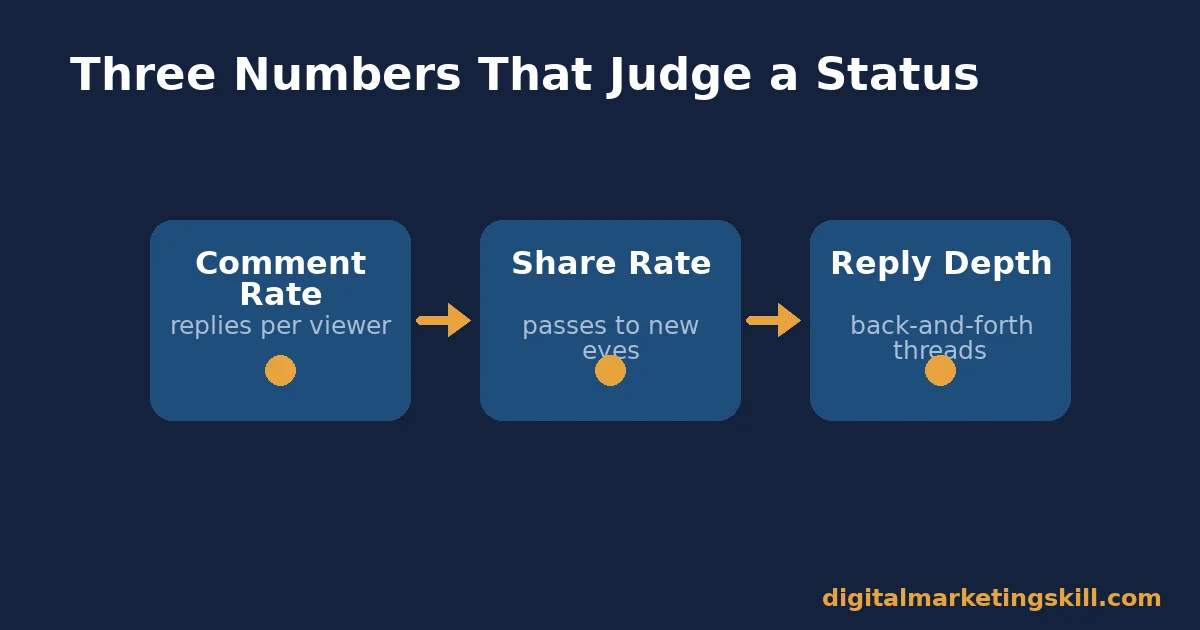
Three numbers show whether a facebook status idea is actually working. Each one tells you something different, so none of them should be read alone.
Comment rate is the share of viewers who left a reply. Fill-in-the-blank prompts usually win here. That happens because the reply effort is so low that almost any viewer can clear the bar.
Share rate is the share of viewers who passed the status to their own network. Personal, relatable statements usually win here instead. A share means a reader wants their own friends to see it, not just react to it themselves. Venngage’s survey of 105 marketers found that original, relatable content consistently outperformed generic or stock material, which matches the pattern here.
Reply depth is how many comments turn into a short back-and-forth, rather than a single one-off reply. This is the number Meta’s own ranking signal rewards most. It favours comments that get a reply from the page, or from friends of the poster, over comments that just sit there unanswered.
Tracking Facebook Status Ideas Without Special Tools
Track comment rate and share rate separately, because each one catches something the other misses. A status with a high comment rate but a near-zero share rate is doing a different job than one with the reverse pattern, even if both look like “good engagement” at a glance.
A simple way to track this without special software: log each post’s comment count and share count in a spreadsheet, next to which status type it was. After ten or twenty posts, a pattern usually appears. Most pages find that their best facebook status ideas cluster clearly into one family or the other, rather than spreading evenly across both.
The One Decision Rule For Picking a Status Type
If the goal is comments on a specific post, default to a narrow fill-in-the-blank prompt. If the goal is reach beyond your current audience, default to a specific, relatable personal statement. The two formats rarely deliver both outcomes equally well on the same post, so pick one goal before you start writing.
Illustrative, invented numbers: imagine two versions of the same idea posted to similar-sized audiences. A fill-in-the-blank version might draw 40 quick comments and 2 shares. A relatable-statement version of the same idea might draw 8 comments and 25 shares instead. Neither result is wrong. They are simply optimised for different outcomes. So the right choice depends on what the post is actually for, not on which number looks bigger on its own.
A Real Case: A US Health Brand’s Comment Volume
An unnamed US health brand increased its daily Facebook comment volume from roughly 300 to 3,000, a tenfold jump. The brand did this by automating a follow-up question on every comment reply, according to a published replient.ai case study. It kept the same content output and the same team. The change was entirely in how replies were worded, not in how often it posted.
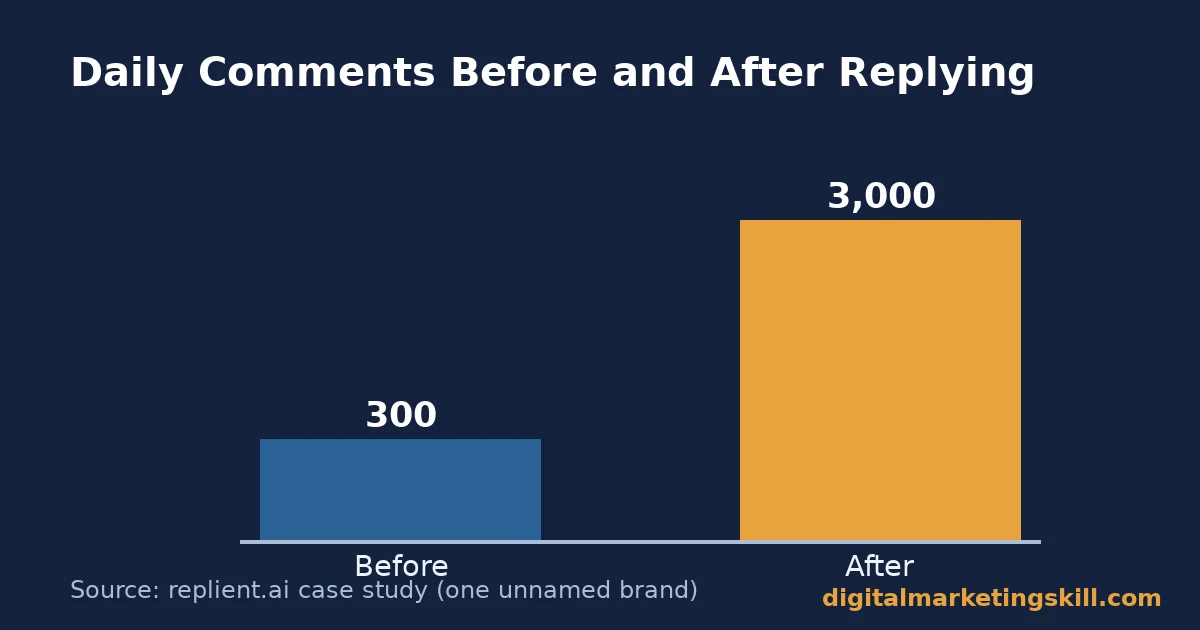
The case study does not name the company. It is also published by the vendor whose own tool powered the automation, so treat the specific multiple as one company’s result rather than a guaranteed outcome. The case study itself notes that matching this manually would have needed roughly 15 extra staff. That detail is a useful reminder that the underlying mechanism, a reply that invites another reply, works whether it is typed by a person or triggered by software.
The lesson for anyone writing facebook status ideas by hand, without automation, is the same at a smaller scale. A single well-worded reply to an early comment can nudge a whole thread toward more activity, because it shows the page is actually present, not just posting and disappearing.
Frequently Asked Questions About Facebook Status Ideas
What makes facebook status ideas actually get comments?
Mostly, a low-effort reply path. A status that gives the reader an obvious, specific thing to type, such as one word or one memory, earns more comments. One that asks them to invent an original thought from nothing usually does not.
Should facebook status ideas always include a question?
No. A question works well for comment volume. However, a strong relatable statement with no question at all can still earn plenty of shares. Pick the format based on whether the goal is comments or reach.
How long should a Facebook status be?
Short, in most cases. Related caption research on Instagram found posts under 30 words earned a higher engagement rate than longer ones. Facebook audiences tend to respond the same way. A quick, specific line usually beats a long paragraph.
Do emojis actually help facebook status ideas get more engagement?
The available data suggests yes. However, the figures come from a secondary compilation rather than a single controlled study, so treat the exact percentage as directional. A status written entirely in emoji with no words, meanwhile, usually confuses more readers than it engages.
Is it worth replying to every comment on a status?
Early replies matter most. Meta’s own description of comment ranking rewards replies from the page or poster. So responding to the first few comments on a fresh post does more for that post’s visibility than replying to comments on something posted days ago.
Can the same facebook status idea work on Instagram or other platforms too?
Often, yes, with light editing. The underlying wording pattern, a narrow prompt or a specific relatable detail, is not platform-specific. The main adjustment is length and tone. A caption-style platform tolerates a slightly longer line than a status feed built around quick scrolling.
How many facebook status ideas should a page test before picking a favourite format?
A dozen is usually enough to see a pattern. Post a mix of fill-in-the-blank prompts and relatable statements over a few weeks, log the comment and share counts, and look for which family consistently outperforms on your specific page. Audiences differ enough that a format popular elsewhere will not always be the best fit for yours.
Why do some joke or meme-style facebook status ideas get huge reach with no clear reason?
Timing and existing momentum matter alongside wording. A joke that lands at the right cultural moment, or on a page that already has an active comment culture, can outperform a technically better-written status posted on a quiet page. Wording improves the odds. It does not guarantee virality on its own.
Do facebook status ideas need to be funny to work?
No. Humour helps, but curiosity and relatability drive just as many replies. A sincere question about a shared frustration, like a long commute or a Monday morning, often earns as many comments as a joke, because the reply still feels easy and obvious to write.
Build the Skills Behind Every Status You Write
Writing facebook status ideas that earn real replies is one small piece of a much broader skill set, taught across the Digital Marketing Skill Institute’s Master Diploma in Digital & AI Marketing.
The program is built from four AI-powered tracks: AI-Powered Social Media Management and Advertising, AI-Powered Lead Generation and Email Automation, AI-Powered Google Specialist, and AI-Powered WordPress and SEO Specialist. Together, these total ten courses, with a Full Stack option for students who complete all four.
Every track includes unlimited 1-on-1 coaching and mentoring, a U.S. Project Internship with a verified U.S. Work Reference Letter, and dual US and UK accreditation recognised in more than 100 countries. The program runs 100% online, so you can build these skills from anywhere in your country.
Compare this with a broader look at Facebook post ideas by format, go deeper on Facebook engagement strategies, or see what moves Facebook Page engagement more broadly. Keep the ideas flowing with this content ideas process, or sharpen the writing itself with these copywriting skills. Read real outcomes on the reviews page, or go straight to the application page. Learn more about the Institute at digitalmarketingskill.com, wherever you live, or start your own program search from the homepage at any time.
Every figure in this guide was checked against its original source before publication. Figures marked as illustrative are invented examples, not real results.