
Most advice on how to get customers online treats every channel the same. Post content, run ads, wait. But that skips the real question: which channel earns trust fast, and which one only earns a click? This guide answers that with the numbers behind each channel, plus one decision rule for where to spend your next hour.
Key Takeaways
- 97% of consumers read online reviews before choosing a business, and 41% always check reviews first. A thin review profile quietly costs you customers before they ever see your offer (BrightLocal survey of 1,002 US consumers).
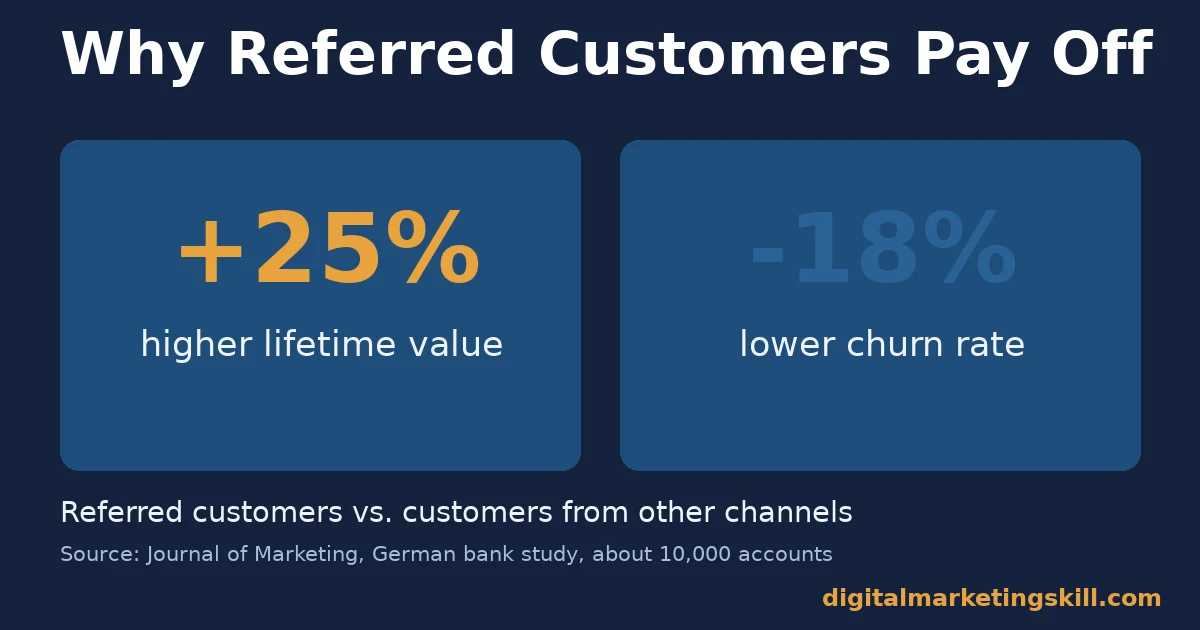
- Referred customers carry about 25% higher lifetime value and churn 18% less often than other customers. That comes from a 33-month study of nearly 10,000 bank customers in the Journal of Marketing.
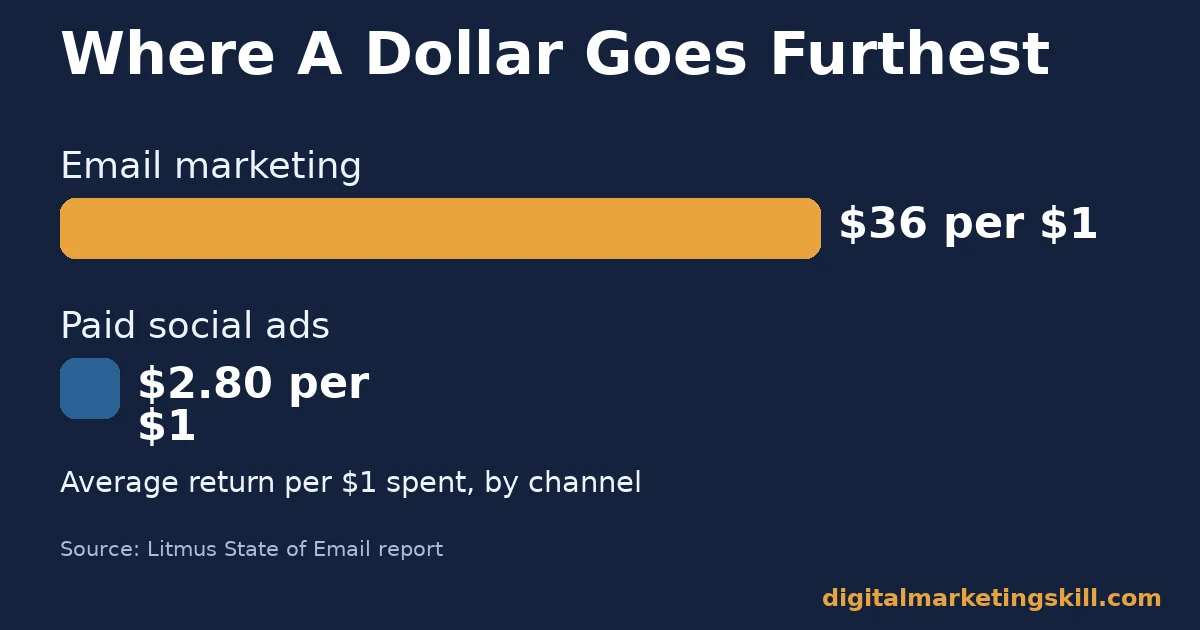
- Email marketing returns $36 for every $1 spent. That is roughly 13 times what paid social advertising returns, per Litmus’s State of Email report.
- 70% of online shopping carts are abandoned before checkout, based on an aggregate of 50 studies by the Baymard Institute. Recovering even a fraction of them beats chasing fresh traffic.
- 65% of marketers work at companies that blog, and 49% of those companies publish specifically to generate leads, per HubSpot’s State of Blogging report of over 500 marketers.
In this guide
- What Most “How To Get Customers Online” Lists Miss
- How Getting Customers Online Actually Works
- What Differs By Channel
- How To Fix Each Channel, In Order
- Common Mistakes That Quietly Block You From Getting Customers Online
- How To Measure Whether It’s Working
- The One Decision Rule: Match The Channel To Your Cash Position
- A Real Case: Getting Customers Online Without An Advertising Budget
- Frequently Asked Questions About How To Get Customers Online
- Turn These Channels Into A Repeatable System
What Most “How To Get Customers Online” Lists Miss
Search this topic and you get fifteen tactics in a row. Blog. Advertise. Partner. Discount. Repeat. What’s missing is a reason to pick one over another.
Blogging and paid ads both bring traffic. But they run on completely different timelines and cost curves. Treat them the same way and you waste budget on the slow one and patience on the fast one.
To get customers online well, you need to know which channels compound, meaning they get cheaper and more effective the longer you run them. It also names which ones reset to zero the moment you stop paying. Every figure below comes from a named study with its scope stated. Where a number is an estimate rather than a measured fact, it is labelled “illustrative, invented numbers.”
Worldwide, the channels behave the same way no matter where your customers live. A referral still beats a cold ad. A review still removes hesitation. Only the specific tools and currencies change from country to country, not the underlying math.
None of this is one fixed formula. The mix that helps any one business get customers online fastest depends on its cash, its sales cycle, and whether it already has customers to ask for a referral. What follows is a method for working out that mix for your own numbers.
How Getting Customers Online Actually Works
Every customer you win online passes through three stages. First they see you, which is awareness. Then they trust you enough to act, which is conversion. Then they stay long enough to be worth more than it cost to win them, which is retention. Most businesses over-invest in the first stage and under-invest in the other two.
Customer acquisition cost, or CAC, is total spend on a channel divided by the customers it produced. A channel with a low CAC but no retention looks cheap. Then it quietly bleeds money, because you keep replacing the same customers instead of building a base. That is why every comparison below pairs a cost signal with a trust or retention signal, never cost alone.
This also explains why two businesses can run the same tactic and get different results. A business with a strong review profile and an engaged email list converts paid traffic far better than one running the same ads to a page with no social proof. The ad is doing only one-third of the job; the rest of the system does the other two-thirds.
What Differs By Channel
Each channel below does one job better than the others when you try to get customers online. Picking the right one first means matching the job to where your business stands right now, not which tactic is trendiest.
Content and SEO: Built For Compounding Traffic
A blog post keeps attracting visitors from search long after you publish it, which helps you get customers online for years, not just one week. 65% of marketers work at companies that maintain a blog, and 49% of those publish specifically to generate leads, according to HubSpot’s State of Blogging report, which surveyed over 500 marketers.
The payoff is slow at first. Then it accelerates as pages pick up rankings and links. Our guide to content marketing for startups walks through building that first batch of pages.
The limit is lead time. A new page rarely drives meaningful traffic in its first weeks. Content alone cannot fix an empty pipeline this month.
Paid Search and Social: Built For Speed, Not Compounding
Paid traffic is the opposite trade. It starts the moment you turn it on, and it stops the moment you turn it off. Paid search and paid social usually cost more per customer than organic or referral channels, because every click is purchased fresh with no carryover once the budget ends.
Use paid channels to test an offer or message quickly. Once you know it converts, shift that message into content and email instead of running paid spend forever on an unproven page. Send every test click to a page built to convert, not your homepage; this guide to landing page optimization covers that step.
Referrals and Reviews: Lead With Trust, Not Reach
97% of consumers read reviews before choosing a business, and 41% always do. That is a sharp jump from the previous measurement, according to BrightLocal’s Local Consumer Review Survey of 1,002 US consumers. Reviews do not create awareness the way ads do. They remove hesitation at the exact moment someone was already about to decide.
That trust effect reaches beyond reviews. Nielsen’s global trust-in-advertising study, covering tens of thousands of respondents across dozens of countries, found that recommendations from people you know outrank every paid form of advertising for trust.
Referral programs go further than reviews, because they bring a pre-qualified customer, not just a convinced one. A Journal of Marketing study tracked nearly 10,000 new customers at a major bank over 33 months. Referred customers delivered about 25% higher lifetime value and 18% lower churn than customers from any other channel. The effect comes from similarity: satisfied customers tend to refer people with needs like their own.
Email: Lead With Margin, Not Volume
Email marketing returns $36 for every $1 spent, against roughly $2.80 for paid social, according to Litmus’s State of Email report. The gap exists because you already own the list. You are not bidding against competitors for attention, and every send reaches people who already chose to hear from you. Starting a list from zero? Our email marketing guide for beginners covers the setup.
The constraint is list size. Email cannot create customers out of nothing. It converts attention you already earned, through content, ads, or a first purchase, into repeat revenue.
How To Fix Each Channel, In Order
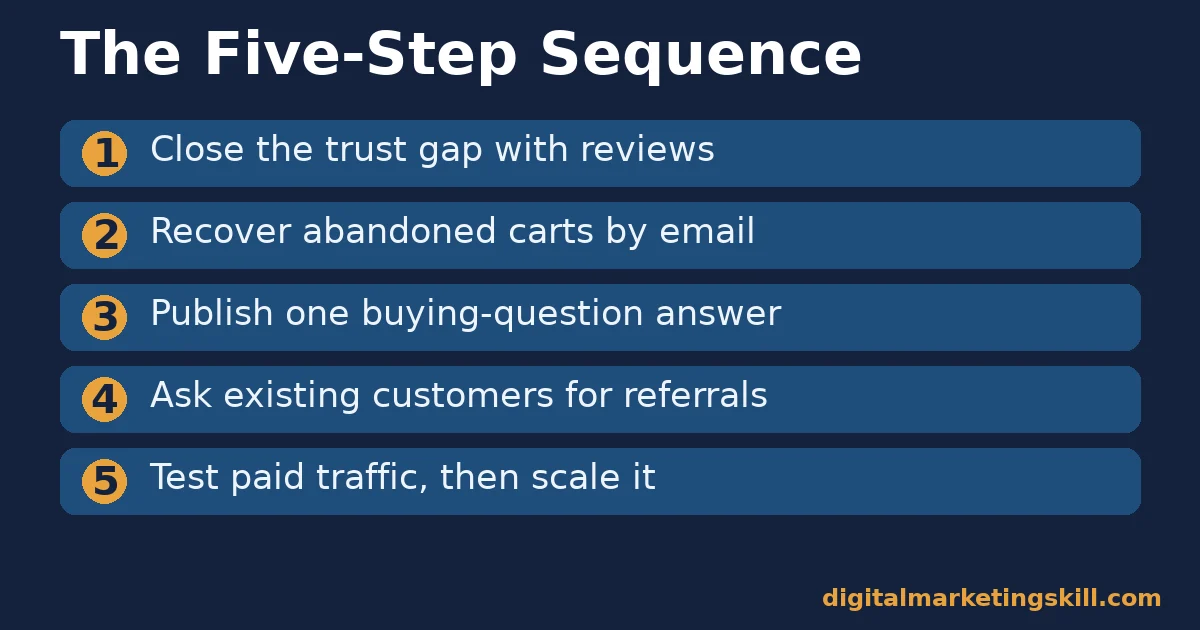
Run these steps in sequence, not all at once. Each step makes the next one cheaper, and each is a concrete way to get customers online before every channel has had time to mature.
Step 1: Close The Trust Gap Before You Spend On Traffic
Ask every recent customer for a review on a third-party platform, not only your own site, within a week of purchase while the experience is still fresh. A visible, answered review profile raises conversion on every other channel you run next. This is the cheapest fix available before you spend a cent on ads.
Step 2: Recover The 70% You’re Already Losing
70% of carts get abandoned before checkout, an average across 50 studies compiled by the Baymard Institute. One automated reminder email to anyone who added an item but did not buy wins back customers you already paid to attract once.
That beats buying a new visitor, because the traffic cost is already sunk. If traffic is thin to begin with, work through this list of ways to increase website traffic for free before you add any paid spend.
Step 3: Publish One Piece Of Content Aimed At A Buying Question
Pick one question your best customers ask before they buy, not a generic topic. Answer it fully on your website. This is slower than ads, but it keeps paying back long after a single campaign ends.
Step 4: Ask Existing Customers For Introductions, Not Just Reviews
Ask a simple, specific question after a good experience: who else do you know with this problem? That converts existing goodwill into new customers at a fraction of paid-channel cost. These new customers also arrive with the retention advantage referred customers show in the research above.
Step 5: Use Paid Traffic To Test, Then Retire It Or Scale It
Run a small paid budget only to validate one offer or headline against real clicks. If it converts, move that winning message into your organic content and email. If it does not convert, you spent little to learn that, instead of scaling a guess.
Common Mistakes That Quietly Block You From Getting Customers Online
Most businesses that struggle to get customers online are not missing a tactic. They are running a tactic the wrong way. Five mistakes show up again and again:
- Running every channel at once, with no order. Split a small budget across ads, content and referrals at the same time, and none of them gets enough attention to work. You also cannot tell which one produced a customer.
- Ignoring reviews until a complaint shows up. 97% of consumers read reviews before they buy (BrightLocal). A profile with no reviews, or only old, unanswered ones, actively repels the traffic every other channel sends you.
- Treating paid traffic as a growth engine instead of a test. Paid spend that nobody analyses for which message converted is money spent to learn nothing. It should always answer one specific question about an offer or headline.
- Never asking for referrals directly. Wait for happy customers to refer others on their own, and you leave the highest-LTV channel in this guide almost entirely unused. Most satisfied customers simply never think to ask.
- Measuring traffic instead of LTV-to-CAC. A channel that brings many visitors but few customers worth keeping looks productive on a traffic dashboard while it quietly loses money underneath.
How To Measure Whether It’s Working
Three numbers show whether a channel is helping you get customers online profitably, each defined in one sentence:
- Customer acquisition cost (CAC): total spend on a channel over a period, divided by the customers it produced in that period. Compare it against what that customer is worth, never against other channels alone.
- Customer lifetime value (LTV): the total revenue, or ideally gross margin, a typical customer generates over the whole time they stay with you, not just their first purchase.
- LTV-to-CAC ratio: LTV divided by CAC. A ratio below 1 means the channel loses money on every customer. Most healthy channels run at 3 or higher, and referral and review-driven channels tend to post the highest ratios of all.
Track these per channel, not blended across your whole business. Otherwise a strong referral channel can mask a paid channel that is quietly losing money.
Illustrative, invented numbers to show the method: a paid channel that costs $120 to win a customer worth $300 over their lifetime has a ratio of 2.5. That sits below the healthy threshold of 3.
A referral channel might cost $20 per customer, say a small thank-you gift. If it wins a customer worth $375, thanks to the lifetime-value premium above, its ratio is nearly 19. Compare ratios like these, not raw cost per customer. That is how you see where your next dollar should go if the goal is to get customers online profitably, not just quickly.
The One Decision Rule: Match The Channel To Your Cash Position
Need customers inside two weeks? Your cash position decides the channel more than anything else does. Low runway rules out content, because content’s payoff lands in months, not days. Healthy runway rules out an all-paid strategy, because every paid dollar must be spent again next month to hold the same customer count.
This is the single most useful lens in this guide. Before picking any tactic, ask two questions: how many weeks of cash do you have left, and do you already have past customers to ask for reviews and referrals?
Those two answers, not industry trend, decide whether reviews, referrals, content or paid testing gets your next hour of work. Skip this question and you tend to copy whatever tactic a competitor runs, even when your cash position and customer list look nothing like theirs.
Illustrative, invented numbers to show the arithmetic: a business with 60 days of cash and no customer list should spend most of this week on reviews and a referral ask. Both are near-zero cost and immediate. It should use a small paid-test budget to validate one offer, then start the content investment once that test confirms a message that converts.
A business with 12 months of runway can reverse that order. It lets content and email compound while paid stays a minor testing budget.
A Real Case: Getting Customers Online Without An Advertising Budget
A Digital Marketing Skill Institute student, Esther Elueme, built her own online presence from nothing. In a month, she built a website, scheduled social media posts, added her business niche to Google Search, and optimized her page for the keywords her customers searched for, as published on the Institute’s reviews page. Her result matches the sequence above: trust and discovery infrastructure built before any paid spend, not after it.
Her case does not prove every business sees the same timeline. It shows one order, visibility first, then optimization, then paid testing, working for one real, named business owner. Income outcomes vary by effort, market and offer, consistent with the Institute’s earnings disclaimer.
Frequently Asked Questions About How To Get Customers Online
What is the fastest way to get customers online with no budget?
Ask recent customers for a third-party review and a direct introduction to someone they know with the same problem. Both cost almost nothing and act immediately, unlike content or paid ads, which need time or money before they start working.
How much does it cost to acquire a customer online?
It varies enormously by channel and industry. Track CAC per channel against that channel’s own LTV instead of comparing it to a single “normal” number. What matters is whether your LTV-to-CAC ratio for that channel sits comfortably above 1.
Do online reviews actually affect sales?
Yes. 97% of consumers read reviews before choosing a business, and 85% say positive reviews make them more likely to use one (BrightLocal). A missing or outdated review profile actively costs you conversions on every other channel you run.
Is content marketing or paid advertising better for getting customers online?
Neither replaces the other. Paid advertising starts fast and stops the moment spend stops. Content marketing starts slowly and keeps paying back for years. Run both together: use paid to test messages, then let content scale the ones that work.
Why do referred customers matter more than other new customers?
They arrive pre-qualified by someone who already trusts both the referrer and the product. Referred customers show roughly 25% higher lifetime value and 18% lower churn than customers from other channels in long-run bank research, and the same social-proof effect applies to most online businesses.
How long does it take to get customers online from a blog or SEO content?
Expect weeks to months before a new page ranks and converts meaningfully. Run it alongside faster channels like reviews, referrals and a small paid test, rather than relying on it alone early on.
What is a good LTV-to-CAC ratio for a new online business?
A ratio of 3 or higher is generally healthy: a customer is worth three times what it cost to win them. Anything below 1 means the channel loses money on every customer and needs a pause or a redesign before you scale it.
Can a small business get customers online without any advertising budget at all?
Yes. Reviews, direct referral asks, and one well-aimed piece of content all cost time rather than money. The real case above shows a business built that way before any paid spend was involved.
Turn These Channels Into A Repeatable System
Getting customers online is not one tactic. It is a sequence: remove hesitation with reviews, recover the traffic you already paid for, compound with content, multiply trust through referrals, then use paid spend only to test what is worth scaling.
Doing all five in the right order, for your own cash position, is exactly what the Digital Marketing Skill Institute’s Master Diploma in Digital & AI Marketing is built to teach.
It runs across four AI-powered tracks: AI-Powered Lead Generation and Email Automation, AI-Powered Social Media Management and Advertising, AI-Powered Google Specialist, and AI-Powered WordPress and SEO Specialist. That is ten courses in total, with a Full Stack option to complete all four.
You also get unlimited 1-on-1 coaching, plus a U.S. Project Internship with a verified Work Reference Letter. The program is dual US and UK accredited, 100% online, and recognised in more than 100 countries.
Start with one channel this week to get customers online, not all five. Measure it honestly against the LTV-to-CAC ratio above, then add the next. Explore the Master Diploma program, browse more guides on the blog, or go straight to apply.
Learn more at digitalmarketingskill.com, wherever you live. The program runs fully online and works the same way no matter where your customers are, including anywhere in your country. Visit digitalmarketingskill.com to get started today.
Every figure in this guide was checked against its original source before publication. Figures marked as illustrative are invented examples, not real results.
![9 Amazing Digital Marketing Skills to Make Money Online [With Proof]](https://digitalmarketingskill.com/wp-content/uploads/2019/07/9-Amazing-Digital-Marketing-Skills-to-Make-Money-Online-With-Proof-17.png)






