To get promoted at work, make your impact visible, not just real. Most managers only see a fraction of what you do. Pair measurable results with a direct conversation about advancement, on a schedule, not by accident. Visibility and a clear ask move you forward faster than quiet hard work alone.
Key Takeaways: How to Get Promoted at Work
- The average annual promotion rate across US tech companies is about 14%, and it rises to 18.3% at fast-growing companies but falls to 11.5% at shrinking ones (Pave analysis of 245,000 employees).
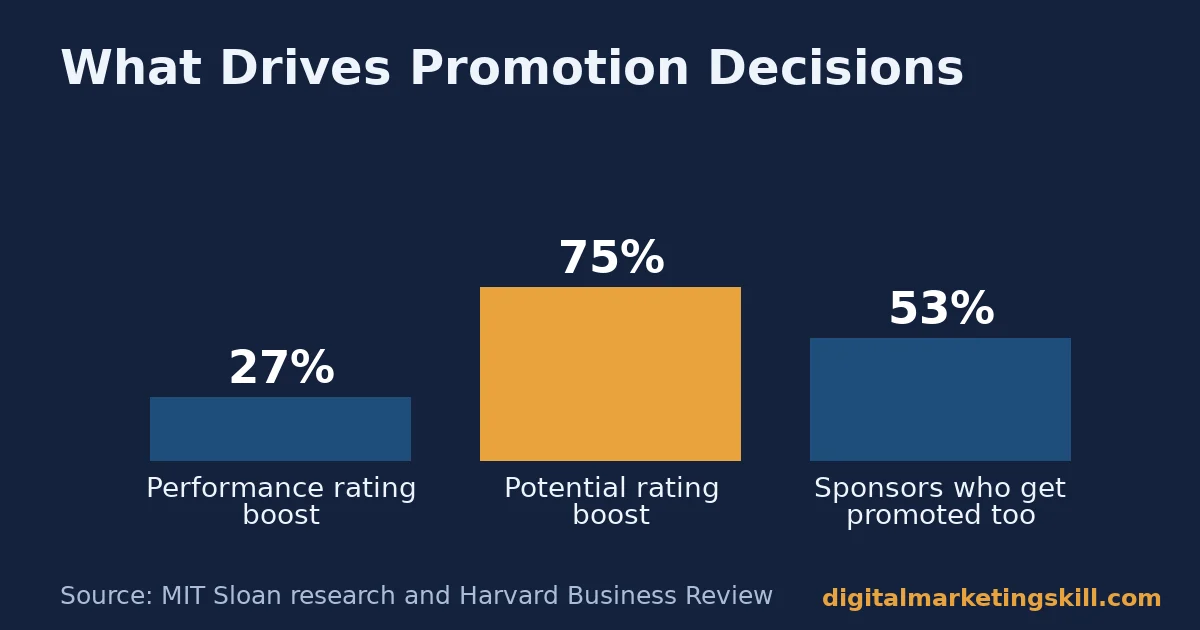
- Moving from a medium to a high “potential” rating raised promotion odds by 75%, versus only 27% for the same jump in a performance rating (MIT Sloan research, Benson, Li and Shue).
- In that same study, women received 8.3% lower potential ratings than men despite equal or higher performance, and were 14% less likely to be promoted as a result.
- Your manager only sees a slice of your actual output, which is why unseen work rarely turns into a case for promotion on its own.
- A documented, quantified track record is what turns “they work hard” into “they are ready,” according to the same potential-ratings research.
In this guide
- Why Hard Work Alone Rarely Gets You Promoted
- How Promotion Decisions Actually Get Made
- What Differs by Where You Work
- How to Lead With the Right Evidence
- Preparing Your Case Before You Ask
- How to Measure Whether You’re on Track
- The One Decision Rule for When to Push Harder
- A Real Case: Growing Into a Bigger Budget
- Frequently Asked Questions About How to Get Promoted at Work
- Your Next Step: Build the Scope That Earns the Title
Why Hard Work Alone Rarely Gets You Promoted
Here is the gap. Research from MIT Sloan, covering 30,000 management-track employees at a large North American retail chain, found that a “potential” rating moved people up far more than a performance rating did.
Moving from medium to high potential raised promotion odds by 75%. The same jump in performance only raised it by 27%. Potential is a judgment call, not a fixed score, which is exactly why you need to shape it.
A ground rule before we go further. These figures come from specific, named studies. They describe a pattern, not a rule for every company or every manager. Use them to understand the mechanism, then adjust your approach to your own workplace.
This guide applies directly to digital marketing roles. Your work already produces numbers: traffic, leads, conversion rate, return on ad spend. That gives you something many roles don’t have when you try to get promoted at work: a built-in scoreboard.
It also helps that marketing management is a growing field. The US Bureau of Labor Statistics projects marketing manager roles to grow faster than average, which means more openings to aim for. However, an opening alone won’t get you promoted at work on its own; you still need to be the visible, documented, ready candidate when it appears.
How Promotion Decisions Actually Get Made
A promotion is rarely a single moment. It is a decision made ahead of time, then confirmed in a meeting. By the time your manager says yes, the real decision already happened in conversations you weren’t part of.
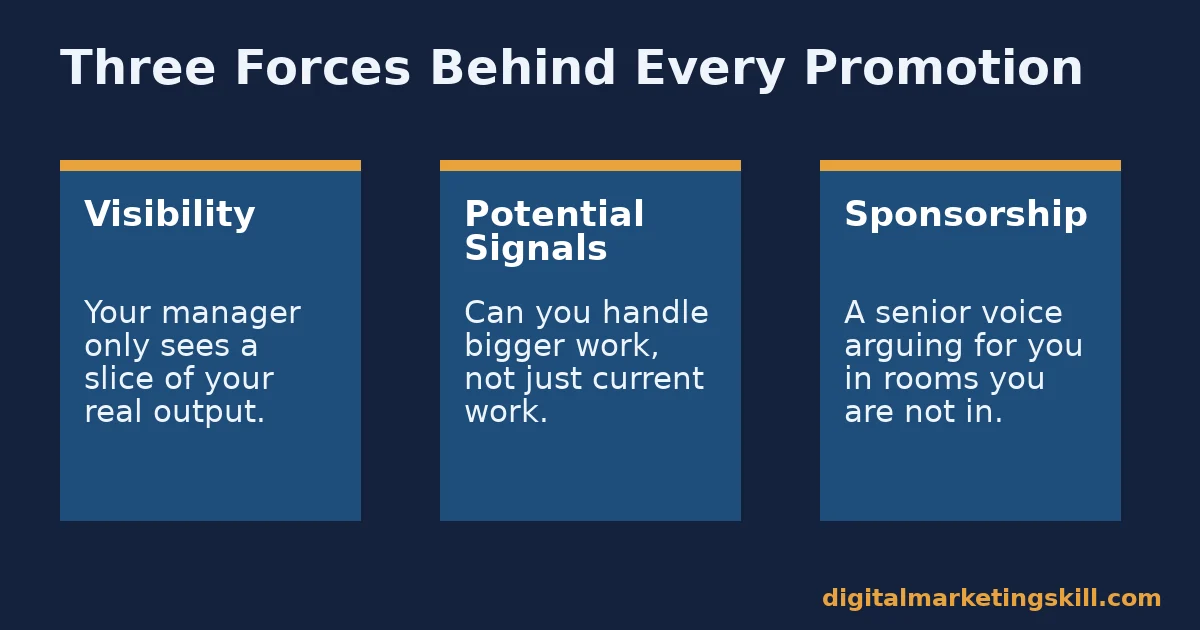
Three mechanics drive most promotion decisions.
- Visibility. Your manager sees a fraction of your actual work. Tasks that fix quiet problems, like cleaning up a broken process, often stay invisible. People notice tasks tied to a visible launch or a report leadership reads. Managers reward visible work more than invisible work, even when the invisible work mattered more.
- Potential signals. Decision-makers don’t only ask “did they do good work.” They ask “can they do bigger work.” That judgment, the MIT Sloan research found, moves the needle nearly three times harder than a performance score alone.
- Sponsorship. A senior person who argues for you in a room you’re not in carries more weight than your own self-advocacy. Sponsorship works both ways: Harvard Business Review research by Sylvia Ann Hewlett found senior people who sponsor someone else are 53% more likely to have received a recent promotion themselves. Without someone sponsoring your case, even strong performance can sit quietly on file.
Understanding these three mechanics changes what you optimize for. You are not just trying to work harder. You are trying to make your work visible, signal that you’re ready for more, and get at least one senior person willing to argue your case. None of that happens by accident; each one takes a deliberate, repeatable habit.
What Differs by Where You Work
How you get promoted at work depends heavily on the shape of the company you’re in. A fast-growing team, a mature flat team, and a small company without a formal ladder each reward different moves.
Fast-Growing Teams: Built For Frequent Openings
Adding headcount quickly creates new roles on a regular basis. A Pave analysis of 245,000 US tech employees found fast-growing companies post median promotion rates of 18.3%, well above the 14% average. The opening exists; your job is to be the obvious, ready candidate when it appears.
Mature, Flat Teams: Built For Scarce Openings
A stable, low-growth team creates far fewer new slots. The same Pave data put promotion rates at shrinking companies at just 11.5%. Here, waiting for a natural opening is a weak strategy; you need to make a case strong enough to create one.
Replacing a skilled employee is also expensive: SHRM research puts the cost of replacing someone at 50% to 200% of their annual salary. That cost is exactly the leverage a well-timed business case can use when you’re trying to get promoted at work on a flat team.
Small Companies Without a Ladder: Built For Scope, Not Title
A small company often has no formal promotion ladder at all. There may be no “senior” or “lead” title to move into. Your leverage here is expanded scope and a title you help define, backed by results a bigger company would recognize.
In practice, this often means you’re already doing the work of the next title before anyone names it. For example, you might already be running campaigns end to end, managing a budget, or mentoring a newer hire. Naming that scope out loud, instead of assuming it will be noticed, is often the only step left.
How to Lead With the Right Evidence
Once you know which environment you’re in, your opening move should match it.
Fast-Growing Teams: Lead With Readiness
Tell your manager directly that you want the next opening and ask what “ready” looks like for that role. In a fast-growing team, the bottleneck is usually readiness, not available slots. Get specific about the gap, then close it visibly.
Mature, Flat Teams: Lead With a Business Case
Write a short case: the scope you already cover, the results tied to it, and the cost to the business of not formalizing your role. In a flat team, you are not asking for a favor. You are proposing a change the business should want to make.
Small Companies: Lead With a New Title You Define
Propose the title and scope yourself, backed by what you already own. In a small company without a ladder, nobody else is going to define the next step for you. Bring the definition already drafted.
Preparing Your Case Before You Ask
Whichever environment you’re in, the groundwork to get promoted at work follows the same six steps.
Make Your Work Visible on Purpose
Share short, regular updates with your manager and, where appropriate, their manager. Mention the metric, not just the activity. “Grew organic traffic 22% this quarter” is visible. “Worked on SEO” is not. A simple marketing portfolio you update as you go makes this almost automatic.
Collect Quantified Wins as You Go
Keep a running, dated list of results: campaigns launched, numbers moved, budgets managed, processes fixed. Update it monthly. Trying to reconstruct a year of work from memory right before a review almost always undersells it.
A simple spreadsheet works fine for this. One row per win, with the date, the metric, and a one-line description. By the time you need to get promoted at work, you’ll have a ready-made case instead of a scramble.
Signal Potential, Not Just Performance
Ask for a task one level above your current role, even a small one. Volunteer to lead a cross-team project. Potential ratings come from evidence that you can handle bigger scope, not only evidence that you handled your current scope well.
This step matters more than it looks, because potential moved promotion odds nearly three times harder than performance in the MIT Sloan research cited earlier. A single stretch project, done visibly, can shift how a decision-maker sees your readiness.
Find at Least One Senior Advocate
Identify one senior person outside your direct manager who sees your work and would speak up for you. A digital marketing mentor can sometimes become that sponsor, but the two roles aren’t the same: build the sponsor relationship deliberately, through cross-team projects or direct conversations, rather than hoping it happens on its own.
Set a Timeline, Then Have the Conversation
Decide a realistic date to raise the topic directly, and put it on the calendar. A promotion rarely arrives unprompted. Someone has to open the conversation, and it should usually be you. Waiting for the “perfect” moment is one of the most common ways people delay trying to get promoted at work by a full extra cycle.
Prepare the Conversation Like a Pitch
Treat the promotion conversation as a short, structured pitch, not a casual chat. Open with the business impact of your current scope, in one or two sentences. Follow with two or three of your strongest quantified wins. Then name the specific next step you want, whether that’s a title, a scope increase, or a formal review.
Close with a direct question: “What would need to be true for this to happen in the next quarter?” That question does two things at once. It moves the conversation from a vague hope to a concrete plan, and it puts the next step on your manager, not just on you. Write down the answer afterward, since it becomes the checklist for your follow-up conversation.
How to Measure Whether You’re on Track
Treat your own promotion case like a campaign. Track leading indicators, not just the final yes or no.
- Visibility ratio. The share of your major wins your manager’s manager has actually seen or heard about, out of all the wins you’ve logged. A low ratio means you’re doing the work without anyone above your manager knowing it.
- Sponsor count. The number of senior people, beyond your direct manager, who could speak up for you by name in a room. Zero is a warning sign.
- Potential signals logged. How many times in the last quarter you took on work one level above your current scope. This should be more than zero every quarter you’re pushing for advancement.
- Conversation cadence. How long it has been since you last discussed advancement directly with your manager. Over six months with no conversation usually means your effort to get promoted at work has quietly dropped off their radar.
Read these four signals together. A strong track record with zero sponsors and no recent conversation is a common, fixable gap, not a sign you aren’t good enough. Most people trying to get promoted at work fix the wrong signal first: they add more wins to an already-strong list, when the real gap is visibility or sponsorship.
The One Decision Rule for When to Push Harder
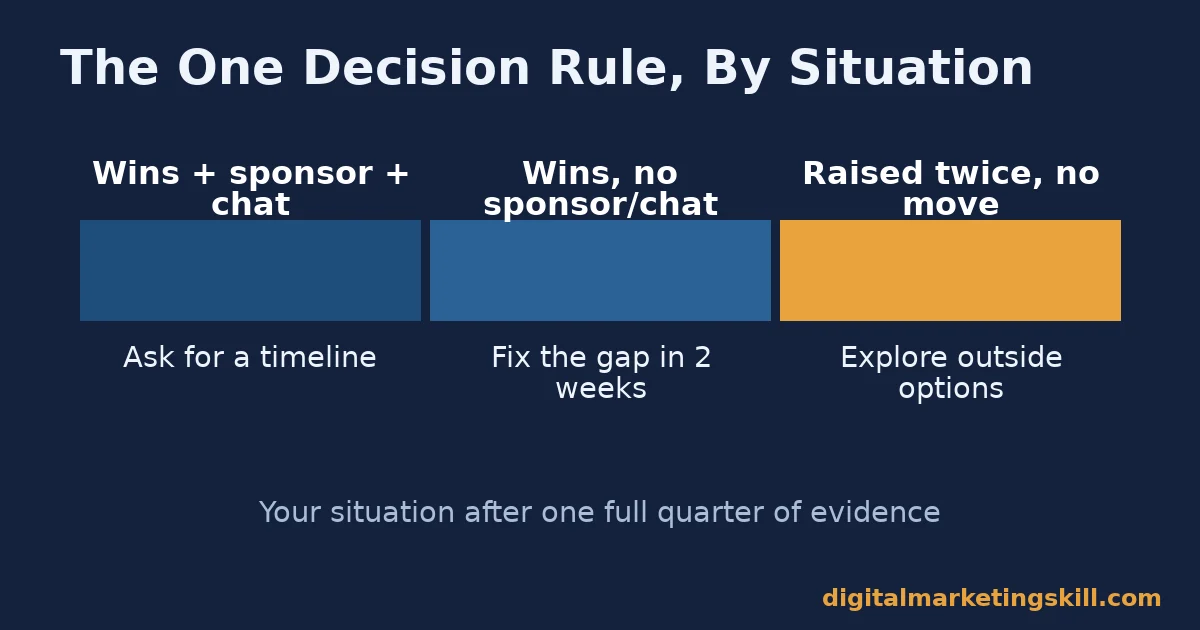
Use this rule once you’ve logged your evidence for at least one full quarter. If you have strong quantified wins, at least one sponsor, and a recent conversation about advancement, stay the course and ask for a specific timeline.
If you have strong wins but no sponsor or no recent conversation, fix that gap directly before asking again; schedule the conversation yourself within the next two weeks. When you’ve raised it twice over six months or more with no real movement and no clear reason why, treat that as a signal to explore external options while you keep building your case internally.
Illustrative, invented numbers: suppose you’ve logged six quantified wins over the past twelve months, have one sponsor, but haven’t discussed advancement in eight months. Under the rule above, the fix isn’t more wins. It’s booking that overdue conversation this month and bringing the six wins with you.
A Real Case: Growing Into a Bigger Budget
Chinelo E., a graduate featured on the Digital Marketing Skill Institute’s reviews page, nearly quit when she got stuck on a technical problem early on. Her mentor cleared the blocker in 15 minutes on a call. She now manages a $7,000 monthly ad budget for a U.S. client, a scope of responsibility she grew into step by step rather than being handed on day one.
The limit is real: this is one person’s path, in one market, with one client relationship, and outcomes like this are never guaranteed, consistent with the Institute’s own earnings disclaimer. A different person, in a different role or industry, could easily see a different timeline. What the case does show is the underlying pattern from the research above: visible, growing responsibility, built one step at a time, is what a bigger title or bigger budget actually gets built on.
Frequently Asked Questions About How to Get Promoted at Work
How long should I wait before asking about a promotion?
There’s no fixed number, but a useful marker is one full review cycle with a documented, quantified track record. If six months or more pass with no conversation about advancement, raise it directly rather than waiting for your manager to bring it up.
What if my company has no formal promotion ladder?
Propose the title and scope yourself, backed by work you already own. Small companies without a ladder still promote people; they just need someone to define the next step, and that someone can be you.
Does asking for a promotion ever backfire?
Rarely, when the ask is specific and backed by evidence. A vague ask with no track record attached is more likely to go nowhere than to actively damage you. Bring quantified wins and a clear, reasonable request.
What if my manager keeps saying “not yet” without explaining why?
Ask directly what specifically needs to change, and ask for it in writing or a follow-up email so it’s documented. A vague “not yet” with no criteria attached often means nobody has escalated the conversation above your manager yet, which is exactly where a sponsor can help.
How important is having a sponsor versus a mentor?
They serve different roles, as Harvard Business Review distinguishes it. A mentor gives advice and feedback. A sponsor is a senior person who actively argues for you when you’re not in the room. Both help, but sponsorship is what the research above ties most directly to promotion odds.
What if I’m doing great work but it’s all behind the scenes?
Translate it into something visible: a short update to your manager’s manager, a metric in a shared report, or a brief write-up of what the work prevented or fixed. Managers rarely reward invisible work, no matter how valuable it is.
Should I threaten to leave to get promoted?
Treat an outside offer as information, not a threat. If you’ve built a strong case internally and genuinely have no path forward, exploring external options is reasonable. Using a bluff you won’t follow through on tends to damage trust either way.
What’s the single biggest mistake people make trying to get promoted at work?
Assuming good work speaks for itself. The research above is clear: your manager only sees a slice of your output, and potential ratings move promotion odds nearly three times harder than performance alone. Quiet excellence, without visibility or a direct ask, is the most common reason strong performers stay stuck.
Can introverts get promoted at work without constant self-promotion?
Yes, but visibility still has to happen somehow. For an introvert, that might mean a written monthly update instead of a verbal one, or leaning on a sponsor to represent your work in rooms you’d rather avoid. The goal is visibility, not a personality change.
Is it different to get promoted at work versus negotiate a raise?
They overlap but aren’t identical. A raise can happen without a title or scope change, and it has its own playbook if you want to negotiate your salary directly. A promotion usually combines a scope change with a pay change, and it typically runs through the potential and sponsorship dynamics covered above, not just a market-rate comparison.
Your Next Step: Build the Scope That Earns the Title
If you remember one thing from this guide, make it this: getting promoted at work comes down to visible, growing scope, backed by a documented track record and at least one person willing to argue your case. That is exactly the kind of portfolio-building, measurable work the Master Diploma in Digital & AI Marketing at the Digital Marketing Skill Institute is built around.
The program runs four AI-powered tracks, built from ten execution-first courses. These cover AI-Powered Social Media Management and Advertising, AI-Powered Lead Generation and Email Automation, AI-Powered Google Specialist, and AI-Powered WordPress and SEO Specialist. A Full Stack option lets you complete all four.
Every track includes unlimited one-on-one coaching and mentoring, plus a U.S. Project Internship with a verified U.S. Work Reference Letter. That reference is exactly the kind of visible, verifiable evidence that helps you get promoted at work once you’re in a role.
The diploma is dual US and UK accredited and recognised in more than 100 countries. The entire program runs 100% online, so you can build that track record from anywhere in your country.
See the full track breakdown on the Master Diploma program page, and browse real outcomes on the reviews page. Or go straight to apply when you’re ready to start building the case for your next move. No income or outcome is guaranteed; see the earnings disclaimer. Finally, read more career and skills guides on the blog, and start wherever you live at digitalmarketingskill.com.
Every figure in this guide was checked against its original source before publication. Figures marked as illustrative are invented examples, not real results.