To negotiate your salary as a digital marketer, open with a research-backed range. Anchor near the top of that range. Then ask in writing. Most people lose money simply by not asking. Roughly half of professionals accept the first number offered. Those who counter usually walk away with more.
Key Takeaways: How to Negotiate Your Salary
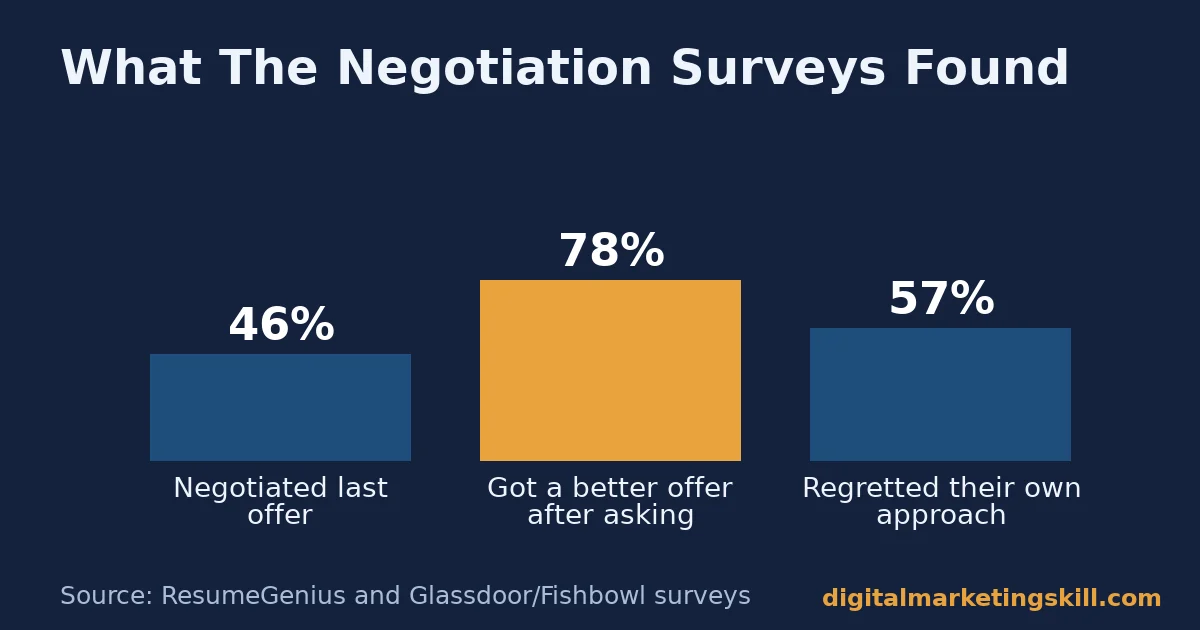
- Only about 46% of professionals negotiated their most recent salary. Rates ranged from 22% to 67% by industry (Glassdoor/Fishbowl survey).
- 78% of new hires who negotiated their starting pay got an improved offer. 51% got the full amount they asked for (ResumeGenius survey).
- 57% of workers later regretted how they handled their own negotiation, usually by asking for too little or not countering at all (ResumeGenius survey).
- Hiring managers’ typical comfort zone for a counter is a 10-25% increase over the first offer. The median acceptable bump is around 22% (ResumeGenius survey of hiring managers).
- Only about 10% of hiring managers will approve an increase of 40% or more. An opening ask far outside the 10-25% band risks a flat no (ResumeGenius survey).
In this guide
- Why Most People Never Negotiate Your Salary Properly
- How Salary Negotiation Actually Works
- What Differs by Negotiation Type
- How to Lead With Your Strongest Case
- Preparing Your Case Before You Negotiate Your Salary
- How to Measure Whether Your Negotiation Is Working
- The One Decision Rule for Any Counter-Offer
- A Real Case: Pricing a Freelance Rate From Scratch
- Frequently Asked Questions About How to Negotiate Your Salary
- Your Next Step: Build the Evidence Before You Negotiate Your Salary
Why Most People Never Negotiate Your Salary Properly
Here is the gap. More than half of working professionals accept the first number an employer offers. That comes from a Glassdoor-commissioned survey of nearly 6,700 professionals, run on the Fishbowl network. The same survey found negotiation rates ranging from 22% among graduate-level hires to 67% in advertising roles. That spread tells you the real problem. It is confidence and process. It is not whether negotiation is allowed.
A few ground rules before we go further. The figures below are a snapshot from the specific surveys named. They are not a permanent ranking of who negotiates best. Each number is an informed input for your own conversation, not a guarantee of your outcome. Use the percentages as a starting point. Then adjust for your role, your market and the employer in front of you.
This guide focuses on how to negotiate your salary in a digital marketing role specifically. Marketing gives you something many professions don’t: concrete, measurable outcomes like traffic, leads and return on ad spend. Those numbers make a far stronger case in digital marketing careers than a vague claim about hard work.
Illustrative, invented numbers: consider two candidates for the same role. One says, “I’m good at social media.” The other says, “I grew a client’s email list by 2,400 subscribers in one quarter and lifted open rates from 18% to 31%.”
Even though both might be equally skilled, the second candidate gives the hiring manager a number to anchor on. That is the real advantage digital marketers have when they sit down to negotiate your salary: your work already produces a scoreboard.
How Salary Negotiation Actually Works
A job offer is rarely one fixed number. It is a starting point drawn from a budget range. A hiring manager or recruiter already has approval to move within that range. Employers build this flexibility in on purpose. A ResumeGenius survey of hiring managers found most are comfortable moving an initial offer up by 10% to 25%. The typical acceptable increase lands around 22%.
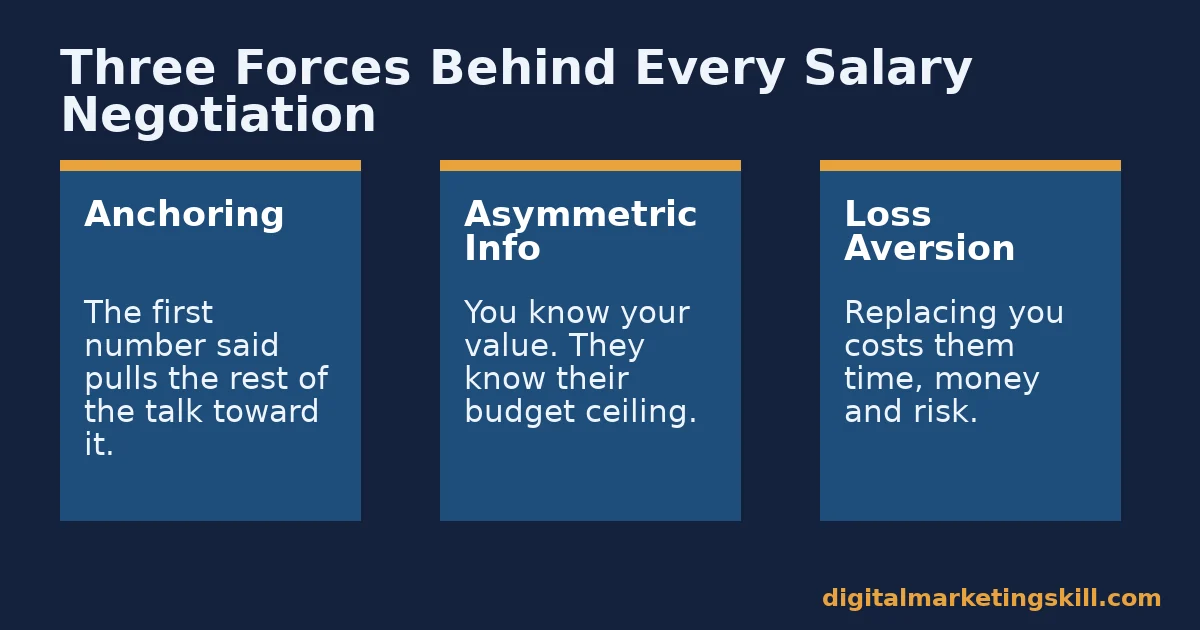
Three mechanics drive almost every negotiation.
- Anchoring. The first specific number mentioned pulls the rest of the conversation toward it. This is a well-documented effect described by the Program on Negotiation at Harvard Law School. Name your range first and anchor near the top of it. The employer’s counter tends to land closer to your number. But the Program also notes a catch: let the recruiter anchor first if they know the pay band better than you do.
- Asymmetric information. You know your market research, your track record and your walk-away point. The employer knows their budget ceiling. They also know how badly they need this role filled. Negotiation is the process of trading enough information to find the overlap.
- Loss aversion. Once an employer has invested time interviewing you, replacing you costs them time and risk. SHRM research puts the cost of replacing an employee at 50% to 200% of their annual salary, depending on seniority. That cost is leverage for you. It is part of why 78% of people who negotiated a starting offer, per the ResumeGenius data, ended up with something better than the original number.
These three mechanics are what separate a scripted ask from a real negotiation. You are not demanding a number. You are closing the gap between what you know and what they know.
What Differs by Negotiation Type
Not every salary conversation is the same conversation. A new job offer, an internal raise and a freelance rate each run on different leverage, timing and evidence, so how you negotiate your salary should change with the situation. Here is what each one is actually built for.
New Job Offer: Built For Leverage Before You Start
A new offer is the single highest-leverage moment in your entire time with a company. Your market value hasn’t been “anchored” yet by an internal pay band. You have outside options and a clean comparison point from other interviews. You also have a deadline, which motivates the employer to move.
This is also the only point where you can negotiate sign-on terms, like a later start date, remote flexibility or a signing bonus. That is one more reason to get your cover letter and application materials right before the offer stage even begins.
Internal Raise: Built For Proven Track Record
An internal raise runs on a different asset entirely: a documented history inside the company. You cannot point to “the market” the way a new candidate can. But you can point to campaigns you’ve actually run, budgets you’ve managed and results the employer has already seen.
The leverage here is continuity risk, not scarcity. In other words, it is the cost of losing someone who already knows the brand, the tools and the team. The groundwork overlaps heavily with how you get promoted at work more broadly: visible results and a documented track record.
Freelance Rate: Built For Market Comparables
Setting or raising a freelance rate runs on comparables and positioning, not one employer’s budget line. A client compares your rate to other freelancers, and to the cost of hiring in-house. So your evidence is a portfolio of results, not a performance review.
For example, one DMSI graduate, Damola Akanbi, left a full-time role and now averages $1,500 per client running digital marketing campaigns. That rate was built on a portfolio of case studies, not a single employer’s internal pay band.
How to Lead With Your Strongest Case
Once you know which type of conversation you’re in, your opening move should change too. Use the matching approach below instead of a generic script.
New Job Offer: Lead With Competing Data
Open with your researched range for the role, level and location. Don’t open with your current pay. Naming your current salary first weakens your position, because it anchors the employer to where you are, not to where the market says you should be.
Instead, try something like this: “Based on my research for this role and level, I was expecting a range of [X] to [Y].” That way, the number comes from outside evidence, not your history.
Internal Raise: Lead With Quantified Impact
Open with a short, numbered list of what you changed and what moved because of it. List campaigns launched, traffic or lead volume before and after, budget you managed responsibly, or a process you fixed. Quantified impact is the strongest lever in an internal conversation. It reframes the ask from “I want more” to “here is the return the company is already getting.”
Freelance Rate: Lead With Portfolio Proof
Open with two or three case studies. Show a before-and-after result for a past client, with the scope of work attached to each number. A client paying a freelance rate is really buying predictability. Showing your rate has already produced a measurable result, backed by a clear marketing portfolio, does more work than any amount of persuasive language.
Preparing Your Case Before You Negotiate Your Salary
Whichever type of negotiation you’re walking into, the way you prepare to negotiate your salary is the same five steps.
Research the Real Range First
Pull numbers from more than one source. Check public salary databases, recent job postings for the same title and level, and people you know in comparable roles. For a benchmark, a Salary.com analysis of the US market put the typical base salary for a digital marketing manager between roughly $98,600 and $140,100.
By comparison, the US Bureau of Labor Statistics separately lists median pay of $166,790 for marketing managers and $133,660 for advertising and promotions managers. That spread shows why a single “market rate” headline figure is rarely the whole story. So treat any single figure as a starting range to adjust, not a fixed target, and always note when a number you cite is specific to one country’s market.
Write Down Your Specific Wins
List the concrete outcomes you can point to: a campaign’s measured lift in traffic or leads, a budget you managed without overspend, or a process you automated that saved hours every week. Specific, countable wins move a conversation forward. By contrast, vague claims about being “hardworking” rarely do. For instance, “I grew organic traffic 40% in one quarter” lands far better than “I worked really hard on SEO.”
Decide Your Walk-Away Point in Advance
Before any conversation, decide the minimum number or package you would actually accept. Keep this separate from the number you’re asking for. Decide it in a calm moment, not mid-conversation. That keeps you from accepting a number you’ll regret later, which happened to 57% of workers after their own negotiation, per the ResumeGenius data.
Rehearse the Specific Sentences
Say your opening ask out loud before the real conversation. Say your likely responses out loud too. Practice with another person, such as a digital marketing mentor. Rehearsal turns a nervous, vague ask into a calm, specific one. It is the difference between freezing on a counter-offer and already knowing your next sentence.
Plan for the Full Package, Not Just Base Pay
Decide in advance which non-salary items you’d trade for. Remote flexibility, a learning budget, extra paid time off, equity or a revised title all count. A lower base number with strong non-salary terms can beat a slightly higher base with nothing else attached. Decide your trade-offs before you’re negotiating them live.
How to Measure Whether Your Negotiation Is Working
Treat your own negotiation like a campaign. Define what you’re tracking before you negotiate your salary, not after.
- Offer-to-ask ratio. Divide the counter-offer you receive by the number you originally asked for. A ratio above 0.85 usually signals a serious, workable counter. A ratio under 0.6 signals a gap wide enough that you may need a second round or more evidence.
- Response time. Track how long the other side takes to reply after your counter. A reply within one to two business days usually signals real interest in closing. A long silence often means the number needs more justification, or the budget is genuinely fixed.
- Written counter rate. Note whether your counter was made in writing, by email, rather than only spoken aloud. A written counter creates a record both sides can refer back to. It tends to get a more considered reply than a verbal ask dropped into a call.
- Benefits-adjusted value. Add up the total value of base pay plus the non-salary items you’d trade for, estimated in dollars. Comparing two offers on base pay alone can hide a meaningfully better, or worse, total package.
Read these four numbers together. Don’t fixate on the base salary figure alone. Together, they tell you whether to accept, counter again, or walk away.
The One Decision Rule for Any Counter-Offer
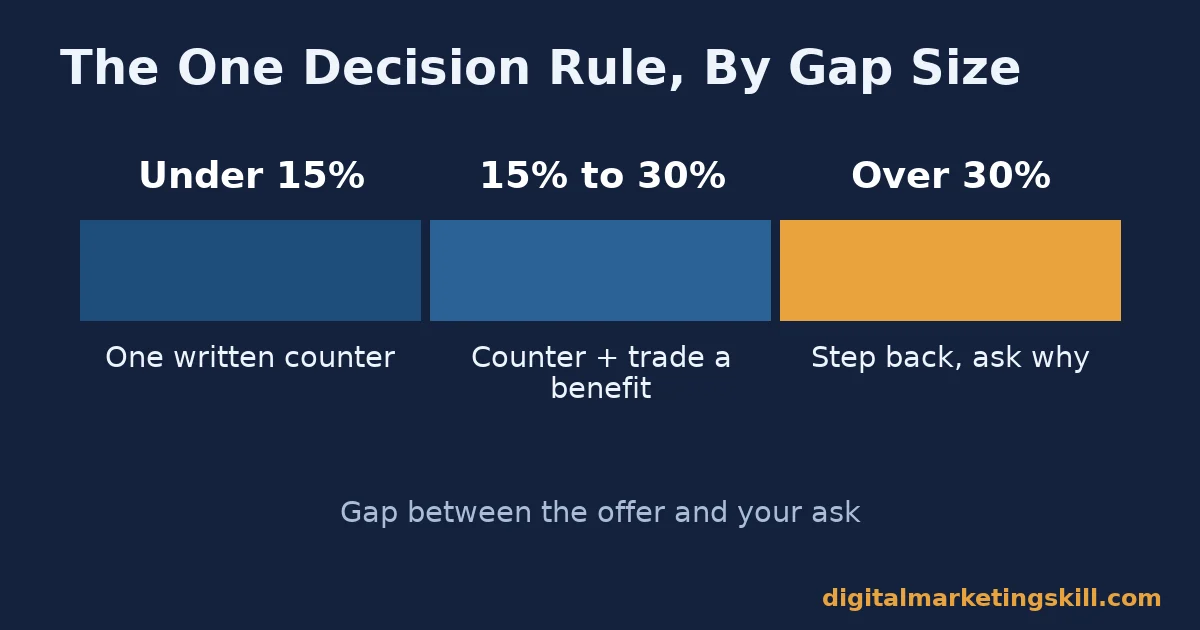
Use this rule once you have a real number in front of you. If the gap between the offer and your ask is under 15%, send one clear written counter with your strongest piece of evidence attached, and be ready to accept a reasonable response.
When the gap is between 15% and 30%, counter once with your evidence, and also name one non-salary item you’d accept in exchange for meeting partway.
If the gap is over 30%, treat it as a signal to step back. Ask directly what flexibility exists, then decide whether this is still the right opportunity before you counter again.
Illustrative, invented numbers: suppose you’re offered $70,000 against a researched range of $78,000 to $85,000. The gap to your low end is about 11%. Under the rule above, you’d send one written counter at $80,000, backed by two quantified wins. Then be ready to accept a response anywhere from $75,000 to $80,000.
A Real Case: Pricing a Freelance Rate From Scratch
Damola Akanbi, a graduate featured on the Digital Marketing Skill Institute’s reviews page, left a full-time job. He now averages $1,500 per client running digital marketing campaigns. The case is useful because it shows a rate built from the bottom up. A documented portfolio of campaign results stood in for the “market research” a job candidate would normally pull from salary surveys.
The limit is just as real. This is one person’s outcome, in one market, for one type of service. Results like this are never guaranteed, consistent with the Institute’s own earnings disclaimer. What it does show clearly is this: a rate negotiation and a salary negotiation share the same underlying move. Let documented evidence set the number. Don’t guess at what sounds fair.
Frequently Asked Questions About How to Negotiate Your Salary
Can I lose a job offer by trying to negotiate your salary?
It’s rare. Employers generally expect some negotiation and build room into their first offer for it. The ResumeGenius hiring-manager data shows most employers plan for a 10-25% counter as normal. A reasonable, evidence-backed ask is very unlikely to cost you the offer.
Should I share my current salary when asked?
Where it’s legal to decline, it’s usually stronger to redirect to your researched range for the new role instead. Naming your current pay anchors the conversation to your past, not to the market rate for the role you’re moving into.
What if the employer says there’s no room to negotiate?
Ask directly whether the base figure is fixed, or whether other items are flexible. Think about a signing bonus, extra paid time off, a review date at six months, or remote days. “No room” on base pay is sometimes true and sometimes just an opening position. Asking about the full package tells you which one it is.
How do I negotiate a raise without a competing offer?
Lead with quantified impact rather than comparison to another employer. Point to specific campaigns, numbers moved, and budget managed responsibly. An internal raise runs on proven track record, not market scarcity, so your strongest evidence is what you’ve already delivered.
How much should I ask for above the initial offer?
Aim inside the 10-25% band that hiring managers report as their typical comfort zone. Attach your strongest piece of evidence to the number. Asking for 40% or more is rarely approved, according to the same hiring-manager survey, and it risks the conversation feeling unserious.
Is it different to negotiate your salary versus a freelance rate?
The mechanics are similar, but the evidence changes. A salary negotiation leans on market salary data and your track record with one employer. A freelance rate leans on a portfolio of results across clients, since there’s no single internal pay band to reference.
What’s the biggest mistake people make when they negotiate your salary?
Accepting the first offer out of fear, or because the conversation feels awkward. The ResumeGenius data on regret is the clearest evidence of this: 57% of workers later wished they had handled their own negotiation differently, most often by asking for too little. A close second mistake is countering with no evidence attached, which turns a researched ask into a guess the employer has no reason to take seriously.
Does negotiating ever backfire?
Occasionally, but usually only when you negotiate your salary with an aggressive tone or no evidence behind the number. A calm, specific counter backed by research rarely damages the relationship, even when the employer can’t meet it in full. Treat a “no” on your number as information about their budget, not a verdict on your value.
Your Next Step: Build the Evidence Before You Negotiate Your Salary
If you remember one thing from this guide, make it this: negotiating your salary well comes down to one habit. Build real, specific evidence of your impact before you ever sit down at the table, whether that’s for a job offer, an internal review, or a client proposal.
That is exactly the kind of portfolio-building, measurable work the Master Diploma in Digital & AI Marketing at the Digital Marketing Skill Institute is built around.
The program runs four AI-powered tracks, built from ten execution-first courses. These cover AI-Powered Social Media Management and Advertising, AI-Powered Lead Generation and Email Automation, AI-Powered Google Specialist, and AI-Powered WordPress and SEO Specialist. A Full Stack option lets you complete all four.
Every track includes unlimited one-on-one coaching and mentoring, plus a U.S. Project Internship with a verified U.S. Work Reference Letter. That reference is exactly the kind of evidence this guide describes, and it is the kind of detail that helps you negotiate your salary from a position of proof rather than hope.
The diploma is dual US and UK accredited and recognised in more than 100 countries. The entire program runs 100% online, so you can build that evidence from anywhere in your country.
See the full track breakdown on the Master Diploma program page, and browse real outcomes on the reviews page. Or go straight to apply when you’re ready to build the track record that makes your next negotiation easier. No income or outcome is guaranteed; see the earnings disclaimer. Finally, read more career and skills guides on the blog, and start wherever you live at digitalmarketingskill.com.
Every figure in this guide was checked against its original source before publication. Figures marked as illustrative are invented examples, not real results.