
The AIDA Model is a classic marketing framework that describes four stages a buyer moves through: Attention, Interest, Desire and Action. It gives you a simple order for any ad, email or landing page. First you grab attention, then you build interest and desire, and finally you ask for action. As a result, it remains one of the most used tools for writing copy that sells.
Key Takeaways
- AIDA stands for Attention, Interest, Desire and Action.
- It is mainly used to plan ads, emails, sales pages and video scripts.
- Each stage has one job, and the message moves the reader to the next stage.
- The model is simple, so real buyers often don’t follow it in a straight line.
- Variants such as AIDAS add a stage for satisfaction after the purchase.
What Is the AIDA Model?
AIDA is a way to think about how people respond to a message. First, they notice it. Then they become curious. Next, they start to want what is on offer. Finally, they do something about it, such as buying or signing up.
The model is usually credited to E. St. Elmo Lewis, an early American advertising and sales pioneer. Since then, marketers have used it to plan everything from print ads to social posts. It is often taught as the first copywriting framework, because it is so easy to remember.
Think of a street food stall. The smell of grilled food catches your attention. Then you see the menu and wonder what the special is. After that, you watch someone take a big bite, and you want one too. So you join the queue and order. That is AIDA in a few seconds.
The guide from IONOS describes each stage clearly. At the start, you win attention with striking content, design or sound. In the final stage, you prompt the purchase with calls to action, time limits or incentives. However, it also calls AIDA “a simplified formula”, which is a fair warning.
Why It Matters
Why should you learn AIDA? Because it stops you from skipping steps. For example, many ads jump straight to “Buy now” before anyone cares. In contrast, AIDA reminds you to earn attention and interest first. Also, it gives teams a shared language. So a writer, designer and manager can all say “the desire part is weak” and know what that means.
Common Variants
Over time, marketers have built new versions of AIDA. For example, AIDAS adds Satisfaction at the end, because happy buyers return. Another version adds Conviction before Desire, so the reader trusts the offer first. Also, some longer models add stages for search, sharing and loyalty. These reflect how people now read reviews and tell friends online. Still, the core idea stays the same. You guide people step by step, from first notice to a clear next step. So if you learn AIDA well, the variants are easy to pick up. Then you can choose the version that fits your landing page, ad or email.
How the AIDA Model Works
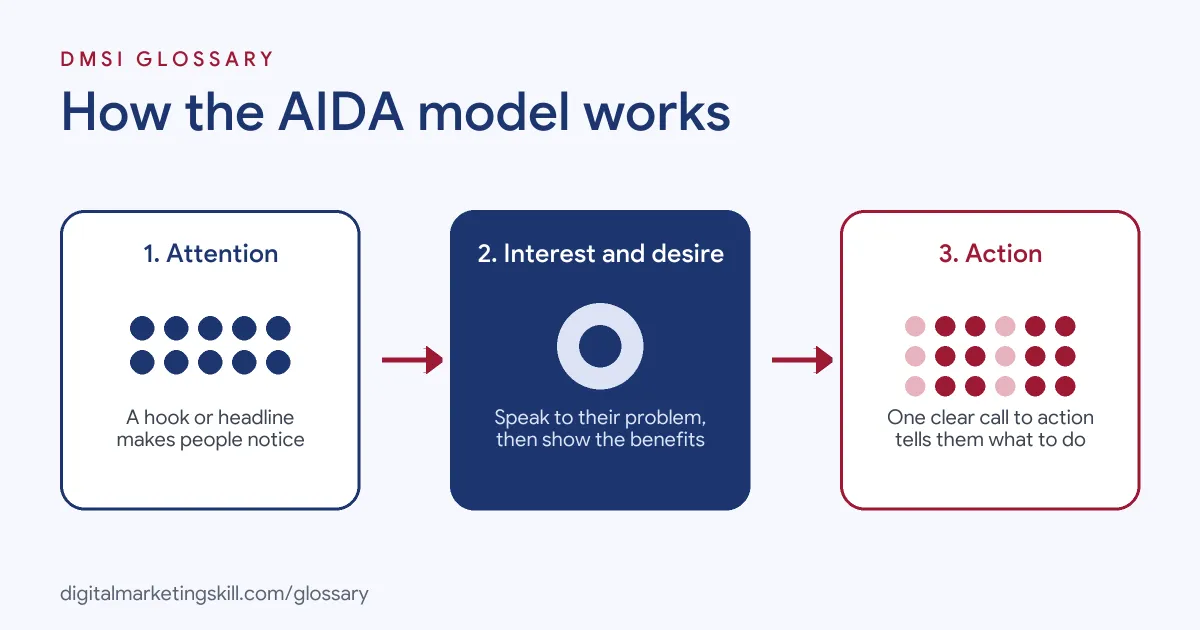
The AIDA model works by moving a person through four stages in order. Each stage has one clear goal. When one stage succeeds, the reader is ready for the next.
Attention
First, you need to be noticed. People scroll past most content, so the opening must stand out. For example, you might use a bold headline, a surprising number or a striking image. In video, the first few seconds do this job. In short, this is where a strong hook earns its place.
Interest
Next, you keep them reading or watching. You do this by speaking to a problem they have. Also, you share a useful fact or a short story they can relate to. The goal is to make them think, “This is about me.” So keep the message focused on the reader, not on your company.
Desire
Then you turn interest into wanting. Here you show the benefits, not just the features. For instance, a running shoe has foam soles, but the benefit is less sore knees. In addition, social proof, such as reviews and case studies, helps people trust that the benefit is real.
Action
Finally, you tell people exactly what to do next. A clear call to action works best, such as “Book your free trial” or “Shop the range”. Also, remove anything that makes acting hard. For example, cut extra form fields and make the button easy to find.
Examples of the AIDA Model
- A Facebook ad for a yoga studio. The ad opens with “Stiff back after work?” to grab attention. Then it explains a short evening class for desk workers. Next, it shows a happy student’s review. Finally, it ends with “Book your first class free”.
- A welcome email for an online bookshop. The subject line teases a reading list. After that, the email shares three books matched to the reader’s taste. Then it adds a small discount and a clear “Shop now” button.
- A landing page for accounting software. The headline names a common pain, such as late invoices. Below it, a short demo video builds interest. Then customer quotes and a feature list build desire. At the bottom, a button invites visitors to start a trial.
AIDA Model vs Other Marketing Frameworks
| Framework | Stages | Best for |
|---|---|---|
| AIDA | Attention, Interest, Desire, Action | Ads, emails and sales pages |
| AIDAS | AIDA plus Satisfaction | Brands that focus on repeat buyers |
| PAS | Problem, Agitate, Solution | Short, problem-led copy |
| Sales funnel | Awareness to purchase, often in top, middle and bottom stages | Planning a whole campaign |
In practice, AIDA works inside a single message, while a sales funnel maps the wider journey across many messages.
How to Use the AIDA Model
- Know your audience. Write down who you are talking to and what problem they want solved.
- Pick one goal. Decide the single action you want, such as a sign-up or a sale.
- Write the attention line. Draft several headlines or hooks. Then choose the one that is clearest and most surprising.
- Build interest. Add a relatable problem, a fact or a short story.
- Create desire. List the main benefits and add proof, such as reviews or results.
- Add the action. Write one clear call to action and make it easy to follow.
- Test and improve. Try different versions of each stage. After that, keep the ones that perform best.
Best Practices for the AIDA Model
- Lead with the reader. Talk about their problem before you talk about your product.
- Keep each stage short. On social media, all four stages may fit in a few lines.
- Show, don’t just tell. Use images, demos and examples to build desire.
- Use proof. Reviews, ratings and case studies make benefits believable.
- Make one ask. A single call to action is easier to follow than several.
- Think beyond the sale. Follow up after purchase, so happy buyers come back and tell others.
Common Mistakes to Avoid
- Jumping to action. Asking for a sale before building interest often fails.
- Clickbait attention. A shocking headline that doesn’t match the offer breaks trust.
- Listing features only. Features explain what it is. However, benefits explain why anyone should care.
- A weak call to action. Vague buttons such as “Submit” give people no reason to click.
- Treating AIDA as the whole journey. Real buyers loop back, compare and research, so one message rarely does it all.
Limits of the Model
AIDA is useful, but it is not a perfect picture of how people buy. For example, Google’s research on the “messy middle” says “People loop through these twin modes of exploration and evaluation” before they decide. So buyers may skip stages or go back. Also, the classic model stops at the sale. Because of this, many marketers add a fifth stage for satisfaction, or pair AIDA with a full customer journey map.
Where You’ll Use the AIDA Model at Work
AIDA is a daily tool in copy and creative roles. For example, copywriters use it to structure ads, emails and sales pages. Similarly, social media managers use it to plan posts and short videos. Also, paid ads specialists use it to brief designers on new ad creative. Finally, email marketers and landing page builders use it to check that every message ends with a clear next step.
Learn It in the Social Media and Paid Social Track
You can practise writing ads with frameworks like AIDA in the AI-Powered Social Media Management and Advertising track. Every track includes a U.S. Project Internship from day one, with unlimited 1-on-1 mentoring.
Frequently Asked Questions
What does AIDA stand for?
AIDA stands for Attention, Interest, Desire and Action. These are the four stages a message moves a buyer through.
Who created the AIDA model?
It is usually credited to E. St. Elmo Lewis, an American advertising and sales pioneer. Other writers later shaped and named it.
Is the AIDA model still useful?
Yes, for planning single messages such as ads and emails. However, real buying journeys are less linear, so use it with other tools.
What is AIDAS?
AIDAS adds a fifth stage, Satisfaction. It reminds you that the experience after the sale matters for repeat buying.
Can I use AIDA for social media posts?
Yes. In a short post, the hook grabs attention, the body builds interest and desire, and the last line asks for action.
Sources: IONOS Digital Guide: What is the AIDA model and how does this advertising success formula work?; Wikipedia: AIDA (marketing); Think with Google: How people decide what to buy lies in the ‘messy middle’ of the purchase journey.