
Deep Learning is a type of machine learning that uses neural networks with many layers to learn patterns from large amounts of data. It powers many of the AI tools marketers use every day, from chatbots and image generators to speech-to-text. So even if you never build a model, knowing how deep learning works helps you use these tools well. It also helps you spot their limits.
Key Takeaways
- Deep learning is a branch of machine learning built on multi-layered neural networks.
- The “deep” part refers to the many hidden layers between the input and the output.
- It learns useful features from raw data, such as images, text and audio, by itself.
- It needs a lot of data and computing power to train.
- Large language models, image generators and speech tools all rely on deep learning.
What Is Deep Learning?
Put simply, deep learning is one way to teach computers to spot patterns. Google Cloud describes it as “a type of machine learning that uses artificial neural networks to learn from data, similar to the way we learn.” In other words, the system learns from examples, rather than from rules a person writes by hand.
For example, think about how a child learns to recognise a dog. Nobody gives them a list of rules about ears and tails. Instead, they see many dogs and slowly learn the pattern. Deep learning works in a similar way. So after seeing thousands of labelled photos, a model can learn to spot a dog in a new picture.
Also, it sits inside a bigger family. Artificial intelligence is the widest term. Next comes machine learning, where systems learn from data. Then deep learning is a part of machine learning that uses layered neural networks.
Why It Matters for Marketers
In fact, deep learning is behind many tools you already use. For instance, IBM notes that deep learning models “power most state-of-the-art artificial intelligence”. That includes large language models that write copy and image tools that create visuals. Also, it helps with speech-to-text, translation and spam filters. So when you understand the basics, you can choose tools more wisely. In addition, you can explain to clients why AI outputs sometimes go wrong.
How Deep Learning Works
Deep learning works by passing data through layers of connected nodes, often called neurons. Along the way, each layer picks up a slightly more complex pattern. Then the model checks its answer, measures the error and adjusts itself. It repeats this many times until its predictions improve.
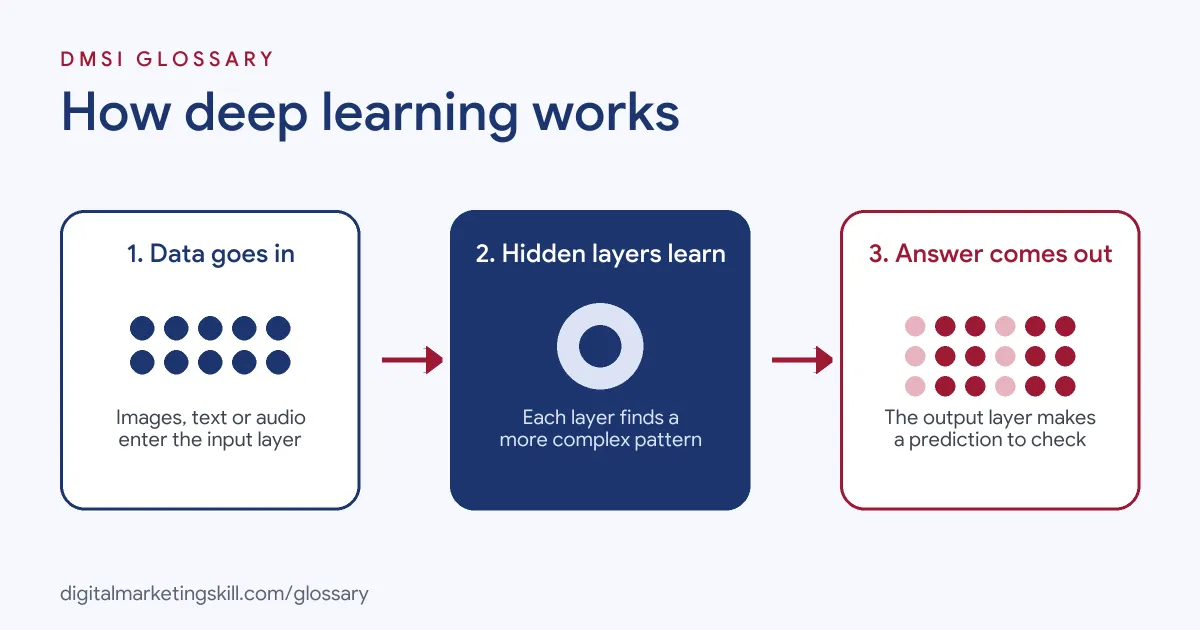
Layers of a Neural Network
In general, a neural network has three kinds of layers. First, the input layer takes in the raw data, such as the pixels of an image. Next, the hidden layers process that data. IBM says these hidden layers “are where most of the learning occurs.” Finally, the output layer gives the answer, such as “dog” or “not dog”. A network with many hidden layers is called “deep”.
Learning Features by Itself
In contrast, older machine learning often needs people to pick the important features by hand. Deep learning, however, finds them on its own. For example, in a photo model, early layers may spot edges. Then later layers combine them into shapes, and finally into faces or objects. IBM explains that multiple hidden layers let a model “learn complex hierarchical features of data.”
Training and Backpropagation
So how does the model improve? During training, it makes a guess and compares it with the right answer. Then a method called backpropagation works out how much each connection added to the error. After that, the model nudges each connection to reduce the error. Then this loop runs many times over the training data.
Data and Computing Power
However, all this learning has a cost. IBM states that “Deep learning requires an exceedingly large amount of data and computational resources for training.” That is why companies train large models on powerful chips, often at great cost. As a result, most marketers use deep learning through ready-made tools, rather than building models from scratch.
Types of Deep Learning Models
There are several kinds of deep learning models. For example, IBM notes that convolutional neural networks suit image tasks. Similarly, recurrent neural networks handle sequences, such as speech and time series. Then there are transformers, which underpin large language models. In addition, some models create new content, which is the basis of AI image generation. So the model type depends on the data and the task.
Examples of Deep Learning in Marketing
- A content team writing blog drafts. The team uses an AI writing assistant built on a large language model. Then an editor checks facts and tone before anything goes live.
- An online shop with lots of product photos. The shop uses an image recognition tool to tag photos by colour and style. So customers can filter products more easily.
- A customer service team. The team uses a deep learning model for sentiment analysis on reviews and support tickets. As a result, it spots unhappy customers faster.
Deep Learning vs Machine Learning vs AI
| Point | Artificial Intelligence | Machine Learning | Deep Learning |
|---|---|---|---|
| What it is | The broad field of making machines act smart | Systems that learn from data | Machine learning with many-layered neural networks |
| Feature selection | Varies | Often chosen by people | Learned by the model |
| Data needs | Varies | Small to large | Usually very large |
| Best at | Any task that needs reasoning or decisions | Structured data, such as tables | Images, text, audio and video |
| Marketing example | A rules-based chatbot | A lead scoring model | An AI image generator |
How to Use Deep Learning in Your Marketing Work
- Start with a clear task. Pick one job, such as drafting ad copy, tagging images or sorting reviews.
- Choose a ready-made tool. In practice, most marketers use existing AI tools, rather than training their own models.
- Read the tool’s documentation. Check what data it uses, its limits and how it handles privacy.
- Test on a small sample. Try the tool on a few real examples first. Then compare the output with your own work.
- Add human review. Next, check every output for facts, tone, bias and brand fit.
- Measure the results. Track time saved and quality, so you know if the tool truly helps.
- Scale with care. Once it works, roll it out step by step and keep checking outputs.
Best Practices for Deep Learning
- Keep a human in the loop. Deep learning models can sound confident and still be wrong, so always review outputs.
- Protect customer data. Don’t paste personal data into tools unless your company has approved them.
- Watch for bias. Because models learn from their training data, they can repeat its biases.
- Use the right tool for the job. For simple spreadsheet data, basic machine learning or rules may be enough.
- Learn the basics. Knowing terms like generative AI and fine-tuning helps you judge tools.
- Follow AI guidelines. Agree clear rules for responsible AI use in your team.
Common Mistakes to Avoid
- Treating AI output as fact. Deep learning models can make up details, so check every claim.
- Thinking deeper always means better. A complex model is not always the best choice for a simple task.
- Ignoring data quality. Poor or biased training data leads to poor or biased results.
- Using the term loosely. Not every AI feature uses deep learning, so check before you claim it does.
- Skipping privacy checks. Uploading customer data to unapproved tools can break data protection rules.
- Expecting instant results. Even good tools need testing, prompts and review to fit your work.
Where You’ll Use Deep Learning at Work
Deep learning roles are mostly technical, such as AI and machine learning engineers. For example, real remote job listings ask people to:
- “Profile and analyze deep learning workloads to identify and remove bottlenecks.” (Senior Deep Learning Engineer).
- “Familiarity with tabular or mixed-modality deep learning: categorical, ordinal, count, and bounded targets alongside continuous ones.” (Deep Learning Research Engineer Intern).
As a marketer, you won’t usually build these models. Instead, you’ll use the tools they power. For instance, content marketers use AI writing tools, and social media managers use AI image and video tools. Also, analysts use AI features in ad platforms and analytics tools. So a basic grasp of deep learning helps you work well with technical teams.
Learn It in the Full Stack Programme
You can learn to use AI tools across marketing in the Full Stack programme, which covers all four tracks. Every track includes a U.S. Project Internship from day one, with unlimited 1-on-1 mentoring.
Frequently Asked Questions
Is deep learning the same as AI?
No. Instead, deep learning is one part of machine learning, which is one part of artificial intelligence.
Why is it called “deep” learning?
Because the neural networks have many hidden layers. More layers let the model learn more complex patterns.
Do I need to code to use deep learning?
Not for most marketing work. Instead, you use ready-made tools that run deep learning models behind the scenes.
Is ChatGPT based on deep learning?
Yes. ChatGPT runs on large language models, which are deep learning models built on the transformer design.
What data does deep learning need?
Usually a lot of it. In most cases, deep learning models learn best from large sets of examples, such as images, text or audio.
Sources: IBM: What is deep learning?; Google Cloud: What is deep learning?; Google for Developers: Neural networks, Machine Learning Crash Course; remote job listings on Himalayas and Himalayas.