
A sales pipeline is a visual view of every open deal, grouped by the stage it has reached, from first contact to closed sale. Each stage shows what needs to happen next to move the deal forward. It matters because a clear pipeline tells you how much revenue is likely to come in, where deals get stuck and which leads need attention today.
Key Takeaways
- A pipeline is a set of stages that deals move through, such as qualified, proposal sent and closed.
- Salesforce describes it as “a visual representation of where each prospect is in the sales process”.
- CRMs such as HubSpot can give each stage a probability, which helps you forecast revenue.
- A pipeline is not the same as a sales funnel. The pipeline tracks deals and actions, while the funnel shows the buyer’s view.
- Marketing feeds the pipeline with qualified leads, so both teams share responsibility for it.
What Is a Sales Pipeline?
Imagine a board with columns, one for each step of your sales process. Every deal is a card. As a deal moves forward, its card moves to the next column. That board is your pipeline.
Salesforce explains that a sales pipeline “helps you identify next steps and any roadblocks or delays so you can keep deals moving toward close”. It also gives “a clear picture of potential overall revenue”, which supports forecasting.
For example, a web design agency might have 12 deals in its pipeline. Four are at “discovery call”, five at “proposal sent” and three at “contract sent”. At a glance, the owner knows where to focus this week.
How a Pipeline Works
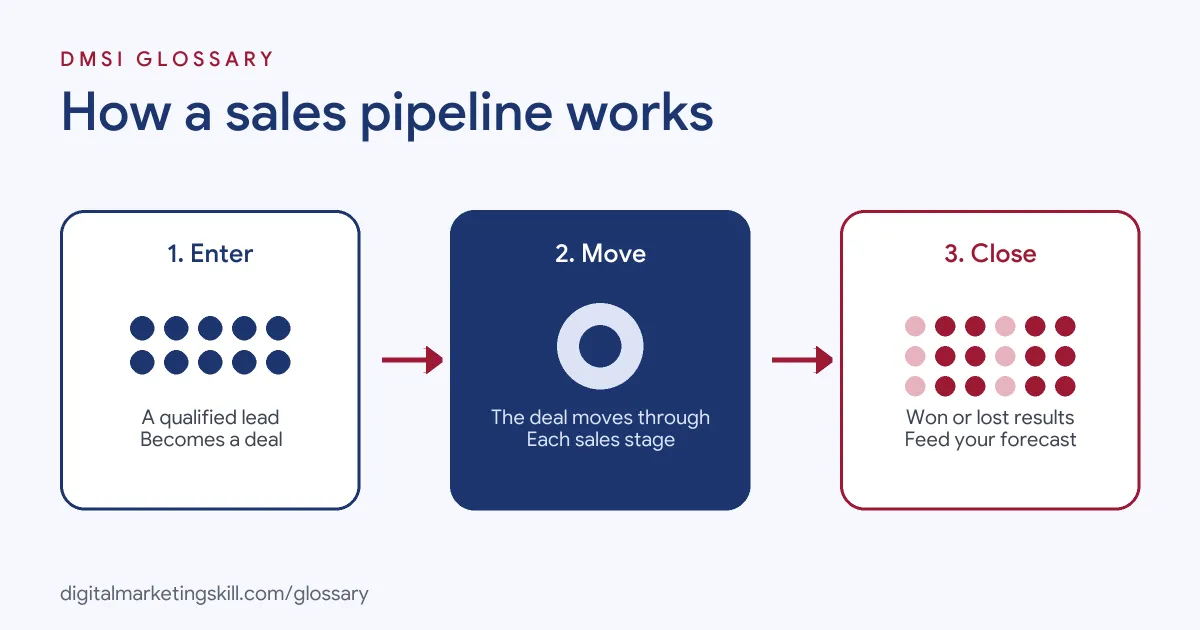
Every pipeline works in three steps. First, a qualified lead becomes a deal and enters the first stage. Next, the deal moves through stages as the buyer and seller take agreed actions. Finally, the deal closes as won or lost, and the result feeds your forecast.
Pipeline Stages
Stages are the steps in your sales process. HubSpot says pipelines “help visualize your processes through stages, which are steps that signal where a record is in a process”. You can rename, add or remove stages to match how you really sell.
An Example of Default Stages
HubSpot’s default sales pipeline has seven deal stages, each with a probability of closing:
- Appointment scheduled (20%)
- Qualified to buy (40%)
- Presentation scheduled (60%)
- Decision maker bought-in (80%)
- Contract sent (90%)
- Closed won (100%) and Closed lost (0%)
Weighted Forecasts
Probabilities turn a pipeline into a forecast. HubSpot calculates a weighted amount “by multiplying the total amount in each stage by the stage probability”. So a deal worth £10,000 at the 60% stage counts as £6,000 in the weighted forecast.
Pipeline Examples
Here are three made-up examples of sales stages in different businesses:
- Marketing agency: New enquiry, discovery call, proposal sent, negotiation, closed. The agency reviews every deal at the proposal stage each Monday.
- Software company: Demo booked, trial started, decision maker engaged, contract sent, closed. Marketing tracks how many trials its webinars create.
- Training provider: Application received, consultation booked, offer sent, enrolled. The team follows up on any offer older than a week.
In each case, the stages match real steps that the buyer takes. That makes the pipeline honest and useful. It also means anyone on the team can read the board and understand it without a long explanation.
Pipeline vs Sales Funnel
These terms are often mixed up, so here is a quick comparison:
| Question | Sales pipeline | Sales funnel |
|---|---|---|
| Whose view? | The seller’s: deals and next actions | The buyer’s: awareness to purchase |
| What does it track? | Each open deal and its stage | How many people move from stage to stage |
| Main use | Managing deals and forecasting revenue | Spotting where prospects drop out |
Salesforce makes the same point. It says the pipeline focuses on where the prospect is, to help reps decide what to do, while the funnel shows the process “from the customer’s point of view”.
A Worked Example of a Weighted Pipeline
Here is a simple made-up example using HubSpot’s default probabilities. Suppose you have these open deals:
- £20,000 at Qualified to buy (40%), which gives £8,000 weighted.
- £15,000 at Presentation scheduled (60%), which gives £9,000 weighted.
- £10,000 at Contract sent (90%), which gives £9,000 weighted.
The total pipeline is £45,000. However, the weighted forecast is £26,000. That lower figure is a more realistic guide to what you can expect, as long as your stage probabilities reflect your real results.
How Marketing Feeds Sales
Deals do not appear from nowhere. Marketing creates most of the leads that later become them. So the handover between the two teams matters a great deal. First, agree on what counts as a qualified lead, such as someone who booked a call or asked for a quote. Next, make sure those leads reach the sales team quickly, ideally through an automatic link between your forms and your CRM. Then track which campaigns produce deals that close, not just leads that fill a list.
When both teams look at the same numbers, they stop arguing about lead quality. Instead, they can work together on the stages where deals slow down.
How to Build a Sales Pipeline
Follow these steps to set one up in any CRM:
- Map your real sales steps. Write down what actually happens between first contact and payment.
- Turn steps into stages. Keep them few and clear, with a single exit action for each.
- Set entry rules. Decide what a lead must do to become a deal, such as booking a call.
- Add probabilities. Start with your CRM’s defaults, then adjust them using your own win rates.
- Connect marketing. Make sure qualified leads from forms and ads create deals automatically.
- Review weekly. Look for stuck deals, missing next steps and old opportunities.
- Clean it up. Close out dead deals, so the forecast stays honest.
Best Practices for Your Pipeline
- Give every deal a next step. A deal with no planned action is likely to stall.
- Keep stages buyer-based. Move a deal only when the buyer does something, not when you send something.
- Track time in stage. Deals that sit too long often need a nudge or a rethink.
- Share it with marketing. Then marketing can see which campaigns create deals, not just leads.
- Use automation. Tools can create tasks, send reminders and move deals when actions happen.
Common Mistakes to Avoid
A common mistake is filling the pipeline with leads that were never qualified. As a result, the forecast looks great but few deals close. Another is keeping dead deals open, which hides the real picture. Some teams also use too many stages, so nobody agrees where a deal belongs. Finally, many never update the probabilities. If your real win rate at a stage is 30%, a default of 60% will mislead you.
Where You’ll Use a Sales Pipeline at Work
These skills appear in many sales and marketing job ads. For example, remote listings mention:
- “Develop and Manage sales pipeline, ensuring accurate forecasting and timely progression of deals” (National Account Executive).
- “Pipeline generation and driving outbound strategies to build a strong sales pipeline” (Account Executive).
- “Managing pipeline inside GoHighLevel” (Sales and Marketing Specialist).
So if you want to work as a Lead Generation Specialist or Marketing Automation Specialist, you will feed the pipeline, automate its stages and report on which campaigns create real deals.
Learn It in the Lead Generation Track
You can learn to feed and automate a sales pipeline in the AI-Powered Lead Generation and Email Automation track. You build a lead magnet and an automated email sequence that converts, which moves leads towards a sale. In addition, you get unlimited 1-on-1 mentoring and a U.S. Project Internship from day one.
For more ideas, read our guides to sales funnel stages and CRM in digital marketing. You can also learn what makes a sales qualified lead.
Frequently Asked Questions
What is a sales pipeline in simple terms?
It is a view of all your open deals, sorted by how close each one is to closing.
What are typical sales stages?
Many follow a path such as qualified, meeting, proposal, contract and closed. HubSpot’s default has seven stages, from Appointment scheduled to Closed won or lost.
What is a weighted pipeline?
It is the value of each deal multiplied by its stage probability. It gives a more realistic forecast than the total value.
Is a pipeline the same as a funnel?
No. The pipeline tracks deals and the seller’s next actions. The funnel shows how buyers move from awareness to purchase.
How often should I review my pipeline?
Weekly is common. Check for stuck deals, missing next steps and deals that should be closed out. A short, regular review beats a long one every few months.
Sources: Salesforce: What is a sales pipeline; HubSpot Knowledge Base: Set up and manage object pipelines; HighLevel: Platform features; remote job listings on Himalayas.