
Social media advertising works differently from organic posting. You pay for guaranteed placement instead of hoping the algorithm favors you. This guide covers what social media advertising actually costs, which platform fits which goal, and how to measure whether a campaign is working, using real benchmark data instead of guesswork.
Key Takeaways
- Facebook ads reach roughly 2.28 billion accounts worldwide, per DataReportal’s essential Facebook statistics, making it the largest paid social audience of any single platform.
- The blended average cost per click on Facebook ads is about $1.72, with cost per thousand impressions (CPM) ranging from $6.80 to $28.40 depending on objective, per TapClicks’ Facebook Ads Benchmarks.
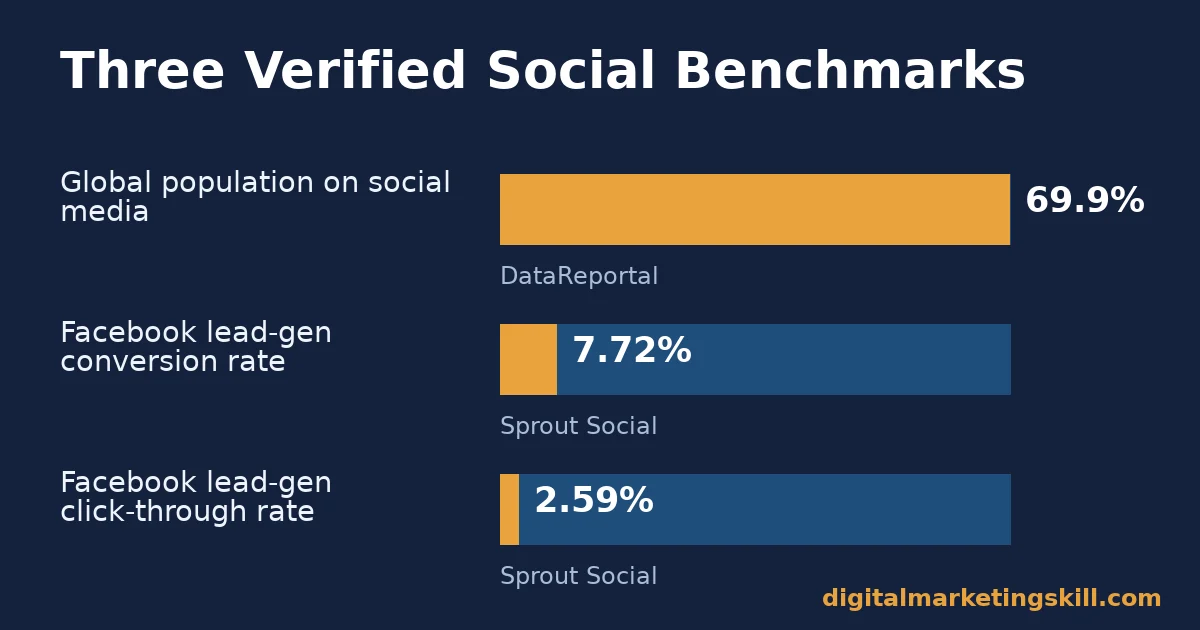
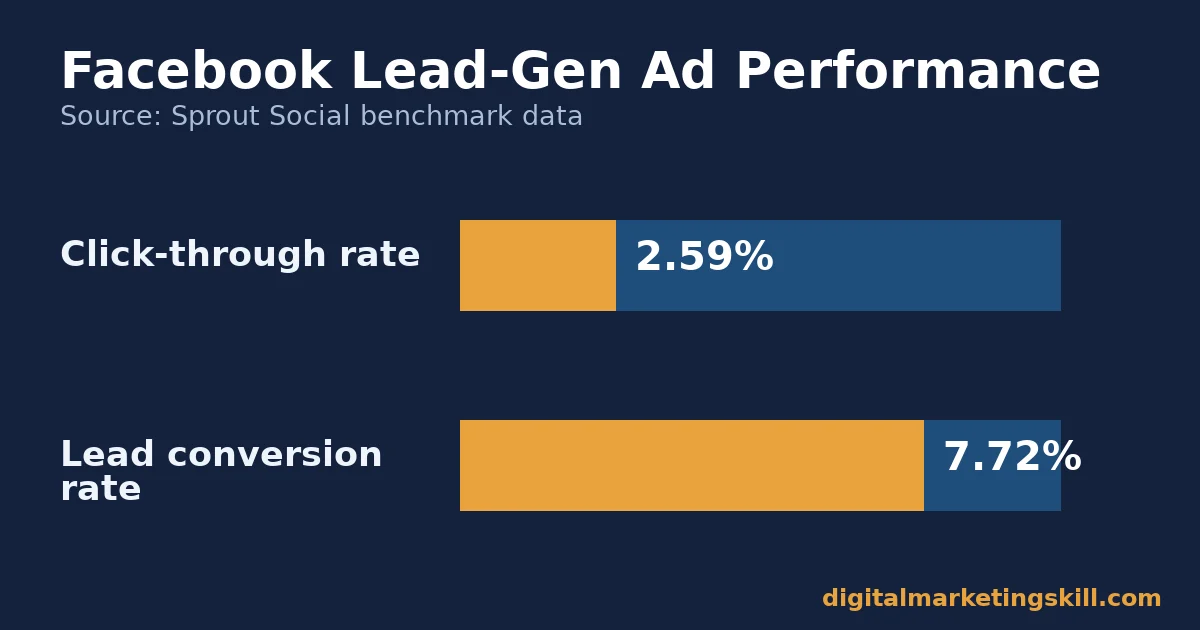
- Lead-generation ads on Facebook average a 2.59% click-through rate and a 7.72% lead conversion rate, per Sprout Social’s own benchmark data.
- 5.79 billion people worldwide now have a social media identity, 69.9% of the global population, per DataReportal’s Digital Global Overview Report.
- A real Digital Marketing Skill Institute student spent $14 on Facebook and Instagram ads and generated $878 in sales, a concrete example of how small, well-targeted budgets can work.
In this guide
- Why Most Social Media Advertising Guides Miss The Point
- The Mechanism: How Social Media Advertising Actually Gets Priced
- What Differs By Platform
- How To Lead With Each Platform
- How To Measure Whether Social Media Advertising Is Working
- The One Decision Rule: Match The Platform To Your Budget And Asset
- A Real Case: A Small Budget, Tracked Closely
- Frequently Asked Questions About Social Media Advertising
- Turn Social Media Advertising Into A Repeatable Skill
Why Most Social Media Advertising Guides Miss The Point
Most social media advertising guides walk through every platform’s ad manager, step by step. That is useful once you have already chosen a platform. It does not help you choose one, tell you how much to budget, or help you recognize when a campaign is actually working.
Two ground rules. Every benchmark below is a cross-account average. Your actual cost per click and conversion rate will vary by industry, audience size, and how well your ad matches what your audience wants. A benchmark tells you whether your own numbers are in a reasonable range, not what you should expect to pay exactly.
Second, social media advertising is a paid, rented channel. Results stop the moment you stop paying. Organic content keeps earning visits for free, long after you publish it.
This guide is written for a worldwide audience. Platform mechanics and benchmark costs here apply the same way to a business anywhere in your country, even though exact costs shift by currency and local competition.
The Mechanism: How Social Media Advertising Actually Gets Priced
Every major social platform sells ad space through an auction, not a fixed price list. You set a budget and a goal. The platform’s algorithm then competes your ad against every other advertiser targeting a similar audience at that moment.
Two things decide the price you pay. First, how much competition exists for that audience. Second, how relevant the platform’s algorithm judges your ad to be. These two factors interact. Two advertisers targeting the exact same audience can pay very different prices, depending on how well each ad resonates.
A highly relevant ad, one people actually click and engage with, can cost less per result than a poorly targeted one. This holds true even with an identical budget, because the algorithm rewards engagement with cheaper delivery.
This is why learning to identify your target audience matters more than any single setting in the ad manager. A vague audience forces the algorithm to guess, which raises your cost per result. A specific, well-matched audience lets the algorithm spend your budget more efficiently from the first day.
The auction also rewards consistency. An account that runs the same well-targeted audience over weeks tends to build up a performance history the algorithm can learn from. An account that changes its audience and creative every few days never gives the algorithm enough signal. Even a generous budget cannot fix that.
What Differs By Platform
Facebook And Instagram: Built For Precise Targeting
Facebook and Instagram share one ad manager and the same targeting engine. Facebook ads alone reach an estimated 2.28 billion accounts, per DataReportal, giving advertisers the largest addressable audience of any single ad platform.
The targeting options go deep. You can target by location, interests, and past behavior. You can also build lookalike audiences from your existing customers, which often outperform broad interest targeting. Layer two or three targeting signals together, rather than relying on one broad interest alone, to narrow in on people who genuinely match your offer.
The tradeoff is competition. So many advertisers target the same broad interests that costs can climb quickly for generic audiences. That is exactly why specific targeting matters even more here than on smaller platforms. Our Facebook advertising techniques guide goes deeper into the targeting controls themselves.
YouTube And Short-Form Video: Built For Attention, Not Precision
YouTube and short-form video platforms sell attention at scale. YouTube ads reached an estimated 2.53 billion people, per DataReportal’s analysis of Google’s own ad planning tools, and that is a reach estimate, not a precise headcount.
Video ad formats range widely. Skippable in-stream ads only charge you once someone watches past the first several seconds. Non-skippable formats are priced per impression instead.
The tradeoff is production effort. A compelling static image ad can be made in minutes. A compelling video ad usually cannot. Platforms reward watch-through, so a weak video can cost more per result than a weak image ad on a feed-based platform.
LinkedIn And X: Built For Niche, Professional Reach
LinkedIn and X serve smaller, more specific audiences than Facebook or YouTube. LinkedIn’s audience skews toward working professionals and decision-makers. That makes it a strong fit for B2B offers, recruitment, and anything selling to a job title rather than a general consumer.
The tradeoff is cost. The audience is narrower and more valuable to advertisers, so cost per click on LinkedIn typically runs well above Facebook’s blended average. That premium can still pay off for an offer genuinely targeting professionals willing to spend more. It rarely makes sense for a low-priced consumer product.
How To Lead With Each Platform
Facebook And Instagram: Lead With A Narrow, Specific Audience
Do not start with a broad interest category and hope the algorithm narrows it for you. Start with the specific person who buys from you: their stage of life, the problem they have, and what they have already searched for or bought.
Write that description down before you open the ad manager. A clear written description keeps you from drifting back to a broad, generic audience once you start clicking through the targeting options.
Build a lookalike audience from your existing customers once you have enough of them. Lookalikes consistently outperform cold interest targeting, because they start from people who already converted.
Give the algorithm a source list of at least a few hundred real customers before building a lookalike, if you can. A thin source list produces a thin, unreliable match. A larger, higher-quality list gives the algorithm much more to work with.
YouTube And Short-Form Video: Lead With The First Three Seconds
Most viewers decide whether to keep watching within the first few seconds. Put your strongest visual and your clearest message there. Skip the logo animation and the slow build-up.
A skippable ad that loses its audience in the first three seconds pays for impressions it never gets credit for. The opening moment carries more weight than almost anything else in the ad.
Caption your video too, even though it adds production time. Many viewers watch with sound off, especially in short-form feeds. A video that only makes sense with audio loses a large share of its potential audience before the message even lands.
LinkedIn And X: Lead With Job Title And Industry, Not Broad Demographics
Skip age and location as your primary targeting lines on these platforms. Target by job title, industry, company size, or seniority instead. That is the targeting LinkedIn in particular does better than almost any other platform.
A precise professional audience of a few thousand people often outperforms a broad demographic audience of a few million for a B2B offer. Write the ad copy to match how professionals actually talk about the problem, not how a consumer ad would phrase it; a tone mismatch is one of the fastest ways to lose credibility with this audience.
How To Measure Whether Social Media Advertising Is Working
Check these numbers weekly while a campaign is active. Paid campaigns move fast, so small losses compound quickly if left unchecked.
- Cost per click (CPC): what you pay each time someone clicks your ad. Facebook’s blended average sits around $1.72, per TapClicks, but your number should trend down as your targeting improves.
- Click-through rate (CTR): the share of people who see your ad and click it. A CTR well below the 1.5-2.6% range typical of Facebook campaigns usually signals a weak image, headline, or audience match.
- Cost per thousand impressions (CPM): what you pay to reach 1,000 people, regardless of clicks. Facebook’s range runs roughly $6.80 to $28.40 depending on objective and competition, per TapClicks.
- Conversion rate: the share of clicks that complete your actual goal, a sale, a signup, a lead form. Sprout Social’s own data puts Facebook lead-generation conversion around 7.72%, a useful cross-check for your own numbers.
- Return on ad spend (ROAS): revenue generated per dollar spent. This is the number that ultimately decides whether a campaign should keep running, regardless of how good the other four numbers look.
None of these numbers matters alone. A low CPC with a low conversion rate usually means you are reaching cheap but uninterested people. Cost per result, not cost per click, is what matters most.
Track these five numbers weekly in a simple spreadsheet. A tracked history shows the trend, which tells you whether a campaign is improving or quietly getting worse.
The One Decision Rule: Match The Platform To Your Budget And Asset
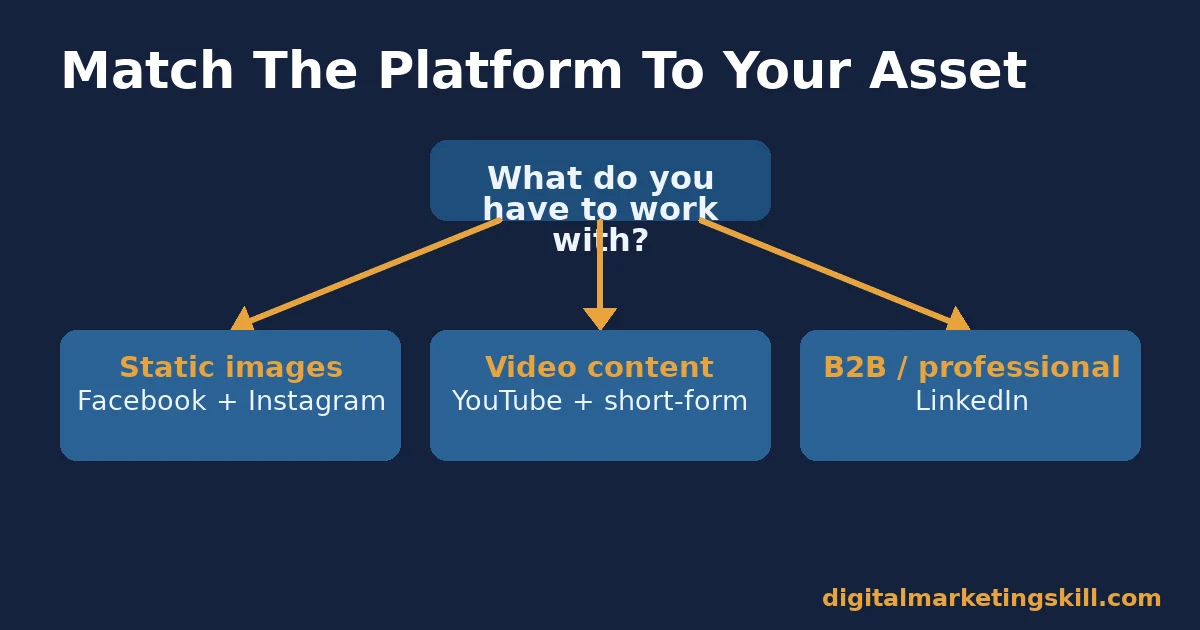
If you have a tight budget and only static images or simple graphics, start with Facebook and Instagram. Their targeting makes small budgets go further. Image ads are also fast to produce and test.
If you have video, or the resources to make some, and a story worth 15-30 seconds, test YouTube or short-form video alongside your image ads. Video formats often cost more per view, but they can earn stronger brand recall for the same spend.
If your offer genuinely targets professionals, business buyers, or a specific job title, test LinkedIn even though it costs more per click. The premium is often worth it. A smaller, more precise audience can beat a larger, cheaper one when your product’s value justifies the extra cost.
Illustrative, invented numbers: imagine two businesses each have a $200 monthly ad budget. Business A spends it entirely on narrowly targeted Facebook image ads. It tracks cost per lead weekly and cuts underperforming ads fast.
Business B splits the same $200 across five platforms with no clear targeting on any of them. Business A typically generates more qualified leads from the same budget. A narrow, well-tracked spend beats a scattered one almost every time. These numbers are invented to illustrate the principle, not a guarantee of your results.
A Real Case: A Small Budget, Tracked Closely
A Digital Marketing Skill Institute student, Ayooluwa Osemi, spent $14 on Facebook and Instagram ads. The campaign generated $878 in sales, as published on the Institute’s own reviews page.
Limits worth naming: this is one self-reported result from one campaign, not an independent audit. Results like this depend heavily on the product, audience, and offer involved. It is not a guaranteed outcome for any specific spend.
What it does show is that a small, carefully targeted budget can produce a real result. That is the core principle behind every tip in this guide.
A $14 budget leaves almost no room for waste, which forces sharper targeting and a clearer offer than a larger, looser budget often allows. A bigger budget can mask weak targeting for a while, simply by reaching enough people that a few convert anyway.
That tight constraint cannot hide weak targeting the same way. Small budgets tend to surface problems faster, which is its own kind of advantage for anyone still learning.
Frequently Asked Questions About Social Media Advertising
How much does social media advertising cost to get started?
There is no fixed minimum. Most platforms let you start with a daily budget as low as a few dollars. What matters more than the total budget is whether your targeting is specific enough to make that budget efficient. A small, well-targeted budget often outperforms a larger, vague one. Start small. Confirm the targeting and offer actually work. Then increase the budget once you have evidence, not before.
Which social media platform is best for advertising?
It depends on your assets and your audience, not a single universal answer. Facebook and Instagram suit businesses with static images and a need for precise targeting. Video-first platforms suit businesses with a strong visual story and the resources to produce short video content.
LinkedIn suits businesses selling to other businesses or to a specific professional role, even though it typically costs more per click than the others. If you are unsure, start with Facebook and Instagram. The audience size and targeting depth make it the easiest place to learn the fundamentals before testing other platforms.
What is the difference between organic social media and social media advertising?
Organic social media is free, but it depends entirely on the platform’s algorithm choosing to show your content to people. Social media advertising is paid, but it guarantees your content reaches the specific audience you choose, for as long as you keep paying.
Many businesses use both together: organic content to build trust over time, and paid ads to reach new people faster than organic growth alone would allow. Neither one fully replaces the other; they solve different problems on different timelines.
How long should I run a social media advertising campaign before judging results?
Most platforms need a short learning period, often one to two weeks, to optimize delivery toward people likely to convert. Judging a campaign after only a day or two usually reflects the algorithm still learning, not the campaign’s true performance. Making major changes during this learning period, like editing the audience or creative repeatedly, usually resets the learning process and delays stable results even further.
Do I need a large following to run social media ads?
No. Social media advertising reaches people who are not already following your page, which is the whole point of paying for placement. A brand-new account with zero followers can still run a successful ad campaign if the targeting and offer are right. A following helps with organic reach and social proof, but it is not a prerequisite for a paid ad to work.
What is retargeting in social media advertising?
Retargeting shows ads specifically to people who already visited your website, opened an email, or engaged with your page, rather than to strangers. Because these people already know your brand, retargeting campaigns typically cost less per result than campaigns aimed at a cold audience.
Our conversion funnel optimization guide covers where retargeting fits once someone has entered your funnel. A small retargeting budget alongside a larger cold-audience budget is a common, effective split for many advertisers.
Can I run social media ads without a landing page?
You technically can send traffic directly to a social profile or product page. But a dedicated landing page built around the specific ad’s message usually converts better. A landing page that matches your ad’s promise gives visitors one clear next step instead of a general page to explore.
Does social media advertising work for small businesses?
Yes, often better than for large ones, because small businesses can target narrowly without worrying about reaching every possible customer segment at once. A local or niche business can often get a lower cost per result than a national brand competing for the same broad audience.
How do I know if my ad creative is the problem, not my targeting?
Run the same ad to two different audiences, or two different ads to the same audience, and compare results directly. If performance stays weak across different audiences with the same ad, the creative is likely the problem.
If performance varies sharply between audiences with the same ad, targeting is the more likely culprit. This simple test takes one extra ad set to run and usually saves far more time than guessing.
Turn Social Media Advertising Into A Repeatable Skill
Audience targeting, ad creative, budget allocation, and campaign measurement are skills. They improve with structured practice on real campaigns, not a one-time course of ad manager tutorials. A tutorial can show you which button to click. Real judgment only comes from running real campaigns, tracking the numbers, and adjusting based on what they say.
The Digital Marketing Skill Institute’s Master Diploma in Digital & AI Marketing includes an AI-Powered Social Media Management and Advertising track built specifically around this kind of paid social work.
The program’s four AI-powered tracks total ten courses, with a Full Stack option for anyone who wants all four. It includes unlimited 1-on-1 coaching and mentoring, a U.S. Project Internship with a verified U.S. Work Reference Letter, and dual US and UK accreditation recognised in more than 100 countries.
It is 100% online, so you can apply these skills to a real campaign from wherever you are in your country.
See real course outcomes on our reviews page, read the full program breakdown on the Master Diploma page, and browse more guides like this on the digital marketing blog. When you’re ready, apply here. Whether you are starting your first campaign or scaling an existing one, wherever you live, Digital Marketing Skill Institute is built to meet you there. Learn more at digitalmarketingskill.com.
Every figure in this guide was checked against its original source before publication. Figures marked as illustrative are invented examples, not real results.
![9 Amazing Digital Marketing Skills to Make Money Online [With Proof]](https://digitalmarketingskill.com/wp-content/uploads/2019/07/9-Amazing-Digital-Marketing-Skills-to-Make-Money-Online-With-Proof-17.png)






